
Filing an Uber Accident Claim in California A Complete Guide
The moments after a rideshare crash are jarring and confusing. You’re trying to figure out what just happened, and the thought of filing an Uber accident claim can feel completely overwhelming. But the first few things you do are absolutely critical. Your immediate actions lay the groundwork for protecting both your health and your legal rights down the road.
This article is for informational purposes and not to be construed as legal advice. No attorney client relationship exists based on the review of this this article and none of the information in this article is legal advice.
What to Do Immediately After an Uber Accident
It’s chaos. That’s the only way to describe the scene of an accident. But how you navigate this chaos can make a huge difference in your claim’s outcome. Your first priority, always, is your safety and the well-being of anyone else involved. Once you’re out of immediate danger, your focus has to shift to gathering the information that will become the backbone of your case.
Prioritize Your Health and Safety
Even if you think you’re fine, you need to get checked out by a doctor. The adrenaline surging through your body after a crash is a powerful painkiller, and it can easily mask serious injuries like whiplash or internal bleeding that might not show symptoms for hours, or even days.
Seeing a doctor right away does two crucial things:
- It spots hidden injuries. A medical professional can diagnose underlying problems before they get worse, getting you the treatment you need.
- It creates a paper trail. This official medical record is undeniable proof that links your injuries directly to the accident—essential evidence for any Uber claim.
Without that link, you can bet the insurance company will argue your injuries happened somewhere else, which can seriously weaken your case. For more on this, you can learn about what to do in the first 72 hours after an automobile accident here: https://www.bizlawpro.com/the-first-72-hours-after-an-automobile-accident/
Document Everything at the Scene
If you’re physically able to, start documenting everything immediately. Evidence has a way of disappearing once cars are towed and memories start to fade. Your smartphone is your best friend in this situation.
Use your phone to take as many photos and videos as you can from different angles. Make sure you capture:
- Vehicle Positions: Show exactly where and how the cars ended up before anyone moves them.
- Property Damage: Get close-ups of the damage to all vehicles involved—dents, shattered glass, everything.
- The Scene Itself: Photograph skid marks, broken debris on the road, traffic lights, stop signs, and even the weather conditions.
- Your Injuries: Take pictures of any visible cuts, bruises, or scrapes as soon as you can.
The evidence you gather in these first few minutes is often the most powerful. It’s a raw, unbiased snapshot of what happened that becomes invaluable when you’re up against insurance adjusters.
To make this easier to remember in a stressful moment, here’s a quick checklist of what you should do at the scene.
Immediate Actions to Take After an Uber Accident
| Action Item | Why It Is Crucial for Your Claim |
|---|---|
| Check for Injuries | Your health is the top priority. Adrenaline can mask pain from serious injuries. |
| Call 911 | This ensures medical help arrives and creates an official police report of the incident. |
| Photograph the Scene | Capture vehicle damage, positions, skid marks, and your injuries. This is vital evidence. |
| Exchange Information | Get names, insurance details, and phone numbers from all drivers and witnesses. |
| Do Not Admit Fault | Avoid saying “I’m sorry” or anything that could be interpreted as admitting responsibility. |
| Seek Medical Attention | A doctor’s visit creates a medical record linking your injuries directly to the crash. |
Following these steps provides a solid foundation for building your claim and protecting your rights.
Gather Information from Everyone
Collecting contact and insurance details is absolutely non-negotiable. Don’t just assume the Uber driver or the police will get it all for you. You need to be proactive. Talk to everyone yourself and take your own notes.
Be sure to get these details:
- The Uber Driver: Their full name, phone number, personal auto insurance info, and license plate number.
- Other Drivers Involved: The exact same information for anyone else in the crash.
- Any Witnesses: Crucially, get the names and phone numbers of anyone who saw what happened. An independent witness can be incredibly persuasive.
While this guide zeroes in on Uber accidents in California, it’s always smart to be familiar with a general motor vehicle accident guide for the basic steps after any collision. This knowledge will prepare you for whatever happens on the road.
Determining Fault in a California Rideshare Crash
Figuring out who is legally responsible for a crash is the single most important part of building a successful Uber accident claim. This isn’t just about pointing fingers. It’s a detailed process of proving who was negligent under California law, and the outcome decides which insurance company is on the hook for your medical bills, lost wages, and suffering.
At first glance, an accident might seem simple. But when a rideshare company is involved, things get complicated fast. It’s no longer a straightforward two-car collision. We have to look at the actions of the Uber driver, the other driver, and sometimes even Uber’s own role in the incident.
This article is for informational purposes and not to be construed as legal advice. No attorney client relationship exists based on the review of this this article and none of the information in this article is legal advice.
Common Liability Scenarios in Uber Accidents
Let’s skip the legal jargon and look at how fault actually plays out on the road. The person or company responsible for the accident is the one whose negligence—or failure to drive with reasonable care—directly caused the crash.
Picture this: you’re a passenger in an Uber that gets into an accident. Here are a few ways the blame could be assigned:
- Your Uber Driver is At Fault: This happens all the time. If your driver was speeding, looking at their phone, or blew through a stop sign, they are almost certainly the negligent one. In this situation, your claim would go through Uber’s commercial insurance policy, provided the driver was actively on a trip.
- Another Driver is At Fault: What if another car T-bones your Uber while you’re going through an intersection? Here, the other driver is clearly responsible. Your first claim would be against that driver’s personal auto insurance.
- Both Drivers Share Fault: Sometimes, it’s not so black and white. Maybe the Uber driver was going a little too fast, but the other driver made an illegal turn right in front of them. This is where things can get messy.
The key thing to remember is that fault isn’t always an all-or-nothing deal. California law is built to handle situations where multiple people contribute to a crash, which directly affects how much compensation you can receive.
Understanding California’s Comparative Negligence Rule
California operates under a legal rule called “pure comparative negligence,” and it’s incredibly important for anyone involved in an Uber accident. In simple terms, it means you can still get financial compensation even if you were partially to blame for what happened.
Here’s how it works in practice: an insurance company or a court will assign a percentage of fault to everyone involved. Your final compensation award is then reduced by whatever percentage of fault you hold.
Let’s say your total damages from the Uber crash add up to $100,000. If it’s decided that the other driver was 90% at fault but you were 10% at fault (maybe you were a pedestrian who crossed outside a designated crosswalk), your potential recovery is reduced by 10%. You would be able to receive $90,000 instead of the full amount. This system ensures that compensation is divided up based on each person’s actual level of responsibility. For a closer look, see our guide on how insurance companies decide who is at fault.
Proving Negligence: What You Need to Show
To officially establish fault, your attorney must prove four key things:
- Duty: The driver had a legal responsibility to operate their vehicle safely and obey traffic laws.
- Breach: The driver violated that duty through a careless or reckless act, like running a red light.
- Causation: The driver’s mistake was the direct cause of the accident and your injuries.
- Damages: You suffered real harm, like medical bills, car damage, or lost income, because of the crash.
The evidence you collect right after the accident—the police report, photos from the scene, and witness phone numbers—is what we use to build a strong case for these four elements. Good evidence makes it very hard for an insurance company to argue about who was really at fault.
Sadly, negligent driving is a huge factor in these crashes. Uber’s own safety reports showed that from 2021-2022, motor vehicle fatalities involving an Uber ride jumped by 40% to 153. More than half of those deaths were linked to risky driving by other drivers on the road. Speeding and drunk driving were factors in over 30% of these fatal incidents, showing just how dangerous the roads can be for passengers and everyone else.
How Uber’s Complex Insurance Policy Really Works
Figuring out the insurance behind an Uber accident claim can feel like trying to hit a moving target. It’s not one simple policy. Instead, Uber uses a tiered system where the coverage available completely changes based on what the driver was doing in the app the second the crash happened.
This isn’t a minor detail—it’s everything. It’s the single most important factor that dictates which insurance company pays for your injuries and how much money is on the table. A simple tap of the app can be the difference between a few thousand dollars and a $1 million policy.
This article is for informational purposes and not to be construed as legal advice. No attorney client relationship exists based on the review of this this article and none of the information in this article is legal advice.
The Three Tiers of Uber’s Insurance Coverage
At its core, Uber’s insurance hinges on the driver’s status. Were they offline, just driving their car for personal use? Were they logged in and waiting for a ride? Or were they on their way to pick you up or actively driving you to your destination? Each scenario triggers a totally different level of insurance coverage.
This flowchart breaks down how the coverage shifts depending on the driver’s app status.
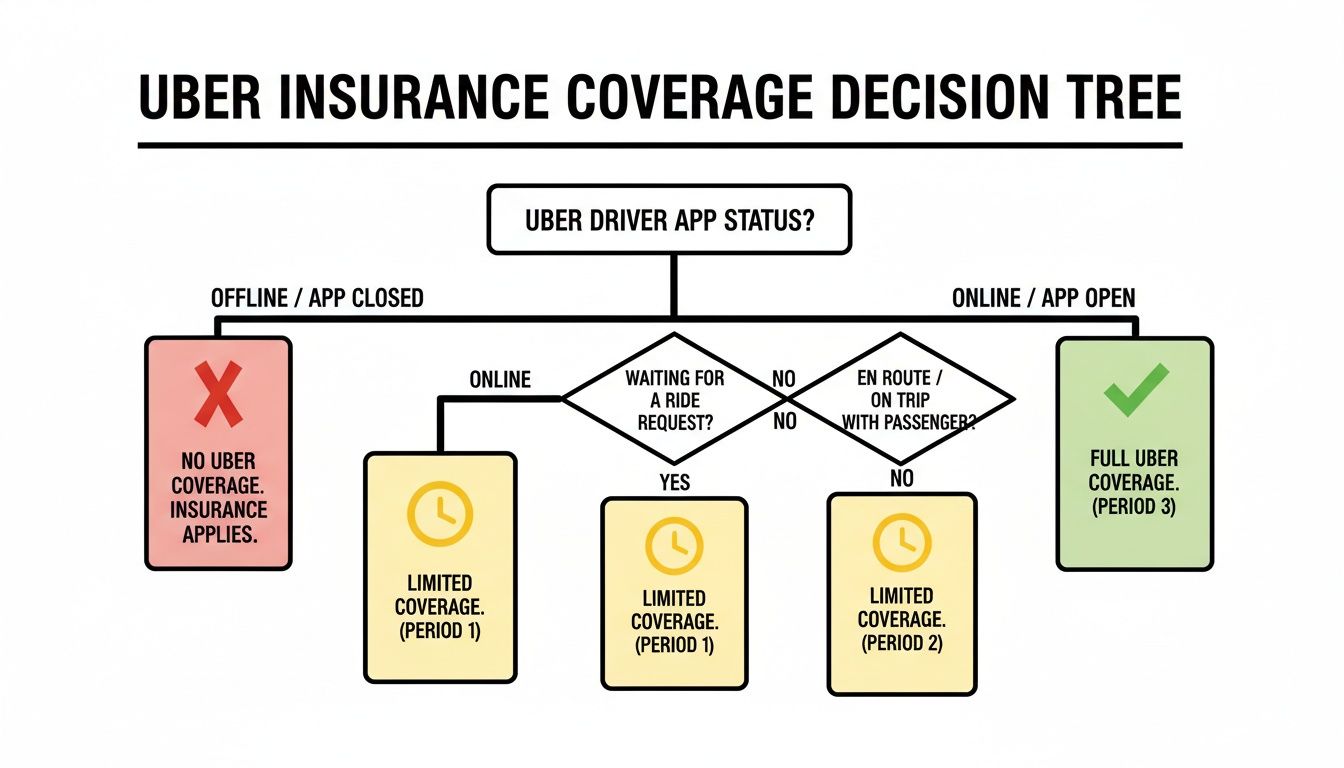
As you can see, that big commercial policy Uber advertises only kicks in when a driver is actively on a trip. This makes proving the driver’s status a critical first step in any claim.
Let’s break down these coverage periods in more detail. The table below outlines exactly what’s available depending on the driver’s status.
Uber Insurance Coverage by Driver Status
| Driver’s App Status | Applicable Insurance Coverage Details |
|---|---|
| Period 1: Offline | When the driver’s app is off, they are considered a private citizen. Uber provides zero coverage. Any claim must be filed against the driver’s personal auto insurance policy. |
| Period 2: Online & Waiting for a Ride | The app is on, but no passenger has been assigned. Uber provides contingent liability coverage: $50,000 per person / $100,000 per accident for bodily injury, and $25,000 for property damage. |
| Period 3: On a Trip (En Route to Passenger or with Passenger) | From accepting a ride request until the trip ends, Uber’s full $1 million third-party liability policy is active. This period also includes $1 million in Uninsured/Underinsured Motorist (UM/UIM) coverage. |
Understanding which period applies to your accident is the key to unlocking the right compensation.
Period 1: The Driver is Offline
If an Uber driver isn’t logged into the app, they’re just another motorist. If they hit you, Uber provides no coverage whatsoever. Your claim is solely against their personal auto insurance.
This is often the toughest spot for an injured person. The driver might only have California’s minimum liability limits, which are rarely enough to cover the costs of a serious injury.
Period 2: The Driver is Online and Waiting
This is the gray area. The driver has the app running and is available for rides but hasn’t accepted one yet. In this “waiting” phase, Uber’s contingent liability coverage is supposed to apply, but often only after the driver’s personal insurer denies the claim.
The coverage here is much lower:
- $50,000 in bodily injury liability per person
- $100,000 in total bodily injury liability per accident
- $25,000 in property damage liability per accident
This middle tier is where we see a lot of fights. Insurance companies will argue back and forth about whether the driver was truly “on duty.” Proving their status is absolutely critical.
Period 3: The Driver is On a Trip
This is where passengers and the public get the most protection. The moment a driver accepts your ride request until they drop you off, Uber’s full $1 million third-party liability insurance is in effect.
This policy is designed to cover injuries or damage the Uber driver causes to anyone—their passengers, people in other cars, pedestrians, you name it. This is why it’s so important to establish that the crash happened during this period.
The Critical Role of Uninsured and Underinsured Motorist Coverage
What happens if the crash wasn’t your Uber driver’s fault? What if another driver hit you and then sped off, or they only have the bare minimum insurance? This is where Uninsured/Underinsured Motorist (UM/UIM) coverage is an absolute lifesaver.
When you’re on an active Uber trip (Period 3), that $1 million policy also includes UM/UIM coverage. This policy is there to cover your expenses when the at-fault driver can’t. It’s a vital safety net that protects you from uninsured or irresponsible drivers.
Navigating these complexities is crucial, especially as some regulations are changing. You can learn more about upcoming changes to California rideshare accident coverage in our detailed guide.
Gathering Evidence to Build a Strong Claim
The success of your Uber accident claim hinges almost entirely on how well you collect and organize your evidence. Think of it as building a case against the insurance company, piece by piece.
Every single receipt, medical report, and note you take adds another layer of strength to your story. It makes it much harder for insurance adjusters to downplay what you’ve been through. Solid documentation is your best weapon against their attempts to lowball your settlement. It turns your personal ordeal into a factual, undeniable record of your losses.
Without it, it’s just your word against theirs.
This article is for informational purposes and not to be construed as legal advice. No attorney client relationship exists based on the review of this this article and none of the information in this article is legal advice.
Tracking Your Economic Damages
Let’s start with the easy part: the tangible, out-of-pocket expenses you’ve racked up because of the crash. These are your economic damages—the losses with a clear dollar amount attached. You need to account for every penny.
Grab a folder or start a digital one on your computer, and start saving everything. Right now.
- Medical Bills: This is everything. The ambulance ride, the ER visit, follow-up appointments with specialists, physical therapy, and prescriptions. All of it.
- Property Damage Estimates: Get quotes for fixing your car or replacing personal items that were destroyed, like your phone or laptop. Keep every estimate and the final repair bills.
- Proof of Lost Wages: This is crucial. You’ll need pay stubs from before the accident to show what you were earning, along with a letter or email from your employer confirming the time you had to take off. If you’re self-employed, gather invoices and bank statements showing the hit your income took.
- Miscellaneous Receipts: Don’t brush off the small stuff. Parking fees for all those doctor visits, over-the-counter pain relievers, and even the cost of hiring someone to mow your lawn because you can’t—it all adds up and paints a full picture of the financial damage.
Keeping an organized file of these expenses isn’t just about good record-keeping. It becomes a powerful negotiating tool that presents a clear, calculated demand that an insurance company can’t easily argue with.
It’s also important to consider long-term needs. A comprehensive claim must include any specialized aids required for your recovery. For example, understanding durable medical equipment like crutches, braces, or a wheelchair is key, as these are significant medical expenses that absolutely must be part of your claim.
Documenting Your Pain and Suffering
This is where things get tricky, but it’s often the most significant part of a personal injury settlement. How do you put a price on your pain, anxiety, and the simple fact that you can’t enjoy life the way you used to?
You do it with consistent, detailed notes. The best way to capture this is by keeping a daily journal. It doesn’t have to be a novel; a few sentences each day can become incredibly powerful evidence down the road.
Make sure your journal captures:
- Your Physical Pain: Rate your pain on a scale of 1 to 10. Where does it hurt? Is it a sharp, stabbing pain or a dull, constant ache? The more descriptive, the better.
- Your Emotional State: Be honest. Are you feeling anxious every time you get in a car? Depressed? Are flashbacks keeping you up at night? Your mental health struggles are a direct result of the accident.
- Impact on Daily Life: This is huge. What couldn’t you do today because of your injuries? Maybe you missed your kid’s soccer game, couldn’t go to the gym, or even struggled to carry groceries. These details show a jury or an adjuster exactly how the accident has robbed you of your quality of life.
This journal creates a real-time account of your experience. It’s far more compelling than trying to remember how you felt weeks or months ago. This record helps your attorney argue for the true human cost of the accident, which is essential for getting fair compensation.
California’s Statute of Limitations: A Deadline You Can’t Afford to Miss
After a car crash, the last thing you probably want to deal with is paperwork and deadlines. But when it comes to an Uber accident claim, there’s a legal clock ticking in the background. These aren’t just suggestions from a lawyer—they are hard-and-fast rules that will decide whether you get a single dollar for your injuries.
The most critical deadline you need to know is California’s statute of limitations for personal injury cases. This law gives you a strict two-year window from the date of the accident to file a lawsuit. If you let that two-year anniversary pass without filing in court, you almost always lose your right to seek compensation forever. It doesn’t matter how severe your injuries are or how clear it is that the other driver was at fault.
Think of it this way: the courthouse doors literally slam shut on your case the day after the two-year mark. The legal system puts this deadline in place to make sure claims are handled while evidence is still available and memories are fresh. Waiting too long kills your claim.
This article is for informational purposes and not to be construed as legal advice. No attorney client relationship exists based on the review of this this article and none of the information in this article is legal advice.
Why Acting Fast is Your Best Strategy
Two years might sound like a long time, but it disappears in the blink of an eye when you’re juggling doctor’s appointments, physical therapy, and just trying to get your life back on track. Building a solid personal injury case isn’t something that happens overnight. We have to gather police reports, track down all your medical records, and interview witnesses—all of which can be a surprisingly slow process.
On top of the legal deadline, insurance companies have their own rules that demand quick action.
- Reporting to Insurance: Most insurance policies, including Uber’s, require you to report an accident “promptly.” If you wait weeks or even months, they can use that delay as an excuse to deny your claim, arguing that you compromised their ability to investigate properly.
- Evidence Vanishes: Time is the enemy of evidence. Witnesses move or change their phone numbers. Nearby businesses might have security footage of the crash, but they often tape over it within a few weeks. The longer you wait, the more of your proof disappears.
This is why we always tell clients to act with a sense of urgency. The sooner you get the ball rolling, the stronger your position will be. Hesitating doesn’t just complicate things; it can wipe out your chance for compensation entirely.
The Big Exception: Claims Against the Government
There’s a massive trap in the law that many people fall into. If a government entity is even partially to blame for your accident, the rules change completely. This could be a poorly maintained road owned by the city, a broken traffic light, or a crash involving a public bus.
In California, you typically have only six months from the date of the accident to file a formal government claim. If you miss this incredibly short deadline, you are permanently barred from suing that government agency. It’s crucial to identify every potentially responsible party right away, because missing this deadline is a mistake you can’t undo.
When to Hire a Rideshare Accident Lawyer
Trying to handle a serious **Uber accident claim** by yourself is a bit like stepping into the ring with a heavyweight champion. On the other side is Uber’s insurance carrier, armed with a team of seasoned adjusters and lawyers whose entire job is to minimize payouts and protect their company’s bottom line. It's a true David vs. Goliath situation, and going it alone puts you at a massive disadvantage from the start.But the moment you hire a personal injury lawyer, the entire dynamic shifts. You’re no longer just another claim number; you have a professional advocate in your corner, ready to level the playing field.
This article is for informational purposes and not to be construed as legal advice. No attorney client relationship exists based on the review of this this article and none of the information in this article is legal advice.
Taking Control of Communications
One of the first things a lawyer does is take over all communications. Almost immediately, those persistent calls and emails from aggressive insurance adjusters will stop. They’re trained to get you to say something that could weaken your claim, but once you have representation, they have to go through your attorney.
This creates an invaluable buffer. It shields you from the high-pressure tactics and lets you focus completely on what matters most—your physical and emotional recovery—without the added stress of sparring with insurance companies.
An experienced lawyer acts as your professional shield, handling every negotiation and demand so you can focus on healing. They know the insurance company’s playbook and how to counter it effectively.
Conducting a Deep and Thorough Investigation
A successful Uber accident claim is built on a foundation of solid, undeniable evidence. While you can gather some important details at the scene, a law firm has the resources to dig much deeper and uncover facts you would never find on your own.
A skilled attorney can:
- Issue Preservation Letters: This is a formal legal demand that forces Uber and other parties to preserve critical evidence like the driver’s trip data, app logs, and internal communications before they have a chance to disappear.
- Hire Accident Reconstruction Experts: If there’s any question about who was at fault, these experts can use crash data and physics to scientifically prove exactly what happened.
- Subpoena Key Records: Your lawyer has the legal authority to compel the release of phone records to check for distracted driving or get their hands on surveillance footage from nearby businesses that you wouldn’t be able to access.
This is often where the “smoking gun” evidence is found—the kind of proof that shuts down arguments and pushes insurance companies to offer a fair settlement.
Accurately Calculating Your Claim’s Full Value
What is your claim actually worth? It’s a lot more than just your current medical bills and the last few paychecks you missed. An experienced lawyer knows how to calculate the true, long-term costs of an accident, something an insurance adjuster will never volunteer.
Your attorney will work with medical and financial experts to project all future expenses, making sure your settlement covers:
- Future Medical Treatment: This can include everything from potential surgeries and ongoing physical therapy to chronic pain management and medications you may need for years.
- Diminished Earning Capacity: If your injuries prevent you from returning to your old job or working at the same level, your claim must account for a lifetime of reduced income.
- Non-Economic Damages: The real human cost of an accident—pain, suffering, emotional distress, and the loss of enjoyment of life—deserves significant compensation.
Without an expert calculation, you risk accepting an offer that runs out long before your expenses do, leaving you to pay for someone else’s mistake out of your own pocket.
Demystifying the Contingency Fee Model
A lot of people hesitate to call a lawyer because they’re worried about the cost. But most top-tier personal injury firms, including ours, work on a contingency fee basis. The model is designed to give everyone access to expert legal help, regardless of their financial situation.
It’s straightforward: you pay absolutely nothing upfront. No retainers, no hourly bills. The law firm advances all the costs of building and fighting your case. We only get paid a percentage of the settlement if we win for you. If we don’t win your case, you owe us nothing. This way, our goals are perfectly aligned with yours: getting you the maximum compensation possible.
If a rideshare crash has turned your life upside down, you don’t have to face the legal battle alone. The team at LA Law Group, APLC is here to fight for the compensation you deserve. Contact us today for a free, no-obligation consultation to discuss your Uber accident claim at https://www.bizlawpro.com.
Disclaimer: This article is for informational purposes and not to be construed as legal advice. No attorney client relationship exists based on the review of this this article and none of the information in this article is legal advice.
Attorney Advertising. This article is general information, not legal advice, and does not create an attorney-client relationship. Prior results do not guarantee a similar outcome.