
Uber Accident Lawyer California: Who Pays and Next Steps
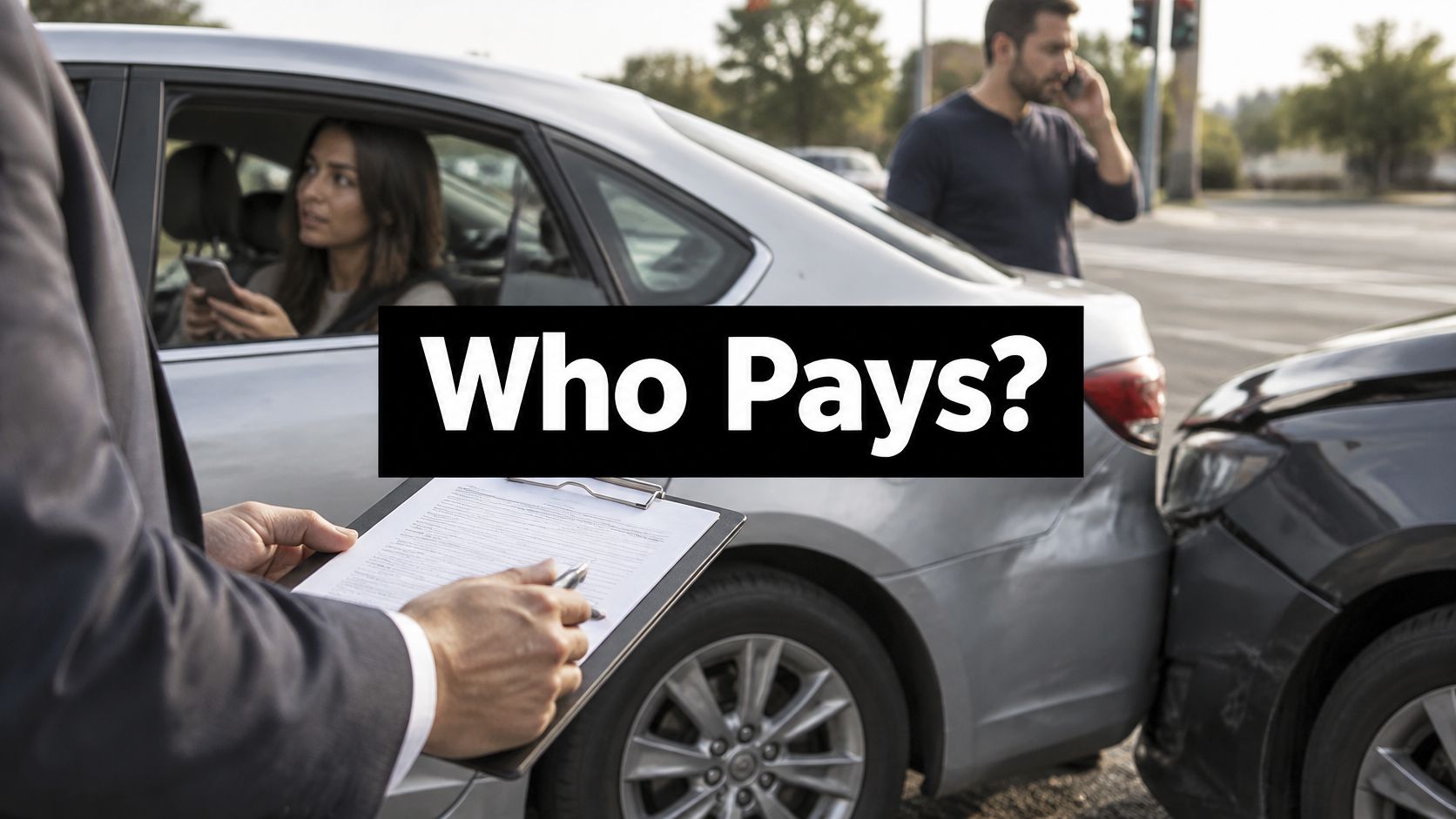
The ride ends two blocks from home, the light turns green, and the next thing you remember is a horn and a paramedic asking your date of birth. Rideshare collisions rarely feel dramatic at the scene. They show up two days later as a stiff neck, a cracked laptop screen, an emergency room bill, and a phone that keeps buzzing with a number you don’t recognize.
That number is usually a claims adjuster. The first question they ask is whether you’ve hired a lawyer. The second question, whether they say it out loud or not, is which insurance policy applies to the ride you were in.
In California, that answer turns on something you probably never saw: the driver’s screen at the instant of impact. This guide walks through the coverage rules by app status, the evidence that proves which rule applies, the filing deadlines that can expire, and what a realistic recovery looks like.
Start here: coverage is decided by the minute of the crash, not by the fact that you were sitting in an Uber.
This article is for informational purposes only and is not to be construed as legal advice. No attorney-client relationship exists based on the review of this article, and none of the information in it is legal advice.
Uber Insurance by App Status in California
California settles the coverage question with a clock, not a logo. Match what the driver was doing at the minute of impact to a row below, and you have the starting point for every conversation that follows.
| App status | Liability coverage | Passenger uninsured or underinsured coverage |
|---|---|---|
| Logged in, no trip accepted | $50,000 per person and $100,000 per incident for bodily injury; $30,000 property damage; $200,000 excess | No platform uninsured or underinsured coverage for a passenger in this period |
| Trip accepted, driver heading to pickup | $1,000,000 primary for death, injury and property damage | No passenger inside yet, so passenger coverage does not attach |
| Passenger in vehicle, pickup to drop-off | $1,000,000 primary for death, injury and property damage | $60,000 per person and $300,000 per incident |
| App off, personal driving | Personal auto policy may apply, no rideshare coverage | Only what the driver’s own policy includes |
Logged in with no trip accepted. The driver is parked in the thinnest window California allows. The California Public Utilities Commission’s TNC insurance requirements set that layer at $50,000 for bodily injury per person, $100,000 per incident, and $30,000 for property damage, with $200,000 in excess coverage sitting above it.
Trip accepted, heading to a pickup. One tap changes the financial picture. From acceptance until the ride ends or the transaction completes, whichever is later, the required primary coverage is at least $1,000,000 for death, personal injury, and property damage.
Passenger in the vehicle. That same $1,000,000 primary layer travels with you from pickup to drop-off, and a separate uninsured and underinsured layer attaches for the passenger-transport window. This layer matters most when the at-fault driver is somebody else carrying a minimal policy.
App off, personal driving. Nothing about the platform applies. You’re looking at the driver’s personal auto policy, which usually excludes transportation-for-hire work, so the crash gets handled like an ordinary car accident.
Why California splits a trip into coverage periods
Before 2015, a driver could be logged into a rideshare app carrying no commercial coverage at all, while the personal policy in the glovebox excluded paid trips. The Legislature closed that gap with Assembly Bill 2293, enacted in 2014 and operative on July 1, 2015, requiring the company and its drivers to maintain insurance that steps up as the trip progresses, as the enrolled text of Assembly Bill 2293 describes.
Who pays depends on the seat you were in
A passenger inside the car is covered by the platform’s primary layer for that trip, with the driver’s own insurer generally behind it. If another motorist caused the crash, that driver’s liability policy becomes the primary target and the platform’s uninsured coverage answers the gap. A driver with the app closed pushes you into a conventional personal-policy claim. Lyft and other networks operate under the same state framework, though each company’s terms deserve separate verification.
Rideshare claims play out against a large backdrop. The California Office of Traffic Safety score card reported 4,061 traffic fatalities statewide in 2023, down nearly 11% from 4,539 in 2022, with a mileage death rate of 1.26 per 100 million vehicle miles traveled against 1.34 the year before. Those are totals across all roadway users, not rideshare-specific, and the state doesn’t publish a simple figure for every collision involving an Uber vehicle. Uber publishes its own: the third U.S. Safety Report, released in August 2024, analyzed reported safety incidents tied to Uber-facilitated trips during 2021 and 2022.
Which is why the sequence never changes. Pin the crash time to a row first. Assemble proof of that row second. Only then does it make sense to talk about limits.
How to Prove the Driver’s App Status
The law is the easy part. Proving which period you were in is where claims are won and lost, because the complete record of the driver’s status sits on the driver’s account, not yours.
Uber’s own insurance page for drivers states that California drivers receive occupational-accident coverage while online and waiting, while traveling to a pickup, and while transporting a rider, but not during personal driving. It also notes that passenger trips beginning January 1, 2026 carry revised uninsured and underinsured limits alongside $1 million in liability coverage. Rules that changed on a specific date are the reason the crash date, not a blog post from two years ago, decides what applies to you.
The steps below are ordered by how fast the evidence disappears.
- Keep the trip receipt. It carries the pickup and drop-off timestamps and the fare, and those timestamps decide whether the collision fell in the lower-limit waiting period or the higher-limit accepted-trip period. Save the emailed copy as well as the in-app version.
- Screen-record the trip history while it’s still live. Capture the ride card, the driver’s name and photo, the plate, and the vehicle description. Once the trip closes, that view can change or vanish entirely.
- Line the timestamps up against the crash time. Write the crash minute beside the acceptance and completion times. If the collision happened at 11:42 p.m. and the request was accepted at 11:39 p.m., you’re in the high-limit row, and that comparison is the whole argument.
- Get the crash report and its number. Ask the responding officer which agency will hold the report and how to request a copy, then record the number somewhere durable. Insurers ask for it early.
- Photograph the scene before it changes. Vehicle positions, damage, traffic controls, signage, skid marks, lighting, weather. A photo of a malfunctioning signal does work no written description can.
- Take witness names and phone numbers at the curb. People leave. A number captured at the scene beats a memory reconstructed three weeks later.
- Keep the medical records that link the crash to the diagnosis. Not only the bills. Treatment notes, imaging, and the mechanism described at intake are what tie the collision to the injury.
- Forward insurer letters before you answer them. A recorded statement in week one can lock in a version of events you can’t correct later. Let the response come from someone who knows what the coverage period is worth.
Recording the driver’s status takes about two minutes and prevents months of argument.
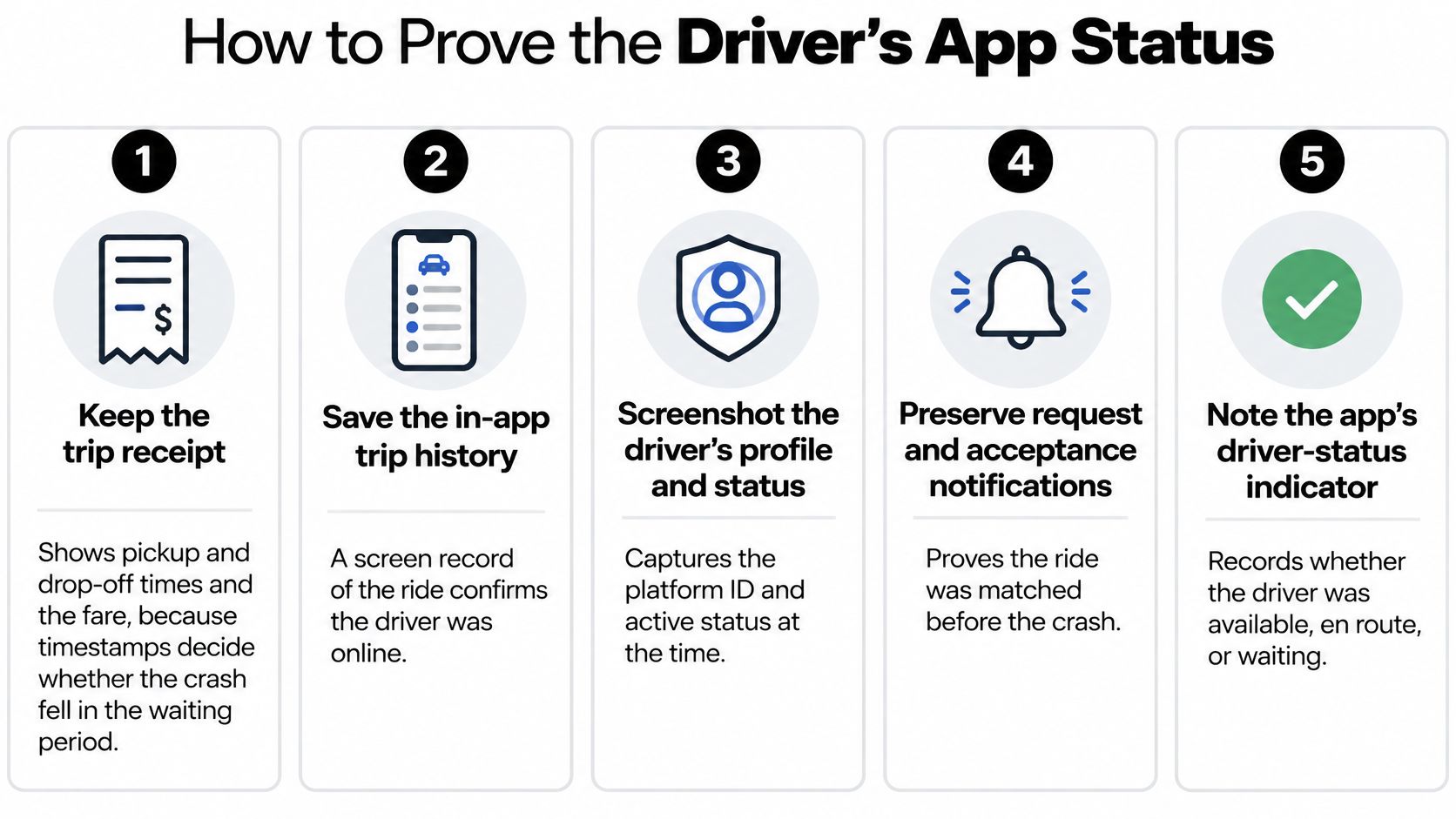
One point runs against instinct. The strongest claim after a rideshare crash isn’t always against the platform. When another motorist ran the light, that driver’s liability policy is the primary target, and the platform’s job is mainly to identify or supply the coverage layer behind it. Chasing Uber alone can leave the largest policy untouched.
Turning the evidence into a one page timeline
Build the page before anyone asks for it. Down the left side, list the driver’s log-in time, the request time, the acceptance time, the pickup time, the crash time, the drop-off time, and the moment the trip record was captured. Across from each entry, name the document that proves it: the receipt, the recording, the crash report, the dispatch data you requested in writing.
That page answers the coverage question visually, which makes it much harder for an adjuster to answer it badly.
Company terms and state requirements can shift between the crash date and the claim date. Confirm the rules in force on the day of the collision before treating any published limit as the number you’ll recover.
Deadlines That Can Shorten Your Claim Window
Two clocks run at the same time after a rideshare injury, and only one of them shows up on an insurance company’s paperwork. Here’s how they break down.
| Claim type | Deadline | Key point |
|---|---|---|
| Injury or death, private defendant such as another motorist or Uber driver | Two years from the injury date | Insurance talks do not stop the clock |
| Claim against a public entity, such as roadway design or maintenance | Administrative claim within six months of the injury | Must be filed before any lawsuit |
| Injury or death claim with unclear defendant | Two years from injury date, confirmed with counsel | Identify all possible defendants early |
The two-year figure comes from Code of Civil Procedure section 335.1. The California Courts self-help guide on statutes of limitation describes that period as the general personal-injury filing deadline, measured from the injury date.
Opening a claim, corresponding with an adjuster, or negotiating a hospital bill does not necessarily substitute for timely filing a lawsuit. Adjusters have no incentive to mention that. Their file can close on their schedule while your filing right expires on the court’s.
Running the dates on a March 3 crash
Say the collision happened on March 3, 2026. For a private defendant, the two-year date is March 3, 2028. If a city or county might share fault, for example because a sight line at that intersection was blocked by overgrown landscaping that maintenance crews had been told about, the administrative claim date is September 3, 2026.
That second date arrives roughly eighteen months before the first. It’s why government defendants get screened in week one rather than month twenty. The interaction between the filing window and insurance negotiation is broken down further in this guide to the California auto accident statute of limitations.
Evidence quality decides how much of the calendar you can use. Medical documentation needs to connect the collision mechanism to diagnoses, treatment, functional limits, and future-care needs. Wage-loss claims need payroll, tax, or scheduling records, not an estimate. Liability analysis has to address driver conduct, traffic controls, vehicle position, app status, and any third-party fault.
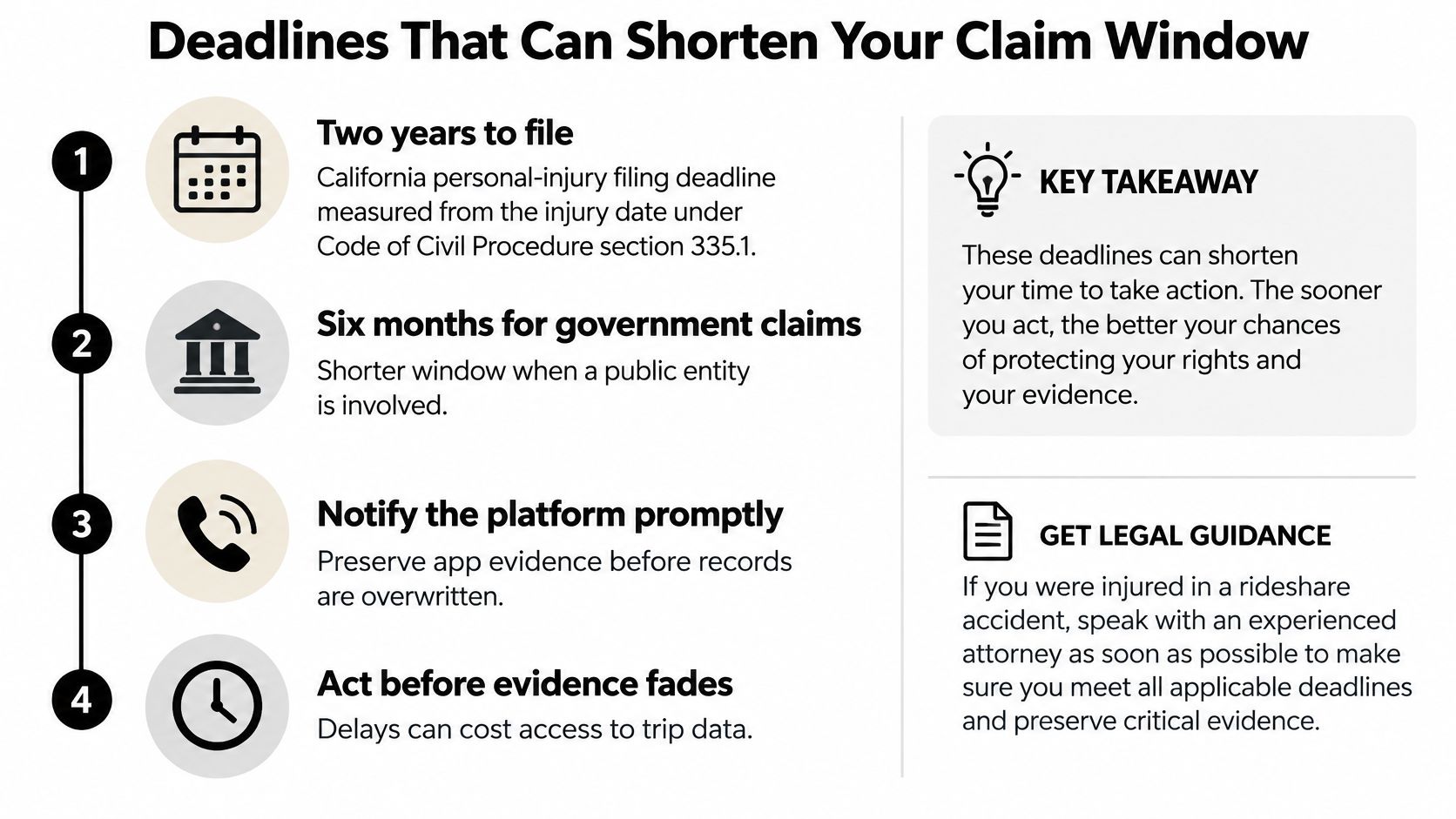
Practical rule: calendar both dates the day you open the claim, with a reminder thirty days before each one.
What an Injury Claim Can Recover
Compensation in a rideshare case divides into two buckets. One holds what the crash cost you in measurable dollars. The other holds what it cost you in ways that never produce a receipt.
The first bucket is the one you can document tonight.
Where economic damages come from
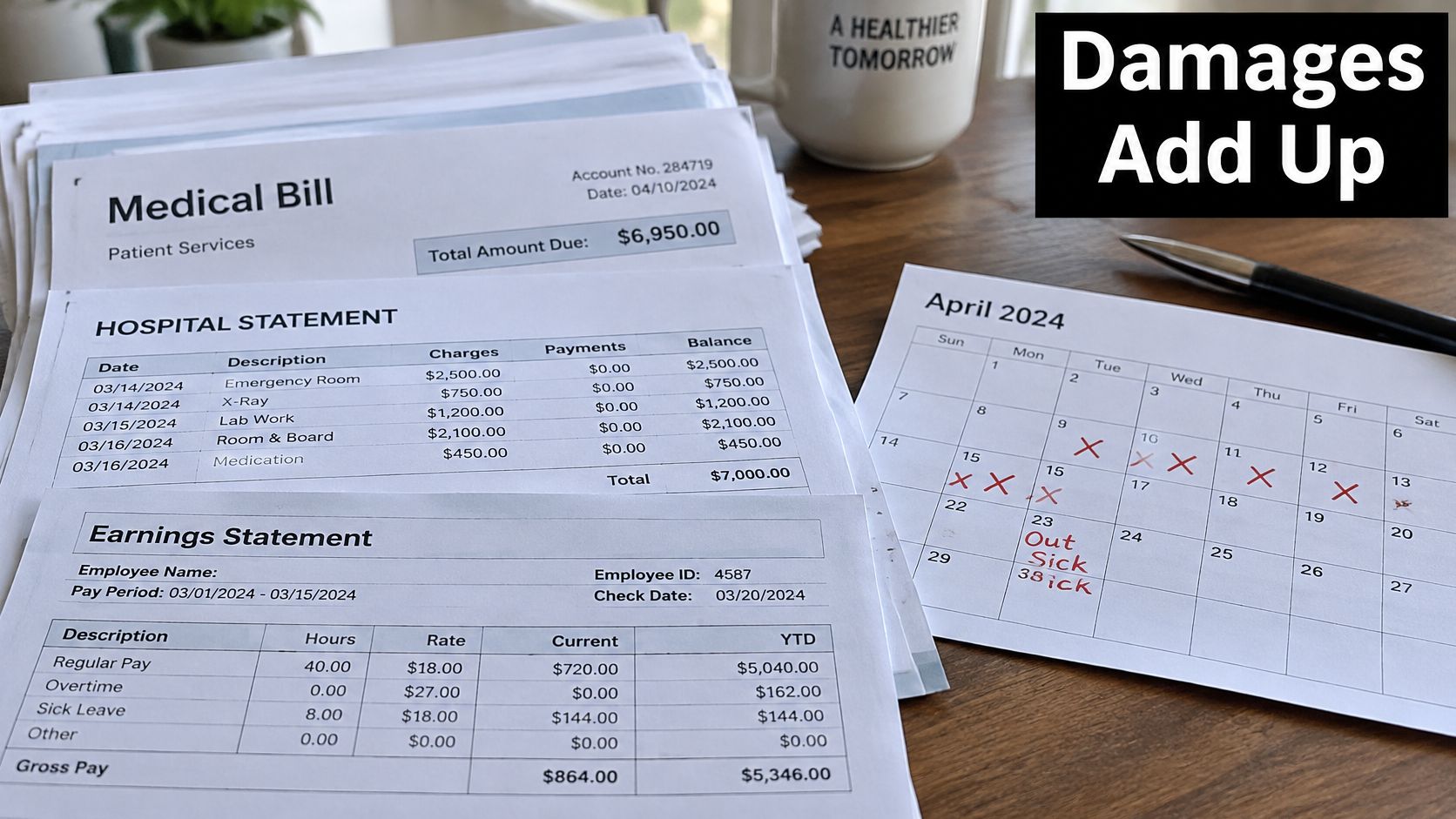
Medical and surgical bills, recovery costs, and lost wages belong in the first bucket, and LA Law Group seeks reimbursement for exactly those categories in the injury claims it handles. Lost wages need backup: payroll records, tax returns, or scheduling records showing the shifts you missed.
Run a simple example. An emergency room visit, follow-up care, and eight weeks of physical therapy total $18,000. Two weeks off work at your normal rate costs $6,000. That’s $24,000 in economic damages, and every dollar should trace to a document an adjuster can read.
Non-economic damages behave differently. Pain and suffering, anxiety after the crash, and the loss of ordinary activities have no statutory price list. Applying a multiplier to economic damages is a common negotiating method in practice, not something the statute requires, and for some cases LA Law Group determines non-economic damages by applying a multiplier to the client’s economic damages. The same $24,000 base can land in very different places depending on the injuries and the quality of the record.
Here’s how that negotiation usually unfolds.
Most claims begin as a negotiated demand rather than a lawsuit. When a client works with LA Law Group’s personal injury lawyers, the firm first negotiates a settlement with the insurance company. That sequence has a practical reason behind it: adjusters evaluate evidence they can read in minutes, so a demand built on a clean timeline and matched records gets a different response than a stack of loose bills. Only some claims end up in court.
How those categories get itemized, and what documentation each one needs, is covered in this overview of compensation for injuries.
Bring four things to any negotiation, whether it’s with an adjuster or a lawyer:
- Every bill and estimate, including imaging, therapy, and any surgery quote.
- Pay records that show the hours you lost, not an estimate of them.
- Treatment notes that link the collision to each diagnosis.
- The timeline you built, which places the crash inside the correct coverage period.
How to Assess an Uber Accident Lawyer
App-status claims are a narrow specialty inside personal injury practice. A firm that handles rear-end collisions every week may never have argued about a trip receipt timestamp, so general experience isn’t the filter that matters here.
| Criterion | What to ask | Why it matters |
|---|---|---|
| Rideshare experience | How many Uber or Lyft passenger cases have you handled? | App-status rules are specialized |
| Insurer contact | Who speaks with the insurer and how often will I get updates? | Consistent communication prevents surprises |
| Language access | Can you serve me in my language? | Clear communication supports accurate claim facts |
| Fee structure | How are fees and case costs handled, in writing? | Net recovery depends on the terms |
| Litigation readiness | Will you file suit if the insurer will not settle? | Some claims require court action |
| Timeline expectations | How long do similar cases take? | Sets realistic plans |
What each question is really testing
The rideshare question tests pattern recognition. Someone who has handled a dozen passenger cases knows which platform records to request and how quickly a trip card disappears from the app.
Fee structure deserves closer attention than it usually gets. A contingency percentage quoted out loud is not a fee agreement. Ask how case costs are advanced, whether they’re reimbursed before or after the fee is calculated, and get the answer in writing before signing anything.
Timeline answers tell you whether the attorney is being straight with you. Many personal injury cases handled by LA Law Group take six months to reach a settlement, and some lawsuits could take up to three years. If you’re quoted a settlement date before anyone has read your records, that’s a sales pitch.
Litigation readiness matters because insurers price cases partly on whether they believe the file will ever reach a courtroom. If LA Law Group cannot reach an agreement with the insurance company, the matter may proceed to litigation. Ask any lawyer you interview the same question directly.
Watch for these signals during the first call:
- A number promised before records exist. Nobody can value a claim before seeing the crash report and the treatment notes.
- Reluctance around fees. Vague answers about costs usually mean costs land on you.
- No explanation of the coverage period. If the attorney doesn’t ask what the driver was doing in the app, the analysis hasn’t started.
Comparing firms side by side, which this guide to how to choose a car accident lawyer walks through, is easier when every interview covers the same six questions.
Decide Whether to Get a Free Case Review
Four actions turn a confusing week into a file someone can work with.
- Fix the coverage row. Use your timeline to confirm whether the crash fell in the waiting period or the accepted-trip window. Write the answer down with the evidence that supports it.
- Write both dates on one page. The two-year date from the injury date, plus the six-month date if a government defendant is even possible.
- Assemble a single folder. Receipts, screenshots, crash report, witness details, medical records, and every insurer letter, in date order.
- Book a consultation with the attorney who would handle the case. Not a call center, not an intake script.
The first consultation with LA Law Group is free and confidential, and it is held with the attorney who will handle the matter. The firm serves clients throughout California in English, Spanish, and Farsi from its office in Chatsworth, and it can travel to a client’s home or hospital when getting to an office isn’t realistic. Expect that first conversation to cover what happened, which coverage period the facts point to, and what a written fee agreement would look like.
Deadlines deserve a final word. California Code of Civil Procedure section 335.1 generally gives a claimant two years to bring an action for personal injury or death caused by another person’s wrongful act or neglect. For an Uber passenger, pedestrian, cyclist, or anyone else injured in a rideshare collision, that period can be affected by claim-specific rules, including the identity of a potentially liable public entity, the claimant’s age, or other legally recognized exceptions. Treat two years as the general rule to confirm, not a guarantee that fits every case.
The recommendation is direct. Act before the earliest deadline on your calendar, not the latest one, because the earliest date is the one that can end the claim.
This article is for informational purposes only and is not to be construed as legal advice. No attorney-client relationship exists based on the review of this article, and none of the information in it is legal advice.
If you were hurt as an Uber or Lyft passenger in California, LA Law Group, APLC can review the trip facts, match the crash time to the correct coverage period, organize the medical evidence, and handle conversations with the insurer on your behalf. Your first consultation is free and confidential, and you’ll speak with the attorney who would handle your case, in English, Spanish, or Farsi, at the office or wherever you’re recovering. Visit LA Law Group, APLC to start with the timeline and get a clear answer on which policy applies before any deadline gets close.
Attorney Advertising. This article is general information, not legal advice, and does not create an attorney-client relationship. Prior results do not guarantee a similar outcome.