
Uber Passenger Accident Lawyer in California
You just climbed out of the back seat. The Uber is pushed into the car ahead, your neck is already tight, and someone on the sidewalk is saying the driver’s personal auto policy “should take care of it.” That guess is often the wrong starting point for a California passenger. The minute you got in, and whether you had gotten out yet, can matter more than the logo on the door.
An Uber passenger accident lawyer starts with that clock, then matches one crash to the policy that applies, the medical care you’ve started, and the wages you can’t earn while you heal.
Why Passengers Call a Lawyer After an Uber Crash
Picture a rear-end crash on a Los Angeles surface street. You’re standing beside the trunk. The other driver is talking about traffic. The Uber driver is on the phone with the app. A bystander tells you to file on the driver’s own auto policy and “let insurance sort it out.”
That advice skips the question that shapes the file. Were you inside on an active trip when the cars met? Counsel ties the ride receipt and the in-app timestamps to California’s coverage periods, names every person who might be responsible, and connects the impact to medical bills, lost wages, and care you may still need.
This article is provided solely for informational purposes and must not be construed as legal advice. No attorney-client relationship exists based on review of this article, and none of the information in it constitutes legal advice.
A dispatcher, not a two-car form
Think of the lawyer as a dispatcher for coverage. One collision gets sent to the right policy. It isn’t handled as an ordinary two-car claim just because two bumpers touched.
You, the passenger, generally bring a third-party bodily-injury claim or an uninsured-motorist claim. The person behind the wheel may have a separate occupational product for that driver’s own injuries. Those buckets don’t swap. Sending the driver’s benefit form doesn’t open your claim.
A citywide safety trend describes many trips at once. It doesn’t name who was careless on yours.
Population patterns can move in one direction while your ride still produces a real injury, real bills, and a real dispute over who pays. The occupied-trip chart, the first-week steps, and the hiring questions below are built for that single ride, not for a statewide average.
California Insurance While the Passenger Is Inside
Use this chart on the day of the crash. It separates the period when you are in the car from two nearby situations people often mix up with it.
| Situation | Primary coverage | Liability | UM/UIM | Key rule |
|---|---|---|---|---|
| Passenger has entered and has not yet exited | TNC coverage is primary | At least $1 million for death, personal injury, and property damage | $60,000 per person and $300,000 per incident | Coverage cannot depend on the passenger’s own insurer denying the claim first |
| App off, ordinary personal driving | Driver’s personal auto policy | The limits printed on that personal policy | Only if that personal policy includes UM/UIM | Not the passenger-occupied TNC period |
| App on but no passenger in the car yet | A different TNC period than the occupied ride | Do not assume the $1 million passenger limit | Do not assume the occupied-trip UM/UIM figures | Prove trip status with timestamps before allocating coverage |
The enter-to-exit meter
Under California Public Utilities Code §5433, from the moment a passenger enters until the passenger exits, the transportation network company’s coverage must be primary, with at least $1 million for death, personal injury, and property damage, plus uninsured- and underinsured-motorist protection of $60,000 per person and $300,000 per incident.
Coverage behaves like a meter that switches on at entry and off at exit. A hit in the pickup lane while you’re in the seat is not the same legal period as a hit after you’ve already left the car and the trip has ended. The statute also says this TNC coverage cannot depend on your own auto insurer denying the claim first. You shouldn’t have to burn through a personal policy just to reach the occupied-trip coverage.
What proves you were inside
Keep four items from the app before anything gets deleted.
- Ride receipt: It shows the trip existed and who was matched to it.
- Timestamps: Pickup and drop-off times bracket the occupied period.
- Driver identity: Name and photo tie the person at the wheel to that trip.
- Vehicle details: Plate, make, and model stop a later argument that a different car was involved.
App-off driving, and time spent waiting for a request with nobody in the back seat, follow different arrangements. Don’t assume those windows carry the occupied-trip liability figure. If the crash sits near a pickup or a drop-off, write down whether your door was open, whether you were seated, and whether the driver had ended the trip. A plain timeline beats a memory a week later. For a closer look at how those layers sit next to each other, see this guide to whether Uber covers accidents.
Crashes caused by someone other than the Uber driver use a different path, which is the next sorting job.
Which Policy Pays for Each Kind of Crash
Three crashes can feel identical from the back seat and still draw from different policies.
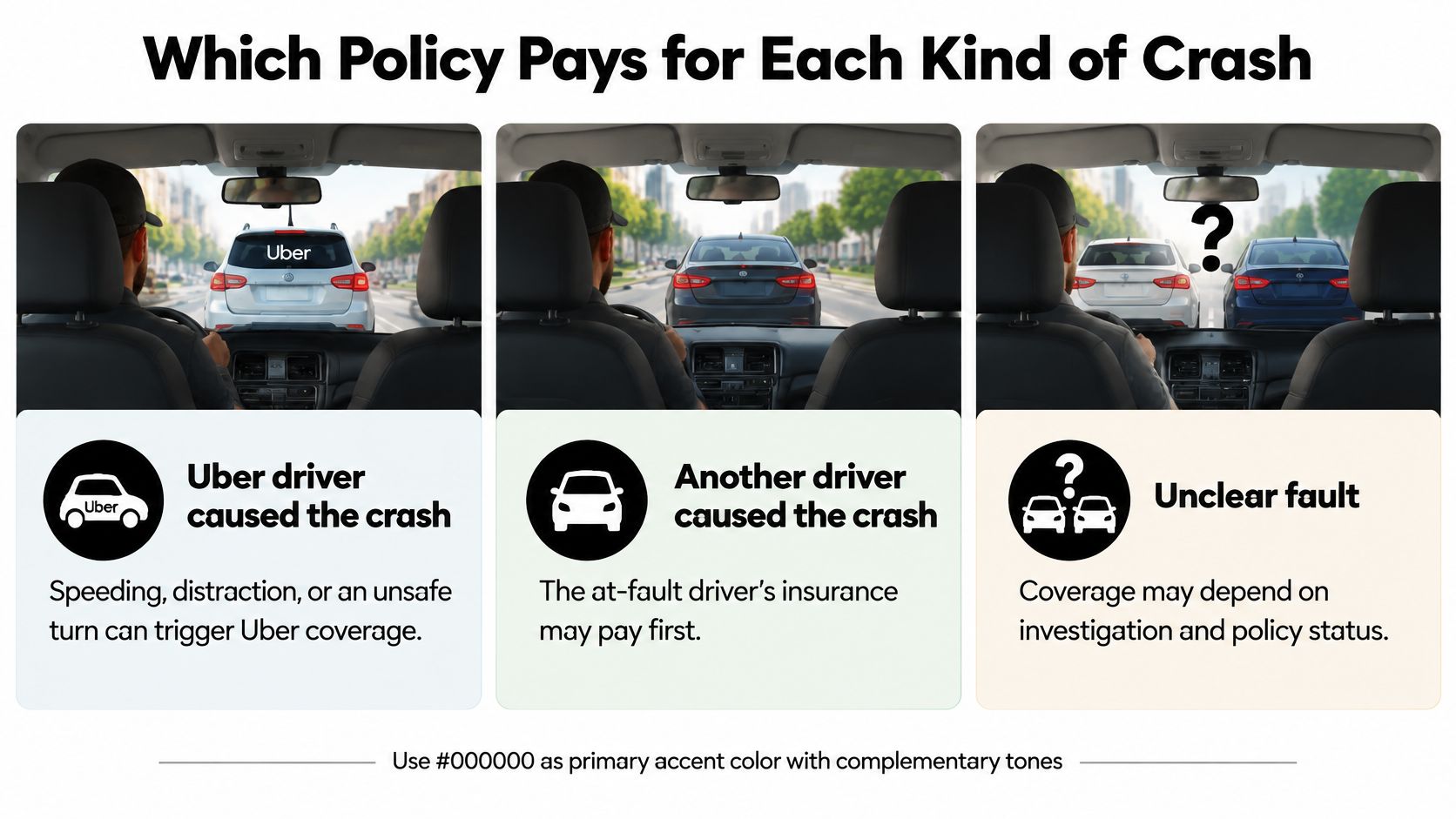
The Uber driver caused it. Say the driver was speeding, looking at the phone, or turned across a lane. Uber describes at least $1 million in third-party liability for bodily injury to riders and other people during a passenger trip. Uber reports that, beginning January 1, 2026, every Uber passenger trip in California will carry that $1 million liability limit for accidents caused by the rideshare driver, along with UM/UIM figures below. Treat that date as Uber’s stated start, and still check the policy that was in force on your crash date.
Another driver caused it, and that driver is short on insurance. A red-light sedan, a thin policy, or a car that leaves the scene points toward uninsured/underinsured-motorist bodily-injury coverage. Uber reports that same 2026 California passenger-trip package at $60,000 per individual and $300,000 per accident, including hit-and-run crashes where the protection applies. Uber’s help materials also describe medical-payments or personal-injury-protection benefits that may cover medical, health-care, or funeral expenses regardless of fault, when the policy in that state includes them. Those benefits are not a stand-in for the liability limit.
The injured person is the Uber driver, not you. Draw a bright line here. Uber describes a separate $1 million occupational-accident policy tied to California’s Proposition 22 for a driver’s medical expenses when the driver is hurt, regardless of fault, including time online and en route. That product is for drivers and delivery workers. It is the wrong bucket for a passenger’s injury claim.
| Who or what caused the harm | Coverage to examine | Stated California amount | Who it is for |
|---|---|---|---|
| Rideshare driver caused the accident | Third-party liability | $1 million | Riders and other injured third parties |
| Another driver lacks enough insurance, or hit-and-run | Uninsured/underinsured motorist bodily injury | $60,000 per individual and $300,000 per accident | Driver and riders on a passenger trip |
| Medical or funeral bills regardless of fault, if the policy includes it | Medical payments or personal injury protection | The benefit listed in the applicable policy | People the policy says it covers |
| Uber driver is the injured worker | Occupational-accident insurance under Proposition 22 | $1 million policy described for driver medical expenses | Drivers and delivery workers, not the passenger’s liability claim |
Accident date, trip status, the policy’s own words, and California law still control which row fits. A broad fatality trend doesn’t wipe out your file either. A 2018 study using monthly National Highway Traffic Safety Administration Fatality Analysis Reporting System data estimated that the overall fatal-crash rate declined by 1.6% for each additional quarter Uber was available, with an alternative specification at 0.7% per quarter. That research measured aggregate fatal-crash rates, not your bills or anyone’s negligence on one ride.
Steps to Take in the First Days After the Crash
Do these in order. Each one protects a fact an insurer will later ask you to prove.
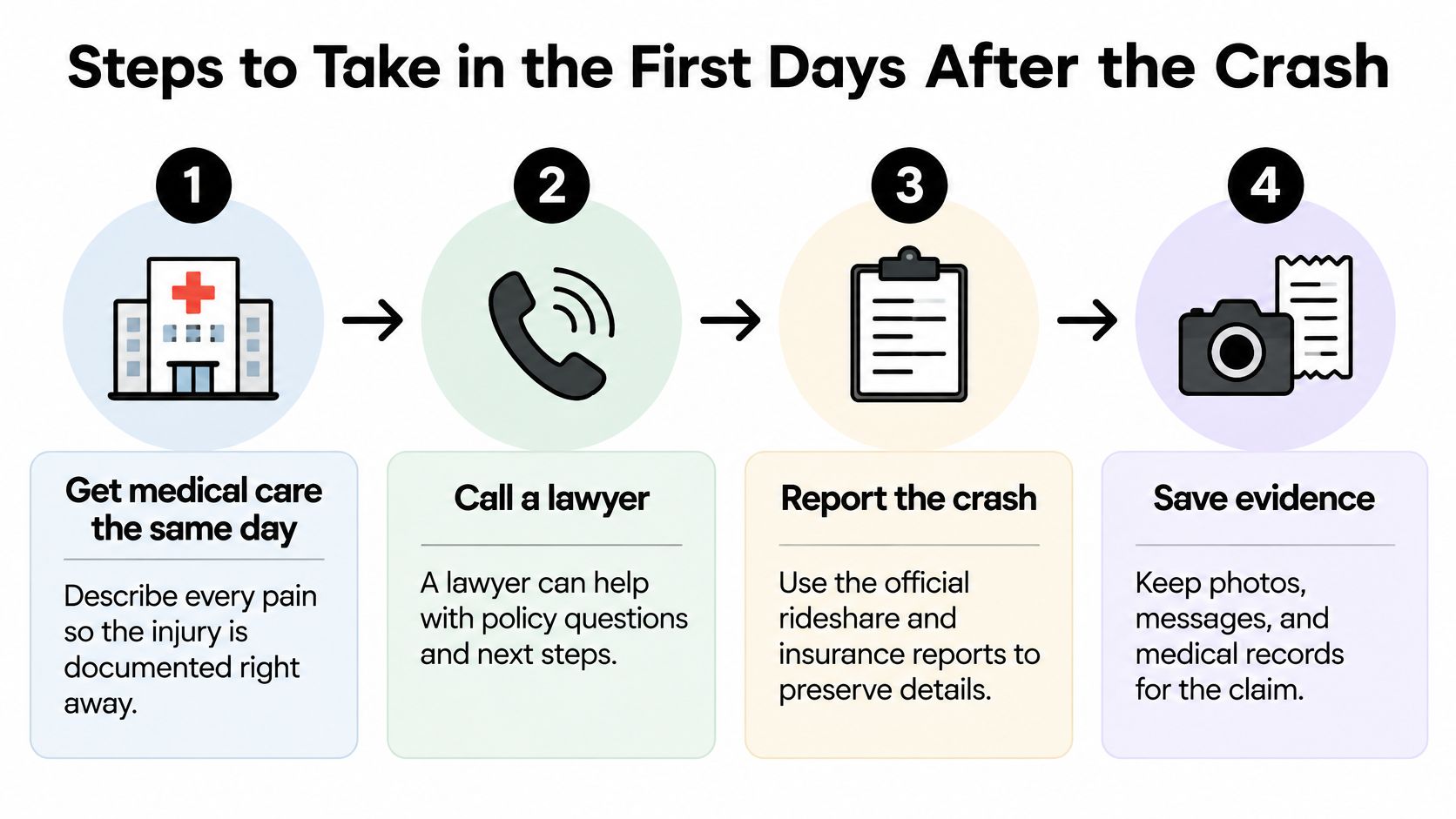
- Get medical care the same day. Tell the clinician every pain, even the ones that feel minor in the adrenaline. A gap of several days is often used to argue the injury came from somewhere else.
- Call the police and ask for a report number, even if both cars can still be driven. An official record anchors time, place, and the vehicles involved.
- Photograph before anything moves. Get vehicle positions, plates, the Uber decal, your visible injuries, and the lane markings. Once cars are towed, that geometry is gone.
- Save the in-app trip and report the crash in the app. Keep the receipt, driver name, vehicle, and pickup and drop-off times. Uber’s crash guidance gives people riding in an Uber a reporting channel. Use it, then keep going, because an in-app report doesn’t replace a police report, a medical chart, or photos.
- Get names and phone numbers for the other drivers, their passengers, and anyone on the sidewalk who saw the impact. A witness who leaves without a contact is hard to find later.
- Don’t give a recorded statement or sign a medical-lien release until you know which coverage is in play. A short answer on a recorded line can get treated as your full account of fault and injury.
- Keep wage records, receipts for rides to follow-up care, and a short daily symptom note. Those papers connect time off work and ongoing pain to this crash, not to a vague “I was sore.”
The driver’s form is not your form
Uber’s insurance materials separate third-party liability, which addresses bodily injury to riders and other affected people, from occupational-accident insurance, which is built for injuries to Uber drivers or delivery workers. A passenger generally presents a bodily-injury liability claim based on negligence, causation, and losses. Occupational-accident paperwork is the driver’s route.
Practical rule: Reporting inside the app preserves the platform’s record. It doesn’t identify every liable vehicle or watch a California filing deadline for you.
If the other car flees, photograph it only if you can do that safely, then still finish the police report. A hit-and-run isn’t self-proving, and uninsured-motorist coverage needs an official record that someone left. Early app data also helps show you were on an active ride, not standing on the curb after the trip ended. A fuller walk-through of those first moves sits in this note on what to do after an Uber accident.
The clip below walks through how a passenger can think about the hours right after impact, before the paperwork starts to scatter.
These seven steps are the raw file. The next part is how that file becomes a claim.
How Real Passenger Claims Get Built From Evidence
Three California-style crashes show how the path changes even when the back seat feels the same. None of these is a promised result. They’re illustrations of proof.
Lane change into a stopped truck. The Uber driver moves left into a truck that’s already stopped. The path to examine is liability coverage aimed at the rideshare driver. The proof is the trip log, the truck driver’s statement, and emergency-room notes from the same day that describe neck and back pain right after the impact.
Red light, small policy. A driver runs the light and hits the Uber, then turns out to carry only a small auto policy. The path to examine is uninsured or underinsured motorist coverage. The proof is the police report plus written confirmation of that other driver’s limits, so nobody is guessing what the other policy can pay.
Car flees. A vehicle clips the Uber and leaves. You still need the report, photos of the scene, and a medical chronology. Flight alone doesn’t identify a policy or document an injury.
What public crash files can’t value
A 2022 peer-reviewed critical review in the American Journal of Epidemiology shows that rideshare-crash research expanded substantially after Uber’s growth, but passenger-accident statistics remain difficult to measure consistently. Researchers have used National Highway Traffic Safety Administration fatal-crash data, trip-level datasets from New York and Chicago with origins and destinations masked into areas such as census tracts, and limited Uber trip-level data used in three studies, including two published in 2021.
A citywide pattern can coexist with a serious injury on a single ride. The dataset doesn’t hold your bill.
Those sources generally track crashes, fatalities, or population-level associations. They don’t list one rider’s medical expenses or an insurance dispute. Whether the Uber vehicle, another motorist, or a roadway condition caused your collision has to be built from trip records, police reports, medical records, photographs, witness accounts, and insurance information.
The file that supports a damages evaluation is concrete.
- Mechanism: How the cars met, in the report and in photos.
- Imaging and specialist opinions: What was found, and who interpreted it.
- Treatment dates: A chronology from the first visit forward.
- Wage loss: Pay stubs or employer notes for time missed.
- Future care: A clinician’s view of treatment still ahead.
Studies of ride-hailing and alcohol-involved crashes can describe traffic patterns. They don’t assign fault for any one collision, and they don’t price your care.
What to Weigh Before Hiring a California Lawyer
Bring a short list to the consultation. You’re testing whether the lawyer can work a passenger file, not asking for a repeat of a coverage chart.
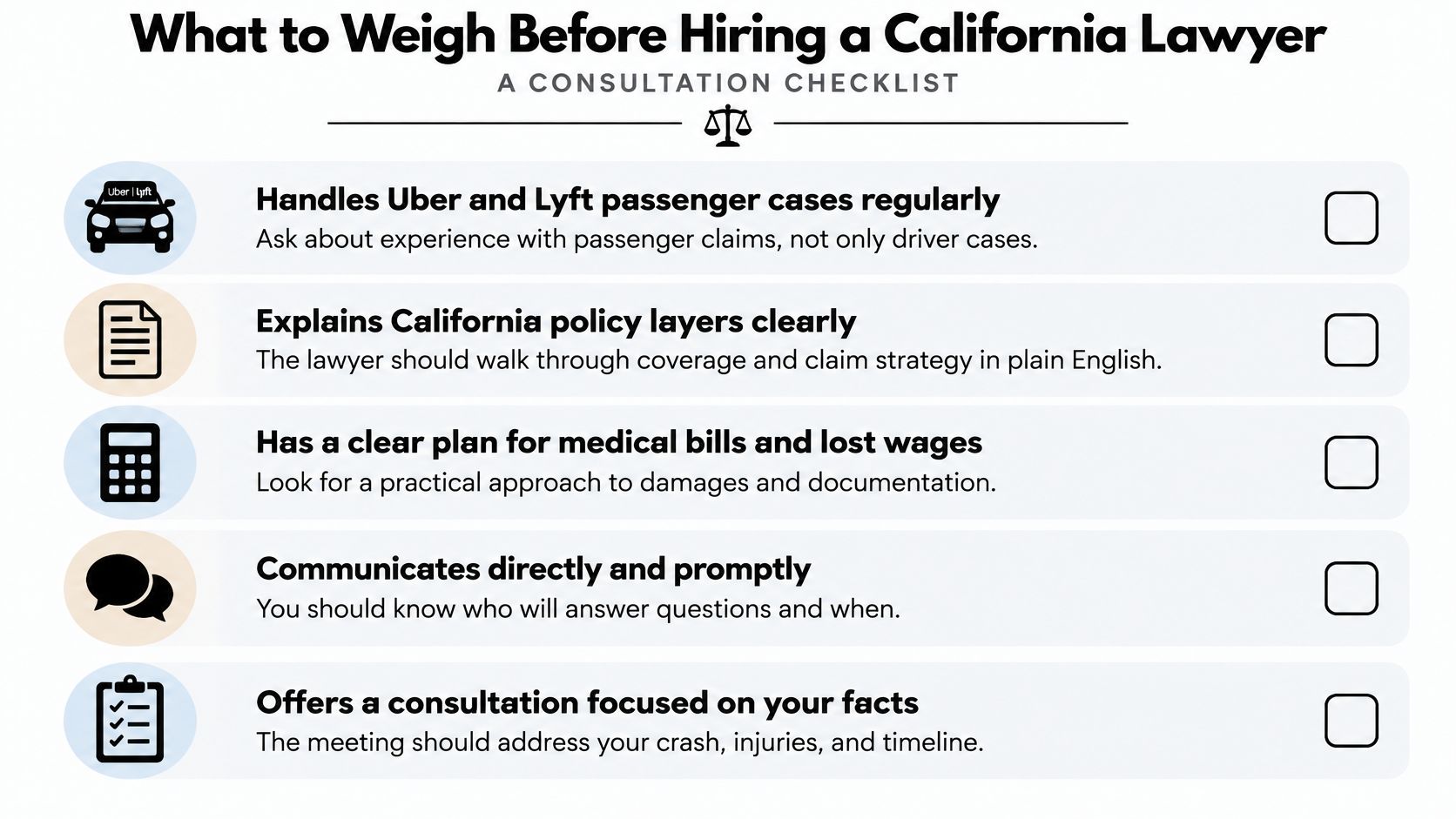
- Passenger cases, not only drivers: Ask whether the lawyer regularly handles Uber and Lyft passengers and can explain the enter-to-exit period without you prompting the timeline.
- Who works the file: Ask who drafts letters, who calls the insurers, and how often you’ll hear an update. A name on the website isn’t the same as a person who returns calls.
- Fees, costs, and the first meeting: Ask how the fee is calculated, which case costs you might see, and whether the first meeting is free.
- Deadlines in plain language: Ask how California filing deadlines apply to a passenger claim, in words you can repeat back.
- Language and location: If you need Spanish-language communication, ask for it directly. If you live in Los Angeles, on the Westside, in the San Fernando Valley, or in the East Bay, ask where you’d meet.
One California office list to verify
One option that lines up with that checklist is LA Law Group, APLC, founded in 2017 and led by Aryan Amid. The firm handles personal injury among other matters, offers free initial consultations, and has offices in Los Angeles, Santa Monica, Chatsworth, and Fremont, with direct attorney access rather than a handoff through intermediaries. Treat that as a fit to check against your facts, not a promise about the outcome of any case.
This guide to choosing a car accident lawyer is a useful companion list if you want questions that apply beyond rideshare. Bring the ride receipt, the photos, and the first medical record. With those three, a lawyer can say whether the passenger period is even in play before anyone talks about a number.
Request a Case Review When the Coverage Is Unclear
Ask for a review when any of these is true. You don’t need every record in a binder first.
- You were inside the Uber when the impact happened.
- Medical care has already started.
- The other driver may be uninsured, or the car left.
- The app report and the police report don’t match.
- An insurer is treating you like the driver and steering you toward occupational forms.
Wait only long enough to gather the receipt, the photos, and the discharge papers. Don’t wait so long that messages, trip screens, or witness numbers disappear. If you want help lining up questions before that meeting, an AI legal assistant from LegesGPT can help you organize dates and documents. It isn’t a substitute for a lawyer reading your trip status.
This article is informational, isn’t legal advice, and doesn’t create an attorney-client relationship. Readers who want a case review can start with LA Law Group, APLC, where a free initial consultation can sort trip status, likely coverage, and upcoming deadlines for a California passenger. The firm’s personal-injury work, and offices in Los Angeles, Santa Monica, Chatsworth, and Fremont, give a local place to begin.
If you can point to the minute you entered the car and the first place you sought care, you have enough to ask whether the occupied-trip liability period applies to you.
LA Law Group, APLC offers free initial consultations and direct attorney access for California personal-injury matters, including passengers hurt in Uber or Lyft crashes who need trip status and coverage sorted before a deadline passes. If your receipt, photos, and first medical visit are already in hand, visit LA Law Group, APLC and ask for a case review focused on that ride.
Attorney Advertising. This article is general information, not legal advice, and does not create an attorney-client relationship. Prior results do not guarantee a similar outcome.