
Uninsured Motorist Claim Attorney Guide
In 2023, 15.4% of U.S. motorists were uninsured, meaning more than one in seven drivers had no liability coverage when a crash occurred, according to the Insurance Research Council’s uninsured-motorist data. In California, that reality becomes especially important when serious injuries exceed the at-fault driver’s policy limits, when the driver leaves the scene, or when medical insurers later claim reimbursement from a settlement.
A California uninsured motorist claim attorney evaluates more than fault. The attorney must trace every available policy, prove the crash and injury connection, address health insurance liens, preserve hit-and-run evidence, and determine whether underinsured benefits can fill the gap after another carrier tenders its limits. The strongest claim is usually built early, before evidence disappears and before an insurer frames the case around incomplete medical or policy records.
Uninsured Drivers in California: The Scale of the Problem
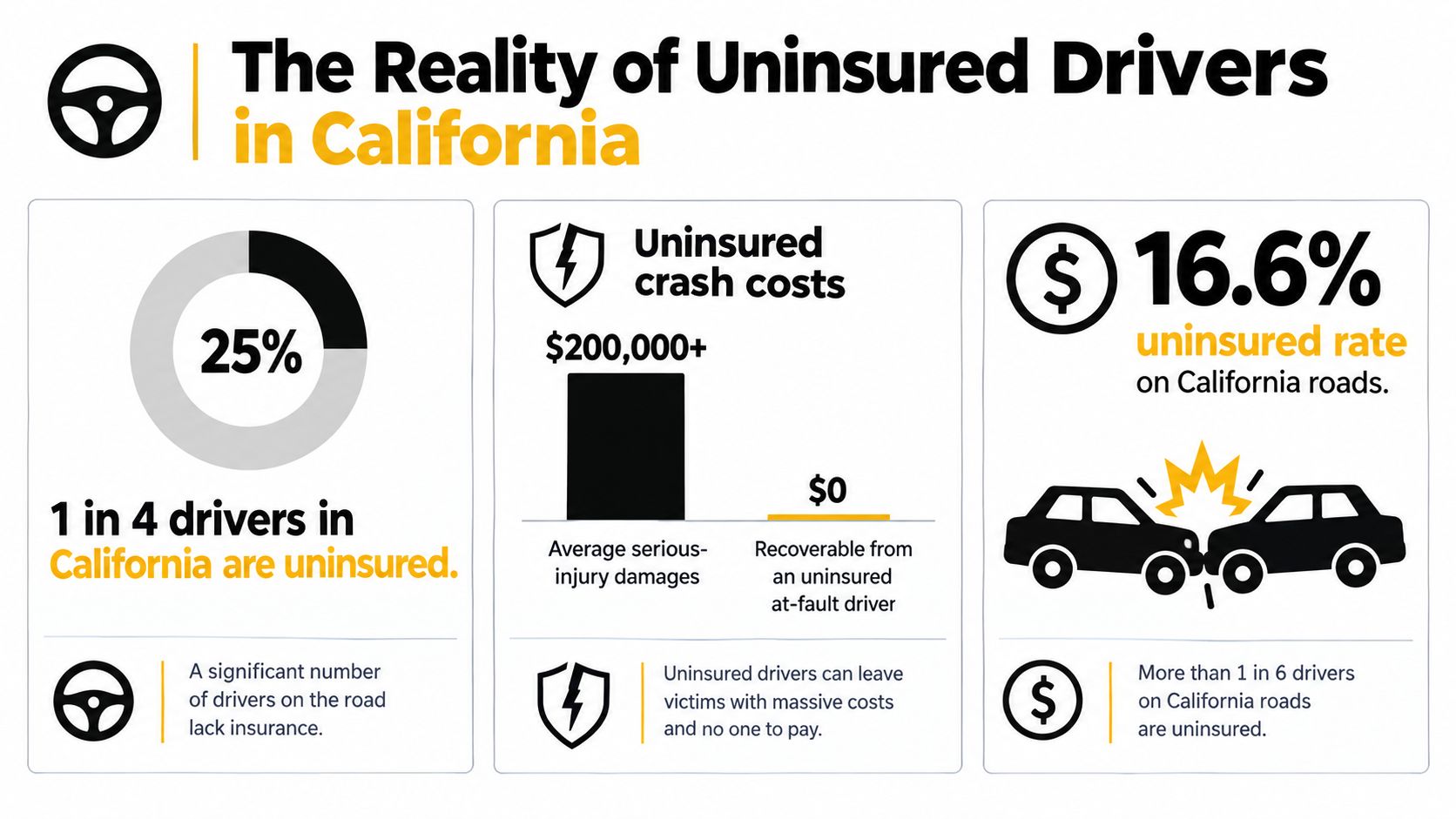
In 2023, an estimated 15.4% of U.S. motorists were uninsured, compared with 12.4% in 2017, according to the Insurance Research Council. The estimated rate ranged from 28.2% in Mississippi to 5.7% in Maine. Those differences show why the governing insurance rules matter alongside the collision evidence.
California injury claims require attention to the source of recovery. A lawsuit against an uninsured driver may establish fault but still produce little payment if that person lacks collectible assets. An insured driver may also carry limits that cover only part of the documented losses. The injured person’s own UM or UIM policy can then become the principal source of compensation, subject to its terms, limits, and proof requirements.
Why your own policy matters
Underinsurance creates a separate gap. In 2023, 18.0% of U.S. motorists were estimated to be underinsured, and the combined uninsured or underinsured rate was 33.4%, approximately one in three drivers, according to the Insurance Research Council. The combined rate was approximately 23% in 2017, a difference of 10 percentage points over that study period.
That gap affects more than the settlement demand. The declarations page should be reviewed for bodily-injury limits, UM/UIM limits, exclusions, notice provisions, household policies, permissive-use issues, and any written rejection or reduction of coverage. Counsel should also preserve photographs, vehicle data, medical records connecting the injury to the collision, wage-loss proof, and evidence showing whether the other driver had insurance.
Health insurance can complicate the net recovery. A medical insurer or benefit plan may assert a lien or reimbursement claim against settlement proceeds, so the available UM/UIM limits cannot be evaluated without considering medical expenses and repayment demands. Hit-and-run cases add another hurdle: the claimant must preserve evidence identifying the vehicle or collision and showing that the event qualifies under the policy and California law.
Practical rule: Negligence proves only part of the claim. Policy limits, hit-and-run evidence, medical causation, and health insurance liens determine whether a valid injury claim produces meaningful compensation.
People without their own coverage can face serious financial consequences after a crash. This guide for self-employed without coverage offers general background on those risks, but a California UM/UIM claim requires review of the actual policy and evidence.
This article is for informational purposes only and is not to be construed as legal advice. No attorney client relationship exists based on the review of this article and none of the information in this article is legal advice.
Understanding UM and UIM Coverage Rules
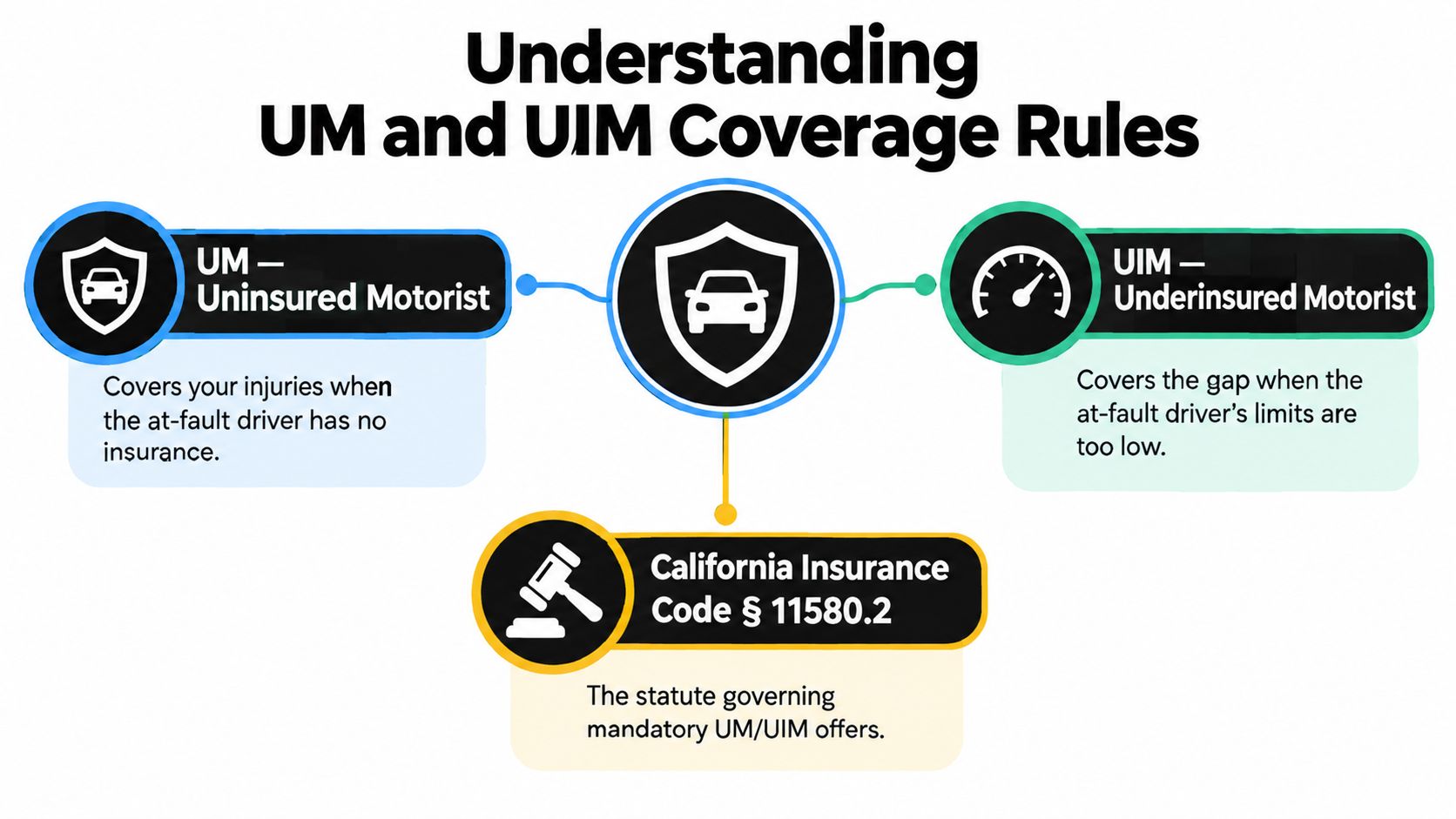
Uninsured motorist coverage generally applies to bodily injury caused by a vehicle with no applicable liability insurance. Underinsured motorist coverage addresses the gap when the at-fault driver has insurance, but those limits do not fully compensate the injured person. A driver may therefore be legally insured while remaining financially underinsured for a serious injury claim.
California Insurance Code § 11580.2 controls important parts of this coverage. It requires qualifying automobile liability policies to include protection for bodily injury or wrongful death caused by an uninsured motor vehicle and treats certain underinsured vehicles within the uninsured-motorist framework. The California Insurance Code text for § 11580.2 is technical. An attorney should compare it with the operative policy, endorsements, and claim facts rather than rely on an adjuster’s summary.
The documents that control the analysis
Collect the declarations page, policy booklet, endorsements, renewal documents, and every written waiver or selection form. Review policies issued to household members, insurance tied to the vehicle, employer-related coverage, and policies that may protect a passenger or permissive user.
California law permits UM coverage to be rejected or reduced only through specified written agreements. A verbal statement that coverage was declined may not resolve the issue. The written record matters because recovery depends on both legal entitlement to damages from the at-fault driver and the limits remaining after other applicable insurance is considered.
The California Department of Insurance explains the distinction between UMBI and UIM coverage options. Its consumer information can help people find uninsured motorist coverage options, but general guidance cannot replace review of the actual policy.
The limits also affect the practical value of a claim. Compare the available UIM limits with the amount recoverable from the at-fault driver’s policy, then account for medical bills, health insurance reimbursement claims, and the severity of the injury. A settlement or release with the other driver may require the UM/UIM carrier’s consent. Accepting that settlement first can create a coverage dispute or jeopardize the excess claim.
For further guidance, review how much uninsured motorist coverage you may need. The appropriate limits depend on the policy, household, expected injury exposure, and the assets or income requiring protection.
Proving Fault in Hit and Run Scenarios
A hit-and-run claim becomes difficult when the claimant can show an injury but cannot reliably show what vehicle caused it. The legal question isn’t only whether another driver disappeared. It is whether the evidence establishes that an unidentified or uninsured vehicle caused the crash and that the claimant suffered legally compensable bodily injury.
Consider a driver who swerves to avoid a vehicle that crosses the center line. There may be no contact between the cars. A later report that an unknown vehicle caused the maneuver may be insufficient without supporting evidence. By contrast, a prompt 911 call, independent witness, nearby surveillance footage, vehicle fragments, and consistent medical records can create a coherent account even when the driver isn’t located.
Evidence that strengthens an unknown-driver claim
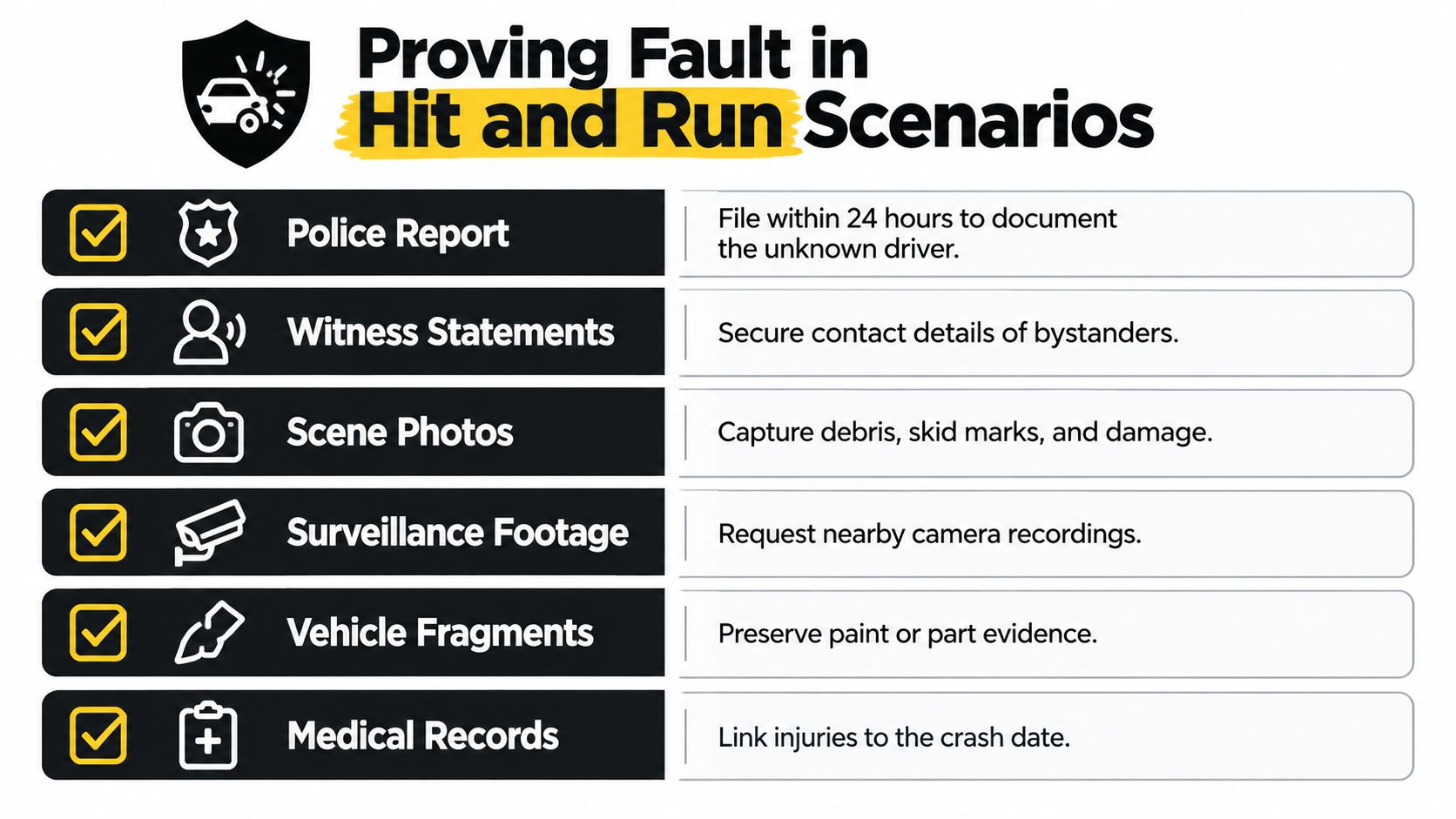
- Report the event promptly: A police report and immediate emergency call help establish when and where the event occurred.
- Preserve witness information: Names, telephone numbers, written statements, and descriptions of the fleeing vehicle can become critical when memories fade.
- Document the scene: Photograph debris, skid marks, vehicle damage, roadway markings, lighting, and the position of the vehicles.
- Request recordings quickly: Businesses, homes, parking facilities, traffic cameras, and dash cameras may capture the event, but recordings can be overwritten.
- Keep physical evidence: Paint transfer, broken parts, fragments, and damaged clothing may help connect a vehicle to the collision.
- Connect treatment to the crash: Emergency records, diagnostic reports, follow-up notes, and consistent injury descriptions help establish medical causation.
California guidance distinguishes bodily-injury coverage from property-damage coverage in an unidentified-driver event. Uninsured-motorist property-damage coverage generally requires identification of the uninsured driver, while UM bodily-injury coverage addresses injuries caused by an uninsured driver, as described in the California Department of Insurance automobile guide.
What weakens the claim
A delayed report doesn’t automatically defeat a claim, but it gives the carrier an argument that the event was reconstructed later. Gaps in treatment, inconsistent accounts, an absence of physical evidence, or a vague description of the fleeing vehicle can also make causation harder to prove. The insurer may question whether the claimant fell, suffered a prior injury, or reacted to a vehicle that never made contact.
The practical lesson is simple. Don’t assume “hit-and-run” is a coverage conclusion. It describes the event, not the proof required to obtain benefits. A focused investigation should begin before repair shops discard parts, businesses overwrite video, or witnesses become unreachable.
For a broader explanation of the coverage issue, see this resource on whether uninsured motorist coverage applies to hit-and-run crashes. The attorney’s job is to build the factual bridge between the unknown vehicle, the collision mechanism, and the documented injury.
Navigating Health Insurance Liens and Damages
Health insurance does not eliminate the value of a UM or UIM claim. It may cover treatment while the injury claim remains unresolved, but the health plan, Medicare, Medi-Cal, workers’ compensation carrier, or another payer may later seek reimbursement from the settlement.
The gross recovery is not the claimant’s net recovery. A sound evaluation accounts for medical bills, amounts paid, contractual discounts, future treatment, lost earnings, pain and suffering, deductibles, and asserted reimbursement claims. The relationship between these items can determine whether a settlement adequately covers the injury.
The payment sources work differently
Private health insurance may seek reimbursement under the plan’s language. Medicare and Medi-Cal can impose separate recovery procedures and notice obligations. Workers’ compensation may assert a lien for benefits paid for an injury connected to the crash. A letter of subrogation often signals that a payer is preserving that reimbursement position.
Paying bills through health insurance does not erase them from the valuation. The lien holder still claims reimbursement, and the carrier may discount the damages analysis because the bills were paid at negotiated rates rather than out of pocket.
The UM/UIM carrier may argue that health insurance has already addressed the medical loss. That position leaves out future care, wage loss, reduced earning capacity, pain, functional limitations, and the at-fault driver’s responsibility. It also overlooks the difference between a provider’s billed charge and the amount a payer accepted.
The settlement question is not merely “Who paid the hospital?” It is “What losses remain, what reimbursement rights exist, and what amount will the claimant actually receive?”
An attorney can request lien information, review plan documents, challenge unsupported reimbursement demands, and negotiate allocation before funds are distributed. Those steps can change the claimant’s net recovery even when the underlying liability evidence stays the same.
Why policy limits still matter
California’s minimum liability limits increased on January 1, 2025, to $30,000 per person, $60,000 per accident, and $15,000 for property damage. Those limits may remain inadequate after surgery, extended treatment, permanent impairment, or substantial wage loss.
A UIM claim can therefore remain valuable after the at-fault insurer tenders its limits. Before signing a release, confirm whether the UM/UIM carrier consented, identify the applicable limits, and determine how the settlement affects the remaining first-party claim. Health insurance liens and underinsured limits must be evaluated together, because paying the lien without protecting available coverage can reduce the recovery unnecessarily.
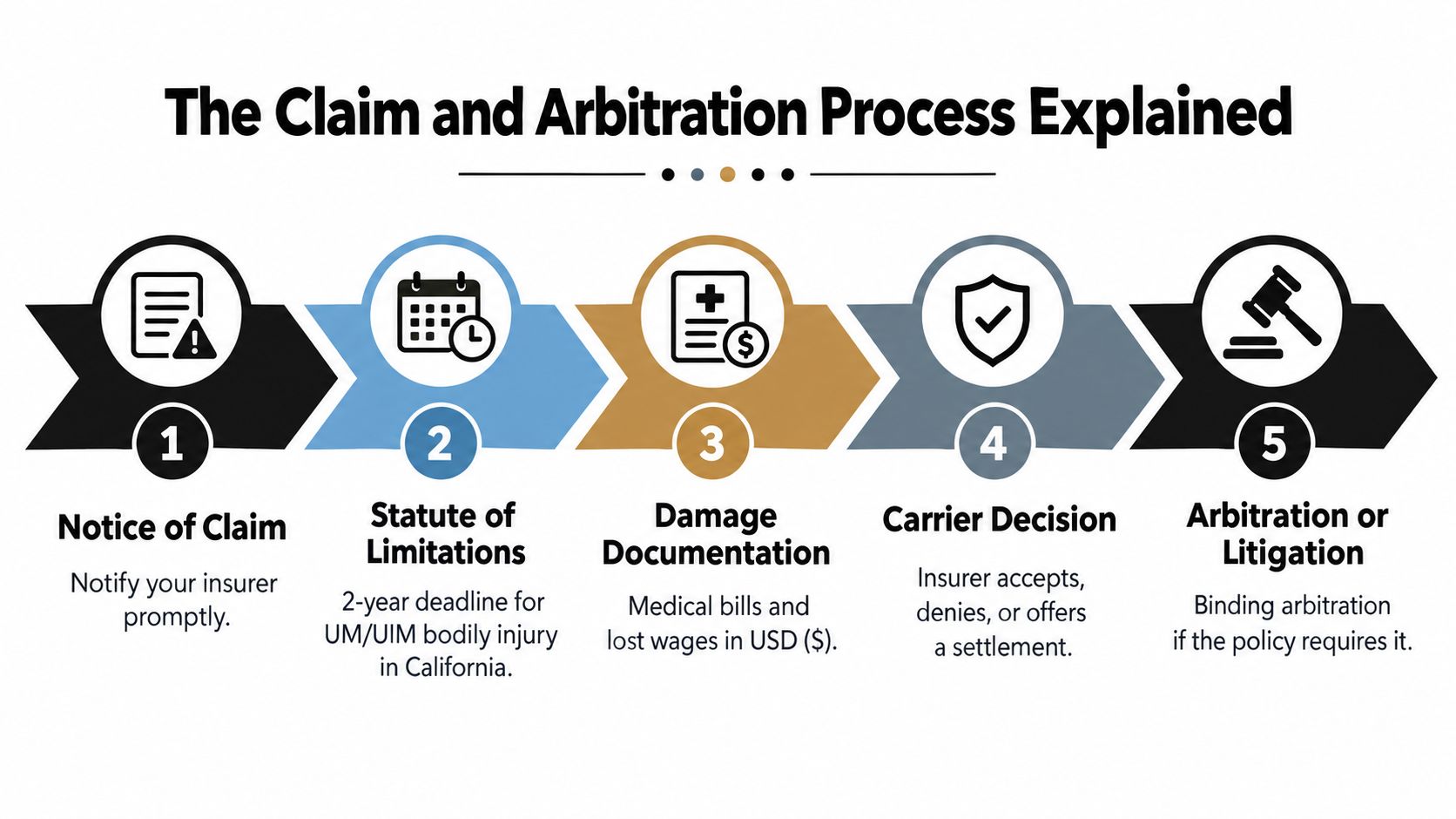
The Claim and Arbitration Process Explained
A California UM/UIM claim is a first-party insurance dispute layered onto the underlying crash. The carrier may investigate liability, injury severity, policy terms, prior conditions, treatment decisions, and the value of future losses. The claimant must present a complete record while protecting against premature statements that can later be used to narrow the claim.
A practical sequence
1. Give notice and preserve the policy. Notify the insurer promptly under the policy’s notice provisions. Request the declarations page, endorsements, claim number, and written confirmation of the coverage being investigated.
2. Establish the underlying liability claim. Gather the police report, photographs, witness information, vehicle records, traffic evidence, and proof of the other driver’s insurance status. In a UIM matter, determine whether the liability carrier’s limits have been tendered and whether the UM/UIM carrier must consent to a release.
3. Build the damages record. Organize medical records, billing statements, diagnostic studies, work restrictions, wage documentation, tax or payroll records, and evidence of future care. The attorney should connect each claimed loss to the crash rather than submitting an unexplained stack of bills.
4. Evaluate the carrier’s position. The insurer may dispute fault, causation, treatment necessity, preexisting conditions, lost wages, future care, policy exclusions, or the available limits. A low offer should be answered with evidence and a reasoned damages analysis, not just a demand for more money.
5. Use the required dispute procedure. California policies may require arbitration of UM/UIM disputes. Arbitration can focus the issues, but the claimant still needs organized exhibits, witness testimony where appropriate, medical opinions when needed, and a persuasive damages presentation. If the policy or procedural posture permits court involvement, litigation may also become relevant.
Deadlines are not a paperwork detail
The infographic identifies a 2-year deadline for UM/UIM bodily injury in California, but the exact limitation analysis can depend on policy language, statutory rules, tolling issues, arbitration provisions, and the claim’s procedural history. Treating the deadline as a distant administrative concern is risky. Notice requirements may arrive earlier, and evidence becomes harder to obtain with time.
An uninsured motorist claim attorney intervenes by controlling communications, identifying the governing deadline, organizing proof, and testing the carrier’s defenses against the policy and record. The goal isn’t to inflate a claim. It is to prevent a valid claim from being undervalued because the insurer received an incomplete account.
Contingency Fees and the Value of Direct Access
Many injured people hesitate to consult an attorney because they expect an hourly bill or an upfront retainer. Personal injury representation is commonly handled through a contingency arrangement, meaning the attorney’s fee is tied to recovery under the written agreement rather than charged as an hourly legal bill. The exact fee, case expenses, and responsibility for costs should be explained before representation begins.
That structure can make professional review available when the claimant is already managing medical treatment, lost work, vehicle damage, and insurance calls. It also aligns the attorney’s financial interest with pursuing a recovery that justifies the work, although no lawyer can guarantee an outcome.
Why handling the claim alone can be costly
An adjuster may be courteous and still evaluate the claim for the insurer’s financial exposure. A claimant handling the matter alone may overlook a household policy, misread a written waiver, accept a release before obtaining consent, or describe symptoms in a way that later appears inconsistent with the medical record.
The technical burden grows when the case includes an unidentified driver, disputed causation, multiple payers, or a UIM claim after a liability tender. A lawyer must analyze both the underlying negligence case and the contract-based coverage dispute. Those are related questions, but they aren’t identical.
Direct attorney access also matters. A claimant should know who evaluates the evidence, who makes strategic decisions, how updates are delivered, and whether an intermediary is filtering material information. Prompt communication can prevent missed records, unsupported assumptions, and settlement decisions made without a clear net-recovery analysis.
A useful consultation should address:
- Coverage: Which policies may respond, and what documents are missing?
- Proof: What evidence supports fault, causation, and injury severity?
- Damages: What losses are documented, projected, disputed, or subject to liens?
- Procedure: Does the policy require arbitration, and what deadlines control?
- Economics: What fee and expense terms apply if the claim succeeds or does not?
The right attorney isn’t defined only by a slogan or a settlement demand. The meaningful comparison is whether the lawyer can explain the policy, evidence, deadlines, risks, and likely net recovery in language the client understands.
Next Steps for Your Injury Claim
Start by preserving documents instead of waiting for the insurer to request them. Create a folder containing the declarations page, policy correspondence, police report, photographs, witness details, medical records, bills, employment records, wage information, and every letter or email from an insurance carrier.
Prepare for the first consultation
Bring the following if available:
- Insurance materials: Declarations pages, renewal documents, endorsements, written waivers, and household policy information.
- Crash evidence: Police reports, incident numbers, photographs, vehicle repair records, dash-camera files, surveillance leads, and witness contacts.
- Medical proof: Emergency records, diagnostic results, treatment notes, prescriptions, invoices, and information about prior relevant injuries.
- Financial records: Pay stubs, employer verification, work restrictions, missed-work dates, and documentation of self-employment losses.
- Settlement communications: Liability offers, releases, lien letters, subrogation notices, and any demand or denial from your UM/UIM carrier.
Don’t sign a release or provide a recorded statement about disputed issues before understanding the policy and the consequences. Prompt notice is still important, but notice and settlement authority are different decisions. Tell the attorney about every insurer and every policy connected to your household or vehicle.
Language access can also affect the quality of the claim. LA Law Group, APLC offers Spanish-language access for California accident clients and maintains offices in Los Angeles, Santa Monica, Chatsworth, and Fremont. A claimant should be able to explain the crash, symptoms, work impact, and insurance history without losing important details in translation.
The firm’s stated process includes a free initial consultation, direct attorney access, case assessment, strategy development, negotiation, and representation when a claim requires further action. Those services are one option among the California firms handling automobile injury and UM/UIM matters. The consultation should leave you with a clearer understanding of coverage, evidence, liens, deadlines, and the next decision.
A hit-and-run or underinsured-driver claim doesn’t become strong merely because the injuries are real. It becomes stronger when the evidence is preserved, the policy is read carefully, medical and financial losses are documented, and settlement decisions account for liens and consent requirements.
LA Law Group, APLC offers free initial consultations and representation for California injury claims involving uninsured or underinsured drivers, including policy review, evidence evaluation, lien issues, and settlement strategy. Visit LA Law Group, APLC to request a consultation and discuss your UM/UIM claim with a team offering direct access and Spanish-language support.
Attorney Advertising. This article is general information, not legal advice, and does not create an attorney-client relationship. Prior results do not guarantee a similar outcome.