
what are special damages: Your Quick Guide

When you get hurt in an accident, the first thing you think about is the pain. But right behind that comes the financial stress. The medical bills pile up, you’re missing work, and your car is a wreck. How do you get back on your feet financially?
In the legal world, these specific, out-of-pocket costs are what we call special damages.
Disclaimer: This article is for informational purposes and not to be construed as legal advice. No attorney client relationship exists based on the review of this this article and none of the information in this article is legal advice.
Breaking Down Your Financial Losses

Think of special damages as the black-and-white financial footprint of your accident. They are all the tangible, dollars-and-cents losses that you can prove with a receipt, an invoice, or a pay stub. There’s no guesswork involved.
Another name for special damages is economic damages, which makes perfect sense—they represent the direct economic hit you’ve taken because of someone else’s negligence.
Quantifiable and Provable Costs
This is where special damages really differ from general damages (which cover things like pain and suffering). Special damages are all about concrete numbers. You can add them up on a calculator.
The whole point of special damages is to make you financially whole again—to reimburse you for every single dollar you were forced to spend because of the injury. These aren’t abstract concepts; they are the real bills you have to pay. For more on how different damages are handled, you can find helpful resources on gainservicing.com.
To make this crystal clear, let’s look at the key differences side-by-side.
Special Damages vs General Damages At a Glance
The distinction between these two categories is one of the most important concepts in any personal injury claim. This table breaks it down simply.
| Attribute | Special Damages (Economic) | General Damages (Non-Economic) |
|---|---|---|
| Nature | Tangible, calculable financial losses | Intangible, subjective harms |
| Proof | Requires receipts, bills, pay stubs | Based on testimony, severity of injury |
| Purpose | To reimburse for specific expenses | To compensate for suffering and distress |
| Examples | Medical bills, lost income, repairs | Pain, emotional distress, loss of enjoyment |
As you can see, one is about reimbursing what you’ve lost, while the other is about compensating for what you’ve endured. Both are critical for a fair settlement.
The Common Types of Special Damages You Can Claim
When we talk about “special damages,” we’re not using some vague legal term. We’re talking about the very real, very specific financial hits you and your family take after an injury. Think of it like this: you’re creating a detailed, itemized invoice for every single dollar the accident has cost you.
These are the damages that come with a receipt. They cover the direct, immediate, and often overwhelming financial consequences of an accident, and they can be calculated down to the penny.
Medical Expenses – Past and Future
This is usually the biggest and most obvious category. We’re talking about every single medical bill connected to your recovery, from the moment the accident happened to all the care you’ll foreseeably need down the road.
It’s not just the first trip to the hospital, either. The costs pile up from many different sources.
- Emergency Room Visits: This covers the ambulance ride, the initial ER treatment, and the cost of being admitted to the hospital.
- Surgeries and Procedures: Any operation you needed to repair the damage from your injuries.
- Ongoing Physical Therapy: Rehabilitation is a long road. These are the long-term costs to help you get your mobility and life back.
- Prescription Medications: All the drugs prescribed for pain, infection, or any other part of your recovery.
- Specialist Appointments: Follow-up visits with surgeons, neurologists, chiropractors, or other medical experts are all part of the bill.
Disclaimer: This article is for informational purposes and not to be construed as legal advice. No attorney client relationship exists based on the review of this this article and none of the information in this article is legal advice.
Lost Income and Earning Capacity
An injury doesn’t just put you in physical pain; it puts your entire financial life on hold. Special damages for lost work are broken into two key areas:
- Lost Wages: This one is pretty straightforward. It’s the income you’ve already lost because you couldn’t work. If your job pays $1,000 a week and you were out for six weeks, that’s a clear $6,000 in lost wages. We prove this with pay stubs and letters from your employer.
- Loss of Future Earning Capacity: This is where things get more complex. We’re looking into the future to see how your injuries will permanently impact your ability to earn a living. Imagine a construction worker who suffers a severe back injury. He might never be able to return to that line of work, leading to a massive loss of income over the rest of his working life.
Property Damage and Other Expenses
The bills don’t stop with doctors and lost paychecks. All the other out-of-pocket costs add up, and they are just as important to track.
The most common example is the cost to repair or replace your car after a crash. But it also includes personal items that were destroyed, like your laptop, phone, or even eyeglasses.
On top of that, you can claim all the “little” things that become big problems—like the mileage and parking fees for driving to what feels like a million doctor’s appointments, or the cost of hiring someone to mow your lawn because you physically can’t do it anymore. Every single receipt matters.
How Are Special Damages Actually Calculated?
Figuring out special damages isn’t just guesswork; it’s a careful, evidence-based process. You don’t just pull a number out of thin air. It all starts with simple addition. Your legal team will gather every single receipt, invoice, and pay stub connected to your injury.
We add it all up to get a clear picture of your past economic losses. This total is the foundation of your claim—without this solid, documented figure, it’s tough to move forward.
The infographic below breaks down the main buckets where these calculable losses come from.
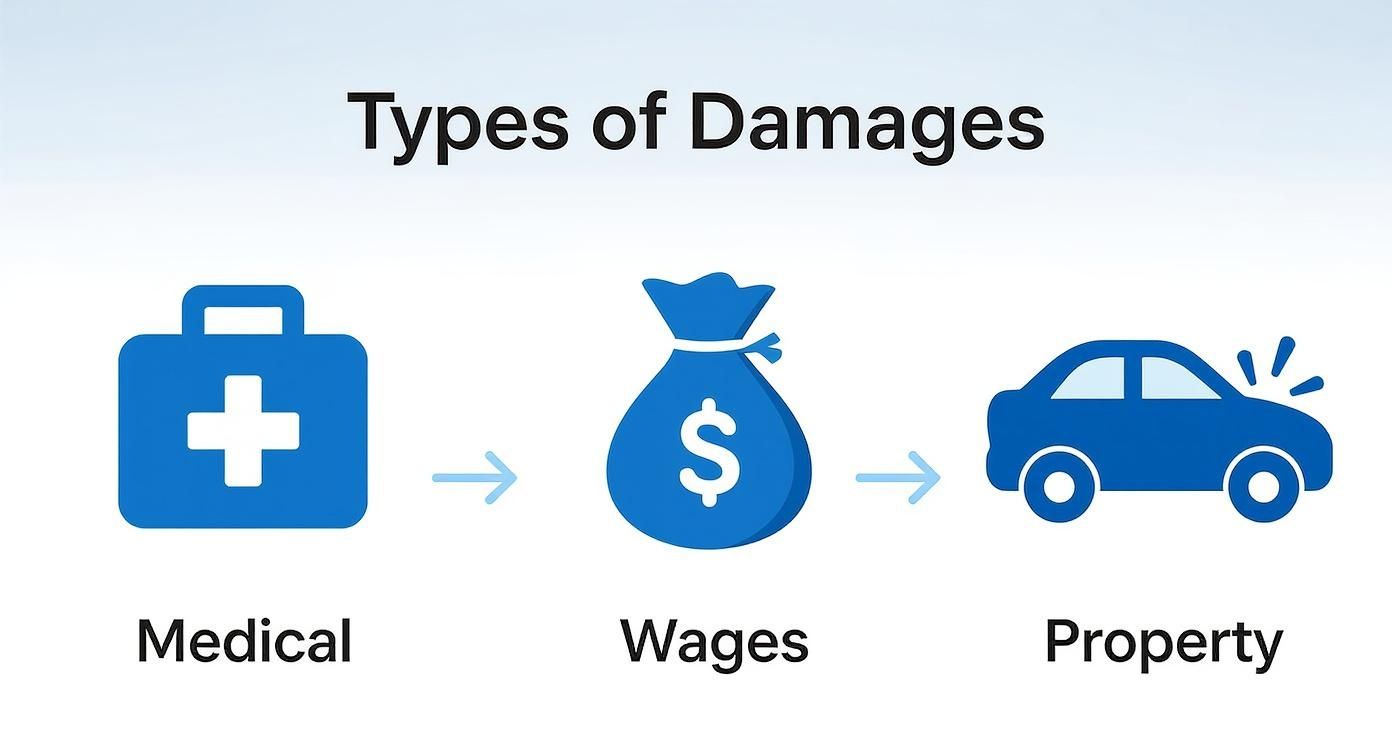
As you can see, every specific financial hit—from hospital bills to car repairs—is a distinct, provable piece of your total compensation.
Projecting Future Financial Losses
Adding up old bills is one thing, but the real complexity comes when we have to look into the future. What if your injury needs long-term care? Or what if it permanently impacts your ability to work? You have to account for these future costs, and that’s far from guesswork. It requires expert analysis.
This is where specialized professionals come in. Think of them as the financial forecasters for your recovery.
- Life Care Planners: These are medical experts who map out every future medical need you’ll have. We’re talking surgeries, physical therapy, medications, and even in-home help. They then calculate the lifetime cost of that plan.
- Vocational Experts: Their job is to assess exactly how your injury affects your career. They project your lost future income based on what you can and can’t do anymore.
- Economists: These experts take all those future cost projections and adjust them for things like inflation and potential career growth. This ensures the final number truly reflects what you’ll need decades down the line.
Disclaimer: This article is for informational purposes and not to be construed as legal advice. No attorney client relationship exists based on the review of this this article and none of the information in this article is legal advice.
The Bedrock of Your Entire Claim
Why is getting this number right so important? Because these carefully calculated figures often become the basis for determining your other damages—namely, pain and suffering (general damages).
Attorneys and courts frequently use a multiplier (usually between 1.5 and 5) on the special damages total to estimate a fair value for general damages. For example, if you have $5,000 in documented medical bills, an insurer might apply a multiplier of 4 to suggest $20,000 for your pain and suffering.
This method shows just how powerful a meticulously documented special damages claim really is. It’s the anchor for your entire case. For a practical look at how claims are itemized in a legal setting, you might find it helpful in understanding the NCAT Scott Schedule.
To dig deeper into the broader category these damages belong to, check out our guide on what are economic damages.
Proving Your Claim With The Right Evidence

When you’re fighting for special damages, your claim isn’t built on feelings or guesswork. It’s built on a foundation of cold, hard proof.
Think of it like this: you’re building a legal case, piece by piece. Every receipt, every invoice, every pay stub is a crucial brick in that foundation. Without solid evidence, your claim is just a story. With it, it becomes an undeniable fact that insurance companies can’t ignore.
Being organized from day one is your biggest advantage. The more detailed your records are, the stronger your position becomes. Every single dollar you claim has to be backed up by a document.
Disclaimer: This article is for informational purposes and not to be construed as legal advice. No attorney client relationship exists based on the review of this this article and none of the information in this article is legal advice.
Building A Rock-Solid Paper Trail
So, what does this evidence actually look like? It’s about creating an undeniable record of every financial loss, big and small. Having the right documents organized and ready is half the battle.
To help you get started, we’ve put together a practical checklist. Think of this as your game plan for gathering the proof you need to build a powerful claim.
Essential Evidence Checklist for Special Damages
| Type of Damage | Required Documents and Evidence |
|---|---|
| Medical Bills | Invoices from the hospital, emergency room, surgeons, specialists, and physical therapists. You also need receipts for prescription medications and any medical equipment like crutches or braces. |
| Lost Wages | Your pay stubs from before and after the accident. Critically, you’ll need a formal letter from your employer confirming your job title, pay rate, and the exact dates you missed work. |
| Property Damage | Every repair estimate for your vehicle or other damaged property (like a laptop or phone). The final, paid invoice for the repairs is the most important document here. |
| Out-of-Pocket Costs | A detailed mileage log for all medical-related travel. Save every receipt for things like parking at the doctor’s office or over-the-counter medical supplies you purchased. |
This table isn’t just a list; it’s your roadmap to substantiating every part of your claim. Each document tells a part of the story, proving the real-world financial impact of your injury.
Don’t Forget The “Hidden” Costs
It’s easy to focus on the big-ticket items like hospital bills, but the smaller out-of-pocket expenses can add up fast. These costs are just as legitimate, but they’re often the first ones people forget to track.
Keep a dedicated notebook or a spreadsheet for these expenses. Log every single trip you make to a doctor, pharmacy, or physical therapist. Note the date, the destination, and the round-trip mileage. Keep every single receipt for parking, tolls, or medical supplies.
This level of detail does more than just add up the numbers. It paints a clear picture of how much your life has been disrupted. When you need to prove your injuries are sufficient for a personal injury claim, this thorough documentation becomes invaluable. Each receipt and logged mile makes your case stronger, pushing you closer to the fair recovery you deserve.
The Legal Standards for Claiming Special Damages
Simply stacking up a pile of receipts isn’t enough to get paid for your special damages. The law is very clear: there are specific standards every single claim has to meet.
Think of it like building a bridge. On one side, you have the defendant’s negligent actions. On the other, you have your financial losses. You have to build a solid, legally sound bridge connecting the two. If you can’t, your claim goes nowhere. The entire legal framework for this rests on two crucial ideas: causation and reasonable certainty.
These rules are in place to keep things fair and to stop people from making claims based on guesswork. They put the burden on the injured person to prove—with real evidence—that their losses are a direct, measurable result of what happened.
Proving Direct Causation
The first big hurdle you have to clear is causation. You must be able to show that the defendant’s negligence was the direct cause, or at least a substantial factor, in causing your financial harm. It’s not enough to say, “I was injured, and now I have bills.” You have to connect the dots in a way that holds up in court.
For example, if a car crash messes up your back, you can absolutely claim the costs for the surgery you needed afterward. But you can’t throw in the bill for an unrelated dental procedure you had a month later. The law looks for a clear, unbroken line from the wrongful act straight to the specific damage you’re claiming.
The Standard of Reasonable Certainty
The second major standard is reasonable certainty. This one really comes into play when we’re talking about future losses, like long-term medical care or the money you’ll lose because you can no longer work the same way. A court won’t just award you money based on vague “what ifs” or what might happen down the road.
You have to bring evidence showing that these future expenses are more likely than not to happen. This is exactly why testimony from medical experts, life care planners, and economists is so critical. They provide the professional analysis needed to turn a potential future loss into something the law recognizes as a certainty.
This isn’t a new concept. The distinction between provable economic losses (special damages) and more subjective general damages has been a pillar of common law for a long time. Both U.S. and U.K. legal systems have long held that special damages are those that “actually flow from a tortious act” and demand solid proof. To keep this distinction clear, many courts now require juries to itemize special damages on the verdict form, separating them from general damages. This ensures every single financial loss has been properly proven. You can dig deeper into the history of special damages in personal injury cases.
Disclaimer: This article is for informational purposes and not to be construed as legal advice. No attorney client relationship exists based on the review of this this article and none of the information in this article is legal advice.
Protecting Your Right to Fair Compensation
Understanding what special damages are is the first, and most critical, step toward getting back on your feet after an injury. These are the tangible, provable losses—think medical bills, lost paychecks, and repair costs—that form the financial foundation of your entire personal injury claim.
Every single documented expense makes your case stronger. The bottom line is simple: document everything. Meticulous record-keeping is your single most powerful tool. When you organize every receipt, invoice, and pay stub, you’re not just collecting papers; you’re building an undeniable picture of the accident’s true financial toll.
Your Next Steps
Now that you know what to look for, you can start taking control. Begin gathering your evidence and get a clear-eyed view of the full scope of your losses. To learn more about how to make sure you get the money you’re owed, check out our guide on how to increase your personal injury settlement.
Disclaimer: This article is for informational purposes and not to be construed as legal advice. No attorney client relationship exists based on the review of this this article and none of the information in this article is legal advice.
Because every injury case is unique, talking to a qualified personal injury attorney is essential. An experienced lawyer can protect your rights, navigate the complex legal system, and fight to ensure you receive the fair compensation you need to rebuild your life. The most important step you can take for your future is to seek professional legal guidance tailored to your specific situation.
Common Questions About Special Damages
When you’re navigating a personal injury claim, it’s natural to have a lot of questions about what you can—and can’t—be compensated for. Let’s clear up some of the most common things people ask when it comes to the nitty-gritty of special damages.
Can I Still Get Special Damages If I Was Partially at Fault?
Yes, in most situations, you absolutely can. California follows a legal principle called “pure comparative negligence.” It’s a bit of legal jargon, but what it means for you is simple: being partially to blame doesn’t stop you from recovering money.
Instead, the court just reduces your total compensation by whatever percentage of fault is assigned to you. For example, if you have $100,000 in provable special damages but are found to be 20% responsible for the accident, you can still collect $80,000. This is exactly why it’s so important to track every single one of your expenses, no matter who you think was at fault.
What’s the Difference Between Lost Wages and Loss of Earning Capacity?
This is a great question, and it’s one we hear all the time. While they both involve your income, they measure two completely different kinds of financial harm. Getting this right is key to making sure you’re compensated for everything you’ve lost.
- Lost Wages: Think of this as looking backward. It’s the actual, hard-dollar income you have already missed because your injuries kept you from working during your recovery. We calculate this using concrete proof like your pay stubs and work records.
- Loss of Earning Capacity: This is forward-looking. It’s an estimate of the income you won’t be able to earn in the future because of your injuries. It answers the question: how has this injury permanently changed my career path, limited my job prospects, or forced me into a lower-paying line of work?
Proving loss of earning capacity is a lot more complex. It usually requires bringing in vocational experts and economists who can project these future losses over the rest of your working life.
Disclaimer: This article is for informational purposes and not to be construed as legal advice. No attorney client relationship exists based on the review of this this article and none of the information in this article is legal advice.
Are There Caps on Special Damages in California?
For the vast majority of personal injury cases, like car accidents or a slip-and-fall, the answer is no. California law does not put a cap on the amount of special damages you can get. The compensation you can receive for these economic losses is tied directly to the actual costs you can prove with solid evidence.
It’s true that some specific case types, like medical malpractice, have caps on general damages (the non-economic part for pain and suffering). But your documented financial losses—your medical bills, lost income, and other out-of-pocket costs—typically aren’t limited by law. An attorney can give you clear answers on the specific rules that apply to your situation.
At LA Law Group, APLC, we know how overwhelming the financial and personal toll of an injury can be. Our team brings together sharp legal skill and real-world business sense to build a powerful case for the full compensation you deserve. We handle the complex legal work so you can put all your energy into getting better. For a free, no-obligation consultation to discuss your case, contact us today.
Attorney Advertising. This article is general information, not legal advice, and does not create an attorney-client relationship. Prior results do not guarantee a similar outcome.