
What Is a Settlement Agreement A Guide to Clauses and Negotiation

Disclaimer: This article is for informational purposes and not to be construed as legal advice. No attorney client relationship exists based on the review of this this article and none of the information in this article is legal advice.
A settlement agreement is, at its heart, a legally binding contract. It’s the document that formally puts a dispute to rest, letting everyone involved close the chapter without ever stepping into a courtroom. Think of it as a private peace treaty. Both sides agree on the terms, give up the right to sue each other over the same issue again, and move on.
Unpacking the Purpose of a Settlement Agreement

When a legal fight kicks off—whether it’s over a personal injury, a soured business deal, or an employment issue—most people picture a dramatic courtroom showdown. The reality is quite different. The vast majority of legal conflicts are resolved long before a judge or jury gets involved.
So, what is a settlement agreement in practice? It’s a carefully negotiated compromise. Each party gives a little to get something in return. For example, the person who filed the lawsuit (the plaintiff) might agree to accept a sum of money. In exchange, they drop the case and release the other party (the defendant) from any future blame for that incident.
This whole process is popular for a simple reason: it puts control back where it belongs—with the people involved. Instead of rolling the dice and letting a judge decide their fate, the parties get to write their own ending.
Why Choose a Settlement Over a Trial?
The shift away from trials isn’t just a feeling; it’s a solid trend in the legal world. Going to trial is a gamble. It’s a long, unpredictable process. Settlements, on the other hand, offer a way to manage that risk and lock in a guaranteed result.
A settlement agreement is a strategic choice to trade the uncertainty of a trial for the certainty of a negotiated outcome. It allows both parties to control the final terms, maintain privacy, and avoid the immense costs and emotional drain of prolonged litigation.
Settlements are especially common here in the United States and other common-law countries. While the exact numbers can shift, one multi-country academic study found that settlement rates in these legal systems are often higher than 50–66%. It’s clear that most prefer a practical solution over a drawn-out legal battle. If you’re interested in the data, you can explore the full findings on global settlement trends to see how this plays out worldwide.
The Core Benefits of Reaching an Agreement
Deciding to settle is usually a smart strategic move, whether for personal or business reasons. When you’re weighing your options, it’s crucial to understand why so many people choose this path.
Here’s a quick rundown of the main advantages:
- Cost-Effectiveness: Trials are incredibly expensive. Between attorney fees, court costs, expert witness payments, and other hidden expenses, the bills pile up fast. A settlement stops the financial bleeding, often saving both sides a huge amount of money.
- Privacy and Confidentiality: Court cases are public. Anyone can look them up. A settlement agreement, however, nearly always includes a confidentiality clause. This means the terms of the deal—and sometimes the entire dispute—stay private.
- Certainty of Outcome: A trial creates a winner and a loser, and you never know which one you’ll be until the very end. A settlement removes that risk. Both sides agree on a resolution they can live with, eliminating the chance of a disastrous judgment.
- Time Savings: Our legal system is notoriously slow. It can take years for a case to even get a trial date. Settlements offer a much faster path to resolution, letting everyone get back to their lives and businesses.
Decoding the Fine Print of a Settlement Agreement
Disclaimer: This article is for informational purposes and not to be construed as legal advice. No attorney client relationship exists based on the review of this this article and none of the information in this article is legal advice.
A settlement agreement is a lot more than just a dollar figure and a place to sign. It’s a complex legal contract where every single word counts, and that “fine print” will dictate your rights and obligations long after the dispute has ended. Getting a handle on these clauses is critical to make sure you aren’t just swapping one problem for a new one.
Think of these clauses as the rules of engagement for the peace treaty you just brokered. They spell out exactly what you can and can’t do, what you have to do, and what you’re giving up for good. To efficiently navigate the complexities and fine print of legal documents, understanding the principles of Intelligent Document Processing (IDP) can be highly beneficial, as it involves technology designed to read and process complex information.
Each clause has a specific job, and together they create the framework that makes the agreement stick. Skipping over them is like signing a loan document without reading it—a gamble you just shouldn’t take. Let’s break down the most common clauses you’ll find.
The Release of Claims Clause
The heart of almost every settlement is the Release of Claims. This is the core promise you make in return for whatever the settlement offers. Simply put, you are agreeing to give up your right to ever sue the other party again for the same incident.
This clause is usually written to be incredibly broad. It often covers not just the problems you know about but also any “unknown” or “unforeseen” claims that might pop up later from the same event. It’s the legal equivalent of wiping the slate clean forever.
For instance, if you settle a personal injury claim after a car crash, this clause stops you from suing again if you later discover a new injury related to that accident. It provides the finality that the other party is paying for.
Confidentiality and Non-Disparagement Clauses
These two are all about controlling what you can say after the ink is dry. You’ll see them all the time in employment disputes and business disagreements where reputations are a top priority.
- Confidentiality Clause: This is a gag order, plain and simple. It stops you from discussing the settlement terms—and sometimes even the fact that there was a dispute—with anyone. Break it, and you could face serious financial penalties.
- Non-Disparagement Clause: This one takes it a step further. It prevents you from saying anything negative, written or spoken, about the other party. It’s a promise not to harm their reputation down the road.
Don’t take these lightly. A single angry social media post could be seen as a breach, potentially forcing you to give back every penny of the settlement.
The “No Admission of Liability” clause is a cornerstone of settlement agreements. It allows a party to resolve a claim and pay money without ever legally admitting they did anything wrong. This is crucial for defendants who want to avoid setting a precedent for future cases.
This clause frames the settlement as a practical business decision, not a confession of guilt. It protects the defendant’s reputation and legal standing, which is why it’s a non-negotiable point in most talks. It’s the reason you hear settlements announced with vague language like “the parties have resolved their differences” instead of “the company admitted it was at fault.”
Payment Terms and Other Key Provisions
The Payment Terms clause lays out the who, what, when, and how of your payment. This section needs to be crystal clear to prevent headaches later. It should specify:
- The total settlement amount.
- Whether you get it in a lump sum or in structured payments over time.
- The exact deadline for payment (e.g., “within 30 days of signing”).
- Any penalties for late or missed payments.
Another crucial piece is the Breach of Agreement clause. This part explains what happens if either side doesn’t hold up their end of the bargain. It might spell out specific fines or detail the process for taking the matter to court, giving you a clear roadmap if someone breaks their promise. All of these clauses have to work in concert to create a solid, legally binding end to the dispute.
Disclaimer: This article is for informational purposes and not to be construed as legal advice. No attorney client relationship exists based on the review of this this article and none of the information in this article is legal advice.
Exploring Different Types of Settlement Agreements
Settlement agreements aren’t a one-size-fits-all solution. Think of them like tools in a toolbox—you wouldn’t use a hammer to turn a screw. The agreement needed for a workplace dispute looks completely different from one that resolves a car accident claim. Getting a handle on these categories is the first step to understanding what might apply to your own situation.
The nature of the original fight really dictates the blueprint for its resolution. Every type of conflict brings its own unique issues to the table, from the need for strict confidentiality in a business deal gone wrong to planning for long-term medical care after a serious injury. By looking at these distinctions, you can start to see which specific terms and protections are most relevant to you.
Employment Settlements
When a job ends on shaky ground, a settlement agreement often acts as the final handshake. You’ll see these pop up all the time in cases involving wrongful termination, discrimination, harassment, or even as part of a standard severance package when a company is downsizing.
A huge part of an employment settlement is defining the future relationship—or more accurately, the lack of one—between the employee and the company. They almost always include a severance payment to the person leaving. In return, the employee signs away their right to sue the company for anything related to their employment and usually agrees to keep quiet about the deal and not say anything negative about the company.
Personal Injury Settlements
This is probably one of the most common places you’ll find settlement agreements. After any kind of accident—a car crash, a slip and fall at a store, or a medical mistake—the injured person (the plaintiff) looks for compensation from the person or company at fault (the defendant), who is almost always represented by their insurance company.
The main goal here is simple: to cover the injured person’s losses. These settlements are meticulously put together to account for all kinds of damages, including:
- Medical Expenses: Covering everything from the initial emergency room visit to ongoing physical therapy down the road.
- Lost Wages: Making up for the paychecks you missed while you were recovering.
- Pain and Suffering: Putting a dollar value on the physical and emotional distress the accident caused.
- Future Costs: Looking ahead to account for long-term medical needs or a permanent impact on your ability to earn a living.
The final document ensures the injured person gets a lump sum or a series of payments to cover these costs, putting the legal matter to rest for good.
Commercial and Business Settlements
In the corporate world, disagreements are just an unfortunate cost of doing business. Commercial settlements are used to clean up all sorts of messes between companies, like breach of contract claims, fights over intellectual property, or disputes between business partners.
Here, the focus is on managing risk and keeping the business running. Rather than getting dragged into a long, expensive, and very public court battle that could wreck their reputations, companies often choose to resolve things privately. The terms usually involve money changing hands, but they can also include other actions, like agreeing to a modified contract or transferring an asset to the other party.
While individual disputes have their own complexities, settlements involving huge groups of people can reach truly mind-boggling figures. These mass and class-action lawsuits often result in massive payout programs designed to compensate thousands or even millions of people at once.
For example, the Broadridge 2025 Global Class Action Annual Report highlighted ten “mega” settlements of $100 million or more in 2024 alone. The Technology sector saw an average settlement of $58.6 million. A massive case like GSK’s Zantac resolution involved a $2.3 billion program to cover around 80,000 cases.
Family law is another area where settlements are incredibly common. When a couple divorces, for instance, a detailed parenting plan in a divorce settlement is a critical piece of the puzzle, laying out all the rules for raising the children after the separation. Each of these specialized agreements shows how the basic idea of a settlement is tailored to fit wildly different legal worlds.
Disclaimer: This article is for informational purposes and not to be construed as legal advice. No attorney client relationship exists based on the review of this this article and none of the information in this article is legal advice.
How a Settlement Agreement Is Enforced in California
Signing a settlement agreement should feel like the finish line of a legal battle—a moment that brings finality and peace of mind. But what happens when the other side simply doesn’t follow through? A promise on paper means nothing if you can’t enforce it.
Luckily, California law provides some powerful tools to make sure these agreements are actually honored.
Think of your settlement as a binding contract. If someone fails to hold up their end of the bargain, like not paying the amount they agreed to, they’ve officially broken the deal. This is what lawyers call a breach of contract, and it opens the door for you to take legal action to get what you’re owed.
California has specific procedures that make this enforcement process much faster than starting a whole new lawsuit from scratch. Knowing how these work is key to feeling confident that your settlement has real teeth. If you want to get into the nitty-gritty, you can learn more about the fundamentals of what constitutes a breach of contract in our detailed guide.
The Power of CCP 664.6
Here’s a real game-changer for settlements reached during a lawsuit: California Code of Civil Procedure (CCP) Section 664.6. This law lets you go back to the same court that handled the original case and file a motion asking the judge to turn your settlement agreement into an official court judgment.
Why is this so important? It’s far quicker and cheaper than filing a new lawsuit. To use this shortcut, however, the settlement must meet one of two key conditions:
- It has to be in writing and signed by all the parties involved—not just their attorneys.
- Or, if the agreement was made verbally in court, it must have been stated on the record right there in front of the judge.
If you meet those requirements, the court can fast-track the process and convert your private agreement into a formal judgment. That’s a big deal, because a judgment is much easier to enforce through things like wage garnishments or property liens.
Special Rules Governing Confidentiality
California has also taken a strong stance on confidentiality clauses, especially in cases involving problems in the workplace. The Silenced No More Act (SB 331) placed serious limits on how employers can use non-disclosure agreements (NDAs) in settlements.
Under this law, a settlement agreement in California can’t stop an employee from discussing the facts of any harassment, discrimination, or retaliation they faced. The goal is to prevent settlements from being used to sweep patterns of illegal behavior under the rug.
This law is a huge protection for victims. It allows them to share their stories while still keeping the financial details of their settlement private if they choose. It’s a perfect example of why you have to pay close attention to state-specific laws when you’re dealing with a settlement.
What to Do When a Settlement Is Breached
So, what do you do if you’re sitting there, agreement in hand, and the other side isn’t complying?
The first step is usually to have your attorney send a formal demand letter. This puts them on notice, outlines exactly how they’ve broken the agreement, and gives them one last chance to make it right before things escalate.
If they still don’t budge, your next move will depend on your specific agreement. You might be able to file a quick motion under CCP 664.6, or you might need to file a separate lawsuit for breach of contract. Either way, California law provides a clear path to hold the other party accountable and make sure the resolution you fought so hard for actually becomes a reality.
Disclaimer: This article is for informational purposes and not to be construed as legal advice. No attorney client relationship exists based on the review of this this article and none of the information in this article is legal advice.
Your Practical Checklist for Navigating Negotiations
Walking into a settlement negotiation without a plan is like trying to build a house without a blueprint. It’s messy, stressful, and the final structure will almost certainly be unstable. You can’t just want a resolution; you need a deliberate strategy to get there.
This checklist is your roadmap. It breaks down the journey from the initial demand to a final, signed agreement into manageable steps. Following this process will demystify the back-and-forth and keep you focused on what really matters: reaching a fair and final resolution.
Preparing Your Foundation
Before you ever sit down at the table, you need to do your homework. The strength of your case—and your confidence—is built on solid preparation.
- Gather All Your Evidence: This is everything. Collect every email, document, photo, and record that backs up your position. The more organized and compelling your evidence is, the more leverage you’ll have.
- Define Your Non-Negotiables: What are the absolute deal-breakers? You need to know your bottom line before talks begin. This clarity prevents you from accepting a bad deal when you’re under pressure.
- Understand Your BATNA: This stands for your “Best Alternative to a Negotiated Agreement.” In plain English: what’s your plan B if you can’t reach a deal? Knowing your alternative gives you the power to walk away if the terms aren’t right.
Getting the terms right from the start is critical. As the infographic below shows, if a signed agreement is later broken in California, the next step is court enforcement.
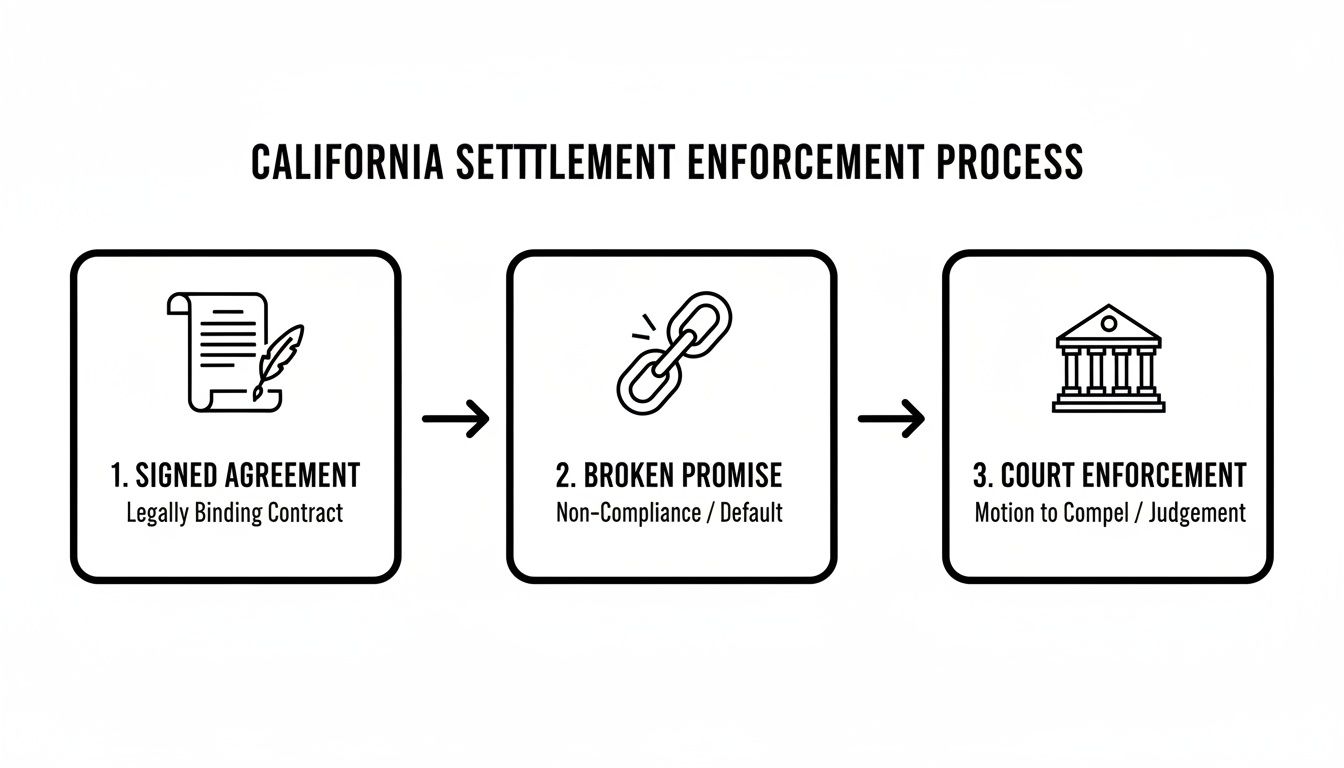
That visual makes it clear: a broken promise can land you right back in a legal battle, which is why a strong, clear agreement is your best defense.
Executing Your Negotiation Strategy
Once your foundation is set, it’s time to engage. How you handle yourself during this phase will directly shape the outcome.
A well-negotiated settlement isn’t about winning at all costs. It’s about finding a mutually acceptable solution that brings certainty and closure—something that is often far more valuable than the gamble of a trial.
Start with a reasonable first offer. It should be backed by your evidence but still leave some room to move. It’s crucial to keep your emotions in check and stick to the facts of the case. The real art of negotiation is knowing when to stand your ground and when to compromise.
This is especially true when dealing with insurance companies, which have their own set of tactics. You can learn more by reading our guide on how to negotiate an insurance settlement.
This preference for settling isn’t just a local trend. The United Nations Conference on Trade and Development (UNCTAD) reports that even in massive investor-state disputes, a large number end in settlement. Why? Because both sides want to manage risk and, if possible, preserve the relationship. This global pattern proves that knowing how to negotiate effectively is an absolutely essential skill.
Why You Should Always Consult a Lawyer
While a settlement agreement is supposed to keep you out of court, it’s a powerful legal document with consequences that last a lifetime. Trying to handle this process on your own is like performing your own surgery—you might know the outcome you want, but you definitely don’t have the training to sidestep critical, and often permanent, mistakes.
Let’s be clear: getting professional legal help isn’t just a suggestion. It’s a must.
An experienced lawyer is your expert guide and your best line of defense. They are trained to spot red flags that a layperson would easily overlook, often because these dangerous clauses are buried in dense legal jargon that sounds perfectly harmless.
Identifying Critical Red Flags
A good attorney knows exactly where the traps are hidden in a settlement agreement. Some of the most common issues that scream for an expert legal review include:
- Vague or Confusing Language: Ambiguous terms are a huge problem. They create loopholes that the other side can, and often will, exploit down the road.
- Overly Broad Release of Claims: A poorly written release clause might have you unknowingly signing away your rights to future claims—claims you don’t even know exist yet.
- Unfair Power Dynamics: If you’re up against a big corporation or an insurance company, you can bet their legal team drafted the agreement to benefit them, not you.
- Clauses Restricting Future Rights: Be wary of any term that limits your future employment options or your right to speak about the matter. These need careful legal scrutiny to make sure they’re both fair and legally enforceable.
Your Attorney’s Role in Protecting You
Viewing a lawyer as just another expense is a massive mistake. Think of it as an investment in a future that’s fair, stable, and truly puts the issue to rest. Your attorney is there to review, draft, or negotiate the settlement entirely on your behalf. They make sure the terms are not only in your favor but are also legally solid under California law.
A lawyer’s real job is to translate what you want into legally airtight language. They close the loopholes, clarify everyone’s obligations, and shield you from long-term risks you can’t see coming.
Ultimately, hiring a lawyer ensures the resolution you fought so hard for is the one you actually get. To get a better sense of the risks, especially in accident cases, check out our detailed post on why you should never settle an injury claim without legal counsel.
Disclaimer: This article is for informational purposes and not to be construed as legal advice. No attorney client relationship exists based on the review of this this article and none of the information in this article is legal advice.
Answering Your Top Questions About Settlement Agreements
Even after you’ve got the basics down, a few practical questions always seem to pop up about settlement agreements. It’s completely normal. Let’s tackle some of the most common ones to clear up any lingering confusion and make sure you feel confident about the process.
Disclaimer: This article is for informational purposes and not to be construed as legal advice. No attorney client relationship exists based on the review of this this article and none of the information in this article is legal advice.
Are Settlement Agreements Public Record?
Generally, no. In fact, one of the biggest reasons people choose to settle is to keep things private. Most agreements include a confidentiality clause, which is a formal, legally binding promise that stops either side from talking about the deal’s terms—or sometimes even that a deal happened at all.
While the court document that officially dismisses the lawsuit might be public, the settlement agreement itself is usually just a private contract between the parties. There are some exceptions, though. If a court has to approve the settlement, which is common in class-action cases or those involving minors, parts of it could hit the public record. The same can happen if a new lawsuit is filed because someone didn’t hold up their end of the bargain.
What Happens If I Break a Settlement Agreement?
Think of a settlement agreement as a legally binding contract—because that’s exactly what it is. Breaking it is a breach of contract, and it’s a serious mistake. The fallout really depends on the specific terms you signed. The other party can take you back to court to force you to comply and could sue you for any damages they suffered because of the breach.
Many agreements are written with a “liquidated damages” clause for this very reason. It spells out a pre-agreed amount of money that must be paid if someone breaks a key term, like confidentiality. Here in California, if the agreement was set up under CCP § 664.6, the original court can step in and quickly turn the settlement into an official judgment, making the enforcement process much faster and more powerful.
A settlement agreement isn’t just a handshake deal; it’s an enforceable contract. Breaching it can reopen old legal wounds and bring on major financial penalties, completely defeating the purpose of settling in the first place.
Is the Money I Receive from a Settlement Taxable?
This is a huge question, and the answer isn’t a simple yes or no. It all comes down to why you received the money. Based on IRS rules, funds you get for personal physical injuries or physical sickness are typically not considered taxable income.
However, money for almost any other kind of damage is usually taxable. This often includes payments for:
- Emotional distress (if it didn’t stem from a physical injury)
- Lost wages or business profits
- Punitive damages (which are designed to punish the other party)
- Any interest that’s added to your settlement amount
The exact wording in the settlement document is incredibly important for tax reasons. It is absolutely crucial that you talk to both a legal expert and a tax professional to figure out the tax implications before you put your signature on anything.
Working through the details of a settlement agreement takes a sharp eye and a solid grasp of the law. If you’re in the middle of a legal dispute or need help with a personal injury claim, the team at LA Law Group, APLC has the expertise to guide you. Protect your rights and work towards a fair resolution by scheduling a consultation today.
Attorney Advertising. This article is general information, not legal advice, and does not create an attorney-client relationship. Prior results do not guarantee a similar outcome.