
What Is Breach of Contract Explained
At its core, a breach of contract is just a broken promise. It’s what happens when one person in a legally binding agreement doesn’t hold up their end of the bargain, and they don’t have a legally valid excuse for it.
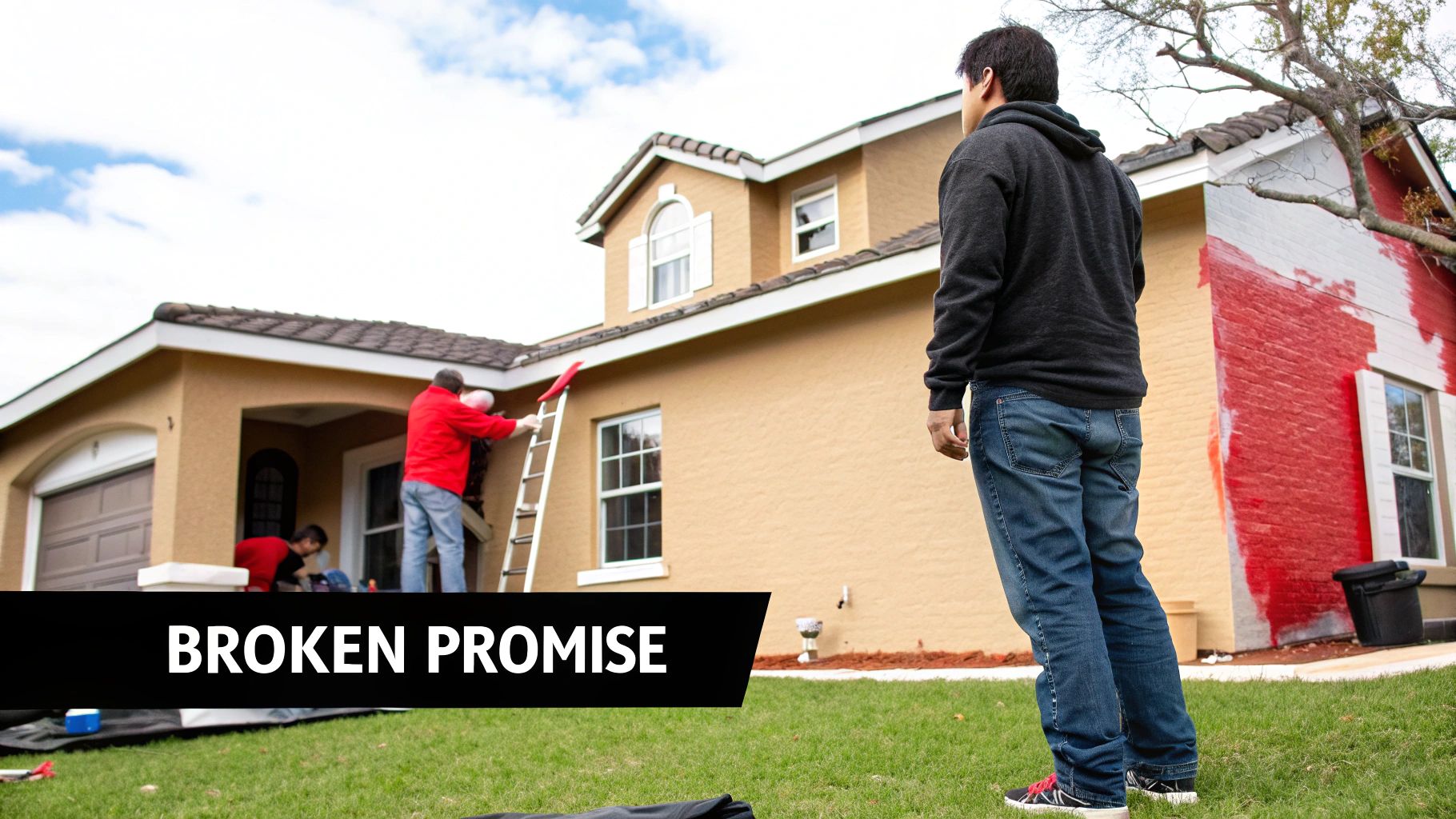
Think of it this way: You hire someone to paint your house blue for an agreed-upon price. If they show up and paint it red instead, you’ve got a classic, straightforward breach of contract.
Disclaimer: This article is for informational purposes only and is not to be construed as legal advice. No attorney-client relationship exists based on the review of this article, and none of the information in this article is legal advice.
First, What Actually Makes a Contract a Contract?
Before we can even talk about breaking a contract, we need to be clear on what makes an agreement legally real in the first place. You can’t breach something that never legally existed.
A solid contract isn’t just a piece of paper; it’s a structure built on three crucial components. If even one is missing, the whole thing falls apart, and you’re left with an unenforceable agreement.
These elements work together to create the “mutual obligations that are enforceable by law” that form the foundation of countless business and personal deals.
The 3 Core Components of a Valid Contract
For any agreement to hold up in court, it absolutely must have these three parts. Each one plays a critical role in making sure everyone is on the same page and the deal is fair.
- The Offer: This is the starting point—one party makes a clear proposal to another. It has to lay out the specifics, like what’s being provided and for how much. For instance, a web designer offers to build a five-page website for $3,000.
- The Acceptance: The other party has to agree to the exact terms of that offer, without ambiguity. A simple “yes” or signing on the dotted line usually does it. So, when the client agrees to the $3,000 price for that specific five-page site, we have acceptance.
- The Consideration: This is the “what’s in it for me?” part of the equation. Each side has to give something of value and get something of value in return. In our web design example, the designer gets $3,000, and the client gets a new website. This mutual exchange is what makes it a two-way street.
Here’s a quick table to break it down.
The Core Components of a Valid Contract
| Component | What It Means | Simple Example |
|---|---|---|
| Offer | A clear proposal from one party to another outlining the terms of the deal. | A roofer offers to replace your roof for $10,000. |
| Acceptance | The clear, unconditional agreement to the terms of the original offer. | You sign the roofer’s proposal, agreeing to the $10,000 price. |
| Consideration | The exchange of something valuable between both parties (e.g., money for services). | You get a new roof, and the roofer gets paid $10,000. |
It’s only when all three of these—the offer, the acceptance, and the consideration—are present that you have a legally binding contract. A solid understanding of proper contract formation in business law is the best way to prevent messy disputes from happening in the first place.
Important Disclaimer: The information provided in this article is for informational purposes only and is not to be construed as legal advice. Reviewing this article does not create an attorney-client relationship. None of the information presented here constitutes legal advice for your specific situation.
The Four Elements Needed to Prove a Breach

When you’re dealing with a broken agreement, simply feeling wronged isn’t enough to win in court. The legal system needs a solid, logical framework to decide if a promise was actually broken in a way that warrants a legal remedy. Think of it like building a structure with four essential pillars—if even one is weak, the whole claim can come tumbling down.
To make a successful breach of contract claim, you have to prove four distinct elements. A court will look for each one to see if your case holds up. Knowing what they are ahead of time helps you see how strong your position is and why keeping clear records is always your best move.
Let’s walk through these four elements using a real-world scenario: a business owner hires a web developer to build and launch an e-commerce site by a set date, but the developer misses the deadline.
The Existence of a Valid Contract
First things first, you have to show that a legally binding contract was actually in place. This is the foundation of your entire claim. As we’ve covered, this means proving there was an offer, an acceptance, and consideration—the exchange of something of value. Without a valid contract, there’s nothing to breach.
In our example, the business owner would pull out the signed agreement. That document should detail the scope of work, the $5,000 payment, and the launch date. This written proof is the best way to show a formal, enforceable promise existed between both parties.
Your Performance of Your Obligations
Next, you must demonstrate that you held up your end of the bargain. Legally, this is known as “performance.” You can’t accuse someone else of breaching the deal if you haven’t fulfilled your own responsibilities. The court needs to see that you acted in good faith and did what you promised to do.
For the business owner, this means showing proof they made the required upfront payment. They’d also need to show they provided the developer with all the necessary website content and product details on time, just as the contract required. By proving they did everything right, they put the spotlight squarely on the developer’s failure.
Proving performance is about demonstrating you met your contractual duties. If one party has not fulfilled their own obligations up to the point of the other party’s breach, it can severely weaken or even nullify their claim.
The Other Party’s Failure to Perform
This element is the heart of the matter—the actual breach. You need to pinpoint exactly how the other party failed to meet their obligations under the contract. This can’t just be a general feeling of dissatisfaction; it has to be a specific, provable failure to follow the terms.
Here, it’s simple: the business owner points to the missed deadline. The contract clearly stated a launch date of June 1st, and the developer did not deliver the finished website by that day. This is a clear, factual failure to perform a key part of the agreement.
Measurable Harm or Damages
Finally, you have to prove the other party’s failure caused you measurable harm, which is almost always financial. The breach must have led to real, tangible losses. If the broken promise didn’t actually cost you anything, there’s usually nothing for a court to award.
The business owner can calculate their damages. They might show lost sales from the delayed launch, money wasted on a marketing campaign for a website that wasn’t ready, or the extra cost of hiring a new developer to clean up the mess. These are quantifiable financial losses that happened because of the developer’s breach. Proving these damages can get complicated, which is why understanding the importance of obtaining verifications to responses in discovery is so crucial when gathering the evidence to support your claim.
Understanding the Different Types of Breaches
Not all broken promises are the same. A contract breach can range from a tiny, almost insignificant slip-up to a complete failure that torpedoes the entire agreement. Knowing the difference is critical, because the severity of the breach directly dictates what legal options are on the table.
Think of it like ordering a custom-built car. If the manufacturer installs a slightly different brand of tires than you specified, it’s an issue, but you still have a working car. But what if they deliver a vehicle with no engine? That’s a whole different story—the entire point of the deal has been defeated. The law sees these distinctions, too, sorting breaches into different categories based on their impact.
Material Breach: The Deal-Breaker
A material breach is the most serious kind of contract failure. This isn’t just a minor mistake; it’s a violation so significant that it strikes at the very heart of the agreement, completely wiping out the value of the contract for the other party. This is the car-with-no-engine scenario—it renders the whole deal pointless.
When a material breach happens, the wronged party isn’t just entitled to sue for damages. They’re also excused from their own obligations. If you hired a company to build a website and they never delivered a single line of code, you don’t have to pay them. Their failure was so fundamental that it effectively killed the contract.
Minor Breach: A Bump in the Road
A minor breach, sometimes called a partial or immaterial breach, is a much less severe violation. This happens when one party fails to perform a small, non-essential part of the contract. The core of the agreement gets done, but there’s a minor flaw.
This is like getting the car with the wrong brand of tires. It’s technically a breach, but you still received a fully functional vehicle. In this situation, you can’t just cancel the contract or refuse to pay. Your legal remedy is to sue for any damages the minor breach caused you—for example, the cost difference between the tires you wanted and the ones you got.
Let’s break down the key differences between these breach types.
Comparing Types of Contract Breaches
The following table provides a clear, at-a-glance comparison of the different breach types, their definitions, and the typical consequences for the party at fault.
| Breach Type | Definition | Typical Consequence |
|---|---|---|
| Material Breach | A serious failure that destroys the core value of the contract. | The non-breaching party can sue for damages and is excused from their own contractual duties. |
| Minor Breach | A less serious failure on a non-essential part of the contract. | The non-breaching party can sue for damages but must still fulfill their own obligations. |
| Anticipatory Repudiation | A clear statement or action that a party will not fulfill the contract before the due date. | The non-breaching party can immediately treat the contract as broken and sue for damages. |
Understanding these distinctions is crucial, as the type of breach determines the strategic next steps and the remedies available.
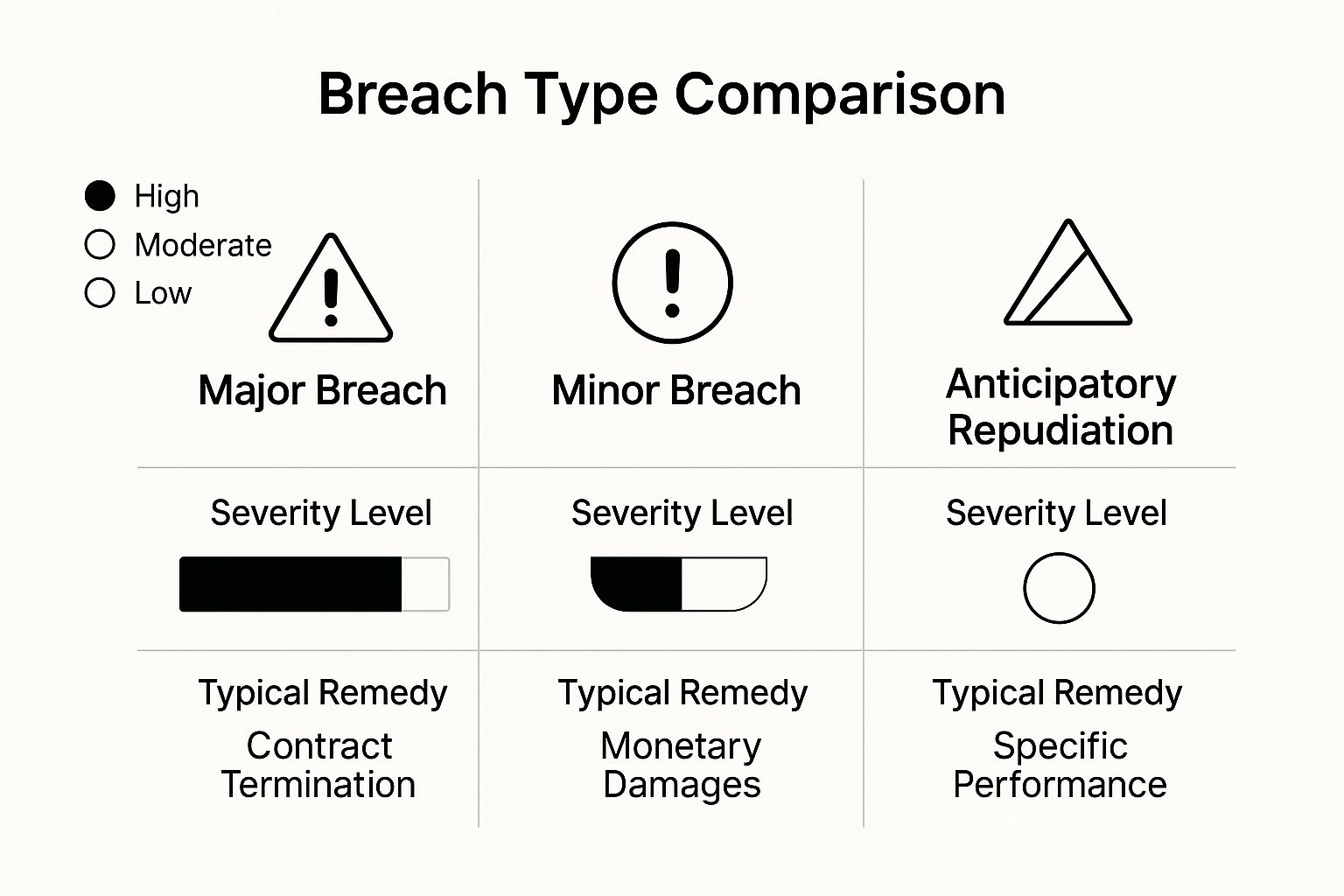
This visual guide neatly lays out how the severity of a breach—whether it’s major, minor, or even just anticipated—directly influences the kind of legal remedies a court will likely grant.
Anticipatory Repudiation: A Warning of Future Failure
So, what happens when a party tells you ahead of time that they won’t be able to hold up their end of the deal? This is called anticipatory repudiation, or an anticipatory breach. It’s basically an advance warning that a breach is on its way.
Imagine a supplier informs you two weeks before a scheduled delivery that their factory shut down and they won’t be able to provide the materials you ordered. Even though the deadline hasn’t passed, their statement is a clear and unconditional sign that they intend to breach the contract.
When anticipatory repudiation occurs, you don’t have to sit around and wait for the inevitable failure. You can immediately treat the contract as broken and seek legal remedies, like finding a new supplier and suing the original one for any extra costs.
Historically, contract law has evolved to handle these nuances. Payment issues are a frequent source of disputes, so knowing about the different types of payment terms is incredibly helpful for both drafting solid contracts and spotting when a financial obligation has been violated.
This isn’t just academic. The distinction between breach types has massive real-world consequences. In the early 2020s, contract disputes made up roughly 25% to 30% of all civil cases filed in U.S. state courts each year. This heavy judicial focus proves just how vital contract compliance is to our economy, and the remedies awarded often hinge entirely on correctly classifying the breach.
Exploring Legal Remedies for Contract Breaches

When someone breaks a contract, the legal system isn’t usually focused on punishing them. Instead, the primary goal is to put the wronged party back in the position they would have been in if the deal had been honored. This is often called making them “whole” again.
To do this, courts have a toolkit of legal remedies they can use to fix the damage. The right tool for the job depends entirely on the specifics of the situation—the nature of the contract, what went wrong, and what would actually be fair for the person who was harmed.
Monetary Damages: The Go-To Solution
Most of the time, the fix involves money. An award of monetary damages is by far the most common remedy for a breach of contract. A court will order the person who broke the contract to pay the other party to cover their losses.
The point isn’t to hit the breaching party with a penalty. It’s about calculating the real financial harm caused by the broken promise and compensating for it. There’s even a legal theory called “efficient breach,” which acknowledges that sometimes it’s more economically sensible for a party to break a contract and pay damages than to follow through on a bad deal.
There are a couple of key types of damages a court might award:
- Compensatory Damages: This is money to cover the direct, out-of-pocket losses. Let’s say you hired a painter for $5,000, but they bailed. If you had to hire someone new who charged $7,000 for the same job, your compensatory damages would be that $2,000 difference.
- Consequential Damages: These are the indirect losses that were a predictable result of the breach. For example, if a supplier’s failure to deliver parts on time forced your factory to shut down for a day, the lost profits from that shutdown could be considered consequential damages.
Disclaimer: This article provides general information and is not to be construed as legal advice. No attorney-client relationship is formed by reading this content, and none of the information herein constitutes legal advice for your specific case.
Equitable Remedies: When Money Just Won’t Cut It
But what happens when cash can’t truly fix the problem? This often comes up when the subject of the contract is one-of-a-kind. In these cases, a court might turn to equitable remedies—non-monetary solutions designed to make things fair.
Courts don’t hand these out lightly. They’re reserved for situations where money simply isn’t an adequate substitute. Sometimes, in very complex disputes where a company’s structure is being used to dodge responsibility, a court might even have to take more drastic steps. You can see how far this can go by reading about piercing the corporate veil in a breach of contract in California.
Specific Performance
Specific performance is a court order demanding that the breaching party do exactly what they promised to do. It’s a powerful remedy used only when the contract involves something truly unique.
- Example 1 (Unique Item): You sign a contract to buy a famous painting. The seller backs out. No amount of money can replace that specific piece of art, so a court could order specific performance, forcing the seller to hand over the painting.
- Example 2 (Standard Item): Now imagine you have a contract to buy 1,000 standard screws. If the seller breaches, a court won’t order specific performance. You can just buy the same screws elsewhere, so monetary damages to cover any extra cost are sufficient.
Rescission and Restitution
Another potent equitable remedy is rescission, which effectively cancels the contract as if it never happened. Both parties are let off the hook, and the goal is to rewind the clock to before the deal was made.
Rescission almost always comes with restitution, which means everyone has to give back whatever they got from the other party. Think of a home sale where the buyer discovers the seller committed fraud. A court could grant rescission—the deal is off. The buyer gets their down payment back (restitution), and the seller gets their house back. The whole transaction is unwound.
What to Do When You Suspect a Breach of Contract
Realizing someone might have broken a promise they made in a contract is stressful, to say the least. The key is to act methodically, not emotionally. How you handle these first few moments can dramatically shape where things go from here, so it pays to be calm and deliberate.
Your first move? Go straight back to the contract itself. Read every line, paying close attention to the specific duties, deadlines, and requirements you believe were missed. This isn’t just about confirming you’re right; it’s about understanding the exact terms that were violated.
At the same time, start a paper trail. Document everything—every email, every phone call, every missed deadline, and every example of shoddy work. This evidence is the foundation of your entire claim, so be thorough.
Opening a Dialogue and Making it Official
With the contract in one hand and your evidence in the other, it’s time to reach out to the other party. You’d be surprised how often a breach is just a simple misunderstanding that a quick, professional conversation can clear up.
If talking it out doesn’t work, you need to escalate things formally. The standard next step is sending a formal demand letter. This isn’t just a regular email; it’s an official notice that should clearly outline:
- Exactly how the contract was breached.
- What you need them to do to fix it (e.g., finish the job, issue a payment).
- A firm deadline for them to respond or take action.
A demand letter puts your complaint on the official record and shows you tried to resolve the problem before taking more drastic steps.
Today’s business world adds a few modern wrinkles to what a breach looks like. Think about tech failures—a third-party vendor’s mistake can cause a ripple effect of broken promises. In fact, 35.5% of all data breaches reported globally in 2024 were traced back to third parties, which shows just how tangled our contractual obligations have become.
A perfect, if unfortunate, example is the May 2025 Coinbase incident. Insider contractors leaked sensitive data for 69,461 users, a textbook breach of their contractual security duties that ended up costing an estimated $400 million. You can discover more insights about recent data breaches to see how events like these are changing what we expect from contracts.
Exploring Your Options and Getting Help
Before you start thinking about court, consider alternatives. Methods like mediation can be a lifesaver. A neutral mediator helps both sides talk through the problem and find a solution you can both live with. It’s almost always faster and cheaper than a lawsuit.
Important Disclaimer: The information in this article is for informational purposes only and is not to be construed as legal advice. No attorney-client relationship exists based on the review of this article, and none of the information in this article is legal advice.
But if none of these steps get you anywhere, it’s time to call in a professional. An experienced attorney can give you a realistic assessment of your case, walk you through your options, and help you navigate the often-confusing world of a formal legal dispute.
Common Questions About Breach of Contract
When you’re caught in a contract dispute, it’s natural for questions to start piling up. Getting clear on the basics can help you figure out your rights and what to do next.
Can a Verbal Agreement Be Breached?
Yes, absolutely. A handshake deal or a verbal agreement can be just as legally binding as a written one, which means it can also be breached.
The real challenge, however, is proving what you both agreed to. Without a written document, these disputes can quickly devolve into a “he said, she said” scenario, making it tough to enforce the terms. Keep in mind that a legal rule called the Statute of Frauds requires certain contracts—like those involving real estate—to be in writing to be valid.
How Long Do I Have to Sue for a Breach?
There’s a strict deadline for filing a lawsuit, known as the statute of limitations. This legal time clock starts ticking the moment the contract is breached.
How much time you have varies dramatically from one state to another. It can also depend on whether the contract was written or oral. Because these deadlines are firm, it’s crucial to act quickly if you think someone has broken their promise to you.
A breach of contract claim addresses a broken promise within an agreed-upon relationship. In contrast, a tort claim deals with a wrongful act that causes harm, often where no contractual relationship exists, like in a personal injury case.
Can the Other Party Pay My Attorney Fees?
Probably not. In the United States, courts almost always follow the “American Rule,” which means everyone pays for their own lawyer, no matter who wins the case.
The one big exception is if your contract includes a specific clause that forces the losing party to cover the winner’s legal costs. If that language isn’t in your agreement, you’ll be on the hook for your own attorney’s fees. When the stakes are high, consulting with a contract law professional can provide the expert guidance you need.
At LA Law Group, APLC, our experienced attorneys combine legal expertise with real-world business acumen to protect your interests. If you’re facing a contract dispute or need guidance on forming solid agreements, we provide direct, personalized advocacy to help you achieve the best possible outcome. Contact us today for a clear assessment of your case by visiting https://www.bizlawpro.com.
Attorney Advertising. This article is general information, not legal advice, and does not create an attorney-client relationship. Prior results do not guarantee a similar outcome.