
Why Would a Personal Injury Lawyer Call Me
You’ve just left the hospital, your phone keeps ringing, and a lawyer’s office wants to discuss an accident you barely have the energy to describe. You may be wondering, “Why would a personal injury lawyer call me?” The short answer is usually one of three things: the firm is screening a potential case, trying to preserve evidence before it disappears, or contacting you after receiving information about the incident.
This article is for informational purposes only and is not to be construed as legal advice. No attorney-client relationship exists based on the review of this article, and none of the information in this article is legal advice. Don’t treat an unexpected call as proof that you must hire the caller, but don’t dismiss every call as a scam either. Your safest move is to slow the conversation down, verify who contacted you, and avoid sharing sensitive information until you understand the relationship.
The Unexpected Call and Your Legal Rights
The caller may know your name, the date of the accident, or the location where it happened. That knowledge can feel invasive, especially if you haven’t contacted a lawyer. You may also hear a polished explanation about helping with medical bills, insurance, or compensation before you’ve had a chance to ask how the firm learned about you.
Your suspicion is reasonable. A reputable firm should let you control the pace. Some calls are legitimate intake conversations, some are advertisements, and some may come from people trying to exploit accident victims. It should identify the lawyer and law firm, explain why it’s calling, answer verification questions, and give you time to decide whether you want a formal consultation.
The call doesn’t automatically mean you have a case
A personal injury firm often begins with case screening, not representation. The intake team may be checking basic facts, including the accident date, location, type of injury, insurance status, and whether you’ve already spoken with an insurer. That preliminary conversation helps the firm decide whether an attorney should review the matter and whether urgent steps may be needed.
Industry guidance describes a first call as a short, informal intake rather than a commitment to hire the firm. You’re allowed to say that you aren’t ready to discuss details. You can ask the caller to send written information and then independently locate the firm’s official phone number before calling back.
Your immediate objective is not to decide whether the caller is right about your claim. It’s to establish who is calling and protect your options.
A legitimate lawyer may be proactive because accident claims involve deadlines, medical documentation, witnesses, and insurance communications. The fact that an attorney reached out quickly doesn’t prove the firm is trustworthy, and it doesn’t make the call unlawful by itself. Evaluate the caller’s conduct, not just the timing.
Strategic Reasons Attorneys Reach Out Early
A lawyer’s urgency often has a practical explanation. Evidence starts becoming harder to obtain after an accident, and the people who document the event first may shape how insurers and opposing parties understand what happened.
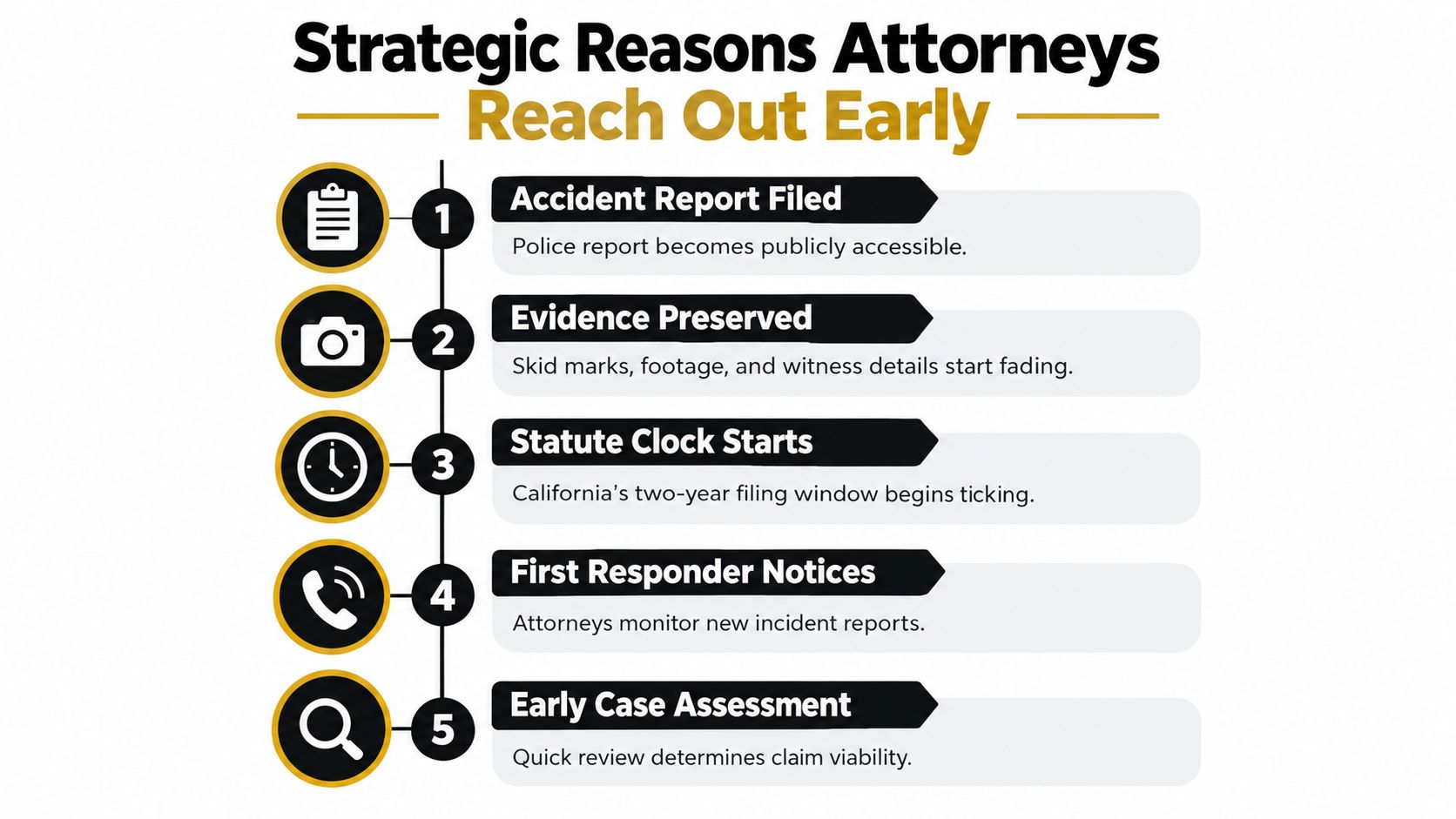
Evidence can disappear before you realize it
Body-worn camera retention policies vary by agency and location, so request footage early.
That difference matters. A lawyer who learns about a crash early may send preservation letters to a city, business, rideshare company, trucking operator, or property owner. Those letters can identify records that should be retained, such as camera footage, dispatch records, vehicle data, driver logs, or incident reports. They don’t guarantee that evidence will be preserved, but delay can eliminate the opportunity to request it.
For a broader explanation of how lawyers handle sensitive preliminary communications, review this lawyer client confidentiality guide before discussing private medical or financial details.
Insurers may reach you before you understand the claim
An adjuster may sound friendly and ask for a recorded statement, a description of your injuries, or permission to obtain medical records. That conversation can affect how the insurer evaluates fault and damages.
Attorneys often send representation notices early to stop direct adjuster contact and begin developing the claim. Official collision reports can take time to become available, so early work may involve collecting your own documents, identifying witnesses, preserving photographs, and tracking treatment while formal records are still pending.
The scale of accidents explains the attention
Road crashes create a large pool of potential injury claims. The World Health Organization reports that about 1.16 million people die in road crashes each year, while another 20 million to 50 million suffer non-fatal injuries globally. Road traffic injuries are the leading cause of death for children and young adults ages 5 to 29.
The same WHO reporting states that road crashes cost most countries about 3% of GDP. In 2021, road traffic deaths remained around 1.2 million worldwide, or 15 deaths per 100,000 population. Those figures don’t establish the value of your claim, but they explain why firms monitor accident reports and attempt early contact.
A prompt call can therefore reflect a real preservation strategy. It can also reflect a firm’s marketing process. Your job is to separate the two.
Verifying Legitimacy and California Solicitation Rules
Treat an unexpected call like an unverified business inquiry. Don’t use the caller’s phone number, website link, or email signature as your only proof. A scammer can imitate a law firm’s name, copy its branding, or route calls through a number that appears local.
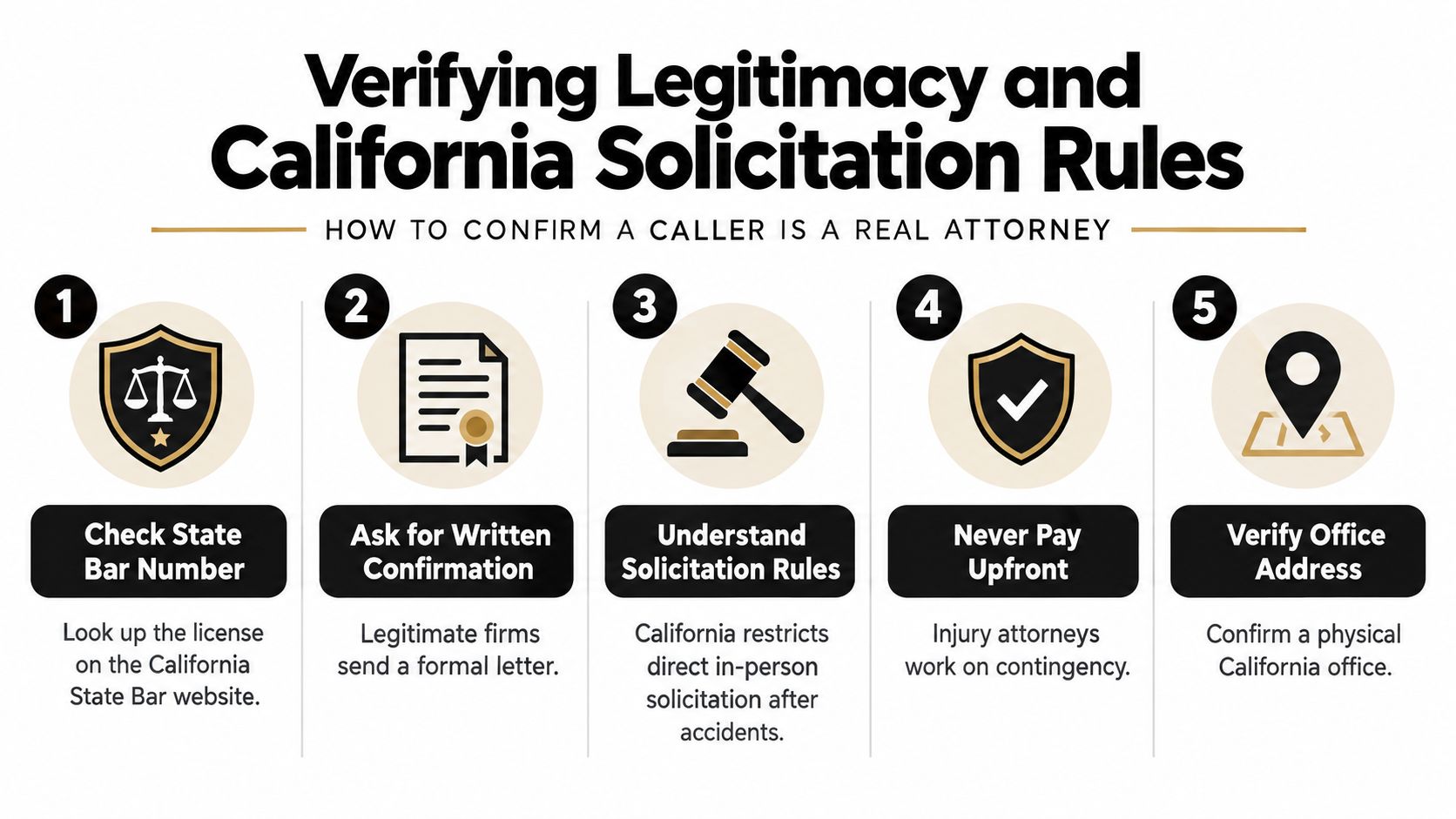
Use an independent verification process
-
Write down the caller’s identity. Record the person’s full name, law firm, office location, website, phone number, and the reason given for contacting you. Ask whether you’re speaking with a licensed attorney, an intake employee, or a marketing company.
-
Request the attorney’s State Bar number. Search the lawyer independently through the State Bar of California attorney search. Check the lawyer’s name, license status, and public disciplinary information. If the caller refuses to provide a license number, end the call.
-
Call the firm through an independent source. Type the firm’s web address into your browser yourself or use an official directory. Don’t click a link sent during an unsolicited conversation. Ask the firm’s receptionist whether the caller works there and whether the firm initiated contact.
-
Ask for written information. A legitimate firm should be able to send its office address, attorney names, practice areas, consultation terms, and engagement paperwork. Read those materials without signing immediately.
-
Confirm the communication rules. California restricts certain direct solicitation practices, particularly in-person contact after an accident. A caller who pressures you at a hospital, approaches you at an accident scene, or uses a third party to steer you toward a specific lawyer deserves heightened scrutiny.
Keep the first conversation limited
You can safely provide broad facts needed for identification, such as the general type of accident and whether you were injured. Don’t send your Social Security number, online banking details, passwords, complete medical history, or copies of identity documents during an unsolicited call.
That distinction doesn’t remove your right to verify the caller. If the firm won’t tolerate basic questions, it isn’t the right firm to handle your injury.
Red Flags and Common Legal Scams to Avoid
The difference between legitimate intake and predatory contact usually appears in the caller’s behavior. A real case-screening call may be efficient, but it shouldn’t feel like a threat, a forced purchase, or an attempt to extract private information before you know who is asking.
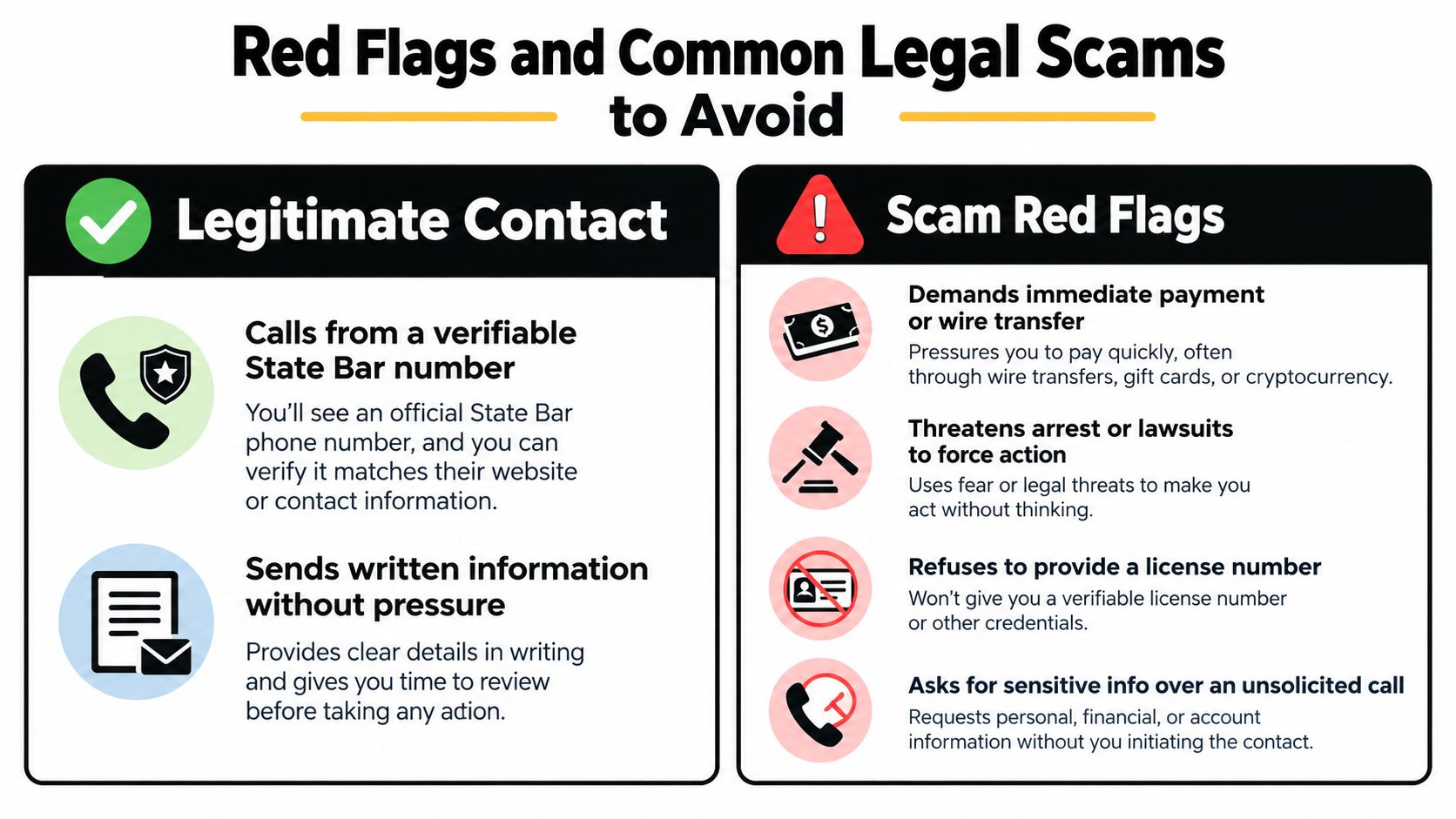
Compare the caller’s conduct
| Legitimate intake | Warning sign |
|---|---|
| The caller identifies the firm and explains the reason for contact. | The caller won’t name the actual law firm or attorney. |
| The firm accepts that you need time to verify information. | The caller demands an immediate signature. |
| The firm sends written information and engagement terms. | The caller asks for a wire transfer, gift card, or upfront payment. |
| The intake team asks focused questions about the accident and injuries. | The caller demands extensive sensitive information during an unsolicited call. |
| The firm provides a verifiable office and license number. | The caller refuses to provide credentials or uses shifting explanations. |
A personal injury practice commonly handles matters through a contingency arrangement, but the exact fee, litigation expenses, and responsibility for costs must appear in the written agreement. Never pay money merely to prove that you’re entitled to speak with a lawyer.
Watch for runners and manufactured urgency
Some unethical operators use intermediaries, sometimes called runners or cappers, to steer accident victims toward selected clinics or lawyers. A person who appears at the accident scene, hospital, tow yard, or home and insists that you use a particular firm may not be acting for your benefit.
The phrase “ambulance chaser” has a specific history and can obscure the practical issue. The important question is whether someone is using accident information to pressure you into a legal or medical relationship. For useful background, read this explanation of what an ambulance chaser is.
If the call feels fraudulent, don’t argue. End it, preserve voicemails and text messages, and verify the firm independently. This definitive guide to phone scams can help you recognize broader warning signs beyond legal marketing.
The middle ground matters. Many calls are neither a lawyer representing you nor a lawyer for the opposing side.
Essential Questions to Ask During the Call
Don’t let the caller’s script control the conversation. Turn the call into an interview. You’re evaluating the firm just as much as the firm is evaluating your potential claim.
Start with identity and purpose:
- Who exactly is calling? Ask for the person’s full name, job title, attorney’s name, firm name, office address, and California State Bar number.
- How did you learn about my accident? The answer may reveal whether the firm received a public incident report, a referral, an online inquiry, or information from a third-party marketer.
- Are you offering general information, a consultation, or representation? Those are different relationships. Don’t assume that discussing your accident means the firm represents you.
- Is this conversation confidential? Ask whether the firm treats the preliminary consultation as confidential and whether a conflicts check is required before substantive advice.
Initial calls often gather the facts needed to determine whether a claim can proceed. Attorney-client privilege and confidentiality generally depend on the purpose of the communication and the professional relationship, although a preliminary consultation may qualify when you’re seeking legal advice in good faith. Don’t treat privilege as permission to disclose everything to an unidentified caller.
Ask about competence and conflicts
A focused caller should be able to explain whether the firm handles your type of case. It is worth asking:
- Have you handled accidents involving rideshares, commercial vehicles, premises incidents, or similar injuries?
- Who would handle my claim? It may be the person on the phone, another attorney, or an outside referral.
- Does the firm have a conflict of interest? Give only enough information for an initial conflicts check until the firm confirms confidentiality.
- What should I avoid doing right now? A useful answer may address insurer statements, social media, medical treatment, photographs, and preserving documents.
Then comes the money conversation. It is worth asking how the contingency fee is calculated, whether expenses are deducted before or after the fee, who pays case costs if the claim fails, and whether you’ll receive a written agreement. A broader checklist is available in these questions to ask an injury lawyer.
Don’t sign because the caller sounds confident. Sign only after you understand who represents you, what the firm charges, and how you can end the relationship.
Taking the Next Steps with LA Law Group
You don’t need to hire the first firm that calls. In many cases, the stronger choice is to contact a verified firm yourself, explain the situation at your pace, and compare the proposed relationship before signing anything.
A client-focused personal injury practice should give you a clear point of contact, explain what happens next, and communicate without forcing you to decode legal jargon. You should know whether the firm handles automobile accidents, motorcycle accidents, truck crashes, rideshare injuries, premises liability, product liability, catastrophic injuries, or wrongful death matters before you proceed.

Look for direct communication and clear terms
LA Law Group, APLC states that it offers personal injury representation, free initial consultations, and direct attorney access rather than relying entirely on intermediaries. Its stated practice areas include automobile accidents, motorcycle accidents, premises liability, product liability, truck accidents, catastrophic injuries, and wrongful death.
Ask whether the initial conversation is confidential, whether it’s free, and who will handle your claim. If the firm works on a contingency basis, request the written agreement and read every provision concerning fees, litigation expenses, medical liens, settlement authority, and termination.
Timely communication is a legitimate reason for a lawyer to reach out quickly.
Don’t confuse speed with pressure
Personal injury matters can involve strict filing deadlines and lengthy settlement processes. Those ranges aren’t a promise about your case. They show why an attorney may need to discuss medical treatment, records, evidence, and strategy early.
The right firm won’t demand that you surrender control just because it contacted you first. Verify the attorney, ask direct questions, obtain written terms, and choose representation based on transparency and capability rather than urgency.
LA Law Group, APLC offers free initial consultations and direct attorney access for California injury claims, including automobile accidents, rideshare incidents, premises injuries, and other personal injury matters. Visit LA Law Group, APLC to request a confidential conversation and discuss what happened before an unsolicited caller makes the decision for you.
Attorney Advertising. This article is general information, not legal advice, and does not create an attorney-client relationship. Prior results do not guarantee a similar outcome.