
Wrongful Death Attorney Fees Explained for Families
Most wrongful death attorneys work on contingency, typically 33% to 40% of the settlement or verdict, often starting at one-third, and they’re paid only if money is recovered. Case costs, such as filing fees and expert expenses, are usually separate from that percentage.
You may be reading this after a sudden loss, with funeral bills, unanswered questions, and an insurance company asking your family to make decisions before you feel ready. The fee question can feel especially heavy: How can you hire a lawyer when you’re already facing financial pressure?
A contingency agreement can remove the need for an upfront attorney retainer, but it doesn’t mean every expense disappears. The written agreement should explain the fee percentage, whether it changes as the case advances, who pays litigation costs, and what happens if there’s no recovery. It should also show how liens and other obligations affect the amount survivors ultimately receive.
This guide explains wrongful death attorney fees in plain language, including the difference between a headline percentage and the net recovery left for the estate and surviving family members. It also compares regulated fee schedules in Connecticut and New York, using those rules as illustrations rather than assuming they apply everywhere.
If your family is still investigating what happened, you may also need practical information about the cost of a private wrongful death autopsy. For general background on the legal claim itself, review this overview of a wrongful death case.
This article is for informational purposes only and isn’t legal advice. No attorney-client relationship exists based on your review of this article, and none of the information in this article is legal advice. A lawyer licensed in the relevant jurisdiction can evaluate your family’s facts, deadlines, beneficiaries, and fee agreement.
Introduction to Wrongful Death Attorney Fees and What Families Should Know
A family might speak with a lawyer after a fatal collision, medical error, workplace incident, defective product, or another event involving alleged negligence. The surviving spouse, children, parents, or estate representatives may have a potential claim, but the family may hesitate because legal bills seem impossible to manage during grief.
That concern is exactly why contingency arrangements are common in wrongful death litigation. Under this structure, the lawyer generally receives a percentage of money recovered through a settlement or verdict. If the case produces no recovery, the attorney normally doesn’t receive a contingency fee, although the agreement must be read carefully to determine how case expenses are handled.
A useful way to think about the arrangement is to separate the final recovery into several layers:
- Gross recovery, the total settlement or verdict.
- Attorney fee, calculated under the written contingency agreement or an applicable legal schedule.
- Case costs, such as experts, filing fees, transcripts, and investigation expenses.
- Liens and obligations, which may need to be resolved before distribution.
- Net proceeds, the amount ultimately available for the estate and survivors.
The percentage alone doesn’t answer what your family will take home. A lower rate may still produce a smaller net amount if a case requires substantial experts, depositions, or investigation, while a higher rate may reflect the additional work and risk involved in trial preparation.
Families should ask for a written explanation before signing. Ask whether the fee is calculated from the gross recovery or from an amount reduced by costs, whether the percentage changes after filing suit, and whether expenses are owed if the case doesn’t recover. These details can matter as much as the stated rate.
How Contingency Fees Work in Wrongful Death Cases
A family may have a strong wrongful death claim but no practical way to pay hourly legal bills while grieving. A contingency fee addresses that gap through a shared-success arrangement. The attorney provides legal work, investigation, negotiation, and litigation resources, then receives an agreed percentage only if the case produces a recovery.
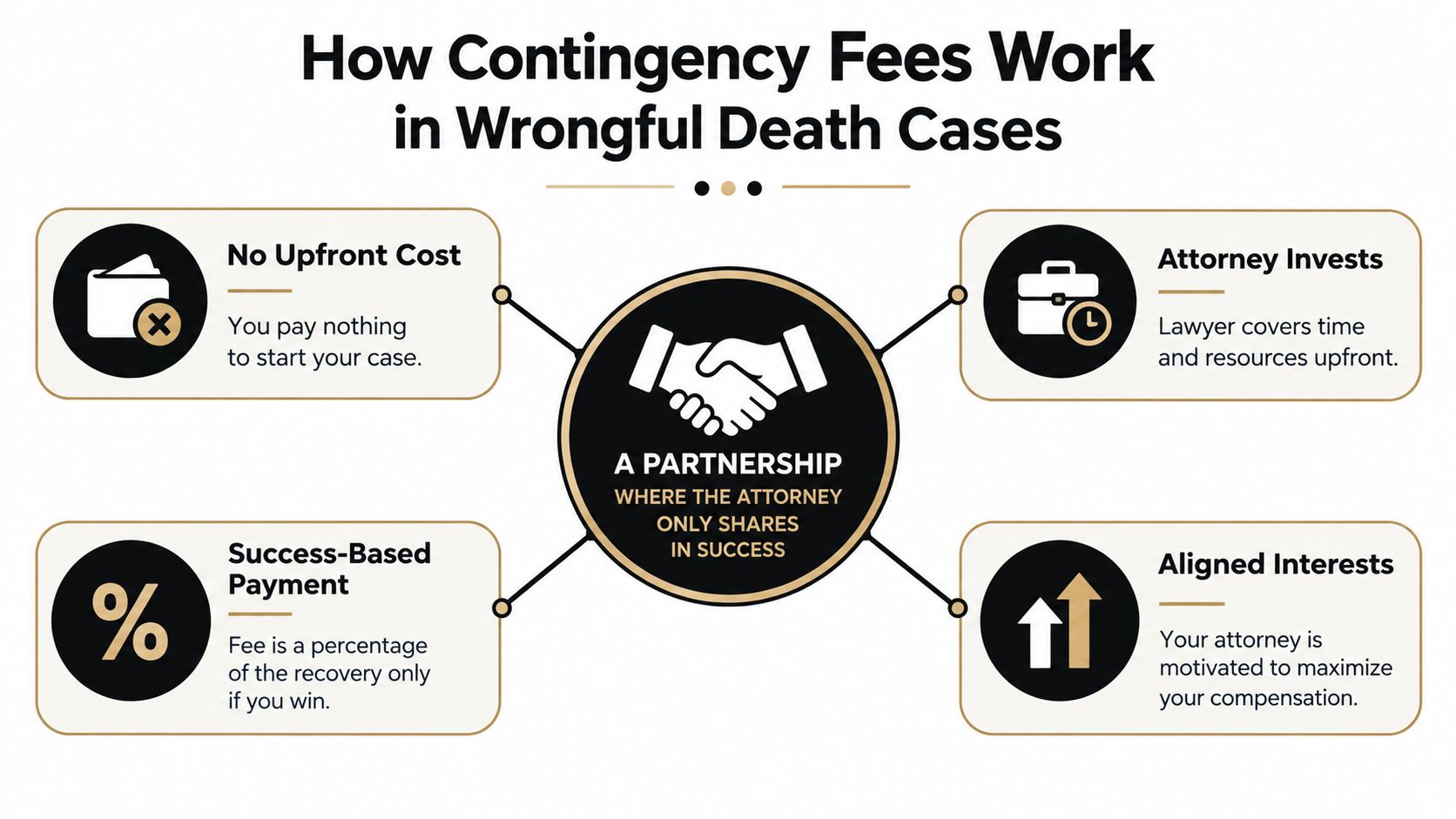
Consider a claim that resolves for $50,000. With a 40% contingency fee, the attorney’s fee is $20,000. If the agreement then lists $3,000 in case costs and a $2,000 lien, the family’s estimated net recovery is:
$50,000 gross recovery − $20,000 attorney fee − $3,000 costs − $2,000 lien = $25,000 net recovery
That calculation shows why the headline percentage is only one part of the answer. Costs, liens, and the agreement’s distribution language can change what the family ultimately receives.
Core rule: A contingency fee is paid from a recovery, but case expenses and liens may create separate deductions.
Hourly billing charges for time worked, whether the case succeeds or fails. A flat fee covers a defined service. Wrongful death claims can develop as evidence emerges, defendants respond, and negotiations change. A percentage-based fee connects payment to the result, rather than sending the family recurring hourly invoices.
What the written agreement should answer
The contract should state the percentage, the event that triggers payment, and the method used to calculate the fee. It should also explain whether the percentage changes after filing a lawsuit, during trial preparation, on appeal, or when the matter settles through negotiation.
Look for clear language about:
- The fee base: Whether the percentage applies to the gross recovery or another defined amount.
- Case expenses: Which costs the firm advances and how reimbursement occurs.
- No-recovery responsibility: Whether the family owes expenses if the case produces no money.
- Multiple attorneys: How fees are handled if more than one lawyer works on the claim.
- Distribution timing: When the family receives a settlement statement and net proceeds.
Before signing a contingent-fee agreement, ask the lawyer to show a sample distribution using simple figures. Ask where costs and liens appear, and whether each deduction comes before or after the fee calculation. A written example can make the path from gross recovery to net proceeds easier to follow.
A short video can also help visualize the basic partnership concept:
Typical Percentage Ranges and Why They Vary
A family may hear one firm quote 33% and another quote 40%. The difference is not only a headline rate. It can reflect the case stage, expected workload, and how costs or liens will be taken from the recovery.
In wrongful death claims, contingency fees commonly fall within a broad 25% to 45% range. Many agreements cluster around 30% to 40%, with one-third, or 33.3%, often used as a starting point. These figures describe general practice, not a universal legal rule. State law, court rules, professional regulations, and the written agreement may limit or change the fee.
The family’s result is easier to understand by tracing each deduction. Suppose a claim resolves for $300,000. At a 33.3% fee, about $100,000 goes to the attorney before other permitted deductions. At 40%, the fee is $120,000. If the case also has $20,000 in reimbursable costs and a $50,000 lien, the approximate net recovery would be $130,000 at the lower fee and $110,000 at the higher fee, assuming both deductions come from the remaining balance. The agreement should explain whether costs and liens are handled before or after the fee calculation.
Why the percentage can change
An early settlement may still require investigation, record review, damages analysis, and negotiation. It may avoid formal discovery and trial preparation, however. A case reaching trial can involve depositions, expert testimony, motions, witness preparation, and courtroom work. A higher percentage may account for that added labor and the risk that the attorney invests substantial time without a recovery.
Complexity also affects the estimate. Multiple defendants, disputed causation, medical evidence, employment records, insurance questions, and disagreements among beneficiaries can each increase the work.
Ask every firm the same questions:
- Does the rate change after filing?
- Is trial preparation charged at another percentage?
- Are appeals included?
- Are costs deducted before or after the fee?
- Who pays unpaid costs if there is no recovery?
The clearest agreement shows the path from gross recovery to the family’s net distribution.
Statutory Limits and Court Approved Fee Structures
Wrongful death attorney fees aren’t always controlled only by private negotiation. Some jurisdictions use statutes or court rules that set schedules, caps, or percentages considered reasonable. Those rules can protect a larger recovery from a single flat percentage applied to every dollar.
Connecticut provides a clear example. Its wrongful death contingency-fee statute uses a declining schedule: 33.33% on the first $300,000, 25% on the next $300,000, 20% on the next $300,000, 15% on the next $300,000, and 10% above $1.2 million, as set out in Connecticut General Statutes Section 52-251c.
New York’s historical court schedule uses a different structure. It reaches 50% on the first $1,000 recovered, 40% on the next $2,000, 35% on the next $22,000, and 25% on amounts above $25,000. The rule also recognizes an alternative flat contingency rate capped at 33 1/3% in certain cases, according to the New York appellate court rule.
Example tiered contingency fee caps in wrongful death cases
| Recovery Bracket | Connecticut Statutory Rate | New York Schedule Reference |
|---|---|---|
| First $1,000 | 33.33% of the first $300,000 | 50% |
| Next $2,000 | 33.33% of the first $300,000 | 40% |
| Next $22,000 | 33.33% of the first $300,000 | 35% |
| Amount above $25,000 | Connecticut’s declining tiers apply as recovery rises | 25% |
| Larger recoveries | 25%, 20%, 15%, then 10% as the Connecticut brackets advance | Alternative flat rate capped at 33 1/3% in qualifying matters |
The table compares examples, not a universal formula. Connecticut’s schedule and New York’s rule operate differently, and neither should be applied automatically to a claim filed elsewhere.
A bar-journal discussion also describes jurisdictions where court rules cap personal injury and wrongful death fees at one-third of the total recovery, reinforcing that lawyers may face regulatory limits rather than unrestricted pricing. The relevant ethics discussion of attorney fees is useful background, but a local lawyer must determine which rule controls a particular claim.
Ask during the consultation whether your state imposes a cap, whether the cap is tiered, and whether court approval is required. A declining schedule can substantially change the effective rate on a large recovery, which is why the contract and governing rule should be reviewed together.
Attorney Fees Versus Case Costs and Expenses
The attorney fee pays for legal services. Case costs pay for the work needed to build and present the claim. They’re related, but they’re not interchangeable deductions.
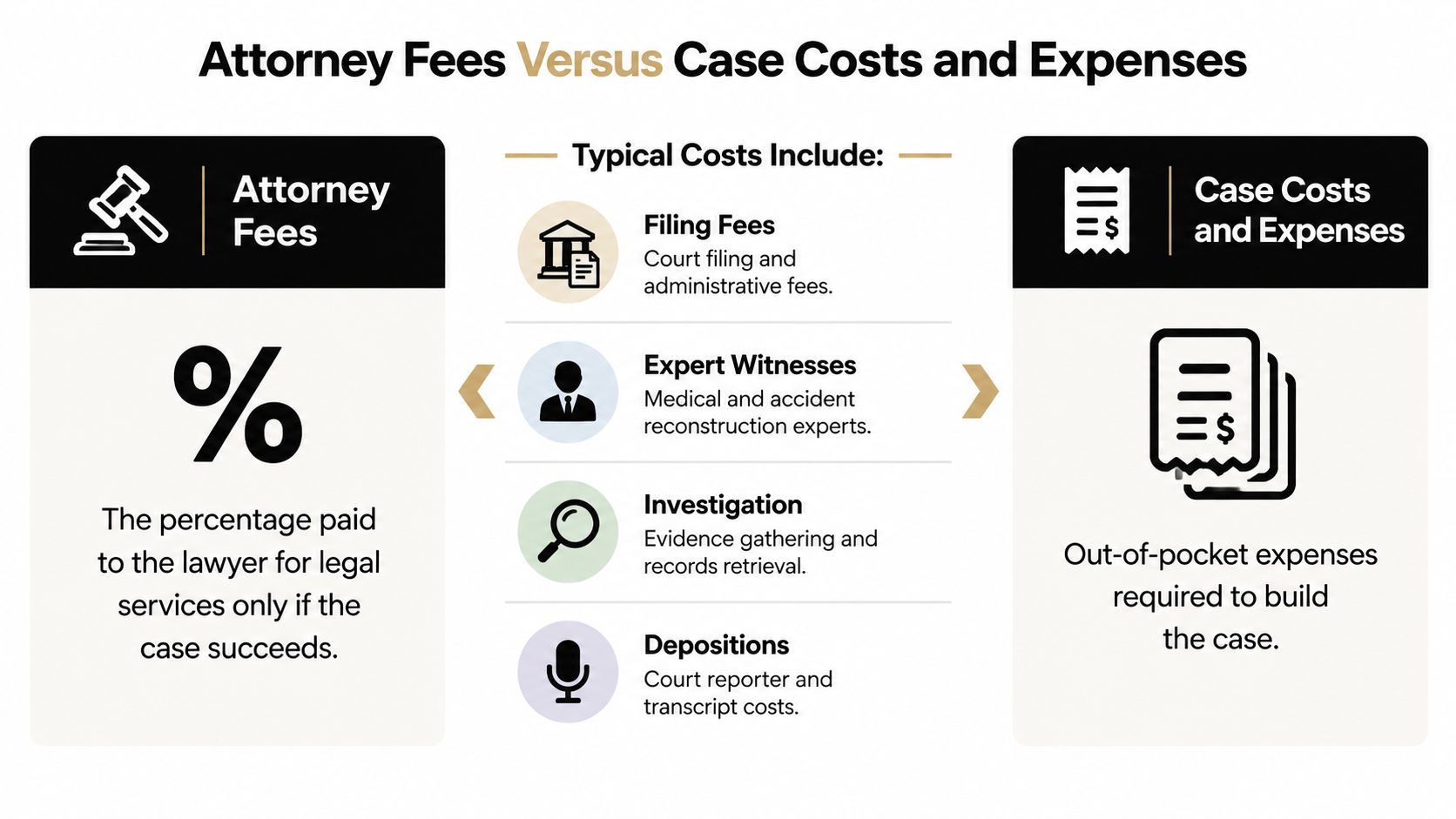
Common costs may include:
- Filing fees: Court filing and administrative charges.
- Expert witnesses: Medical, economic, engineering, or accident-reconstruction professionals.
- Depositions: Court reporters, transcript preparation, and related services.
- Investigation: Evidence gathering, records retrieval, photographs, and other fact development.
- Case administration: Copies, postage, and similar litigation expenses.
A firm may advance these costs so the family doesn’t pay bills as they arrive. If the case recovers money, the firm may then seek reimbursement from the settlement or verdict. Some agreements make the client responsible for costs even when the case doesn’t recover, while others assign that risk to the firm. The contract controls.
Industry modeling illustrates why this distinction matters. Early settlements may involve modeled case costs of roughly $5,000 to $20,000, while a case continuing through trial may involve $50,000 to $150,000 or more, according to this wrongful death lawsuit cost analysis. These are modeled ranges, not a prediction for your claim.
A side-by-side net recovery example
Consider two hypothetical agreements for a $50,000 recovery:
| Deduction | Agreement A | Agreement B |
|---|---|---|
| Gross recovery | $50,000 | $50,000 |
| Attorney fee | 33.3% of the recovery | 40% of the recovery |
| Case costs | Separate deduction under the agreement | Separate deduction under the agreement |
| Liens and obligations | Must still be resolved | Must still be resolved |
| Net proceeds | Cannot be calculated without the cost and lien amounts | Cannot be calculated without the cost and lien amounts |
Agreement A has the lower headline fee, but that doesn’t automatically make it the better financial result. If the firm advances fewer resources, the case may face limitations in expert development or investigation. A higher percentage may sometimes accompany a firm’s willingness to fund demanding litigation, although the family should never assume that price alone proves value.
Ask for a sample settlement statement. It should identify the gross recovery, attorney fee, each reimbursed cost, liens or other deductions, and the final amount payable to the estate or beneficiaries. For an explanation of how legal fees can fit into a broader recovery, review this guide on how personal injury lawyers get paid.
In matters with multiple beneficiaries or attorneys, fee allocation adds another layer. Florida wrongful death practice, for example, treats the contingency fee as a single fund shared among attorneys from the one allowable contingent fee, preventing layered or duplicated contingent fees, as discussed in this wrongful death fee explanation. That rule is jurisdiction-specific, but it shows why families should ask how one fee affects the entire distribution.
When Fees Are Deducted and What to Expect Working With LA Law Group
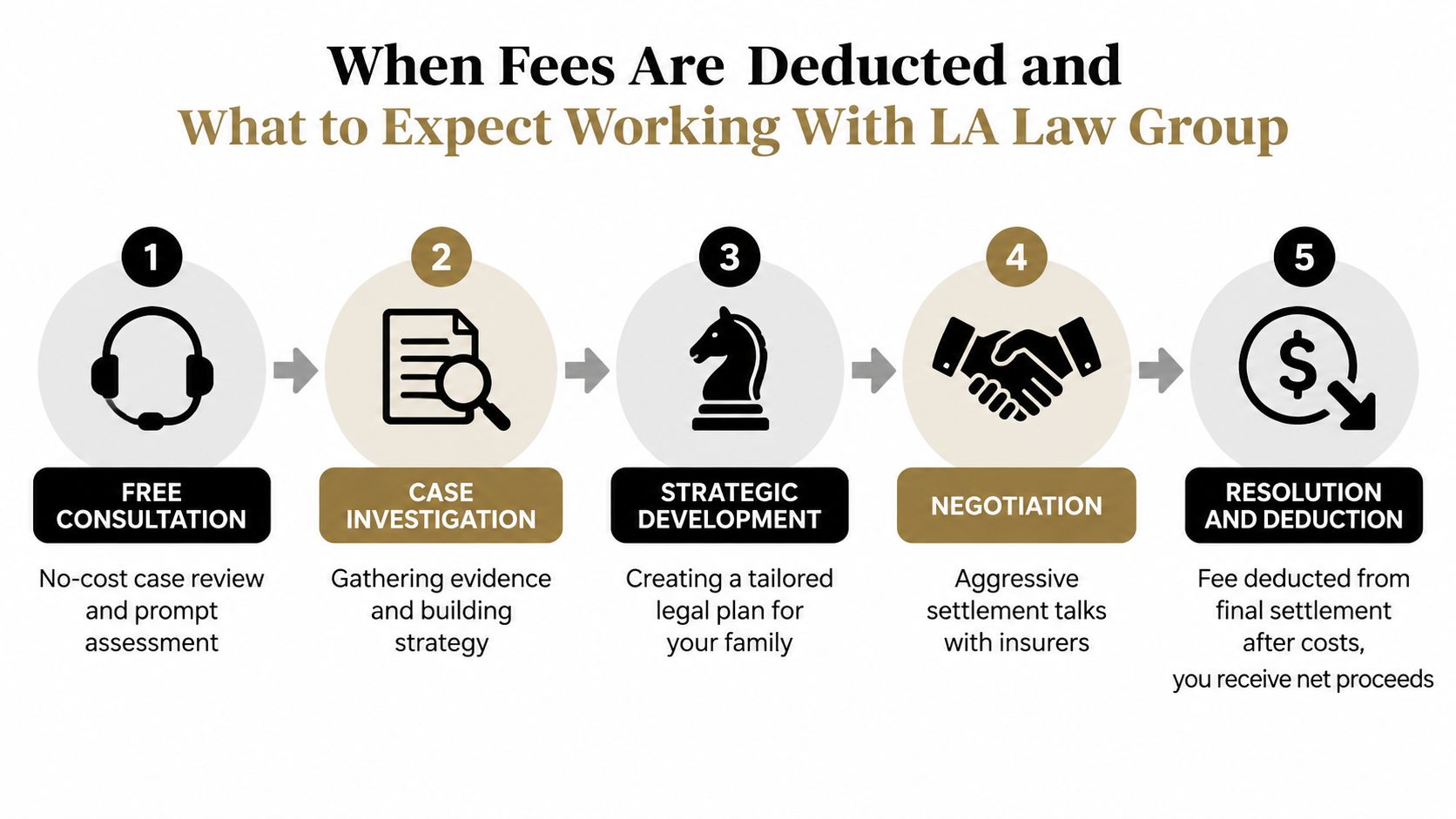
The deduction usually happens after a settlement is received or a verdict produces an actual recovery. The lawyer’s office prepares a distribution statement, reimburses permitted case costs, addresses liens and other claims, deducts the agreed attorney fee, and sends the remaining proceeds to the proper estate or beneficiaries.
The order can vary under the contract and applicable law. That’s why a family should ask to see the proposed calculation before approving a settlement, rather than relying on a verbal percentage.
What the working relationship should include
A law firm handling a wrongful death claim should begin by understanding the incident, identifying potential beneficiaries, reviewing available evidence, and checking the applicable deadlines. The firm then develops a case strategy, communicates with insurers or opposing counsel, and prepares for litigation if negotiation doesn’t produce a fair result.
For a firm such as LA Law Group, APLC, the stated process includes a complimentary consultation, prompt case assessment, strategic development, negotiation, and resolution. Its practice materials also describe contingency representation with a no-recovery, no-fee arrangement. Families should confirm the exact terms for their own matter in writing.
The consultation is the right time to ask:
- Fee percentage: What rate applies before filing, during litigation, and at trial?
- Fee base: Is the percentage calculated before or after costs?
- Cost responsibility: Who advances expenses, and who bears them if there’s no recovery?
- Lien handling: Which liens will the firm identify, negotiate, or pay from the recovery?
- Communication: Who answers questions, and how often will the family receive updates?
- Distribution: Will the firm provide a detailed written settlement statement?
Multiple attorneys may work on one matter, but families should ask whether the total contingent fee remains one agreed fund or whether the agreement permits another arrangement. The answer can affect the amount available for survivors.
Clear communication won’t remove the pain of the loss. It can remove avoidable uncertainty about what happens to the recovery and why each deduction appears on the final statement.
Key Takeaways for Families Considering a Wrongful Death Claim
The most important point is simple: the headline percentage isn’t the same as the family’s final recovery. A contingency fee commonly falls around one-third to 40%, but the applicable percentage may depend on the case stage, complexity, trial risk, state regulation, and written contract.
Keep these questions with you during consultations:
- What is the exact fee percentage? Ask whether it changes after filing suit or before trial.
- What amount does the percentage apply to? Clarify whether the calculation uses the gross recovery or another defined figure.
- Which costs are separate? Request a list covering experts, filing fees, depositions, investigation, records, and administration.
- Who pays if there’s no recovery? Don’t assume that no attorney fee means no possible cost responsibility.
- How will liens be handled? Ask which claims may reduce the distribution and who will address them.
- What will the final statement show? Request a written example that separates fees, costs, liens, and net proceeds.
- Does a statute or court rule limit the fee? State-specific schedules may reduce the effective percentage as recovery increases.
A family also needs to understand who has authority to bring the claim and how any recovery will be distributed. Those issues can depend on state law, estate administration, family relationships, and the facts surrounding the death.
This article is for informational purposes only and isn’t legal advice. No attorney-client relationship exists based on your review of this article, and none of the information in this article is legal advice. A wrongful death lawyer can explain the rules that apply to your jurisdiction and review the proposed agreement before you commit.
The calmest next step is usually practical: gather the death certificate, medical and funeral records, insurance correspondence, incident reports, and any signed documents, then take them to a confidential consultation. You don’t need to solve the fee math alone, but you should insist on seeing it clearly before making a decision.
LA Law Group, APLC offers complimentary consultations to review potential wrongful death matters and explain contingency fees, case costs, liens, and expected net recovery. Visit LA Law Group, APLC to request a consultation and bring your questions to a California legal team.
Attorney Advertising. This article is general information, not legal advice, and does not create an attorney-client relationship. Prior results do not guarantee a similar outcome.