
Accident Attorney Costa Mesa: What to Do and How to Choose
You were rear-ended on Harbor Boulevard, told the officer you felt fine, and drove home. Two mornings later your neck locks when you check a lane, an adjuster wants a recorded statement, and you’re looking for an accident attorney in Costa Mesa before you explain the crash the wrong way. The pain showed up late. The insurer’s file did not.
Those first days decide what evidence still exists and which insurance pool can pay. Naming the driver who hit you does not answer the second question, especially on an Uber or Lyft trip, where app status and whether you were already a passenger can switch the policy. Outcomes still turn on the facts of your crash. This article is for informational purposes only and is not to be construed as legal advice. No attorney-client relationship exists based on review of this article, and none of the information in it is legal advice.
Steps to Take Right After a Costa Mesa Crash
Say you felt fine at the scene of that Harbor Boulevard rear-end and only noticed neck pain two days later. Delayed soreness is common after impact, and by then skid marks, witness memories, and camera files may already be fading. An accident attorney in Costa Mesa often starts by checking whether these steps happened while the record was still fresh.
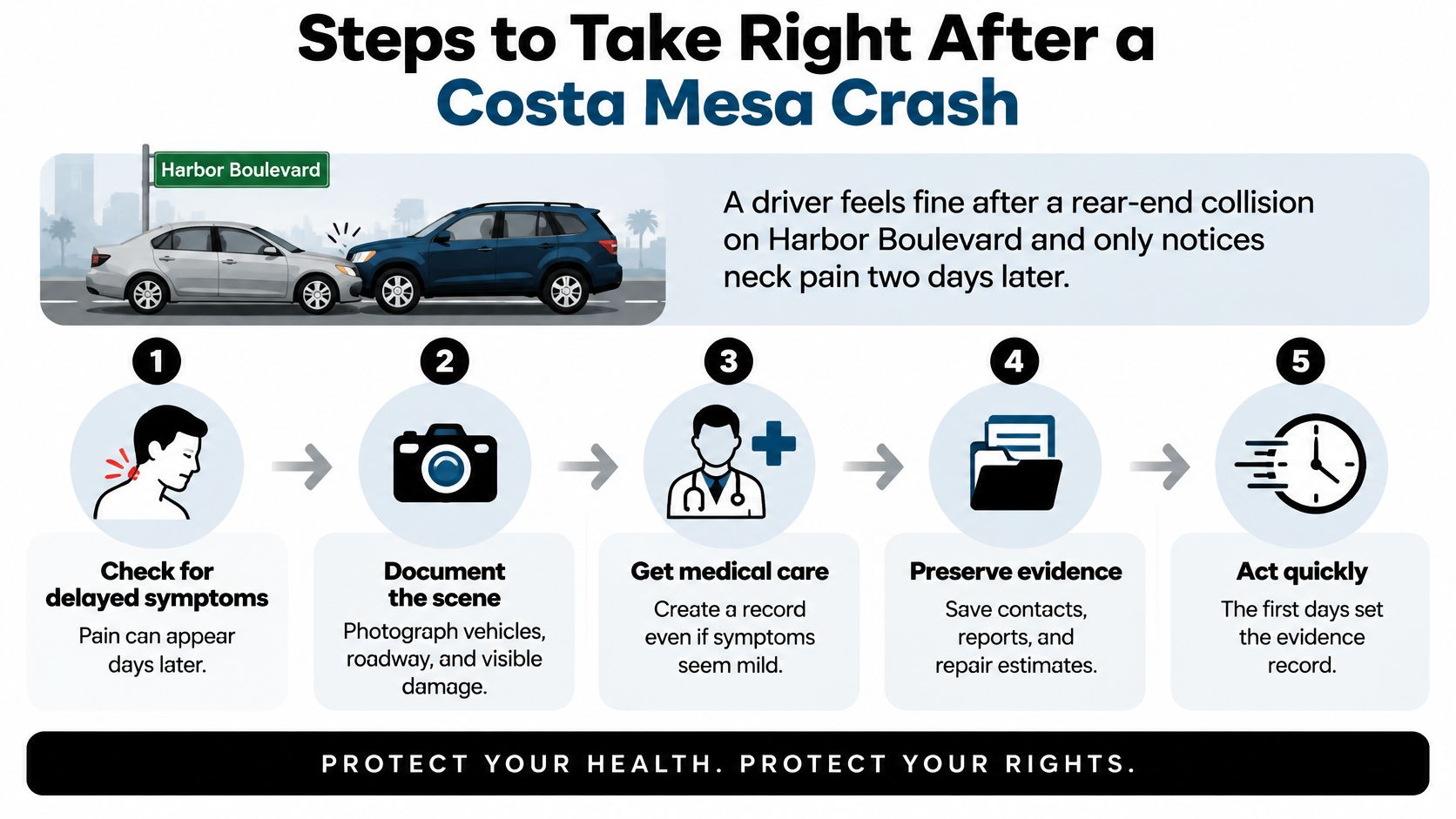
Build the record before it thins out
- Call 911 if anyone is hurt, and get checked even if you feel okay. Adrenaline hides sprains and concussions. A same-day visit creates a medical timeline that starts at the crash, not at the first bad morning.
- Move to a safe spot, then exchange details with every driver. Get names, phone numbers, insurer, policy number, and plate numbers. A missing plate is much harder to chase after the cars leave.
- Ask the responding agency for the report number. Inside Costa Mesa that agency is usually the Costa Mesa Police Department. Under California’s collision reporting rules, a driver in an injury or fatality collision must make a written report to the city police within 24 hours, and each driver must file the DMV SR-1 within 10 days when anyone is injured or killed or property damage exceeds $1,000, even if injuries look minor.
- Photograph the scene before vehicles move. Capture both cars, the road layout, signals, debris, and any visible injury. Then collect witness names and numbers while people are still standing there.
- Keep every medical bill, prescription receipt, and pay record that shows missed work. Those papers are how wage loss and treatment costs get proven later. A verbal “I lost a week” is weaker than a pay stub.
- On a rideshare trip, screenshot the app status and save the receipt with pickup and drop-off times. That screenshot is often the only clean proof of which coverage period applied.
- Give insurers basic facts only. Share your name, the location, and that you were hurt. Skip a detailed recorded statement until you know which policy is in play.
Practical rule: Treat the report number, the SR-1, and the app screenshot as a same-week checklist, not a someday task.
These steps are general information, not legal advice, and they don’t fit every crash.
Why Early Evidence Decides Costa Mesa Claims
Statewide numbers show why a local crash still needs a careful file. The California Office of Traffic Safety reports traffic fatalities fell from 4,539 in 2022 to 4,061 in 2023, and the mileage death rate fell from 1.34 to 1.26 fatalities per 100 million vehicle miles traveled. Fewer deaths doesn’t mean injury claims got simple.
Costa Mesa’s own count is the closer lens. The city recorded 685 victims killed or injured in fatal and injury collisions in 2023, ranking 10th among 62 comparable California jurisdictions, and 84 victims were in alcohol-related collisions, ranking 9th of 62, according to the Office of Traffic Safety’s Costa Mesa rankings. Those rankings help you look for repeat intersections or impaired-driving patterns. They do not prove who was at fault in your crash.
What to pull before it disappears
- Police collision report: Get the number and request the narrative, diagram, and listed witnesses.
- Scene and vehicle photos: Include signal heads, lane markings, and damage you can’t see from the driver’s seat.
- Vehicle event data, where the car stores it: Speed and braking snapshots can disappear after repairs.
- Witness statements: A name without a phone number rarely helps a week later.
- Nearby surveillance: Many shops overwrite footage within days or weeks.
- Medical records: They should connect the crash mechanism to the diagnosis, not just list pain.
- Alcohol evidence, when it fits: Toxicology, officer observations, and field-sobriety notes matter if impairment is in the file.
Say a left-turn crash happens at a Costa Mesa intersection and both drivers swear the light was theirs. A corner business camera may be the only record of the signal phase. If nobody asks for it this week, the shop may tape over it.
A police report on file is not, by itself, proof of fault.
California generally keeps required accident reports confidential, and they can’t be used as evidence merely because they were filed. Fault still has to be shown with testimony, photos, reconstruction, medical causation, and video.
Which Insurance Coverage Pays for Costa Mesa Injuries
Start with three questions before you argue about fault. Whose vehicle was involved? If it was a rideshare, what was the app status? Were you a passenger, or still waiting on the curb? Those answers pick the policy. Fault alone does not.
California splits rideshare insurance by period. The California Public Utilities Commission requires, in Period 1 (app on, no ride accepted), at least $50,000 per person, $100,000 per incident, and $30,000 for property damage, plus $200,000 in excess coverage per occurrence. Periods 2 and 3 require $1 million in primary commercial coverage. Separately, California’s TNC statute as amended by Senate Bill 371 kept that $1 million primary liability coverage, but from January 1, 2026 the uninsured and underinsured protection after a passenger enters fell to $60,000 per person and $300,000 per incident.
A personal policy is a different ceiling. Beginning in 2025, California’s minimum bodily-injury limits became $30,000 per person and $60,000 per accident, which can fall short of surgery, rehabilitation, or lost income, as explained in a 2026 review of Uber and Lyft coverage. The California minimum car insurance requirements page is a useful companion when you’re comparing that floor with a real medical bill.
| Situation | Primary coverage | Uninsured or underinsured coverage | Evidence to keep |
|---|---|---|---|
| App on, no ride accepted (Period 1) | $50,000 per person, $100,000 per incident, $30,000 property, plus $200,000 excess per occurrence | No separate TNC uninsured minimum is listed for Period 1 | App status screenshot and timestamps |
| Ride accepted, passenger not yet picked up (Period 2) | $1,000,000 primary commercial insurance | Passenger UM coverage is not triggered before the passenger enters | Ride acceptance timestamp and app record |
| Passenger in the vehicle (Period 3) | $1,000,000 primary commercial insurance | $60,000 per person and $300,000 per incident (from January 1, 2026) | Ride receipt, trip timestamps, driver insurance information |
| Driver with a personal auto policy at minimum limits | $30,000 per person and $60,000 per accident (from 2025) | Only the UM/UIM limits the injured person actually purchased | Police report and insurer declarations pages |
Say a passenger’s medical bills reach $90,000 and the other driver is uninsured. The at-fault name is clear, and the money still isn’t. You’d look at the passenger’s own UM/UIM, household policies, and the rideshare company’s coverage for that period. A policy limit is the cap on what that policy pays. It isn’t the total value of the claim.
Save the trip receipt, app screenshots, and every insurer letter. Coverage classification can change the recovery even when fault is obvious.
How Fault and Damages Shape Settlement Value
A common assumption is that once you prove the other driver was at fault, a large payment follows. It often doesn’t. Available coverage, your own share of fault, and the documents behind the bills all cut the number before anyone writes a check.
Noneconomic damages follow each share of fault
California Civil Code section 1431.2 makes each defendant’s liability for noneconomic damages several, not joint. Each defendant pays only its allocated share. If a jury assigns 30% of the fault to one defendant, that defendant’s responsibility for the relevant noneconomic damages is generally limited to that 30%, not the whole amount.
Use round, illustrative numbers. If noneconomic damages are $100,000 and one defendant is 30% at fault, that defendant’s share of those damages is generally $30,000, not $100,000. All of those dollar figures are hypothetical.
Economic losses are a separate column
Medical bills and lost wages are economic damages. Pain and suffering sits in the noneconomic column. You evaluate them separately, then check whether any policy can fund either one. Fault can also split among several drivers, vehicle owners, employers, public entities, or property owners. A three-car crash is a typical place where each share needs its own analysis.
Civil Code section 3291 lets a plaintiff claim prejudgment interest in certain personal-injury actions. It is a specific statutory mechanism, not an automatic add-on. Don’t assume a rate or a start date without the facts and the procedural posture.
An early offer can arrive before anyone knows the cost of a future surgery. Accepting it can close off further recovery from that insurer. Settlement value tracks documented damages, available coverage, and how strong the liability proof is.
What a Costa Mesa Accident Attorney Handles at Each Stage
Think of the lawyer as a general contractor on a building job. Insurers, doctors, witnesses, and experts are the subcontractors. Someone has to keep the schedule so you can focus on getting treated. The claim itself is a sequence, not a single phone call.
| Stage | What the attorney handles | What you provide |
|---|---|---|
| Initial case review | Assesses injuries, fault, and coverage questions | Report number, insurance cards, medical records |
| Investigation | Requests the police file, footage, vehicle data, and witness statements | Photos, witness contacts, trip receipts |
| Insurer notice | Notifies insurers and manages adjuster communication | Copies of all insurer letters and call dates |
| Damages valuation | Organizes medical bills, wage loss, and future care estimates | Itemized bills, pay stubs, treatment notes |
| Negotiation | Prepares the demand package and negotiates offers | Your priorities and the final settlement decision |
| Litigation if needed | Files suit and handles discovery, depositions, and trial preparation | Testimony, documents, and availability for depositions |
Many claims settle during negotiation. Some resolve quickly when liability is clear and the injuries are limited. Representation tends to matter most when fault is disputed, several insurers deny coverage, the injury is serious or long-term, or future care is still unknown.
Three questions for the first meeting
Ask who talks to the insurers, so you aren’t fielding adjuster calls alone. Ask how often you’ll get updates, and in what form, so silence doesn’t feel like progress. Ask how the fee is structured, including what costs you pay if the case doesn’t succeed. Get those answers before you hand over the file.
How to Choose an Accident Attorney in Costa Mesa
Picking counsel is a comparison, not a leap. Use the same questions with every firm, and write the answers down.
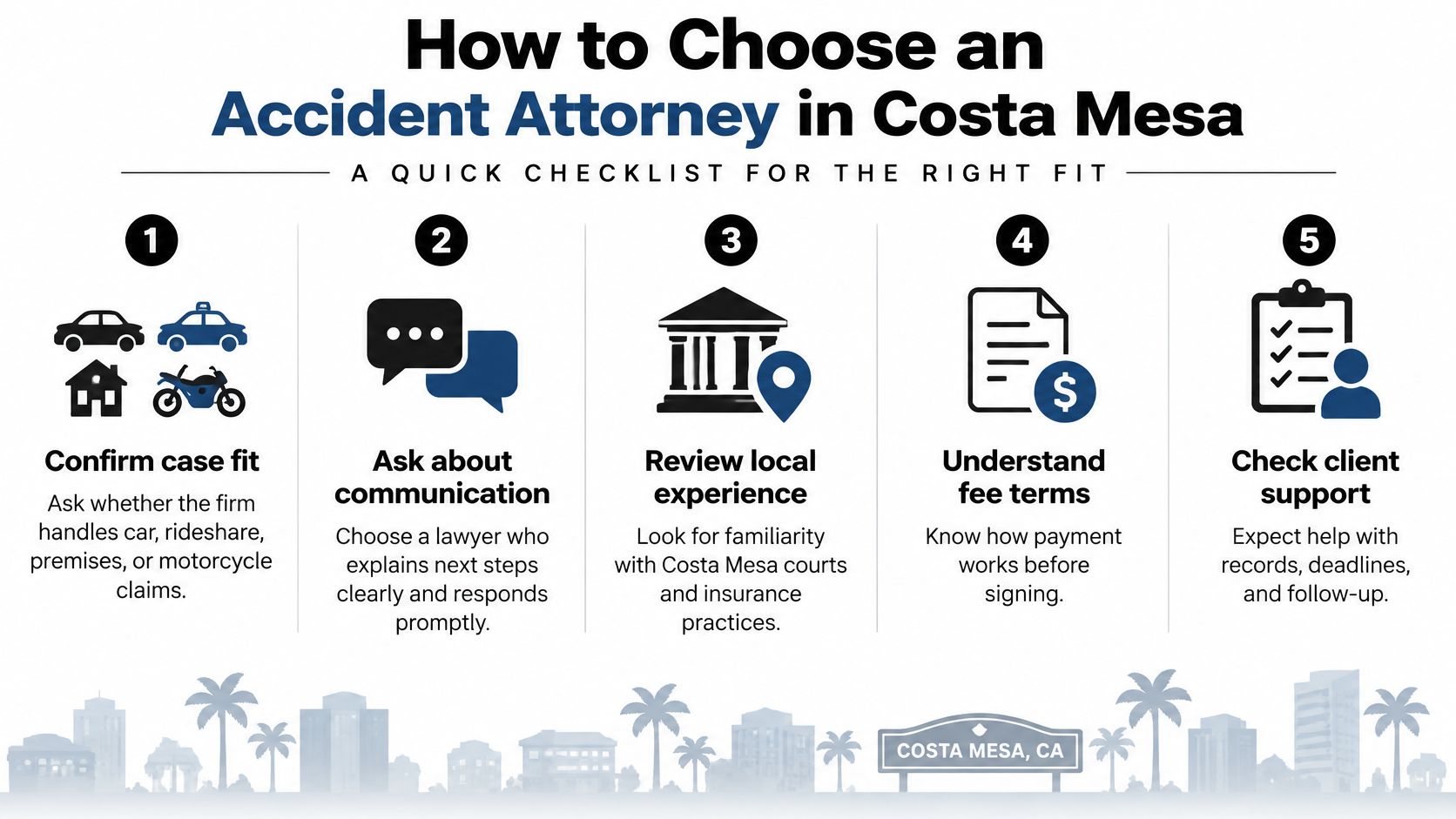
- Confirm the claim type. Ask whether the firm handles car, rideshare, premises, or motorcycle cases. A mismatch shows up later as a referral you could have made yourself.
- Ask about Orange County work. You want experience with local courts, with the insurers on your policy, and with your injury type, not a generic car-crash script.
- Read the fee in writing, and ask if the consult is free. A percentage you haven’t seen on paper isn’t an agreement yet.
- Find out who answers the phone. Ask how often updates come, and whether the lawyer works the file or hands it off.
- Ask where the case is handled, and whether Spanish-language service is available. Location and language both affect whether you can follow the case.
- Request a written engagement letter that states scope and fees. If they won’t put it in writing, keep looking.
Pressure to sign today, a promised settlement dollar amount, and fuzzy answers about who holds the file are reasons to pause.
Compare firms on the same six questions, then keep the one that answers them in writing.
LA Law Group, APLC is one firm a Costa Mesa resident can put on that list. Ask where a Costa Mesa case would be handled and what Orange County experience the team brings, then set those answers next to the other firms you’re calling.
Book a Consultation Before Deadlines Pass
If the 24-hour written report or the 10-day DMV SR-1 is still open, do those first. Then match your crash to the right row in the coverage table using app status and whether you were a passenger. Waiting doesn’t just slow a claim. Camera files get overwritten, witnesses forget, and an early check may ignore surgery you haven’t been told you need.
Bring the police report number, medical records, insurance declarations pages, trip receipts, app screenshots, witness contacts, and a short written timeline of symptoms and missed work. Ask the firm to walk through your specific coverage question, not a generic car-crash overview. A personal injury office that can handle inbound calls more effectively is easier to reach while you’re still in pain and the reporting window is open. Filing deadlines are a separate clock from those report deadlines, and the California auto accident statute of limitations is worth reading before you assume you have plenty of time. You can schedule that review with a personal injury firm such as LA Law Group, APLC.
This article is provided for informational purposes only and is not to be construed as legal advice. No attorney-client relationship exists based on review of this article, and none of the information in it constitutes legal advice. Statutes, limits, and deadlines change, so verify current law for your situation.
LA Law Group, APLC offers personal injury representation for people hurt in California crashes, including rideshare passengers who need to sort out which policy can pay, plus a free initial consultation. If a Costa Mesa collision left you with medical bills, missed work, or an insurer asking for a recorded statement, visit LA Law Group, APLC and bring your report number, records, and trip screenshots to that first conversation.
Attorney Advertising. This article is general information, not legal advice, and does not create an attorney-client relationship. Prior results do not guarantee a similar outcome.