
Amazon Delivery Accident Lawyer: Who May Be Liable
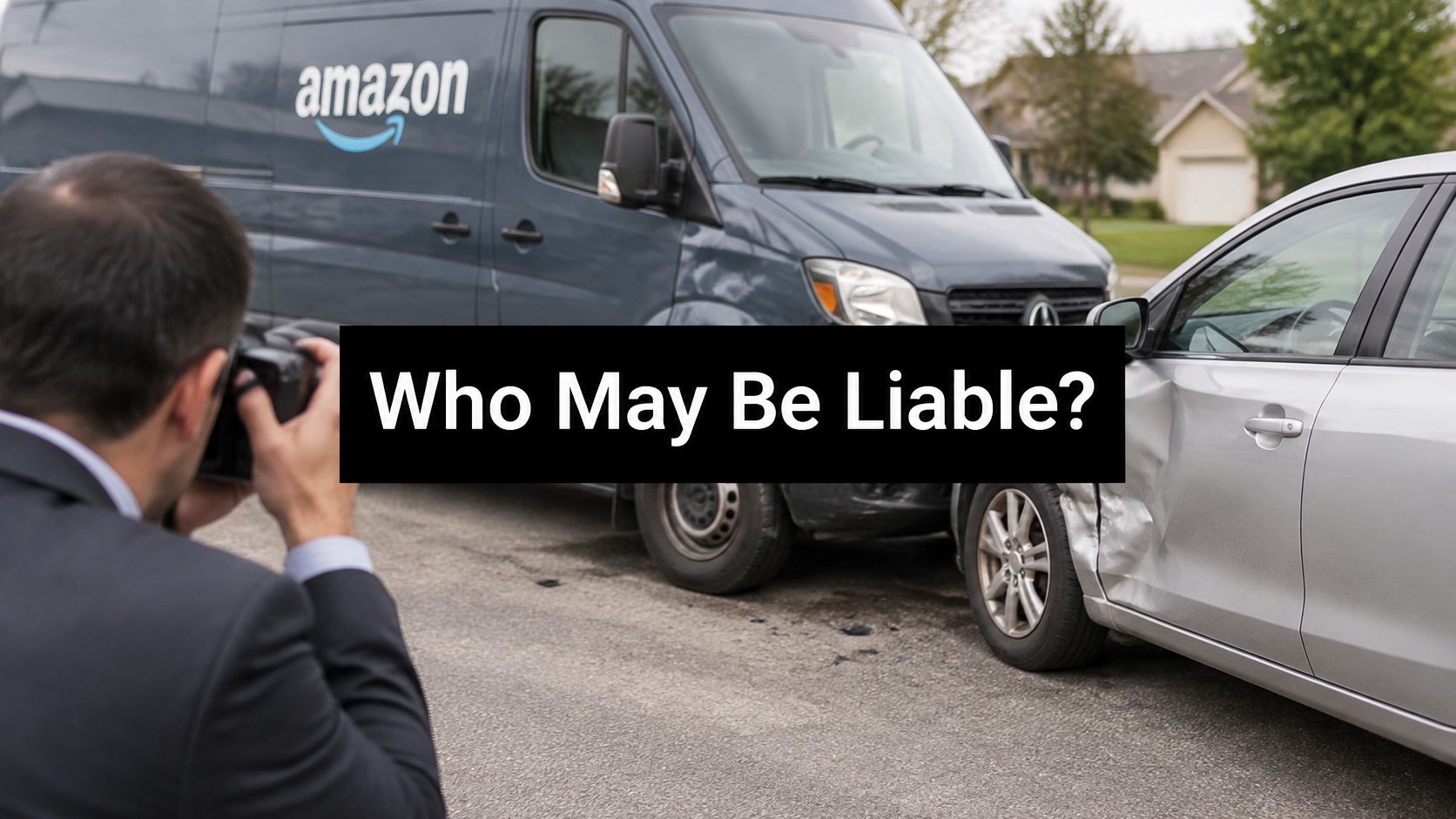
You’re standing beside a damaged car, trying to remember the seconds before impact. The van that hit you has an Amazon logo, so you assume Amazon will handle the claim. Then you learn the driver worked for a separate delivery company, and different insurers start pointing to different policies.
That confusion is common in delivery crashes. The logo identifies a brand, not necessarily the driver’s employer or the insurer responsible for the collision. Understanding the driver’s delivery model, preserving records, and identifying every potentially responsible party can help you avoid a claim built around the wrong assumptions.
Understanding Your Rights After an Amazon Delivery Accident
After a delivery crash, the first questions are usually practical: Who pays for treatment? Who covers damage to the car? Do you speak with the driver’s insurer, a delivery company, or Amazon? The answers depend on how the driver was working, what caused the collision, and which insurance policy applies.
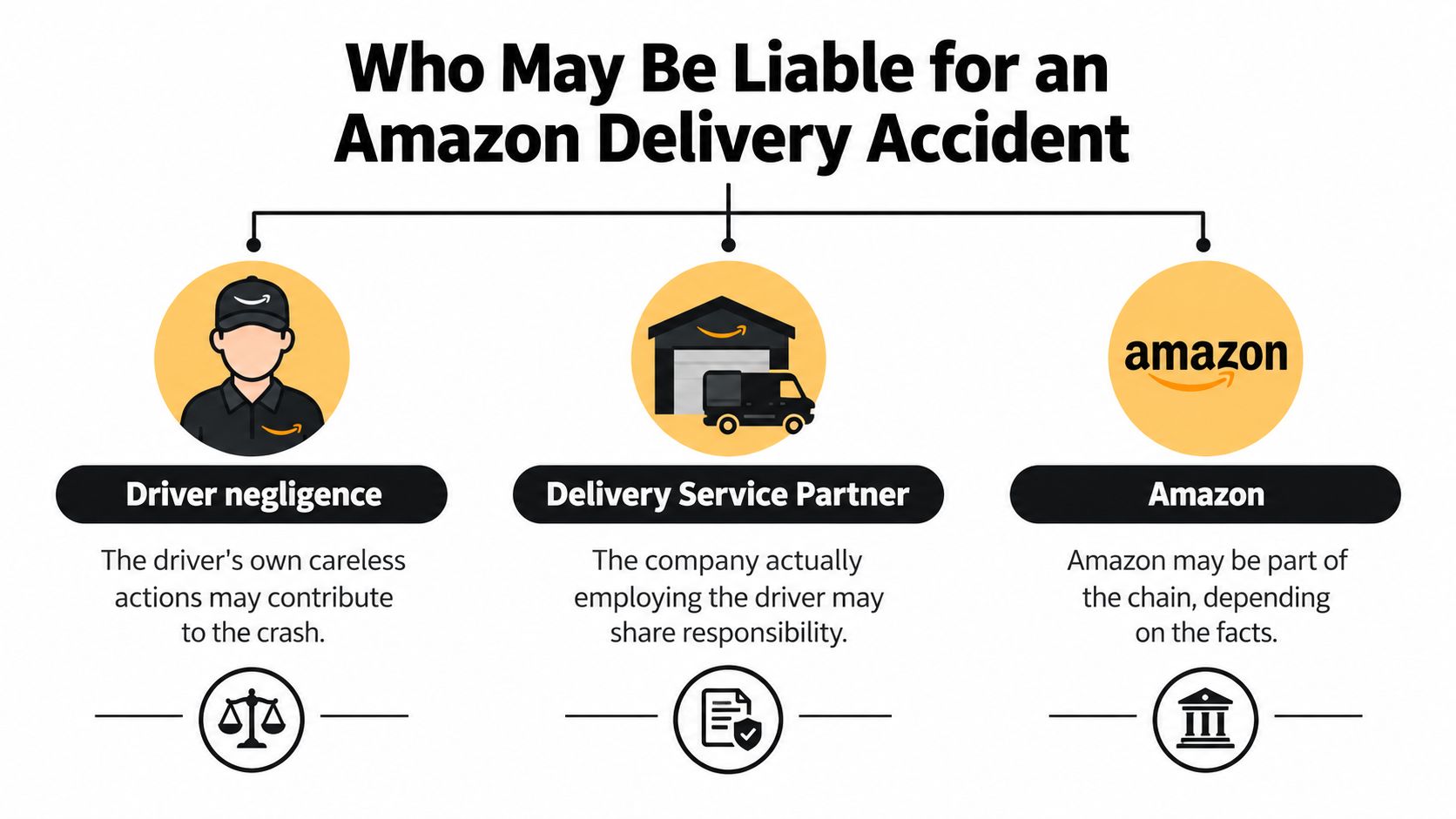
Potentially responsible parties can include the driver, a Delivery Service Partner (DSP) that employs the driver, Amazon, a freight carrier, another motorist, or another party whose conduct contributed to the crash. More than one party may share responsibility. A driver’s employer or contractor status matters, but it doesn’t automatically settle whether Amazon or another company can also be held liable.
The logo is a starting point, not proof of who must pay. The claim needs evidence about the collision, the driver’s work status, the companies involved, and the insurance terms.
If you’ve been hurt, get medical care and report the crash to the appropriate authorities. When you can do so safely, preserve photos, witness details, and any information identifying the vehicle and delivery company. Avoid assuming that a branded van means a single insurer will step forward or that an early insurance explanation resolves who is responsible.
This article is for informational purposes only and is not to be construed as legal advice. No attorney-client relationship exists based on your review of this article, and none of the information in it is legal advice. The sections ahead explain how liability can work, which evidence may matter, and what California filing deadlines to discuss with a lawyer.
Why Amazon Delivery Accidents Are a Growing Risk
Delivery crashes have features that an ordinary fender-bender may not. A driver may be making frequent curbside stops, backing into tight spaces, navigating busy pedestrian areas, or trying to stay on schedule. If a company’s practices contributed to unsafe driving, those practices may become relevant evidence, alongside what happened in the moments before impact.
A Strategic Organizing Center analysis of injury data that Amazon and its delivery partners submitted to the U.S. Occupational Safety and Health Administration found that Amazon delivery drivers experienced 18.3 injuries per 100 full-time-equivalent workers in 2021, approximately one injury for every five workers. The rate was nearly 40% higher than the previous year, according to the reported analysis of Amazon driver injuries.
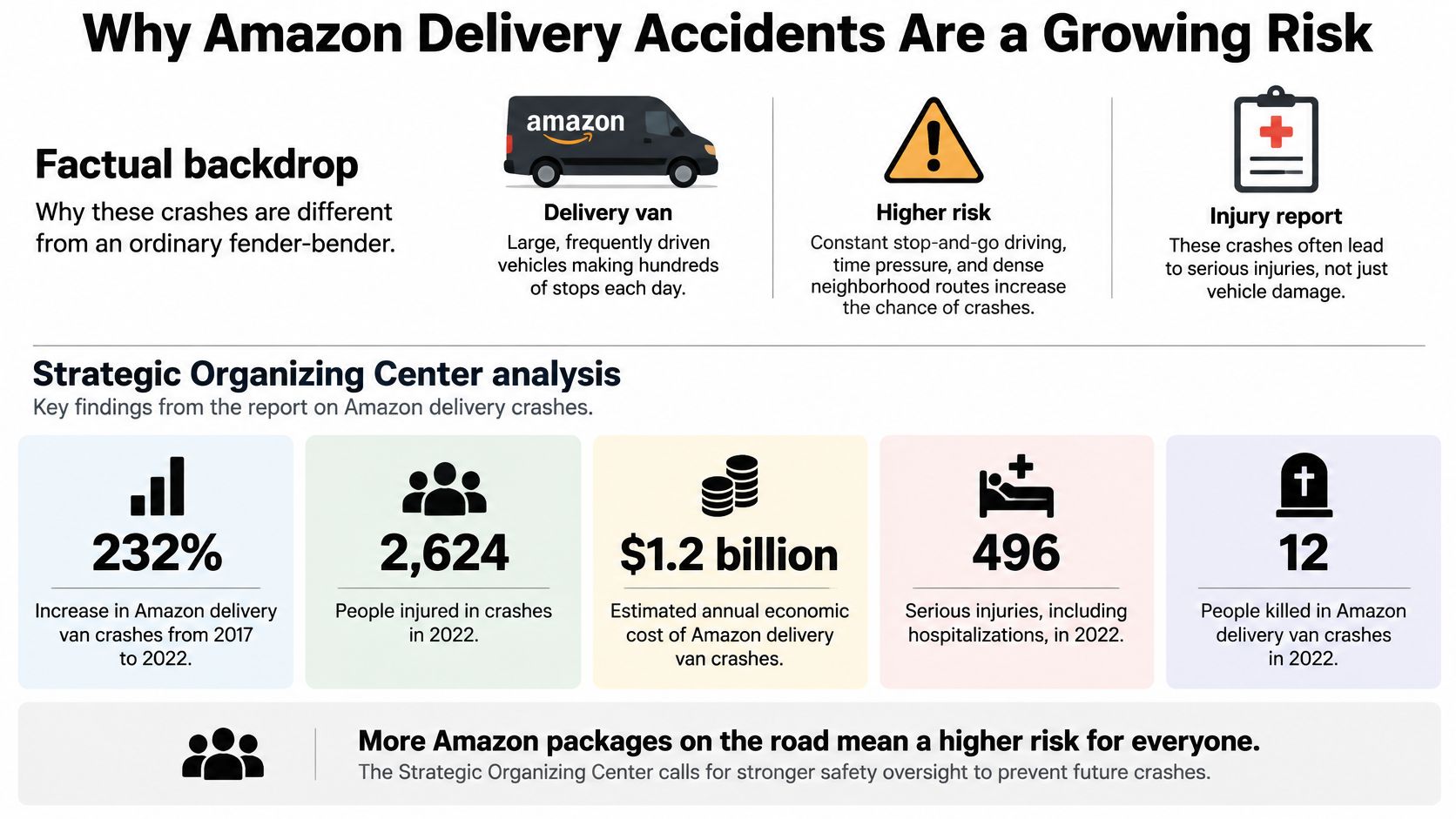
Those figures describe reported workplace injuries involving delivery drivers, not the total number of crashes or all injuries to members of the public. They don’t prove that a particular driver was negligent or determine who is legally responsible for your injuries. They do provide context for why delivery work’s driving, loading, unloading, and time demands can deserve careful examination after a crash.
Why the delivery system may matter
Subcontracting can make the investigation more complicated. A DSP may employ and supervise the driver, while Amazon may have its own role in the delivery system. That division can raise questions about who set schedules, communicated route instructions, monitored performance, or established safety practices. Whether those details support a legal claim depends on the evidence and applicable law.
A careful investigation looks beyond the collision scene. Route assignments, app activity, training records, vehicle inspections, and company communications may help show whether unsafe conditions or practices played a part. The injury statistics alone can’t establish those facts, but records from the companies involved may help answer them.
A crash can still come down to a driver’s conduct, such as failing to yield or backing without checking for people nearby. The point is to preserve evidence that can distinguish an isolated driving mistake from a broader operational issue, if one exists.
If you’re trying to understand the delivery context, this video offers additional background:
Who May Be Liable for an Amazon Delivery Accident
Responsibility depends on what each person or company did, not just the name on the van. The driver may have caused the collision through careless driving, but the investigation shouldn’t stop there.
The driver and delivery company
A driver may be liable if the evidence shows that their actions caused the crash. The DSP may also face a claim because it employs the driver and may be responsible for matters such as hiring, supervision, training, or vehicle provision, depending on the facts and law. Amazon describes DSPs as independent third-party businesses, with the DSP responsible for hiring and managing its drivers; the existence of that arrangement doesn’t, by itself, determine legal liability.
Amazon may also be a potential defendant. A claim might examine whether Amazon’s conduct or degree of control over delivery operations supports a legal theory such as agency, vicarious liability, or direct negligence. These theories require evidence, and the fact that a driver delivered an Amazon package doesn’t automatically establish Amazon’s liability.
Other parties and the injured worker’s situation
Another motorist, a vehicle owner, or a manufacturer may also be relevant if their conduct or a defect contributed to the crash. If the person hurt was the delivery driver, the analysis differs: workers’ compensation may apply to an on-the-job injury, while a separate claim may exist against a third party whose negligence caused the collision. Potential reimbursement rights or liens may affect how those claims interact.
Court verdicts show why investigators may examine the companies behind a delivery, not only the driver. In December 2023, a South Carolina jury awarded $44.6 million after an Amazon contract driver turned left into motorcyclist Shannon Shaw’s path. In August 2024, a Georgia jury awarded $16.2 million in Bradfield v. Amazon Logistics, assigning 85% of responsibility to Amazon, 10% to the driver and employer, and 5% to a neighbor, as reported in the coverage of verdicts involving Amazon drivers. These were case-specific outcomes, not predictions or guaranteed benchmarks for another claim.
For background on how employment status can shape responsibility, see this discussion of direct accountability when working for Amazon. In any individual case, the parties’ contracts and conduct, the crash evidence, and applicable law all matter.
How Amazon’s Delivery Models Affect Insurance Coverage
“Amazon delivery” can describe different working arrangements. The model helps identify who engaged the driver, but you still need to confirm the driver’s status, the vehicle involved, and the actual policy terms.
| Delivery Model | Who Engages the Driver | Typical Insurance Path | Key Issue for Your Claim |
|---|---|---|---|
| DSP | A Delivery Service Partner employs the driver. | The DSP generally provides the van and insurance; the applicable policy and any other coverage must be identified. | Confirm the driver’s employer, vehicle owner, and insurer rather than assuming Amazon directly employed the driver. |
| Flex | A driver uses a personal vehicle and accepts deliveries through the Flex app. | The driver’s delivery-permitted personal or commercial policy may be primary; Amazon’s commercial policy may apply during an active delivery block and may operate as excess. | Determine whether the driver was actively delivering during a block and whether the personal policy excludes delivery. |
| Relay | A carrier hauls freight under an Amazon Relay arrangement. | The carrier’s insurance and contractual arrangements are central to identifying coverage. | Identify the carrier, vehicle, driver’s employer, and policies instead of treating the claim like a DSP or Flex crash. |
Amazon says its Flex commercial auto policy applies only while a driver is actively delivering during a delivery block. In most U.S. states other than New York, Amazon identifies $1,000,000 per accident in auto liability coverage, $100,000 per accident in uninsured or underinsured motorist coverage, and contingent collision coverage capped at $50,000 with a $1,000 deductible, according to Amazon Flex’s insurance information.
Amazon also explains that a driver’s commercial or delivery-permitted personal policy is generally primary, while Amazon’s policy may be excess. If the personal policy excludes delivery activity, Amazon’s commercial policy may become primary. That doesn’t mean coverage can be assumed from an Amazon package or vehicle branding. The driver, vehicle, delivery status, location, and policy language all need to line up.
For a Flex crash, preserve dispatch-block records, route assignments, delivery timestamps, app activity, vehicle ownership information, and the complete policy documents, including exclusions. For DSP and Relay crashes, identifying the employing company or carrier and obtaining its policy information are key steps. A lawyer may help request records and compare coverage layers, but no table can replace the actual contracts and insurance terms.
Evidence to Preserve After an Amazon Delivery Crash
Evidence can disappear or become harder to obtain while you’re recovering. If it’s safe and practical, start with what you can collect yourself, then keep a written record of the information you’ll need to request.
Capture the scene and identify witnesses
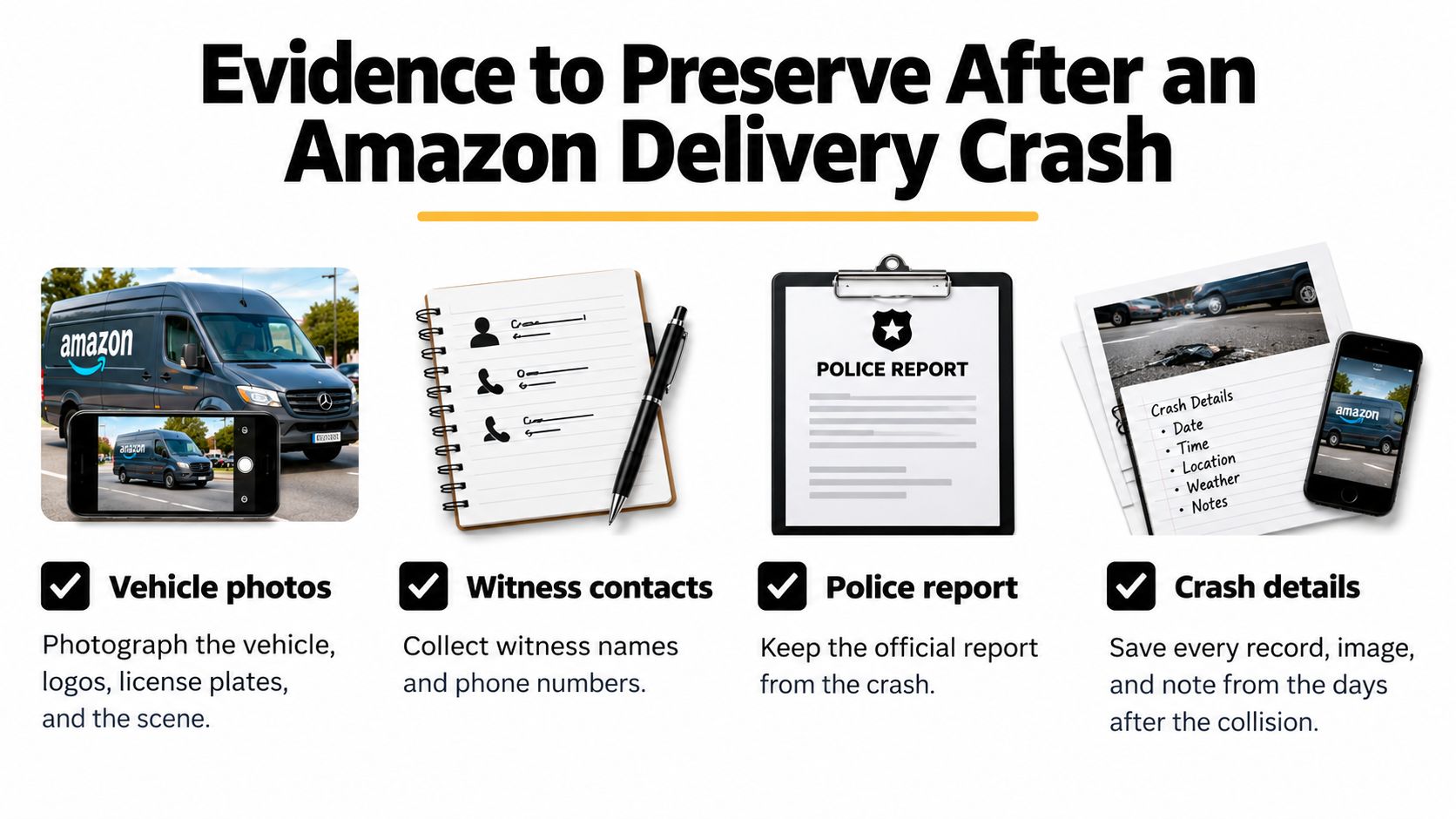
Photograph the vehicles, damage, logos, license plates, road conditions, traffic controls, and the wider scene. These images may help show vehicle identity, impact locations, visibility, and the positions of people and objects. Collect witness names and contact details, and keep the police report or information on how to obtain it.
Write down what you remember while it’s still fresh, including the delivery vehicle’s direction of travel, whether it was stopping or backing, and anything the driver said about work or the route. Don’t guess at details you can’t recall clearly. Medical records and receipts can help document treatment and losses, so keep them together with your notes.
Request records before they disappear
Ask the relevant company and insurer to preserve records that could identify the driver’s status and reconstruct the collision. Depending on the delivery model, that may include dispatch records, delivery-app activity, route assignments, telematics, camera footage, driver hours, training, vehicle inspections, and maintenance history. A prompt preservation request can help prevent routine data handling from removing records before they’re collected.
Vehicle classification matters, too. NHTSA’s 2023 large-truck data reported 5,472 deaths and an estimated 153,000 injuries, with about 70% of fatalities involving occupants of other vehicles. Many urban delivery vans fall below the 10,001-pound “large truck” threshold and therefore may not appear in that category, despite their frequent stops and pedestrian exposure, as discussed in this analysis of last-mile delivery safety. Those national figures don’t explain an individual crash; documenting the specific vehicle’s GVWR, vehicle class, stop sequence, and condition can be more useful to that investigation.
For more on organizing records after a collision, see this guide to car accident injury claim advice. Keep copies of what you send and receive, and avoid altering original photos or files.
California Filing Deadlines and When to Hire a Lawyer
California generally gives an injured person two years from the date of injury to file a personal-injury lawsuit under Code of Civil Procedure section 335.1, according to the California Courts guide to civil lawsuit deadlines. That’s a major planning deadline, not a complete answer for every claim.
Different rules may apply depending on whom you’re suing and why. Claims involving government entities, minors, delayed discovery, wrongful death, or other circumstances can raise separate procedural issues. The California Courts guide also notes that medical-malpractice claims are treated differently. Don’t assume that the general personal-injury period resolves the deadline for every defendant or legal theory.
What early legal help can do
A lawyer can help identify potentially insured parties, send preservation requests for delivery and vehicle records, evaluate how the evidence supports fault and damages, and handle communications with insurers. That work can be particularly useful when a DSP, Flex driver, Relay carrier, and multiple insurers may be involved. You can read more about the California auto accident statute of limitations, but a lawyer should assess how the rules apply to your circumstances.
A firm’s ability to respond promptly can matter when someone has just been hurt and needs a way to reach legal help. For general context on how firms manage incoming inquiries, this overview of automated answering services for injury firms explains one way legal practices may handle calls and route requests.
LA Law Group, APLC is a California personal injury firm that offers free initial consultations and direct attorney access. Its offices are in Los Angeles, Santa Monica, Chatsworth, and Fremont. A consultation can help you understand which records to preserve and which deadlines need attention, without assuming the same approach fits every crash.
Moving Forward After a Delivery Accident
The Amazon logo on a van starts the liability inquiry. It doesn’t answer who employed the driver, which policy applies, or whether another company may share responsibility.
In the coming days, photograph and preserve what you can, write down your recollection, save medical and insurance records, and keep the police-report information. If an insurer asks for a recorded statement, consider speaking with a lawyer before agreeing, especially while the facts and coverage are still being investigated. A consultation can help you understand your options without requiring you to decide every issue immediately.
This article is for informational purposes only, is not to be construed as legal advice, and does not create an attorney-client relationship. If you’re shaken or unsure where to begin, start with the records you have and get guidance on what should be preserved next.
LA Law Group, APLC offers free initial consultations and direct attorney access for people injured in automobile, truck, and other accident cases in California. If you were hurt in a delivery crash and need help identifying the responsible parties and insurance path, contact LA Law Group, APLC to discuss your situation.
Attorney Advertising. This article is general information, not legal advice, and does not create an attorney-client relationship. Prior results do not guarantee a similar outcome.