
Breach of Contract vs Tort Explained for California
A California business owner signs a vendor agreement, pays a deposit, and expects equipment to arrive before a major launch. The vendor misses the delivery date and sends substitute equipment that fails during use. If the failure only causes financial disappointment, the dispute may look like a breach of contract. If the equipment injures an employee or damages unrelated property, the same transaction may raise a tort issue as well.
That overlap explains why people search for “breach of contract vs tort.” The correct legal theory can affect the elements you must prove, the evidence you need, the damages available, the applicable deadline, and whether punitive damages are even legally possible.
Introduction to Breach of Contract vs Tort in California
At the simplest level, a contract claim concerns a promise someone agreed to keep. A tort claim concerns a duty imposed by law, such as the duty to use reasonable care or avoid conduct that causes legally recognized harm.
Core distinction: Contract law protects the benefit of a bargain. Tort law addresses wrongful injury or harm that exists independently of the bargain.
California businesses and individuals often face facts that support more than one theory at first glance. A service provider might promise to install a safe system, then install it negligently. A seller might make statements before signing an agreement, then fail to deliver what was promised. A landlord, retailer, rideshare driver, or manufacturer may also have duties that exist apart from any written agreement.
The label alone doesn’t decide the case. Courts examine where the duty came from, what conduct violated it, and what harm the plaintiff suffered. Calling a broken promise “fraud” or “negligence” won’t automatically create a tort claim or provide broader damages.
This guide compares the foundations, elements, proof burdens, remedies, economic-loss limits, and practical consequences of contract and tort claims under California principles. It also addresses the narrow independent-duty exception, third-party complications, and situations where a single dispute may involve both theories.
This article is for informational purposes only and isn’t to be construed as legal advice. No attorney-client relationship exists based on the review of this article, and none of the information in this article is legal advice. Your facts, contract language, injury, and deadlines may change the analysis.
Understanding Breach of Contract and Tort Foundations
A breach of contract occurs when a party fails to perform a promise required by an enforceable agreement. The promise might involve payment, delivery, construction, licensing, confidentiality, service quality, or timing. The plaintiff generally must identify the contract, show the plaintiff’s performance or excuse for nonperformance, identify the defendant’s breach, and connect that breach to resulting damages.
For a basic example, a California retailer agrees to pay for inventory delivered by a specified date. The retailer pays, but the supplier doesn’t deliver. The central question is whether the supplier failed to perform the bargain, not whether the supplier violated a general duty owed to everyone.
A tort begins differently. The duty may arise from negligence law, fraud principles, premises liability, product-safety rules, fiduciary obligations, or another legal source outside the agreement. The plaintiff must then establish the applicable duty, a breach of that duty, causation, and legally recoverable harm. The exact elements vary by tort theory.
Why the two systems developed separately
Contract doctrine evolved into a distinct common-law framework over several centuries. A legal-history source traces an important contract milestone to Norwood v. Read in 1558, where the court recognized that “every contract executory is an assumpsit in itself.” Modern concepts such as offer and acceptance, conditions, total breach, and anticipatory breach were largely developed during the late eighteenth and nineteenth centuries, as described in the legal-history discussion of contract doctrine.
That history helps explain the practical divide. Contract law asks what the parties exchanged and what performance the agreement required. Tort law asks what conduct the law prohibited or what care the circumstances required, even without a negotiated promise.
A quick self-check
Ask yourself three questions:
- What was promised? If the injury is the failure to receive the agreed product, payment, service, or outcome, contract may be the natural starting point.
- What separate duty was violated? If someone acted carelessly, made a knowingly false statement, or caused physical injury beyond the promised performance, tort may be relevant.
- What harm occurred? Lost profits or replacement costs may point toward contract damages. Bodily injury, damage to other property, or distinct harm may support a tort theory, subject to California’s economic loss rule.
For a plain-language introduction to the promise-based claim itself, see what breach of contract means.
Detailed Comparison of Elements Burdens and Duties
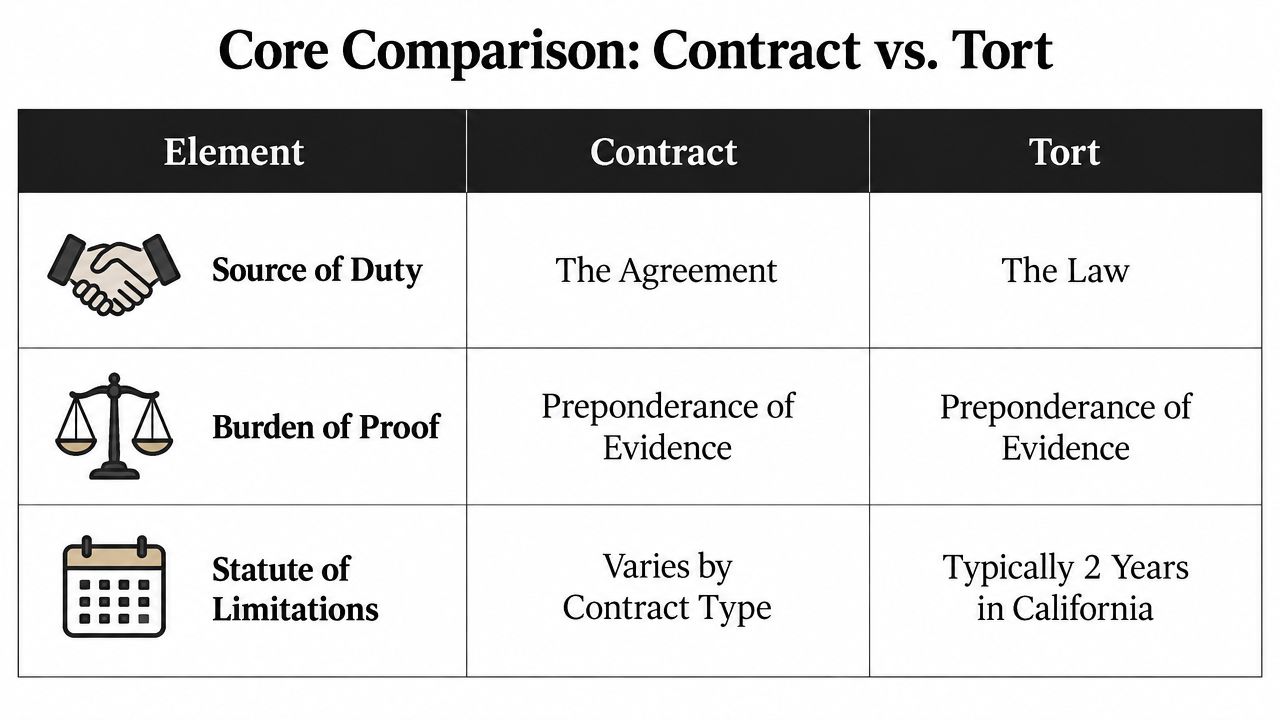
The most useful comparison starts with the source of the duty. In a contract action, the agreement supplies the obligation. In a tort action, the obligation comes from law and applies independently of the parties’ private exchange.
A contract plaintiff typically focuses on the agreement’s wording, performance records, invoices, notices, change orders, and financial consequences. A tort plaintiff may need evidence of unsafe conduct, a misrepresentation, a failure to use reasonable care, a physical injury, or another legally recognized wrong.
Both claims generally require proof by a preponderance of the evidence, meaning the fact finder must conclude that the claim is more likely true than not. The particular elements still depend on the cause of action and the facts.
The boundary California courts draw
California courts distinguish between protecting expectancy interests and imposing a general duty of reasonable care. The California Supreme Court has described contract law as protecting the parties’ expectations while generally requiring contract recovery for purely economic disappointment unless an independent duty and additional harm exist. The California appellate decision discussing the economic-loss boundary explains why a purchaser ordinarily proceeds in contract when the alleged loss is only the failure to receive the expected value.
The key question isn’t whether the defendant acted badly. It’s whether the duty that was breached existed independently of the contract.
Pleading matters because a plaintiff can lose access to a desired remedy by choosing a theory that doesn’t fit the facts. A contract claim may support expectation damages but generally won’t support punitive damages for a commercial breach. A tort claim may offer broader recovery, but only if the plaintiff can prove the independent duty, the required mental state where relevant, and distinct legally recoverable harm.
Core criteria at a glance
| Criteria | Breach of Contract | Tort |
|---|---|---|
| Source of duty | The parties’ agreement | A duty imposed by law |
| Main injury | Disappointed contractual expectation | Wrongful injury or independent harm |
| Typical evidence | Contract, amendments, invoices, notices, performance records | Safety evidence, medical records, communications, witness accounts, property-loss proof |
| Causation focus | Loss proximately caused by the breach | Harm proximately caused by the tortious conduct |
| Pure financial loss | Often the central subject of the claim | Often restricted by the economic loss rule |
| Punitive damages | Generally unavailable for a commercial breach | May be possible in an appropriate tort case, subject to applicable requirements |
| Third-party involvement | Usually centers on contracting parties | May involve duties owed to nonparties, depending on the theory |
The statute of limitations requires separate attention. Contract deadlines vary by the type of agreement and the governing law. Tort deadlines also vary by claim, but California injury claims can involve a relatively short filing period, making early evaluation important. The contract, the date of breach, the date of injury, and any discovery issues can all matter.
Remedies Damages and the Economic Loss Rule in California
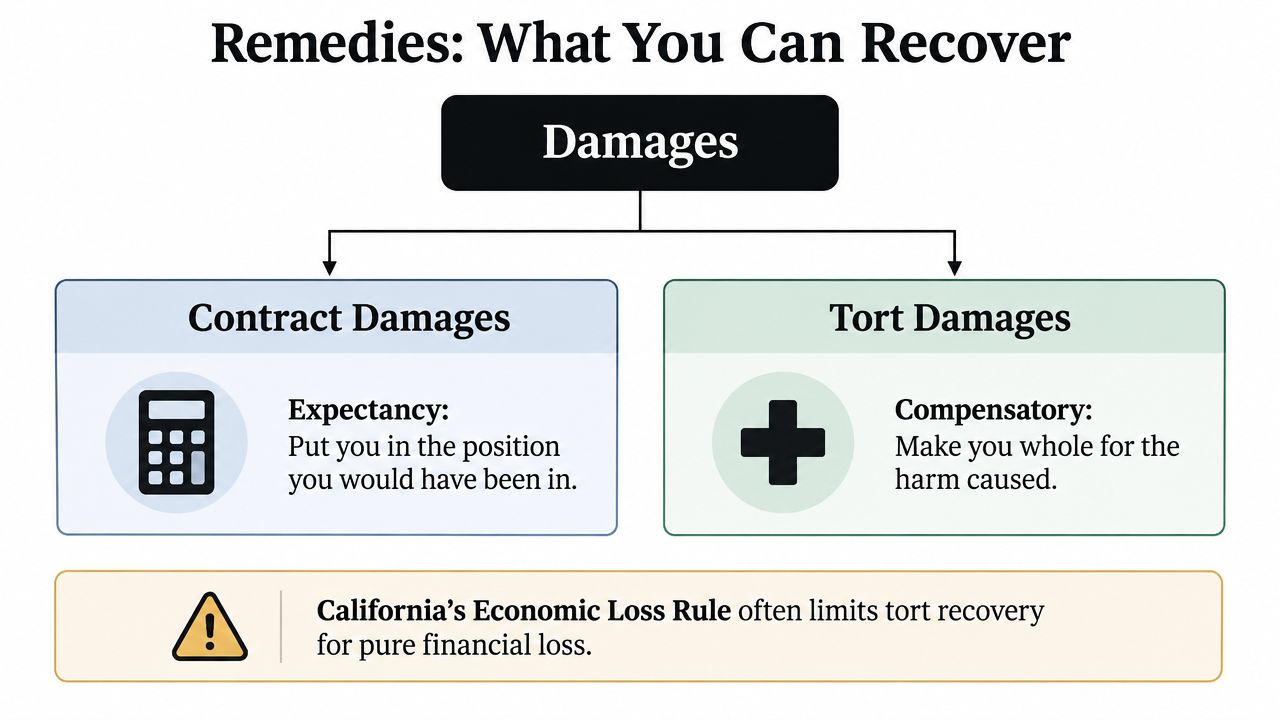
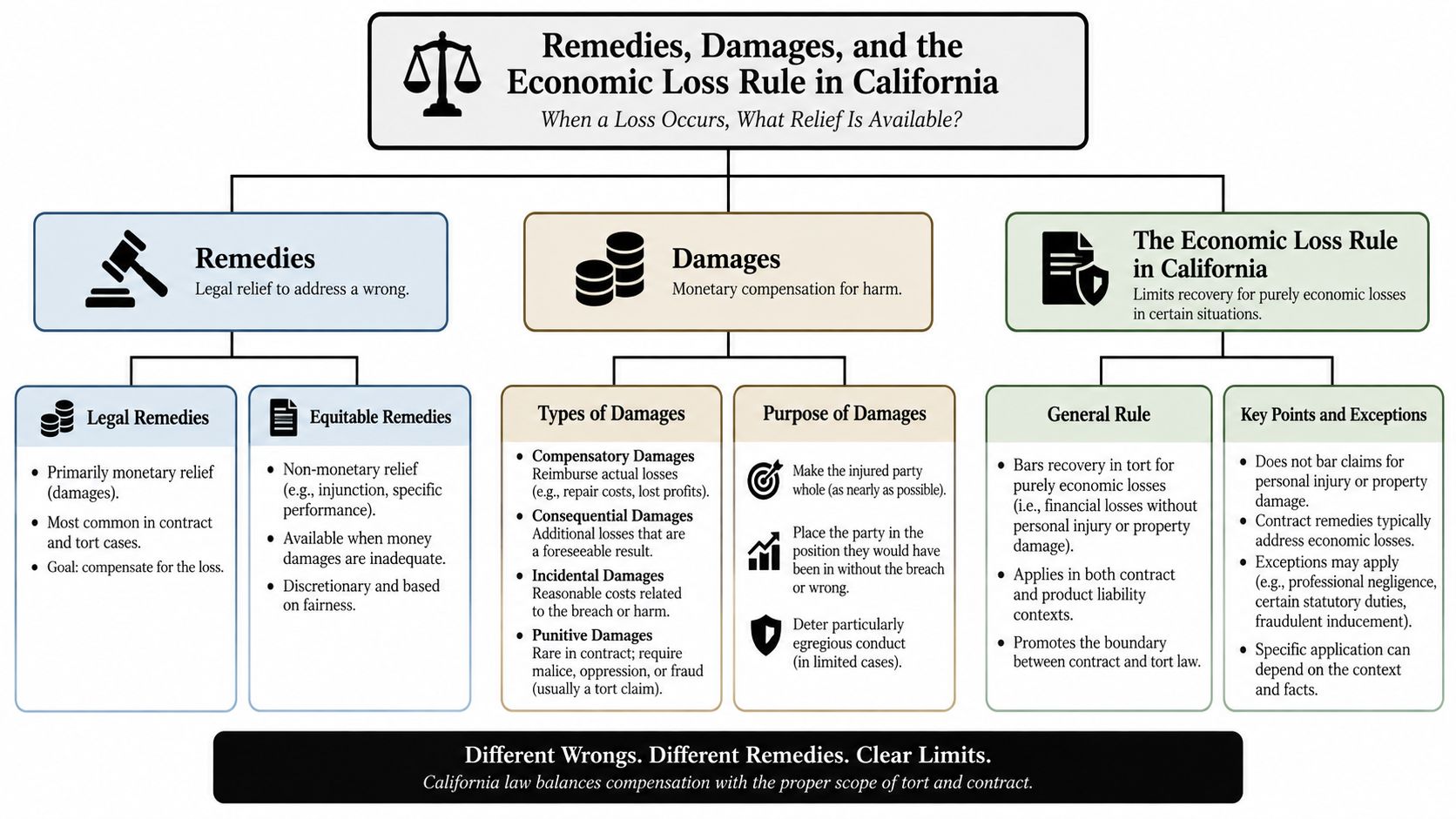
Remedies often determine why the contract-versus-tort distinction matters so much. California contract damages generally aim to compensate the aggrieved party for losses proximately caused by the breach and clearly ascertainable in nature and origin. Courts commonly describe this as expectancy-style compensation, placing the injured party in the position it would have occupied if the promise had been performed, subject to applicable limits.
Suppose a supplier fails to provide custom inventory. The buyer might seek qualifying losses tied to the missed performance, such as the cost of obtaining substitute goods or other proven losses caused by the failure. The buyer can’t claim every financial setback that followed. The loss must connect to the breach and be sufficiently ascertainable.
A useful outside explanation of contract-loss categories is this guide to breach-of-contract damages from Lighthouse Consultants UK. It can help readers organize questions about expectation, reliance, and related damage theories, although California law and the specific contract still control.
Pure financial loss and independent harm
The economic loss rule is the main technical boundary. When the only injury is financial loss caused by disappointed contractual expectations, tort recovery is usually barred unless the plaintiff can identify an independent duty separate from the contract. The rule prevents ordinary nonperformance from becoming a negligence or fraud case merely because the plaintiff describes the same unpaid amount or lost bargain in tort language.
Tort recovery becomes more plausible when the conduct causes harm beyond the broken promise, such as bodily injury or damage to other property. In that setting, tort damages may extend to all harm proximately caused by the wrongful conduct, depending on the claim and proof.
Practical takeaway: A broader remedy doesn’t replace the need to prove a separate duty and separate harm.
California’s contract framework also limits recovery to losses that are proximately caused and clearly ascertainable. The California Supreme Court’s discussion of contract remedies and independent social policy appears in this California decision on contract and tort boundaries.
Why punitive damages need careful analysis
Punitive damages are generally unavailable for a commercial contract breach. The California Supreme Court has stated that, under statute and common law, breach of a commercial contract can’t itself support punitive damages, as explained in the California Supreme Court’s punitive-damages decision.
That doesn’t mean a contract dispute can never involve punitive-damages allegations. It means the plaintiff must identify and prove a legally viable tort or another basis that permits such relief. Re-labeling the same failure to pay, deliver, or perform won’t satisfy that requirement.
For a related plain-language explanation of financial-loss concepts, readers can review economic damages in civil claims.
When a Contract Dispute Also Becomes a Tort and Who Can Sue
A contract breach alone usually doesn’t create tort liability. The exception is narrow but important. A tort claim may survive when the defendant owed a duty outside the agreement and violated that duty in a way that caused damages distinct from the contract loss.
Consider a contractor hired to repair a commercial property. If the contractor fails to complete the agreed work, the dispute is ordinarily contractual. If the contractor’s negligent conduct causes a worker to suffer bodily injury or damages unrelated property, the analysis may include tort principles because the alleged harm isn’t limited to the disappointed bargain.
Fraud requires the same care. A statement that was false when made can be different from a promise that later became false because the speaker failed to perform. The timing, purpose, relationship, and damages all matter. A plaintiff who was induced to sign by a knowingly false existing fact may have a different theory from a plaintiff who signed a valid agreement and later received nonperformance.
Signals of an independent duty
Use this checklist to organize the facts, not to decide the legal result:
- Physical injury: Did the conduct cause bodily harm to a person?
- Other-property damage: Did something beyond the promised subject matter become damaged?
- Pre-contract deception: Was a material statement false when made and used to induce the agreement?
- Separate legal relationship: Did the defendant owe a duty based on a relationship or legal rule independent of the contract?
- Distinct damages: Are the tort damages different in kind from the amount needed to restore the bargain?
- Third-party injury: Was the claimant outside the contract, and does the applicable law recognize a duty to that person?
A third party can’t automatically sue just because a contract was breached. The claimant still needs a recognized legal theory and a duty that reaches that claimant.
The third-party question becomes more complicated across jurisdictions. Recent French and Canadian materials discuss circumstances in which nonparties may invoke contractual misconduct in tort and situations where contractual and tortious duties coexist unless the agreement excludes them. The discussion of tortious liability toward third parties illustrates why the simple slogan “contract law is for parties, tort law is for everyone else” can be misleading.
California courts still examine the independent-duty question and the economic-loss rule closely. A plaintiff shouldn’t assume that adding negligence, fraud, or emotional-distress language will expand recovery. The pleaded facts must establish a separate duty, a separate wrong where required, and damages the law permits.
Real World Use Cases for California Businesses and Individuals
A vendor misses a delivery deadline, and the buyer loses a sales opportunity. If the buyer’s complaint is that the promised goods never arrived, the evidence will center on the purchase agreement, delivery terms, payment records, notices, and proof of the resulting loss. That fact pattern usually points toward contract analysis.
The result changes when the vendor delivers a defective machine that injures an employee. The purchase agreement still matters, but the injury may implicate negligence or product-related duties independent of the delivery promise. Medical records, incident reports, photographs, maintenance documents, witness accounts, and the machine itself may become important evidence.
A software company may also promise to protect customer data. If it fails to provide an agreed feature, the customer may have a contract dispute. If separate conduct exposes personal information or causes legally recognized harm, the available theories may require a different analysis. The answer depends on the duty, the conduct, and the type of loss, not on the label the customer chooses.
Personal injury situations with contractual connections
A person injured on commercial property may have signed a membership, rental, or service agreement. The injury claim doesn’t automatically become a contract case. The central issues may instead involve property control, notice of a dangerous condition, reasonable care, causation, and the injury itself.
A rideshare passenger may have app-based terms governing the relationship, but those terms don’t eliminate the need to examine the driver’s conduct, the circumstances of the collision, available insurance issues, and the passenger’s injuries. A contract may affect procedure or limitations, while tort principles address the alleged careless conduct.
These scenarios call for prompt fact assessment rather than an automatic choice. LA Law Group, APLC’s practice includes contract and business matters as well as personal-injury claims, so a case review may examine both the agreement and the alleged injury without promising a particular outcome.
How to Choose the Right Cause of Action and Next Steps
Start with the facts in this order:
- Identify the duty. Write down the exact promise, then list any duties that California law may impose independently.
- Separate the harm. Distinguish unpaid amounts, lost profits, replacement costs, bodily injuries, and damage to other property.
- Match the remedy. Ask whether the goal is to recover the bargain’s value, repair physical harm, address broader losses, or pursue another legally available remedy.
- Preserve proof. Keep the signed agreement, amendments, invoices, text messages, emails, photographs, medical records, incident reports, and damage calculations.
- Check timing. Note the breach date, injury date, discovery facts, notice provisions, arbitration language, and any contractual deadline.
Pursuing contract, tort, or both may be appropriate when the facts support separate duties and distinct losses. It may be risky to plead a tort theory based only on the same disappointed financial expectation covered by the agreement.
This article is for informational purposes only and isn’t legal advice. No attorney-client relationship exists based on reading it, and no information here should be treated as legal advice. A California attorney can evaluate the agreement, conduct, damages, and deadlines together. For more context on finding a California contract lawyer, review the relevant legal-service information and prepare specific questions before a consultation.
LA Law Group, APLC can review California contract disputes, business claims, and injury-related facts to help identify potentially relevant legal theories and preserve important evidence. Visit LA Law Group, APLC to request an initial consultation and discuss your situation with a legal team serving clients across California.
Attorney Advertising. This article is general information, not legal advice, and does not create an attorney-client relationship. Prior results do not guarantee a similar outcome.