
California Rideshare Accident Lawyer: Coverage Guide
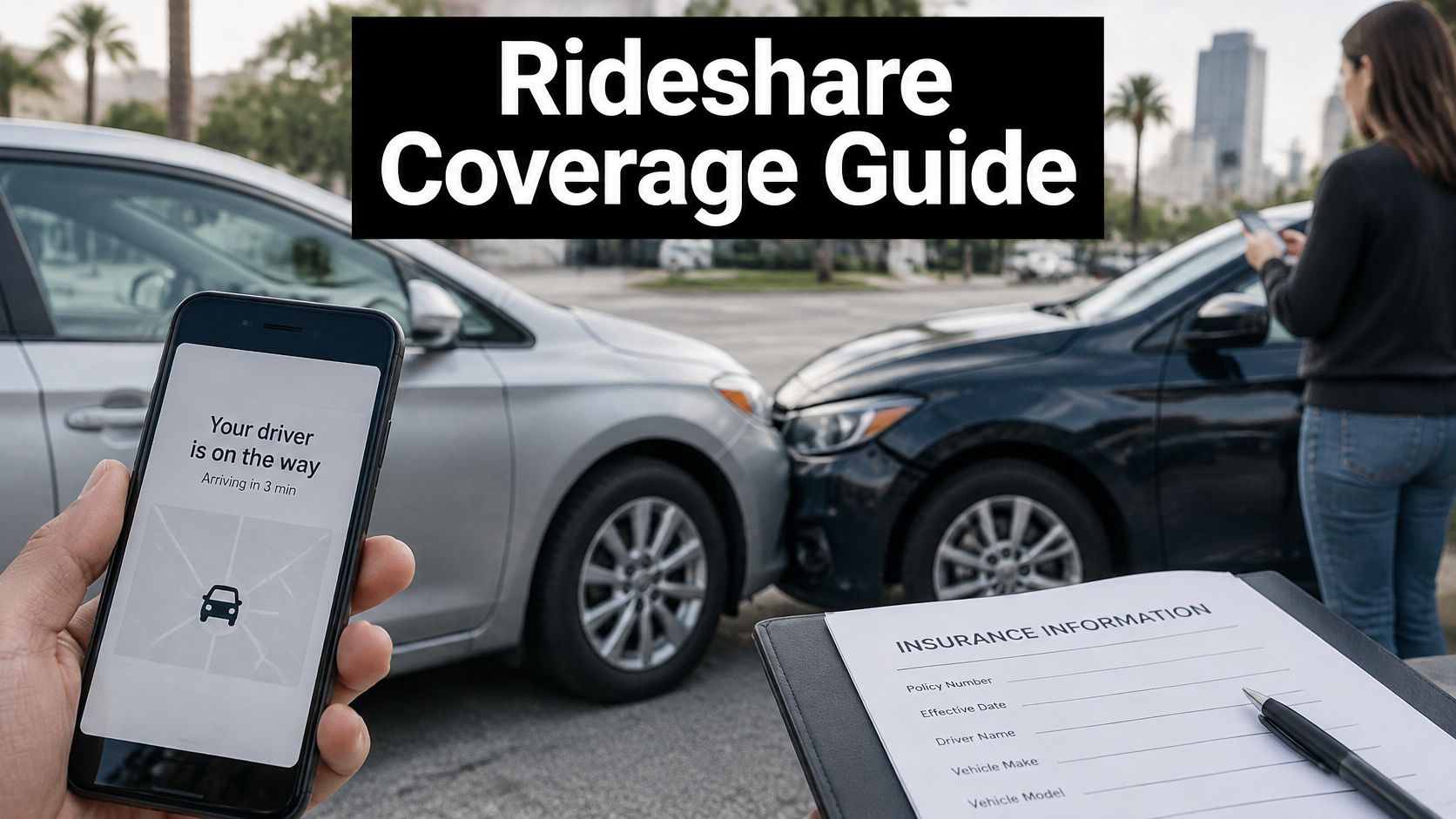
Your Uber or Lyft ride has ended in a collision. You’re sore, your phone is filling with messages, and an insurance adjuster wants to know what happened. You might not even know whether the driver had accepted a trip when the vehicles collided.
That last detail can change which insurance applies. A California rideshare accident lawyer needs to establish both who caused the crash and what the driver’s app showed at the moment of impact. Keeping proof of that status can be just as important as photographing the damage.
Which Insurance Applies at Each Stage of a Ride
This article is for informational purposes only and is not to be construed as legal advice. No attorney-client relationship exists based on reviewing this article, and none of the information in it is legal advice.
California rideshare coverage works like a switch with three positions. The same driver, in the same car, can fall under a personal policy, a lower contingent policy, or a full commercial policy depending on what the app showed at the moment of impact. During accepted-trip activity, California Public Utilities Code section 5433 requires primary liability protection of $1,000,000. Separately, Senate Bill 371 sets passenger UM/UIM minimums of $60,000 per person and $300,000 per incident, applying to accidents on or after January 1, 2026.
Coverage by app status in California
| Trip phase | Coverage that usually applies | Reference limits |
|---|---|---|
| App off, no ride | Driver’s personal auto policy; rideshare coverage generally does not apply | Personal policy limits |
| Logged in, waiting for a request | Rideshare contingent liability | $50,000 per person, $100,000 per incident, $30,000 property |
| Ride accepted through drop-off | Rideshare primary liability | $1,000,000 per occurrence |
| Passenger inside the vehicle | Rideshare primary liability plus UM/UIM | $1,000,000 liability; UM/UIM $60,000 per person and $300,000 per accident for accidents on or after January 1, 2026 |
App off, no ride. A driver using the vehicle privately generally looks to personal auto insurance. A rideshare decal on the windshield doesn’t, by itself, establish commercial coverage.
Logged in and waiting. The driver is available for work but hasn’t accepted a request. This is a separate coverage period, so an insurer may investigate the app records before accepting responsibility under the rideshare policy.
Ride accepted through drop-off. Accepted-trip liability coverage can apply while the driver travels to collect the passenger, not just while someone is seated in the car. The statutory period continues through completion of the transaction or ride, whichever occurs later.
Passenger inside. Liability coverage and uninsured/underinsured motorist coverage answer different questions. Liability addresses harm for which an insured party is legally responsible, while UM/UIM addresses qualifying injuries caused by another driver who lacks sufficient insurance.
Injury coverage isn’t vehicle repair coverage
Coverage for an injured passenger and coverage for the rideshare driver’s own car are separate questions. The California Department of Insurance’s rideshare insurance explanation distinguishes liability insurance from collision protection, which isn’t automatically provided without qualifying personal-policy protection.
The table identifies potential insurance layers, not guaranteed payments. Fault, exclusions, policy language, and the accident date still need review.
Start with this question: What was the driver’s app status at the moment of impact, and where is the proof?
How to Protect Your Claim in the First 72 Hours
Get somewhere safe and prioritize medical needs. You don’t need to finish an evidence checklist before accepting emergency treatment, and someone you trust can help gather records while you recover.
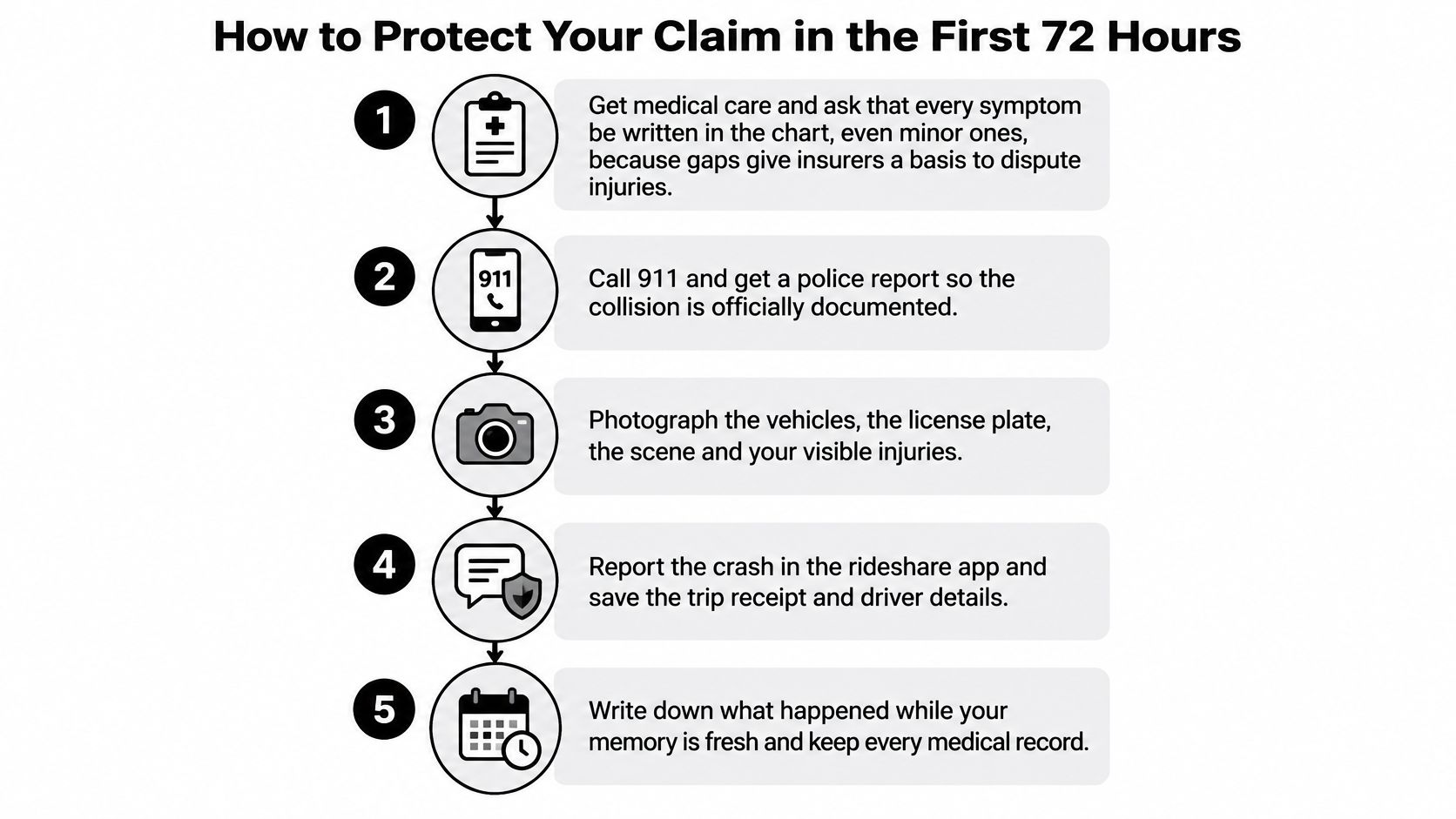
This checklist keeps the immediate tasks manageable.
Preserve what you can access now
The Walch Law California rideshare injury guide highlights how trip evidence can become harder to obtain over time. Don’t wait for the platform to disclose its records before saving your own.
-
Get medical care and describe every symptom. Tell the clinician about pain, dizziness, numbness, headaches, anxiety, or other changes, even if they seem minor. Ask that your symptoms be documented accurately, because missing information can complicate later injury analysis.
-
Call 911 when emergency help is needed and obtain the report number. Ask which agency responded and how to request its collision or incident report. If officers don’t attend, keep a record of your reporting efforts.
-
Screenshot the app before its display changes. Capture ride status, trip ID, timestamps, driver name, vehicle information, and pickup location. Don’t place yourself in danger to photograph someone else’s phone.
-
Save the receipt and messages. Download the trip receipt and preserve conversations with the driver and platform support. Keep original emails and attachments, not just cropped screenshots.
-
Photograph the scene safely. Include vehicle positions, license plates, impact damage, road defects, traffic signals, signage, and visible injuries. Wider photographs help explain where close-up details fit.
-
Collect witness names and phone numbers. Ask what they observed without suggesting an answer. Independent witnesses may help resolve conflicting accounts.
-
Request camera footage promptly. Identify nearby businesses, homes, transit cameras, or traffic-camera operators that might have recorded the collision. Recording systems can overwrite footage within days, so ask that the relevant interval be preserved.
-
Write a dated account. Describe the sequence of events, your seating position, what you heard, and when symptoms appeared. Separate what you personally remember from what someone later told you.
-
Get advice before giving an insurer a recorded statement. Don’t guess about speed, fault, or medical recovery. Keep correspondence and distinguish an insurance interview from providing truthful information to emergency responders.
-
Arrange help if you can’t travel. Our injury consultations are confidential, and we can travel to a client’s home or hospital if needed. Hospitalization shouldn’t prevent you from getting guidance about evidence preservation.
Assemble a usable claim folder
By the end of this early period, aim to have a report number, app screenshots, receipt, photographs, witness list, available medical notes, and dated account. Missing items aren’t a reason to abandon the claim, but they tell your attorney where investigation should begin.
Keep an untouched copy of original files and a separate working folder. Preserve your phone and location history rather than deleting material to free storage.
Evidence That Proves Trip Phase and Fault
A rideshare claim turns on the driver’s app status at the moment of impact, so the evidence has to do two jobs at once. It must show who caused the collision, and it must pin down which insurance layer was active when the cars hit. Medical proof answers a third question: whether the crash caused the injuries and losses being claimed.
Because coverage follows app status, a single timestamp can decide which policy responds. California’s transportation network company insurance provisions tie coverage to vehicle use through the company’s platform and require coverage disclosures to participating drivers. That makes electronic activity records as important as the physical evidence at the scene.
Evidence by what it proves
| Evidence | What it proves | Who usually holds it |
|---|---|---|
| App status history and trip ID | Whether the driver was offline, waiting, matched, or carrying a passenger | Rideshare company |
| Ride receipt with timestamps | Start and end of the trip phase | Passenger’s email or app account |
| Dash camera or telematics data | Speed, braking, and lane position | Driver or vehicle system |
| Phone-use records | Distraction, relevant to breach and comparative fault | Driver; may require a formal request |
| Police or incident report | Parties, observations, and any citations | Police agency |
| Medical records and imaging | Link between the crash and injuries; treatment gaps | Medical providers |
| Photographs and witness contacts | Scene conditions and independent accounts | You and witnesses |
| Insurance disclosures | Which policies and limits may respond | Insurers and drivers |
One item rarely proves both questions. A receipt showing an accepted ride can establish coverage timing without proving that the rideshare driver caused the crash. A witness may describe an unsafe turn yet know nothing about whether the driver had accepted a passenger request.
Phone records need the same care. An app interaction near the impact time may warrant investigation, and it still falls short of proving that distraction caused the collision on its own.
Request records with a precise time window
Send Uber or Lyft a written request identifying the collision, the trip, and the relevant interval. Ask for app-status history, trip ID, acceptance time, pickup time, and the timestamps surrounding impact. Keep a copy of the request, the date sent, the support ticket number, and every response.
A customer-support request is narrower than a formal preservation demand or legal process, so treat it as a first step. Keep your own copies rather than assuming platform records will remain readily accessible.
The guide to getting a police report can help you organize the agency request. Review the report for errors once it arrives. An officer’s observations are useful evidence, and the report remains one piece of the file rather than the entire case.
Medical documentation should describe functional changes as well as diagnoses. If exhaustion affects work or daily activities, a resource on documenting exhaustion for Taylorsville crash patients illustrates how fatigue can be described in concrete, functional terms. Report those symptoms to your treating clinician rather than diagnosing their cause yourself.
Deadlines That Can End a Rideshare Claim
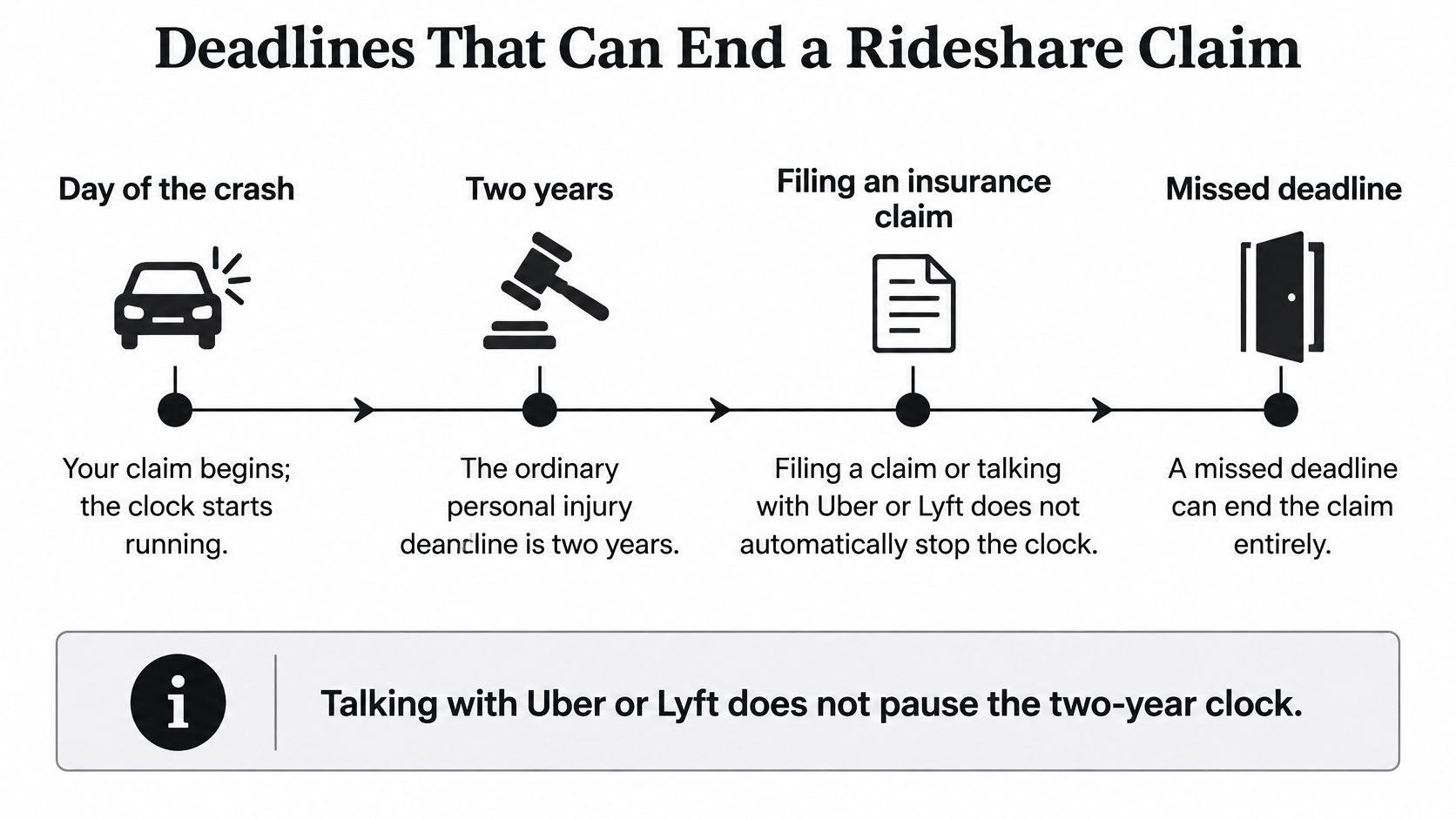
California’s ordinary personal injury lawsuit deadline is two years, under Code of Civil Procedure section 335.1, as explained by California Courts’ statute-of-limitations guide. Filing an insurance claim, exchanging messages with Uber or Lyft, or negotiating with an adjuster doesn’t automatically stop that clock.
The timeline illustrates the basic warning, but special claim-presentation rules can require action sooner.
Filing deadlines by claim type
| Claim type | Typical deadline | Note |
|---|---|---|
| Personal injury against a driver or rideshare company | 2 years under CCP 335.1 | Generally runs from the injury date; tolling can change it |
| Wrongful death | 2 years | Generally measured from death; heirs and estates follow separate rules |
| Claim against a public entity | Written claim within 6 months | Earlier deadline; strict notice requirements |
| Vehicle property damage | Generally 3 years under CCP 338 | Check whether the vehicle claim is handled separately |
These are starting points, not a personalized deadline calculation. A claimant’s age, incapacity, delayed discovery, defendant identity, and other rules can affect the analysis.
A public-entity issue may not be obvious at the scene. A collision involving a transit vehicle, traffic-signal condition, or alleged dangerous public roadway deserves prompt review, even if a private driver also contributed.
Calendar the earliest potentially applicable deadline, not the deadline you hope applies.
Our explanation of the California auto accident statute of limitations provides additional context for discussing the calendar with counsel. Don’t assume that an open claim number means the right lawsuit or government claim has been filed.
Settlement timing is a different issue
Many personal injury cases handled by our firm take six months to reach a settlement, and some lawsuits could take up to three years. Those are possible case durations, not extensions of filing deadlines or promises about your claim.
Treatment needs, disputed responsibility, and access to records can affect the pace. Keep scheduled care and respond to document requests while your attorney handles the legal calendar.
For an additional explanation of claim timing, watch the following video.
When the At-Fault Driver Has Too Little Insurance
A rideshare passenger often assumes the trip comes with substantial protection no matter who caused the crash. That assumption blurs the difference between liability insurance, which pays for the harm a driver causes, and uninsured/underinsured motorist coverage, which responds when that driver’s insurance falls short.
According to Uber’s explanation of California insurance reform, Senate Bill 371, effective January 1, 2026, reduced the statutory rideshare UM/UIM requirement from $1 million to $60,000 per person and $300,000 per accident.
Rideshare UM/UIM limits before and after January 1, 2026
| Accident date | UM/UIM per person | UM/UIM per accident |
|---|---|---|
| Before January 1, 2026 | $1,000,000 prior statutory figure, subject to the shared policy limit | Prior $1,000,000 shared limit |
| On or after January 1, 2026, under SB 371 | $60,000 | $300,000 |
The earlier figure was a shared pool covering everyone hurt in the crash, not a separate payment reserved for each passenger. The governing policy, the collision date, and the statutory language in effect that day all need review.
Say another driver runs a red light and seriously injures you while you’re a rideshare passenger. Proving fault is only half the problem. Your attorney still has to identify which policies respond and whether their limits leave a recovery gap. Platform policies may also carry additional liability layers beyond the statutory minimums, and those terms must be reviewed in the policy itself rather than assumed.
Check every possible recovery source
Our guide to uninsured motorist coverage explains how this coverage category works. For an actual collision, gather:
- Accident date. Establish which version of the coverage rules applies.
- Trip phase. Confirm whether you were inside the vehicle and whether the ride remained active.
- Every involved driver’s insurance. Identify carriers, policies, and disclosed limits.
- Your own UM/UIM policy. Ask counsel to review potential coverage and restrictions rather than assuming it applies.
- Medical-payment sources. Identify health coverage and any medical-payments benefits.
- Possible public responsibility. Investigate public vehicles or roadway conditions that may support another claim.
We can review what happened, explain injury claim options in plain language, and speak with insurers on your behalf. If we can’t reach an agreement with the insurance company, the matter may proceed to litigation, but a lawsuit doesn’t itself create additional insurance.
How Injury Claims Are Valued and Settled
A policy limit isn’t a settlement estimate. Your claim’s value depends on the losses you can establish, the injuries’ consequences, disputed fault, and the money legally available to satisfy the claim.
Economic damages are measurable financial losses. We seek reimbursement for medical and surgical bills, recovery costs, and lost wages, supported by records rather than a round-number demand.
Separate financial loss from personal harm
Non-economic damages address pain, suffering, and reduced quality of life. Difficulty sleeping, inability to lift a child, and loss of independence can matter, but they need an accurate account of how the injury changed your life.
For some cases, we determine non-economic damages by applying a multiplier to economic damages. This is a valuation method, not a required formula that an insurer or jury must accept.
For a hypothetical example, assume medical bills and lost wages total $30,000. Applying a hypothetical multiplier of 2 would place the non-economic component near $60,000, separate from the economic losses. Actual valuation still depends on injury severity, permanence, prognosis, and documentation.
A calculation can organize a demand. It can’t replace proof of what happened to you.
A temporary strain with a documented recovery and an injury causing lasting restrictions shouldn’t be evaluated by comparing bills. The treatment course and expected future limitations help explain the difference.
How settlement discussions proceed
When you work with our personal injury lawyers, we first negotiate a settlement with the insurance company. The process generally involves:
- Organizing the demand. Assemble liability evidence, medical documentation, financial records, and an explanation of daily limitations.
- Addressing the insurer’s objections. Resolve factual questions where possible and challenge unsupported assumptions.
- Evaluating the offer. Consider the evidence, available coverage, unresolved treatment needs, and practical risks before accepting or rejecting it.
- Considering litigation. If agreement can’t be reached, assess whether filing suit is appropriate.
California’s comparative-fault rules can reduce recovery in proportion to an injured person’s share of responsibility. Being a passenger doesn’t eliminate the need to investigate fault, though the relevant conduct will differ from a driver’s.
Maintain a valuation file with itemized bills, pay stubs or employer letters, treatment notes, prognosis statements, and a mileage log for medical trips. Record concrete limitations truthfully, without exaggerating good days or minimizing bad ones.
Frequently Asked Questions About Rideshare Claims
Can I hire a lawyer after the insurer contacts me?
Yes. An adjuster’s call does not extend the filing deadline, and it does not lock you into handling the claim alone. The first job is still to pin down app status at impact, because that controls which policy is even in play. We can talk with insurers on your behalf.
Do I pay anything upfront?
Fee and cost-advance terms vary, so ask for the written fee agreement during the free consultation. Read who advances case costs and how those costs are treated if there is no recovery before deciding whether to proceed.
Can I sue Uber or Lyft directly?
That may be possible, depending on the facts, trip phase, and the company’s role. Access to a rideshare insurance policy does not by itself establish that the company is liable.
Does a passenger have to prove fault?
Fault generally must be established against a responsible party. For a passenger, the evidence still starts with app status, then turns to which driver’s conduct caused the impact and whether any other defendant shares responsibility.
What if I was walking or cycling?
The driver’s app status still matters when a rideshare vehicle hits a pedestrian or cyclist. If the app was off, the investigation generally starts with the driver’s personal auto coverage.
Will my health insurance pay?
It may cover eligible treatment while the injury claim is pending. Have counsel review reimbursement claims or lien rights before settlement funds are distributed.
How long will my claim take?
Timing depends on disputed app-status evidence, ongoing treatment, and whether suit becomes necessary. Many personal injury cases handled by LA Law Group take six months to reach a settlement, and some lawsuits could take up to three years.
This article is for informational purposes only, is not legal advice, and creates no attorney-client relationship. None of its information is legal advice about your individual circumstances.
Choose a Rideshare Lawyer and Book a Free Consultation
Choose a lawyer who can explain how they’ll investigate your claim, not just quote a coverage limit. You should leave the initial conversation understanding what evidence is missing, who may be responsible, and which decisions require prompt attention.
Questions that help you compare representation
- Trip-phase investigation. Ask whether the attorney has handled disputes involving app status, overlapping policies, and preservation of electronic records. Request a plain-language explanation of the immediate investigation.
- Fees and case costs. Have the attorney explain the contingency agreement, any recovery percentage, cost advances, and what happens to expenses if there’s no recovery.
- Language access. We serve clients throughout California in English, Spanish, and Farsi from our Chatsworth office. Confirm your preferred language for consultations, calls, and written communications.
- Communication responsibilities. Establish who will handle insurer contact, who your day-to-day contact will be, and how you’ll receive updates. Ask how urgent questions should be raised.
We help injured people with car accidents, rideshare crashes, pedestrian and bicycle injuries, and premises claims. A free consultation allows an attorney to review your options and discuss what to expect without requiring you to arrive with a complete investigative file.
Before the conversation, write down the trip phase you remember, evidence you have, deadlines you’ve calendared, and questions you need answered. Mark uncertain details as uncertain rather than filling gaps with guesses.
This article is for informational purposes only and is not to be construed as legal advice. Reviewing it creates no attorney-client relationship, and none of its information is legal advice.
LA Law Group, APLC offers a free, confidential consultation to review your rideshare collision, discuss potential insurance coverage, and explain your injury claim options. Gather your ride receipt, screenshots, and available medical records, then visit LA Law Group, APLC to book a consultation and discuss the next steps.
Attorney Advertising. This article is general information, not legal advice, and does not create an attorney-client relationship. Prior results do not guarantee a similar outcome.