
Can You Sue Uber for an Accident in California?
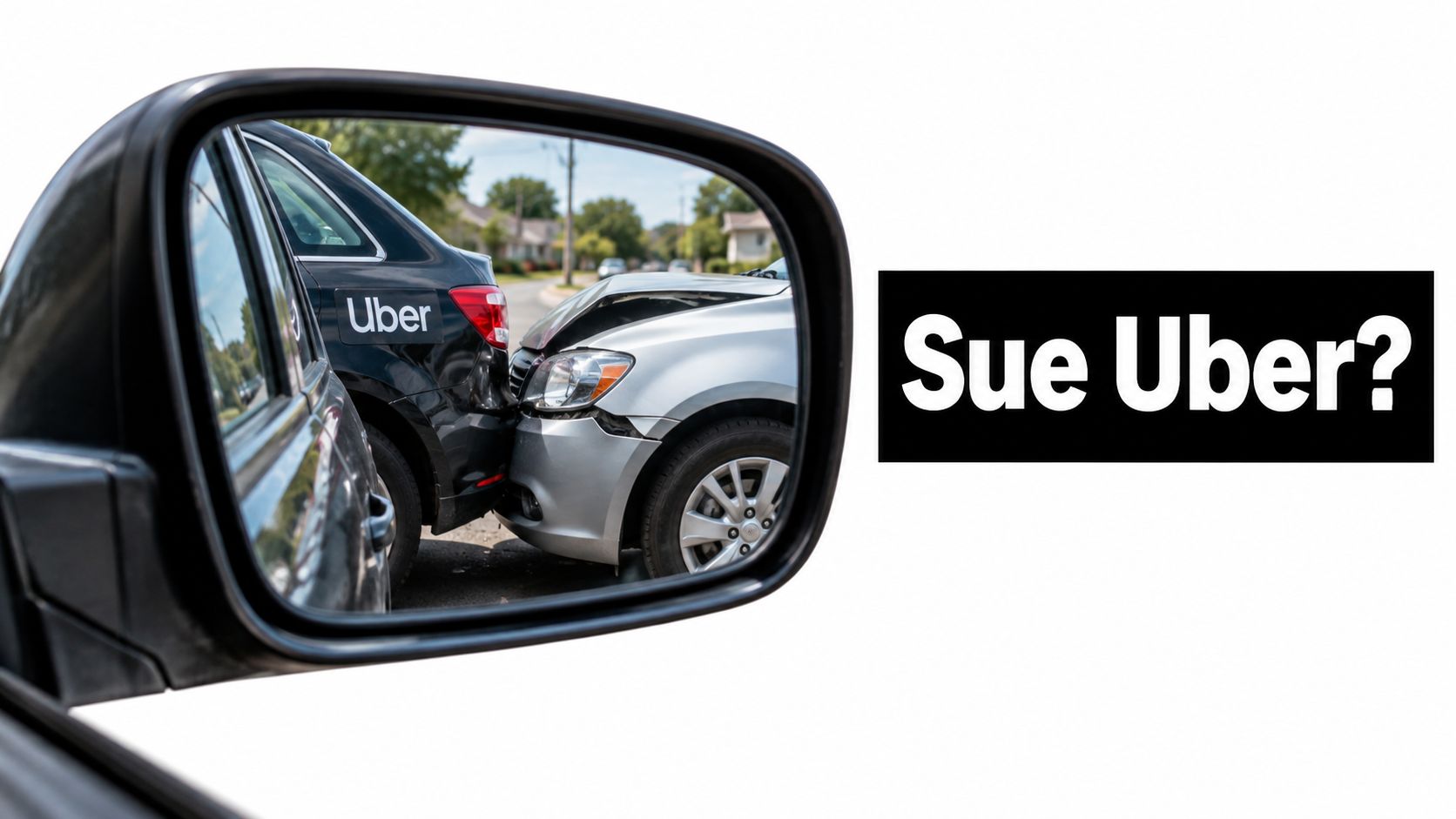
Yes. In California, injured passengers and third parties can sue Uber or its driver in many cases, but the recovery often turns on which app-status period was active at the time of the crash, because coverage can range from $50,000 per person and $100,000 per accident in a waiting-for-request period to $1 million from ride acceptance through drop-off.
If you’re reading this after a crash, you’re probably dealing with the same immediate problems I see in rideshare cases all the time. Your phone still shows the trip receipt. Your neck or back hurts more than it did at the scene. An adjuster wants a statement. And the question isn’t abstract. It’s whether there is money available to cover treatment, lost income, and the disruption the crash just caused.
Most articles stop at the surface answer to can you sue Uber for an accident. The harder issue is whether suing Uber opens meaningful coverage, and whether California’s newer insurance rules help you or cap your claim in a way most riders never see coming. That matters most when another driver caused the wreck, because fault and available recovery are not always the same thing.
This article is for informational purposes only and is not to be construed as legal advice. No attorney client relationship exists based on the review of this article, and none of the information in this article is legal advice.
What Riders and Bystanders Should Know Right Now
A common fact pattern looks like this. You’re being dropped off in Los Angeles, the Uber driver rear-ends another car, and you walk away thinking you’re lucky until the stiffness sets in and the emergency room bill lands. In that moment, almost everyone has the same three questions.
The three questions that actually matter
-
Can I sue Uber at all?
Usually, yes. But in practice the first claim may be against the driver, Uber’s insurance, another driver, or some combination of them. -
Whose insurance pays first?
That depends on the driver’s status in the app when the crash happened. California treats rideshare crashes differently from ordinary car wrecks because rideshare coverage is layered instead of sitting under one simple personal auto policy. -
How long do I have to act?
Faster than many think. Evidence disappears early in rideshare claims, especially digital evidence tied to trip timing and app activity.
Bystanders follow the same basic framework. If an Uber vehicle hit you while you were driving, biking, or walking, the legal analysis still starts with app status and fault.
Practical rule: In rideshare cases, “Was it an Uber?” is only the first question. “What was the driver doing in the app at that exact moment?” is the one that usually decides coverage.
Why rideshare cases feel different
With a normal crash, you identify the driver and open a claim under that driver’s policy. With Uber, the answer changes depending on whether the app was off, on and waiting, or actively carrying a passenger. That shift affects who gets named, which insurer responds, and whether a modest policy or a much larger commercial layer is available.
If you’re trying to decide what to do next, don’t assume the logo on the windshield answers the money question. It doesn’t. The framework below is what determines your real options.
How Uber’s Insurance Phases Actually Work
Think of Uber coverage like a driver clocking in and out. The coverage doesn’t turn on whether the driver says they were “working.” It turns on what Uber’s records show the app was doing at the time of impact.
The three phases
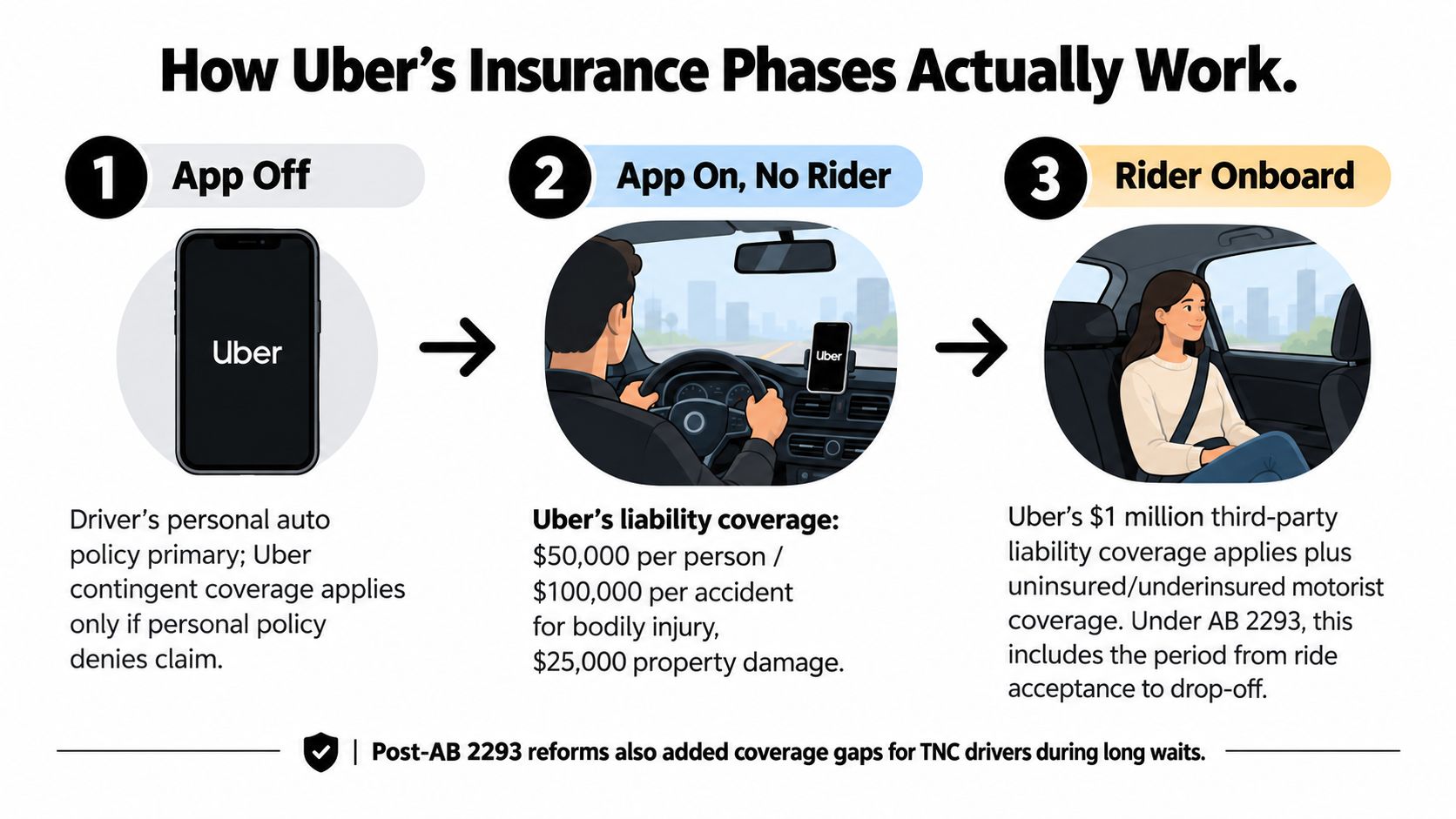
Phase 1 means the app is off. In that situation, the driver’s personal auto insurance usually applies. Uber describes app-off periods as outside its active rideshare coverage structure in its driver insurance overview.
Phase 3 starts when a ride is accepted and continues through drop-off. Uber states that from ride acceptance through drop-off, its commercial liability policy can provide up to $1 million in coverage in its rideshare insurance explanation.
Why timestamps matter more than conversation
In real cases, the driver’s memory doesn’t control. The app timestamp does. Trip logs, GPS history, telematics, and ride receipts usually tell the better story.
That is why a rider should save the trip screen immediately. It’s also why lawyers push quickly for backend records when the phase is disputed. If the impact happened seconds before pickup or seconds after a rider exited, that timing can change the available insurance dramatically.
If you want a clean plain-English comparison of how business-use exposure differs from ordinary car insurance, it helps to compare commercial auto policies with personal ones. The distinction is exactly why so many Uber claims turn into coverage fights.
What works and what doesn’t
What works is objective proof. Screenshots, trip receipts, and electronic records move claims forward. A detailed overview of how these coverage layers come into play appears in this rideshare accident coverage guide.
What doesn’t work is assuming the insurer will sort out the right phase on its own. If the timing is close, every carrier involved has a reason to argue another policy should pay first.
Who You Are Really Suing. The Driver or Uber
Most people ask whether they can sue Uber as if there are only two choices. There are really three.
The three defendant setups that show up in practice
First, you may sue the driver individually. That’s the most straightforward path when the app was off. It can also matter when damages go beyond available insurance and the driver has collectible personal assets.
Second, you may sue Uber as the company tied to the active rideshare coverage. That becomes realistic when the ride was in a phase where Uber’s commercial layer attaches.
Third, you may sue both. That is often the practical move at the start of a case because it preserves your ability to sort out fault, coverage, and app status without guessing wrong too early.
| Phase | App Status | Primary Defendant | Available Coverage |
|---|---|---|---|
| Phase 1 | App off | Driver | Driver’s personal auto policy |
| Phase 2 | App on, waiting for request | Driver and potentially Uber-linked coverage | Contingent liability coverage tied to waiting period |
| Phase 3 | Ride accepted through drop-off | Driver and Uber-linked coverage | Commercial third-party liability coverage tied to active trip |
Why direct liability theories against Uber are harder than people expect
Uber structures these cases around the driver as an independent contractor, not a traditional employee. That doesn’t make Uber untouchable. It does make old-fashioned respondeat superior arguments harder than people assume.
Claims framed as negligent hiring, negligent retention, or negligent entrustment can exist in the right facts, but they aren’t the easy lane in most collision cases. They usually require proof focused on Uber’s own conduct, not just the driver’s bad driving. California’s contractor-versus-employee fights have also been litigated through tests like Borello and the ABC framework, but that debate doesn’t automatically convert every accident case into a clean employer-liability claim.
Suing Uber usually isn’t about scoring a dramatic courtroom win against a tech company. It’s about reaching the insurance layer that a personal auto policy can’t match.
The practical lens
When people ask me whether naming Uber matters, the honest answer is this: it matters when doing so opens the right coverage and forces the platform to preserve records. It matters much less when the crash clearly sits outside the rideshare period.
If your goal is compensation rather than headlines, focus less on the name in the caption and more on which defendant makes the viable policy accessible.
The 2026 California Coverage Gap Most Articles Miss
The headline change sounds simple. Uber announced that in California, starting January 1, 2026, every passenger trip would be covered by $1 million in liability insurance for injuries or property damage caused by the rideshare driver in its California insurance reform update.
That sounds broad. It isn’t broad in every direction.
The overlooked problem
The harder issue comes up when someone other than the Uber driver causes the crash. In that situation, you’re not using liability coverage against your own rideshare driver. You’re looking for uninsured or underinsured motorist coverage, often called UM/UIM.
Under the same California update, Uber says passenger-trip UM/UIM coverage is $60,000 per person and $300,000 per accident beginning in 2026. Effective January 1, 2026, rideshare companies must provide uninsured and underinsured motorist coverage of $60,000 per person and $300,000 per incident while a passenger is in the vehicle; it is provided by the rideshare company and is primary. Before January 1, 2026 the statutory amount was $1,000,000. Whether and how it applies to a particular crash depends on the facts. Source: Pub. Util. Code section 5433, as of October 2026.
| App Status | Liability Limit | UM/UIM for Passenger | Net Recovery Risk |
|---|---|---|---|
| Ride accepted through drop-off, Uber driver at fault | $1 million | Not the key coverage issue in that fault setup | Lower risk of a low-policy ceiling |
| Passenger in the vehicle, third-party driver at fault | Liability may depend on the third party’s policy first | $60,000 per person and $300,000 per incident, only while a passenger is in the vehicle | Higher risk in serious injury or multi-victim crashes |
| App on before pickup or disputed timing | Coverage analysis becomes more contested | Recovery may depend heavily on the exact status and available policies | Highest risk of a sharp cap or denial fight |
Why this detail matters more than the press release number
A catastrophic injury claim can outgrow a third-party driver’s small policy very quickly. Sometimes it doesn’t. The coverage that matters may be the UM/UIM layer, and that can be the bottleneck.
That gap becomes even more important in chain-reaction crashes, freeway collisions, or any case with multiple injured passengers. One useful discussion of the issue appears in this California rideshare coverage change analysis.
Pedestrians and other bystanders face a different posture. They are usually looking at liability coverage tied to the rideshare driver’s conduct, not passenger UM/UIM tied to an active trip. Same crash ecosystem. Different recovery path.
Arbitration, Opt-Out, and Filing Deadlines
A lot of valid claims never turn into strong recoveries because procedure gets ignored. In rideshare cases, three procedural issues shape the whole file.
Arbitration changes the battlefield
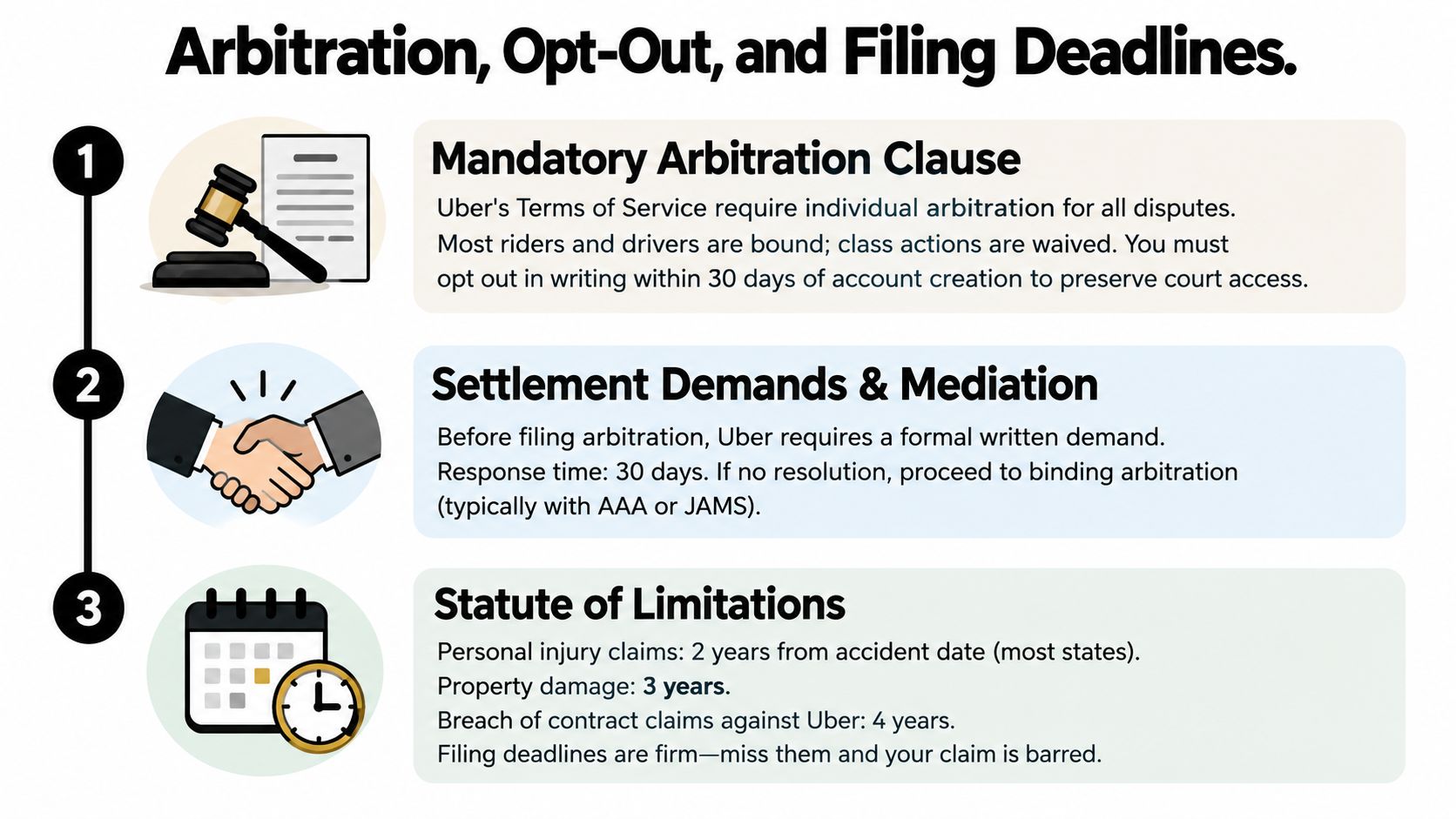
Uber has historically required many disputes to go into individual arbitration rather than open court. For riders, that often means no jury trial and no class-action path. The practical effect is that your case may still be pursued aggressively, but the forum is different and the process is more private.
Some users had an opt-out window after account creation. Many missed it because almost nobody signs up for a rideshare app expecting to litigate later. If you didn’t opt out, assume arbitration may become part of the defense playbook until your lawyer confirms otherwise.
Deadlines that control the case
California deadlines matter even if the claim starts with an insurance demand instead of a lawsuit.
- Personal injury claims: California generally gives two years to file.
- Property damage claims: California generally gives three years to file.
- Government involvement: If a public entity or road condition issue is part of the case, much shorter notice rules can apply.
A practical overview of the claim path appears in this Uber accident claim guide.
Deadline warning: Missed filing deadlines usually aren’t fixable. You can argue value later. You usually can’t revive an expired claim later.
What this means in real life
People often think the key early decision is whether to settle or sue. Usually it isn’t. The key early decision is whether someone is preserving the right evidence and tracking the right deadline while the medical picture develops.
Arbitration also changes negotiation strategy. A demand package for an arbitrator is usually built differently from one aimed at a jury pool. That doesn’t reduce the value of a strong case. It changes how you present it.
Evidence to Collect at the Scene and After
The first evidence in a rideshare case is usually gathered by the injured person, not by a lawyer. The good news is that the most important items are simple if you know to preserve them fast.
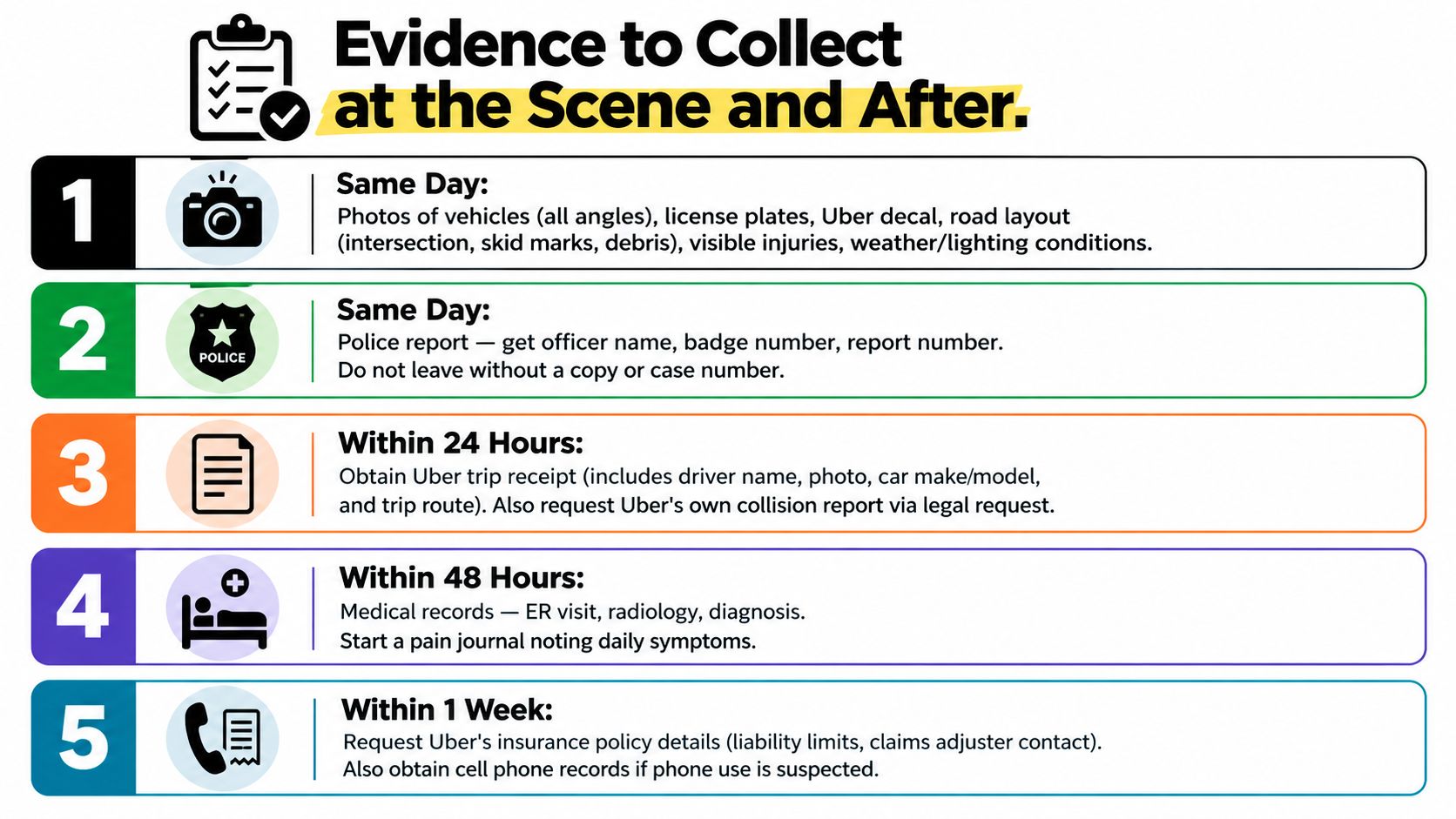
- Vehicle photos: Take all angles of every car involved, plus the license plates.
- Rideshare identifiers: Photograph the Uber decal if visible.
- Scene layout: Capture lane markings, intersections, debris, skid marks, and traffic controls.
- Visible injuries: Bruising, cuts, swelling, and airbag burns can look very different a day later.
- People and paperwork: Get the driver’s name, insurance information, and witness contact details.
Save the Uber app screen showing the ride, timestamp, driver identity, and trip status. That single screenshot can end a later dispute about whether the trip was active.
What to gather in the next few days
Request the traffic collision report. Start a basic symptom journal while memories are fresh.
A short daily note is enough. Record pain, headaches, sleep disruption, missed work, difficulty driving, and limits on routine tasks. Those details often matter more than people expect because they connect the collision to daily loss in a way billing records alone cannot.
To see how lawyers discuss scene preservation and post-crash proof, this video gives a practical overview:
The records you usually can’t get by yourself
Uber’s internal app logs, GPS records, trip data, and other backend records often aren’t directly accessible to the rider. Those records can decide which insurance phase applied and whether the company can deny that its commercial coverage was active.
The best evidence in a rideshare case is usually the evidence nobody can later “remember” differently.
That is one place where counsel can materially change the outcome. A lawyer can send preservation notices, subpoena records, and pin down the timing before the digital trail goes stale.
Two Rideshare Scenarios Walked Through
The same legal framework can produce very different results depending on who caused the crash and when it happened.
Scenario A and Scenario B compared
| Factor | Scenario A: Passenger Rear-Ended | Scenario B: Pedestrian Hit by App-On Driver |
|---|---|---|
| Who was injured | Uber passenger | Pedestrian |
| Fault setup | Another driver rear-ends the Uber | Rideshare driver runs a yellow light |
| Ride status | Passenger is in an active ride | Driver is app-on with no passenger |
| Main coverage focus | Third-party liability first, then Uber-related protection if needed | Driver liability plus waiting-period rideshare coverage |
| Best early move | Pursue both the at-fault driver and the rideshare-related coverage path | Sue the driver directly and lock down app-status proof |
| Main risk | Third-party policy may be too small for the injuries | Coverage fight over exact app timing |
Scenario A
A passenger riding in an Uber is stopped at a red light and gets rear-ended by another vehicle. The rider suffers whiplash and a mild concussion. The other driver’s policy exists, but the injuries and follow-up care may push the claim beyond that policy’s comfort zone.
In that setup, the smart move is usually to pursue the third-party driver and preserve the Uber-related coverage path at the same time. Waiting to see if the outside driver has “enough” often burns time and gives insurers room to point at each other.
Scenario B
A pedestrian is crossing with the signal when a rideshare driver, logged into the app but carrying no passenger, strikes them while pushing a yellow light. This is not the million-dollar active-trip fact pattern people usually imagine.
The first move is usually against the driver, with immediate focus on confirming the driver was app-on and waiting for a request. If that status is established, contingent rideshare coverage may come into play. If it isn’t, the case may shrink to the driver’s personal policy. It is worth asking how fees and case costs work and getting the terms in writing.
When to Call a Lawyer and What Comes Next
Not every Uber crash requires counsel. Some cases can be handled directly with an insurer. Many can’t.
When self-help is usually enough
If the crash caused minor property damage, no real injury, clear fault, and prompt payment, handling the claim yourself can be reasonable. The same goes for a straightforward reimbursement issue where there is no dispute about causation or treatment.
When a lawyer usually moves the needle
Call a lawyer when any of these are true:
- You received medical treatment: Once treatment starts, valuation and documentation matter.
- The crash happened during an active ride: App status and layered coverage become central.
- More than one party may be at fault: Multi-vehicle rideshare crashes get complicated fast.
- An insurer is disputing liability or minimizing injury: That’s when recorded statements and incomplete medical narratives start hurting claims.
- Policy limits may be tight: Coverage strategy matters when damages may exceed one available policy.
- Uber is being named or its records matter: That often requires faster and more technical preservation work.
One California option in that category is LA Law Group, APLC, which handles rideshare injury claims and related coverage disputes as part of its personal injury practice.
The next steps that help most
Get medically evaluated promptly if you haven’t already. Preserve the app receipt and screenshots. Open the relevant claim without giving a long recorded narrative before you understand the coverage picture. Then have the case reviewed while the filing deadlines are still comfortably open.
This article is for informational purposes only and is not legal advice. No attorney client relationship exists based on reading it, and any consultation about your own crash should happen with the actual facts and documents in front of counsel.
If you were hurt in an Uber or Lyft crash, LA Law Group, APLC can review the trip status, identify which insurance layer may apply, and help preserve the records that often decide these cases. The firm also handles disputes involving third-party drivers, contested liability, and rideshare injury claims across California. To learn more or request a case review, visit LA Law Group, APLC.
Attorney Advertising. This article is general information, not legal advice, and does not create an attorney-client relationship. Prior results do not guarantee a similar outcome.