
Four Way Traffic Signal
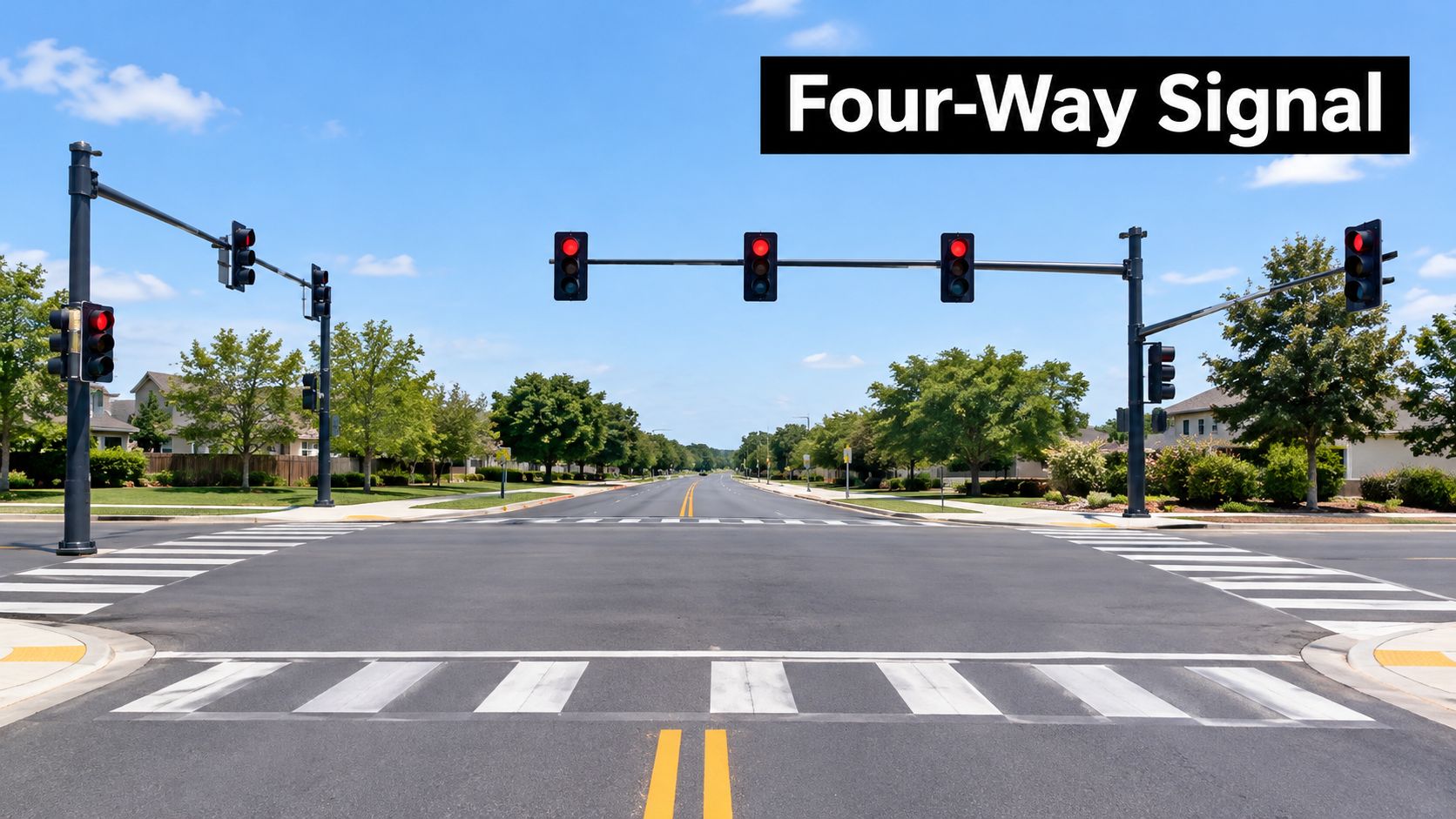
Approximately one-quarter of U.S. traffic fatalities and about one-half of traffic injuries occur at intersections. In 2022, signalized intersections accounted for 4,204 U.S. traffic fatalities, including 1,272 involving red-light running.
You approach a four-way traffic signal on a green light, enter the intersection, and suddenly another vehicle crosses your path. The other driver insists they had the green. You remember your own signal clearly, but the collision report, camera footage, timing records, and witness accounts may tell a more complicated story.
For injured drivers, passengers, pedestrians, and bicyclists, the central question isn’t always just who saw red or green. Yellow duration, all-red clearance, pedestrian timing, detector settings, phase sequence, visibility, and equipment condition can affect how an accident happened and how fault should be analyzed. This article is for informational purposes only and isn’t legal advice. No attorney-client relationship exists based on your review of this article, and none of the information in this article is legal advice.
Understanding Four-Way Traffic Signals and Intersection Safety
A typical collision begins with confidence. A driver sees green, checks the road ahead, and proceeds. A vehicle from the cross street enters against a red indication, or a turning vehicle fails to yield to someone already in the crosswalk. The impact happens in seconds, but determining responsibility can require much more than comparing two drivers’ memories.
The Federal Highway Administration states that approximately one-quarter of U.S. traffic fatalities and about one-half of traffic injuries each year are associated with intersections. Signalized intersections account for roughly one-third of intersection fatalities, which means signals reduce certain conflicts but don’t remove the danger. In 2022, 4,204 U.S. traffic fatalities occurred at signalized intersections, including 1,272 involving red-light running, according to FHWA intersection safety data.
What a four-way signal controls
A four-way signal coordinates movements from four approaches. It assigns separate right-of-way intervals to through traffic, turning vehicles, bicycles, and pedestrians. The system relies on color indications, phase order, clearance intervals, and timing settings to prevent conflicting movements from occurring at the same time.
That system doesn’t guarantee that every road user will comply or that every engineering choice will work perfectly. A driver may enter during a transition, misread a turning arrow, fail to see a pedestrian, or continue through a stale green without checking the intersection. A signal may also have visibility problems, detector issues, or timing settings that require investigation after a serious collision.
Practical rule: A green light gives permission to proceed only when the movement is lawful and safe. It doesn’t erase the duty to observe, yield, and avoid a collision.
Why the investigation matters
Fault may rest with a driver who ran a red light, a turning driver who failed to yield, or multiple parties whose conduct contributed to the crash. In some cases, the available evidence may also raise questions about signal operation, road design, sight distance, maintenance, or inadequate clearance time.
Preserve your own account while it’s fresh. Write down which signal you saw, where each vehicle was positioned, whether the light changed before entry, and what pedestrians or cyclists were doing. If the collision has caused emotional strain for you or your family, a separate resource such as Interactive Counselling’s family services may provide support, but it can’t replace medical care or legal guidance after an injury.
What the Light Colors Actually Mean Under California Law
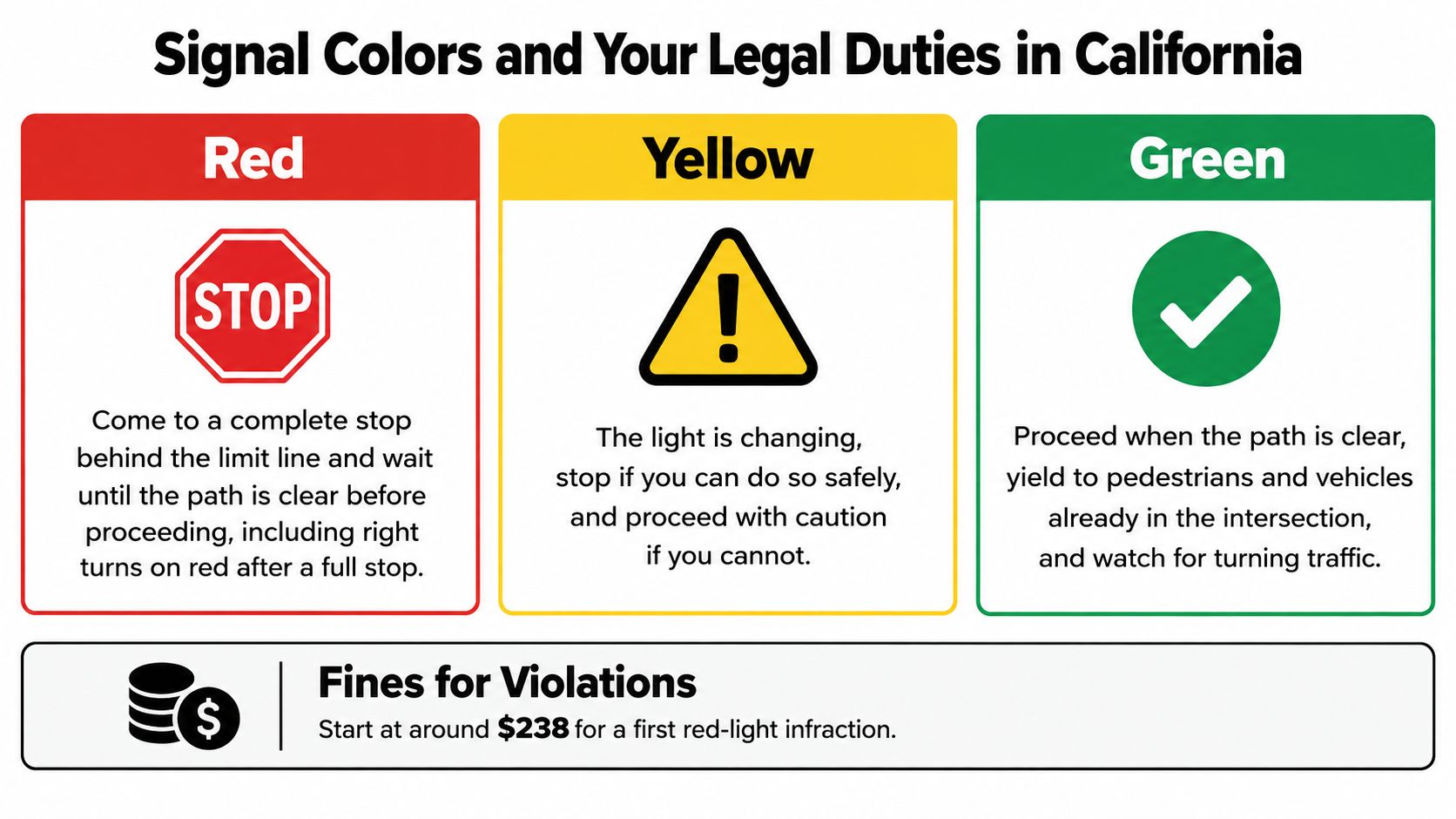
California law gives each signal color a practical meaning, but drivers often reduce the rules to “red means stop and green means go.” That shortcut creates problems in collision cases because a green indication doesn’t eliminate the duty to yield.
Green doesn’t mean unlimited priority
California’s official rules provide that a circular green signal permits a driver to proceed straight, turn right or left, or make a U-turn unless a sign prohibits the U-turn. The same rule requires every driver, including a turning driver, to yield to traffic and pedestrians lawfully in the intersection or an adjacent crosswalk. You can review the rule in California Vehicle Code provisions governing traffic signals.
That distinction is decisive in many fact patterns. A driver turning left on green may still need to yield to oncoming traffic or a pedestrian lawfully crossing. A driver turning right may have to wait for a pedestrian in the adjacent crosswalk. A driver going straight may have a green signal but still must react to a vehicle that has unlawfully entered the intersection.
Yellow requires a judgment about safety
Yellow warns that the indication is changing. It isn’t a guaranteed invitation to accelerate through the intersection, and it isn’t a command to stop abruptly when doing so would create a new danger. The correct response depends on whether the driver can stop safely, the vehicle’s position, speed, road conditions, and the surrounding traffic.
Evidence about the moment of entry matters. A vehicle that entered on yellow may be treated differently from one that entered after the signal turned red, but witnesses often remember the impact rather than the precise transition. Video, event data, signal records, and physical evidence can help establish what happened.
Red prohibits entry
A red indication requires the driver to stop before entering, subject to the applicable legal rules for a permitted movement such as a right turn after a complete stop. A driver who enters on red can face strong liability evidence, but the investigation still should identify whether another road user had already entered lawfully, whether the signal was visible, and whether a separate turning or pedestrian conflict contributed to the crash.
Signal Timing, Equipment Issues, and Engineering Factors
A collision at a four-way traffic signal may look like a simple driver-versus-driver dispute. The engineering record can be more revealing. Signal timing, detector operation, phase sequence, lane assignment, visibility, and clearance intervals can show whether the intersection operated as intended and whether a driver’s account is consistent with the signal plan.
Research from the National Highway Traffic Safety Administration estimated 787,236 intersection-related crashes in the studied dataset, representing approximately 36% of all crashes examined. Among vehicles for which a critical reason was assigned, about 52.5%, or approximately 413,140 vehicles, were traveling on roads controlled by at least one traffic signal. The study attributed about 96.1% of intersection-related crashes to a driver-related critical reason, as reported in the NHTSA intersection crash study.
That last figure shouldn’t end the investigation. “Driver-related critical reason” doesn’t automatically establish sole legal fault, and it doesn’t prove that signal visibility, timing, or equipment played no role. It describes the study’s classification, not the final liability finding in your individual case.
The timing details that can change the analysis
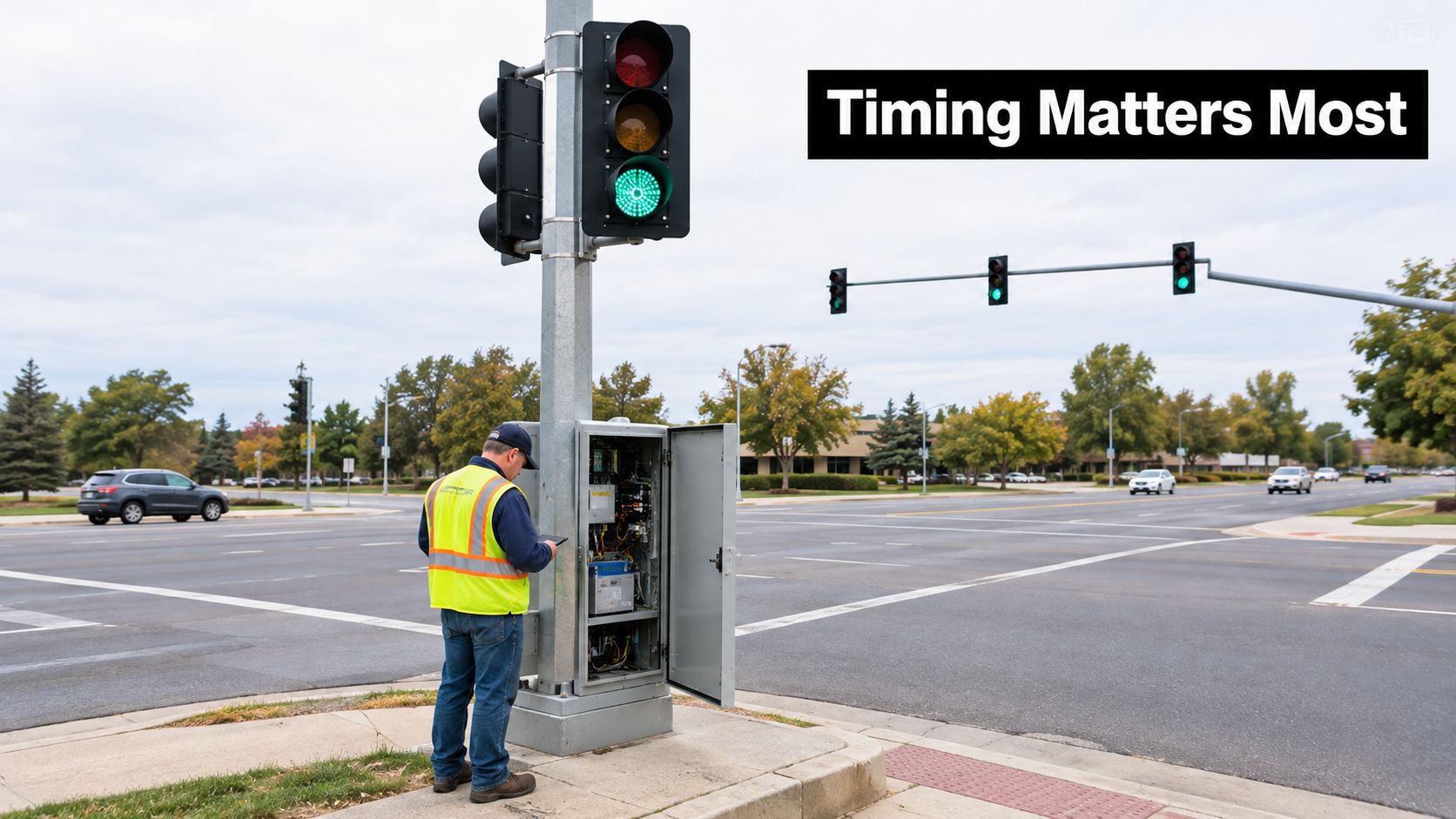
Engineers allocate green time among competing movements while preserving yellow and red-clearance intervals. FHWA defines effective green as displayed green minus startup lost time, and the Highway Capacity Manual commonly uses a default total lost time of approximately four seconds per phase, as explained in FHWA guidance on signalized intersection capacity.
A longer displayed green doesn’t automatically create equivalent usable capacity. Each phase can include startup and clearance losses, and the critical lane group may remain congested even when another approach receives additional green time. Investigators should examine demand by lane group, queue spillback, pedestrian phases, and whether the signal sequence created a conflict.
Detector and maintenance questions
Coordinated signals depend on cycle length, offset, and split. FHWA generally prefers cycle lengths of no more than 120 seconds for conventional four-legged intersections, while unusually large or heavily congested intersections may justify longer cycles. Detector distance, detector length, passage time, and minimum green also must match the intersection’s geometry, traffic volume, and approach speed. These details appear in FHWA signal timing guidance.
After a serious crash, counsel or an investigator may seek the timing plan, maintenance logs, controller records, detector settings, inspection history, intersection-camera footage, and prior complaints. An accident reconstruction expert’s role and potential cost can be relevant when the parties dispute vehicle speed, signal phase, stopping distance, or the point of impact.
Four-Way Stops Versus Four-Way Traffic Signals
A four-way stop and a four-way traffic signal don’t use the same right-of-way system. At a stop-controlled intersection, drivers stop and apply arrival-order rules. At a signalized intersection, active signal phases generally control the movement, subject to continuing duties to observe, yield, and proceed safely.
When arrival order controls
The California Department of Motor Vehicles explains that drivers approaching signals or signs must yield to pedestrians, bicyclists, and nearby vehicles that may have the right-of-way. When vehicles reach an intersection at different times, the vehicle that arrives first has the right-of-way, while other vehicles, bicyclists, and pedestrians must wait for that road user, according to the California Driver Handbook’s rules of the road.
That principle is most useful when traffic isn’t being assigned by a functioning active phase. Examples include a flashing signal, a malfunction, or a situation in which the signal doesn’t clearly communicate which movement has priority. It doesn’t authorize the first-arriving driver to force a passage through a pedestrian crossing or against an unmistakable protected movement.
Why the distinction affects a claim
At a four-way stop, the investigation should establish who stopped first, whether a vehicle stopped at all, whether two vehicles arrived together, and whether a driver yielded to a road user already in the intersection. Witnesses positioned on the corners can be especially important because each driver may have a different view of arrival order.
At a signalized intersection, arrival order usually isn’t the controlling fact. The investigation instead focuses on the signal indication, lane and turn movement, phase sequence, yellow and all-red intervals, and whether the vehicle entered during a permitted phase. Treating a signal like a four-way stop can create a false legal theory.
| Intersection control | Primary right-of-way question | Evidence to preserve |
|---|---|---|
| Four-way stop | Which road user stopped or arrived first? | Witness accounts, stop-line positions, vehicle movements |
| Active traffic signal | Which movement had the assigned indication? | Signal records, video, timing plan, lane markings |
| Flashing or malfunctioning signal | What did each road user reasonably observe, and who yielded? | Maintenance records, photographs, witness accounts |
The safest approach during a malfunction is to slow down, stop when required, and proceed only after confirming that the path is clear. After a crash, don’t assume the rules of a stop-controlled intersection automatically resolve a signal dispute.
Steps to Take After a Four-Way Intersection Accident
The first minutes after a collision are chaotic, but your actions can preserve evidence that may disappear quickly. Protect your health first, then create a clear record of the intersection and the people involved.
-
Get to safety and call 911. Move away from active traffic if you can do so safely. Request emergency medical assistance for anyone who is injured, and don’t refuse necessary care because the collision initially seems minor.
-
Exchange information without arguing fault. Obtain names, contact details, insurance information, license plate information, and vehicle descriptions. Don’t apologize, accuse the other driver, or speculate about the signal. A short statement made under stress can later be taken out of context.
-
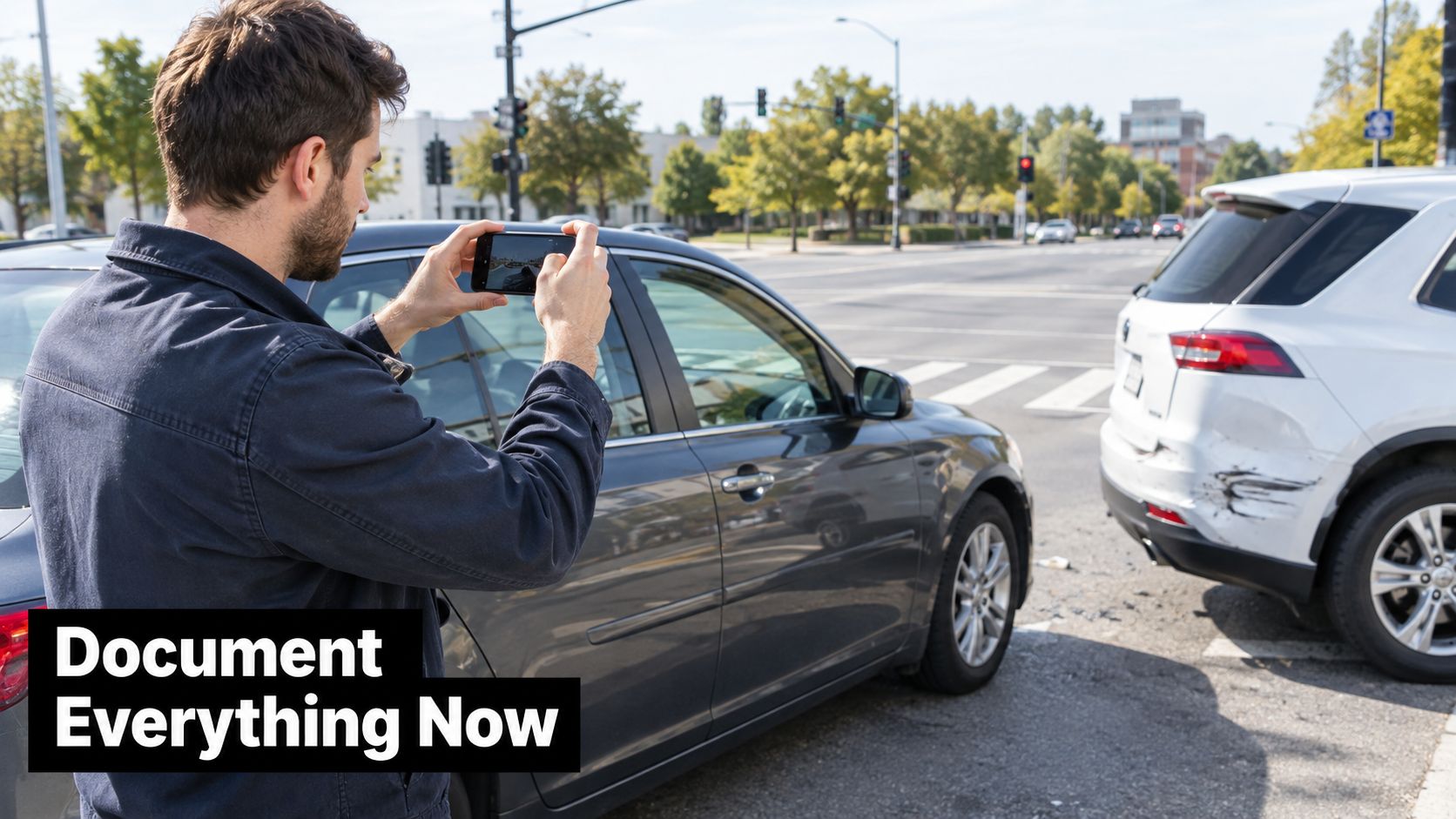
Photograph the scene. Capture vehicle positions, damage, lane markings, stop lines, crosswalks, signs, signal heads, visibility obstructions, road conditions, and any visible injuries. If the light is still displaying a relevant indication, photograph it only from a safe location.
-
Identify witnesses. Ask witnesses for contact information and a brief description of what they observed. Record where each witness stood and whether they saw the signal, the vehicles, or only the impact.
After the immediate scene is handled, request the police report and learn whether fire or emergency personnel created additional records. Seek a medical evaluation even if you feel fine. Some injuries become apparent later, and contemporaneous medical documentation can connect symptoms to the collision.
Evidence often disappears before the dispute begins. Save dashcam footage immediately, because recording systems may overwrite older files. Also preserve photographs, texts, insurance communications, repair estimates, and notes about pain or limitations.
A useful overview of what to do after a car accident can help you organize the early steps. Don’t edit or crop original video files, and keep copies in more than one secure location.
Further evidence may include intersection-camera footage, signal phase and timing records, detector data, maintenance logs, and prior reports concerning visibility or malfunction. A lawyer can send preservation requests before public or private systems overwrite recordings.
Don’t post a detailed account of the collision on social media. Give your insurer accurate information, but avoid recorded statements about fault or the full extent of your injuries until you’ve had an opportunity to understand the evidence and obtain appropriate advice.
How Legal Representation Can Change Your Outcome
Intersection cases turn on details that insurance adjusters may not collect voluntarily. The dispute may involve a driver’s statement, but it can also require the signal timing plan, detector settings, pedestrian phase, camera footage, vehicle data, photographs, witness testimony, and an accident reconstruction analysis.
Consider two competing accounts. One driver says the light was green. The other says it had already turned red. A weak investigation stops there and treats the dispute as impossible to resolve. A stronger investigation asks when each vehicle crossed the stop line, whether the signal sequence permitted both movements, how long the yellow and all-red intervals lasted, whether a detector extended a phase, and whether available video confirms either account.
What counsel should investigate
An attorney should identify the parties responsible for relevant evidence, including drivers, vehicle owners, insurers, public agencies, businesses with cameras, and witnesses. Counsel may also evaluate whether the intersection’s design, visibility, maintenance, or operating records support an additional theory of liability.
The benefits of hiring a personal injury lawyer after a car accident include having someone manage communications, preserve evidence, assess damages, and challenge an incomplete fault narrative. That doesn’t mean every case requires expert testimony or a lawsuit. It means the decision should follow an evidence-based assessment rather than an insurer’s first offer.
The financial impact of incomplete proof
A settlement should account for the actual consequences of the injury, including medical treatment, continuing symptoms, work limitations, property damage, and the effect on daily life. An insurer may focus on an apparent green light or an early medical record while overlooking delayed symptoms, pedestrian obligations, or technical evidence that changes the sequence of events.
Legal representation can also prevent avoidable mistakes. The lawyer can organize records, communicate with claims personnel, evaluate comparative responsibility, and determine whether further investigation is justified. For a pedestrian, bicyclist, passenger, or driver injured at a four-way signal, that process can expose facts that aren’t visible from the roadway after the vehicles have been removed.
The right result depends on proof, not confidence at the scene. Preserve the evidence, obtain medical care, and get a case-specific evaluation before accepting a settlement that may not reflect the full claim.
LA Law Group, APLC offers personal injury representation, evidence-focused accident investigation, and direct attorney access through offices in Los Angeles, Santa Monica, Chatsworth, and Fremont. If a four-way traffic signal collision left you injured, visit LA Law Group, APLC for a free initial consultation and discuss the signal, timing, camera, and liability evidence before you decide how to proceed.
Attorney Advertising. This article is general information, not legal advice, and does not create an attorney-client relationship. Prior results do not guarantee a similar outcome.