
Injured in Lyft Accident: California Coverage Guide
The popular advice to an injured Lyft passenger often starts with the size of the insurance policy. That’s the wrong starting point. A passenger who hears about a million-dollar policy may assume the money is available for any crash, even when another driver caused it. Liability coverage and uninsured-motorist coverage answer different questions, and neither guarantees a payment.
This article is for informational purposes only and is not to be construed as legal advice. No attorney-client relationship exists based on reading or reviewing this article, and none of the information in it is legal advice.
What an Injured Lyft Passenger Should Sort Out First
Say you’re riding home in a Lyft when another car strikes the vehicle. Someone tells you Lyft has a large commercial policy, so you assume your treatment and missed work will be covered. Before anyone can responsibly assess that assumption, they need to establish what happened, which insurance applies, and what records support your losses.
For someone injured in a Lyft accident, the first questions aren’t about the settlement amount. They’re about the facts that determine which claim can be made.
The facts that change the insurance question
Think of the driver’s app status as a switch with several positions. The app can be off, on and waiting, or connected to an accepted trip. Each position can point toward different insurance, even though the same person is driving the same car.
Start by separating these issues:
- App status at impact. Was the driver waiting for work, heading to your pickup, carrying you, or already finished with the trip?
- Who appears responsible. Did your Lyft driver cause the collision, did another motorist cause it, or are the accounts inconsistent?
- Records still available. Can you preserve the trip receipt, crash evidence, and medical documentation before they become harder to obtain?
A repair estimate answers a different question from an injury evaluation. If your own vehicle was involved, Seat Belt Repair’s explanation of repair versus replace after a crash offers useful context for discussing damaged components, but it doesn’t establish medical causation or insurance responsibility.
Start with classification, not compensation. Identify the trip phase and the potentially responsible driver before treating any policy limit as available money.
The coverage table below separates the app periods. The uninsured-motorist discussion addresses California’s changed requirements, while the preservation and medical guidance explains how to build a usable claim file.
Match every coverage figure to the crash date, location, and actual policy documents. A statutory minimum describes required insurance, not a promised payment to an individual passenger.
California Lyft Coverage by App Period
California Lyft liability limits by driver status
The waiting-period and accepted-trip minimums below come from California Public Utilities Code section 5433, which requires waiting-period limits of $50,000 per person, $100,000 per incident, and $30,000 for property damage, plus at least $200,000 in excess coverage per occurrence, and at least $1 million in primary commercial liability coverage once a ride is accepted.
| Driver status at impact | Policy that is generally primary | Liability minimum | Extra coverage noted |
|---|---|---|---|
| App off | Driver’s personal auto policy | Whatever that policy provides, if it covers the loss | Lyft says no Lyft policy applies |
| Logged in, waiting, no ride accepted | Transportation network company | $50,000 per person, $100,000 per incident, $30,000 property damage | At least $200,000 excess per occurrence |
| Ride accepted, en route, or passenger aboard | Transportation network company | At least $1 million for death, personal injury, and property damage | This is liability coverage, not uninsured-motorist coverage |
Read the table using the moment of impact, not when you later opened the app or reported the crash. A receipt generated afterward may help establish the timeline, but its delivery time isn’t necessarily the collision time.
Match the driver’s activity to the correct row
When the app is off, there’s no active platform connection to establish Lyft coverage. The driver’s personal auto policy is generally the starting point, although its exclusions and the actual vehicle use still need review.
When the driver is logged in but hasn’t accepted a request, the waiting-period requirements apply. This category matters particularly to pedestrians and people in other vehicles, since a booked passenger usually isn’t aboard yet.
Once the driver accepts a request, the accepted-trip period begins before the passenger enters the car. A collision while traveling to pickup therefore raises a different coverage question from a collision while merely waiting for a request.
For example, a driver heading toward a busy pickup area might already have accepted your booking. The fact that you weren’t in the vehicle doesn’t, by itself, put that driver in the waiting category.
Distinguish a statewide requirement from a general summary
Lyft’s national help material isn’t a substitute for California-specific policy documents. Its Insurance Policy for Drivers lists contingent waiting-period property-damage coverage of at least $25,000, below California’s $30,000 statutory floor, and says no Lyft policy applies when the app is off.
That discrepancy is a reason to obtain the California policy and endorsements effective on the collision date. A general help-page summary doesn’t displace a statutory requirement. The policy in force must be read alongside applicable law.
Ask the insurer to identify:
- The insured activity. Which trip phase does it believe applied?
- The controlling documents. Which declarations, endorsements, and coverage provisions support that conclusion?
- Any disputed condition. Is it questioning app status, responsibility, an exclusion, or whether a particular loss is covered?
Required minimums are not settlement estimates. An insurer still evaluates coverage, responsibility, injuries, and documented losses before deciding what it will pay.
Why One Million Dollars May Not Be the Recovery
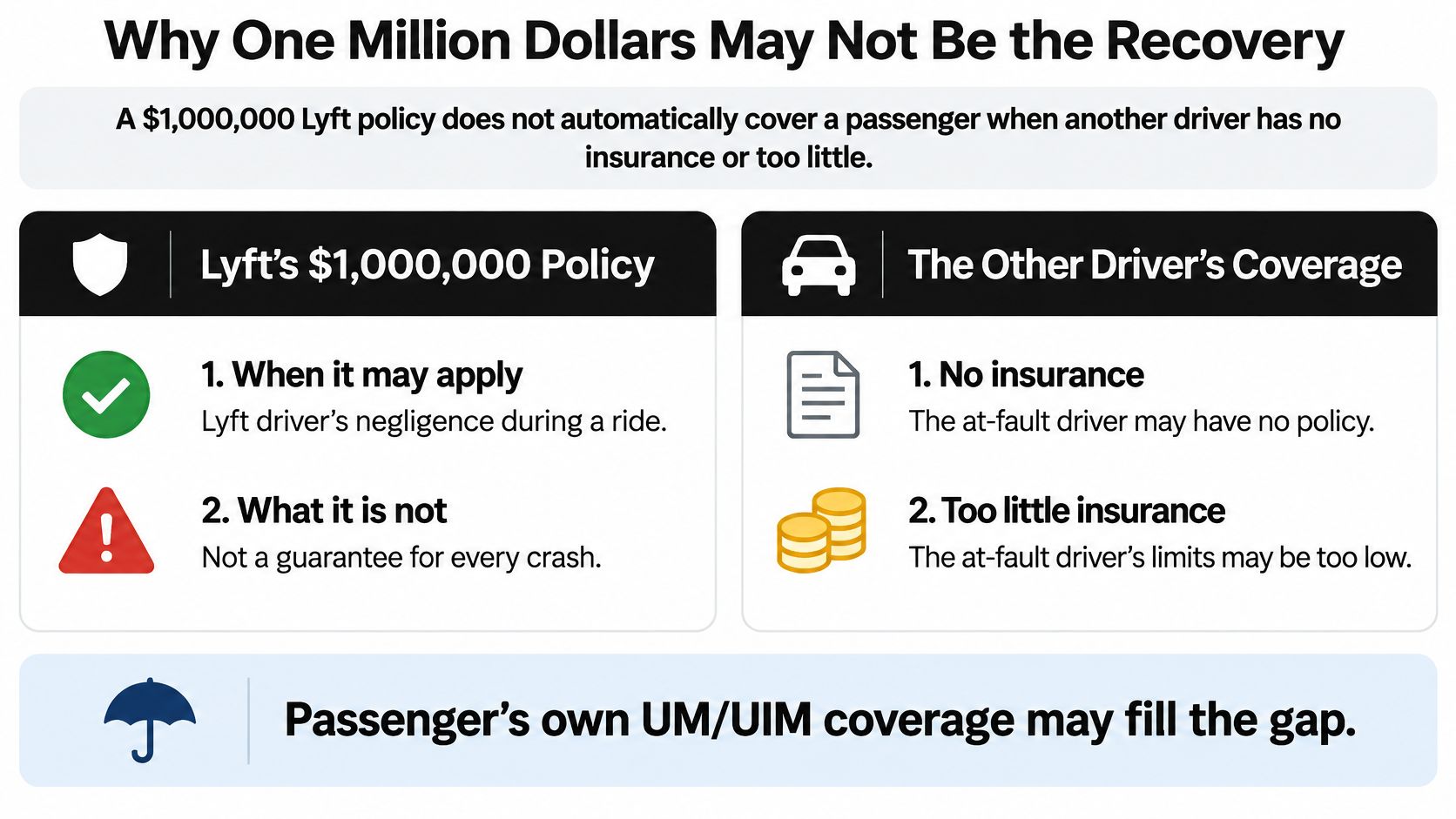
The headline liability policy isn’t automatically the policy that protects a passenger after a hit-and-run. If another motorist caused the collision, the central question may be uninsured or underinsured-motorist coverage, commonly called UM/UIM, rather than liability coverage for the Lyft driver.
California’s SB 371 and accompanying legislative analysis changed the transportation-network-company UM/UIM framework effective January 1, 2026, reducing required coverage to $60,000 per person and $300,000 per incident and placing that responsibility on the company rather than individual drivers. The analysis also reported that available TNC claims data indicated approximately 60% of claims would settle within the former $50,000/$100,000 limits, while acknowledging limited broader evidence.
Liability coverage compared with 2026 uninsured coverage
| Coverage | Typical trigger | Figure people should verify | What it is not |
|---|---|---|---|
| Third-party liability on an accepted ride | Harm allegedly caused while en route or carrying a passenger | At least $1 million | Not a promise that the claim pays $1 million |
| Uninsured or underinsured motorist after January 1, 2026 | At-fault driver uninsured, underinsured, or unidentified | $60,000 per person and $300,000 per incident | Not the same policy as the $1 million liability limit |
The distinction is between whose responsibility is insured and what happens when the responsible motorist lacks adequate insurance.
Follow the responsible driver’s coverage first
If your Lyft driver negligently causes a crash during an accepted trip, third-party liability coverage is the relevant starting question for your passenger injuries. If another identified driver causes it, begin by investigating that driver’s liability insurance.
When that motorist has no insurance, inadequate insurance, or cannot be identified, investigate applicable UM/UIM protection. Your own auto policy may also warrant review, but don’t assume different policies add together. Notice requirements, offsets, exclusions, and coordination provisions can affect how insurers respond.
A hit-and-run claim may also require evidence establishing the collision circumstances and satisfying the applicable policy conditions. Reporting the event doesn’t automatically establish eligibility.
A limit isn’t a valuation
A serious injury can exceed the per-person protection shown in the table. Surgery, interrupted employment, rehabilitation, and future treatment can create losses that available insurance doesn’t fully cover.
Conversely, the existence of a large limit doesn’t establish that a claim is worth that amount. Medical evidence, responsibility, policy terms, and other applicable limits still matter.
Older articles may describe the former million-dollar uninsured-motorist framework. Check whether an explanation addresses your accident date, rather than relying on its headline. Available claims averages also can’t predict the cost of your particular injury.
How to Preserve Lyft Trip Evidence
Without a reliable trip timeline, both fault and the correct insurer can remain disputed. A driver’s recollection that the ride was over may conflict with your receipt, while a screenshot taken afterward may not show what the platform recorded at impact.
Publicly discussed preservation warnings in this San Francisco rideshare passenger injury guide caution that app records and camera footage can disappear in days or weeks. That isn’t a universal retention schedule, but it’s a practical reason to act promptly.
Preserve records in a useful order
-
Get to safety and seek medical care. Don’t stay in traffic or delay needed treatment to photograph the scene. Ask someone else to collect information if your condition prevents it.
-
Photograph the physical evidence. Capture vehicles, license plates, damage, roadway conditions, signs, and visible injuries when safe. Include wider views that show where the vehicles were, not just close-ups.
-
Screenshot the Lyft trip. Save the receipt, trip identifier, driver and vehicle details, pickup and drop-off information, route, and available status screens. Preserve the original files rather than keeping only edited copies.
-
Write a contemporaneous timeline. Record the exact location, collision time as accurately as you can, and what the app displayed. Distinguish what you personally observed from what someone told you.
-
Collect report and witness details. Ask for the police report number and witnesses’ names and phone numbers. An independent account may help resolve conflicting descriptions of a turn, signal, or impact.
-
Identify cameras the same day if possible. Note dash cameras and nearby business or traffic cameras. Ask that relevant footage be preserved, and record the camera’s location and likely viewing direction.
-
Report the crash through Lyft. This guide to filing an accident report with Lyft in California explains the reporting process. Reporting isn’t a guarantee that every underlying record will be retained indefinitely.
-
Save communications in one place. Keep messages with Lyft, claim acknowledgments, insurer correspondence, attachments, and claim numbers. Consider obtaining legal help with a written preservation request for trip, location, and app-status records.
-
Don’t guess in a recorded statement. Say when you don’t know a speed, distance, or sequence. Before participating, clarify which insurer is requesting the statement and whether your own policy imposes cooperation duties.
The checklist below highlights the app-specific records that are easy to overlook.
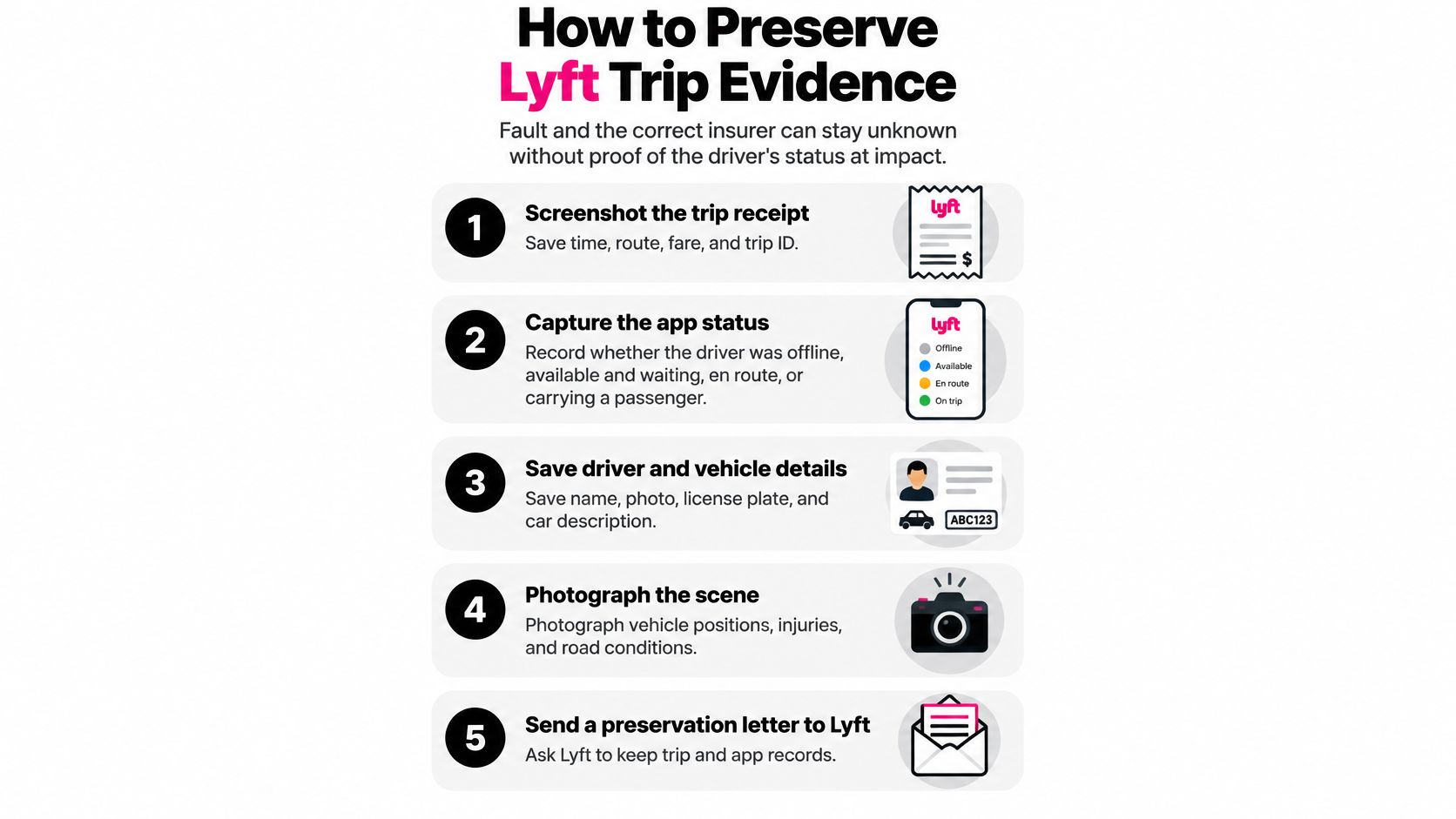
Who was at fault and which insurer applies cannot always be answered without time-stamped trip evidence.
Medical Records That Support the Injury Claim
“My back still hurts” describes a real concern, but it doesn’t give a reviewer a complete medical timeline. A useful file shows when symptoms began, what clinicians found, what treatment they recommended, and how the injury affected work and daily activities.
The National Highway Traffic Safety Administration’s crash-injury research program reviews patient records and imaging when developing detailed injury reports. That process illustrates the value of clinical documentation beyond a general description of pain.
Build the timeline around clinical findings
Prompt evaluation can document neurological, orthopedic, and soft-tissue findings before symptoms change. Delayed or fragmented treatment can make the relationship between the collision and later complaints harder to assess, though a delay doesn’t by itself prove that an injury is unrelated.
Tell providers how the collision occurred and which body regions hurt. Describe whether your head struck something, whether your body twisted, and what symptoms developed afterward, without speculating about legal fault.
Preserve a file containing:
- Ambulance and emergency records. These document early complaints, examinations, and immediate treatment.
- Imaging reports and specialist evaluations. Keep written interpretations, not only image disks or access links.
- Medication and therapy records. Include prescriptions, side effects you reported, physical-therapy measurements, and changes in function.
- Work restrictions and prior symptoms. Preserve medical work notes and accurately disclose comparable pre-crash problems.
- A dated symptom diary. Tie symptoms to activities such as walking, driving, sleeping, lifting, or concentrating.
The medical chart is the timeline. Gaps can look like missing chapters, so document practical reasons for interrupted care, including scheduling problems or transportation barriers, and discuss treatment concerns with your clinician.
Connect treatment to actual losses
Keep medical and surgical bills separate from payment statements and insurance explanations of benefits. Save recovery-related receipts and employment records showing missed work, reduced hours, or duties you couldn’t perform.
Future-care needs should come from treating professionals’ assessments, not your own estimate. Records of activity limitations can help explain why an injury affected your life even when a bill doesn’t capture that effect.
Emotional symptoms also deserve accurate reporting. If you’re experiencing fear, intrusive memories, or difficulty riding in a vehicle, Interactive Counselling’s explanation of trauma and PTSD counselling options offers background for discussing support with a qualified local provider.
Consistent dates help reviewers connect the injury to the collision under investigation. They support evaluation of the claim involving the responsible driver or applicable uninsured coverage, but medical records don’t independently establish traffic fault.
This week, put every bill, treatment note, and work restriction in one folder. Bring that folder to any coverage review.
Passenger, Other Driver, Pedestrian, and Lyft Driver Scenarios
Your position in the crash changes the first insurance question. A passenger’s injury claim isn’t the same as a Lyft driver’s claim for their own injuries or vehicle damage.
These examples show how the questions differ.
A passenger and an identified at-fault driver
You’re riding on an accepted trip when another motorist runs a signal and strikes the Lyft. That motorist’s liability insurance is the first place to investigate, while the rideshare-period coverage remains a separate issue.
The broader obligations and documentation concerns for a passenger in a car accident also apply. The first question is whether the identified driver’s insurer accepts responsibility and what coverage it confirms.
A passenger and a fleeing or inadequately insured driver
The same collision becomes a different coverage problem if the other motorist flees or cannot adequately cover the loss. For a crash after the statutory change, focus on the applicable UM/UIM policy rather than assuming the headline liability limit responds.
The first question is which uninsured or underinsured policy covers this passenger and event. Preserve evidence identifying the other vehicle even if its driver wasn’t located at the scene.
The accompanying video provides another way to approach rideshare insurance questions.
Another motorist or pedestrian injured by the Lyft driver
A Lyft driver turning toward a pickup strikes a pedestrian or another vehicle. If the driver had accepted the trip, investigate active-trip third-party liability coverage and the evidence of negligent driving.
The first question is whether the driver had accepted a request before impact. Being near a pickup location alone doesn’t establish platform status.
The Lyft driver is injured
A Lyft driver suffers injuries and vehicle damage in a collision. The California Department of Insurance’s transportation-network-company notice cautions that required liability insurance doesn’t necessarily include medical-payments, collision, or UM/UIM protection for the driver, and may not cover the driver’s bodily injury or own vehicle damage.
The first question is which policy insures the driver’s own losses. Personal, rideshare, health, medical-payments, and uninsured-motorist policies may require separate review.
California’s TNC insurance disclosure requirements also require written warnings about personal-policy coverage for platform use, including collision and non-collision protection from log-on to log-off. A driver shouldn’t assume their personal policy covers commercial activity merely because they’ve consistently paid the premium.
When to Have a California Lawyer Review the Claim
A legal review is especially useful when you can’t tell whether an insurer is disputing coverage, fault, or the extent of your injuries. Those are different problems, and each calls for different evidence.
For example, an insurer questioning app status needs a trip timeline. An insurer disputing future treatment needs medical support. Sending more medical bills won’t necessarily resolve a platform-status dispute.
Signs that the claim needs closer review
Consider a review when:
- App status is disputed. The driver’s account, receipt, and insurer’s classification don’t match.
- Several insurers are involved. Each points to another policy or gives an unclear explanation of priority.
- The responsible motorist is unknown or underinsured. You need to identify applicable UM/UIM protection and policy conditions.
- Injuries may exceed available uninsured coverage. Ongoing treatment or work restrictions make the financial exposure uncertain.
- You were a passenger, pedestrian, or occupant of another car. You need a clear explanation of which driver and policy your claim concerns.
Our guide to when to hire a personal injury attorney provides additional context for deciding whether representation would help.
This article is informational only, isn’t legal advice, and creates no attorney-client relationship.
What a review with our firm involves
At LA Law Group, APLC, we help injured people with car accidents, rideshare crashes, pedestrian and bicycle injuries, and premises claims. Your first consultation is free and confidential, and you meet with the attorney who will handle the matter.
We can review what happened, explain injury-claim options in plain language, and communicate with insurers on your behalf. We serve clients throughout California in English, Spanish, and Farsi.
When you work with our personal injury lawyers, we first negotiate a settlement with the insurance company. If an agreement can’t be reached, the matter may proceed to litigation. Neither step guarantees a result or a particular recovery.
A productive consultation starts with a clear account of the collision and the records you already have. Don’t delay seeking a review because the file isn’t complete. Bring your trip screenshots, police report number, and medical folder, along with any coverage letters or proposed releases.
If you were injured in a Lyft accident, LA Law Group, APLC offers a free, confidential consultation with the attorney who will handle your matter to review the crash, coverage questions, and injury-claim options. Visit LA Law Group, APLC to arrange that conversation, and bring your trip screenshots, police report number, and medical folder.
Attorney Advertising. This article is general information, not legal advice, and does not create an attorney-client relationship. Prior results do not guarantee a similar outcome.