
Passenger in a Car Accident: Who Pays and What to Do
You’re home after the crash, your neck is getting stiff, and the driver’s insurer has already called. You weren’t driving, but you’re suddenly responsible for finding medical care, explaining missed work, and figuring out whether making a claim means taking action against a friend.
As a passenger in a car accident, you have your own injury claim. You don’t have to let either driver define your position. The practical work is identifying who caused the collision, preserving evidence of your injuries, and finding the policies that might pay. The insurance examples below focus on California.
This article is for informational purposes only and is not to be construed as legal advice. No attorney-client relationship exists based on your review of this article, and none of the information in this article is legal advice.
Who Can Pay for Your Injuries as a Passenger
Your claim doesn’t necessarily follow your driver’s claim. Another driver, your own driver, or multiple drivers may be responsible. Start by matching the crash circumstances to the insurance worth investigating.
Which policy to check first, by crash scenario
| Scenario | First insurer to check | Second source to examine |
|---|---|---|
| Driver of another car at fault | At-fault driver’s liability policy | Your own UM/UIM or medical payments coverage |
| Your own driver at fault | Driver’s liability policy | Vehicle owner’s policy and your medical payments coverage |
| Driver uninsured or underinsured | Your own UM/UIM coverage | Vehicle owner’s policy if the car was insured |
| Rideshare app on, no match yet | Driver’s personal policy, which may need a rideshare endorsement | Platform’s coverage, checked against trip status |
| Rideshare with a passenger on board | Platform’s trip coverage under its published terms | Driver’s personal policy |
| Rideshare driver offline | Driver’s personal auto policy | Your own UM/UIM coverage |
These are starting points, not promises of coverage or a binding payment order. A vehicle owner’s insurance may be the same policy already identified for the driver, rather than a separate source of money. A rideshare driver’s personal policy may exclude commercial activity.
Uninsured/underinsured motorist coverage, or UM/UIM, is protection under your own applicable policy when the responsible driver has no insurance or too little. Medical payments coverage, or MedPay, pays covered medical bills regardless of fault, subject to its terms.
Keep your claim separate
You can investigate coverage without adopting either driver’s account of the collision. If both drivers made mistakes, preserve evidence concerning both rather than choosing a side because you know one of them.
The California Department of Insurance’s accident guide calls for documentation of injuries, medical expenses, and lost wages for uninsured-motorist or medical-payments claims, and warns consumers to examine policy exclusions and limits. Being an innocent passenger doesn’t remove those requirements.
For rideshare crashes, record whether the driver was offline, waiting for a match, collecting a rider, or carrying a passenger. The California Department of Insurance’s rideshare brochure explains why app-on activity before a match can require rideshare-specific protection.
Practical rule: Identify every possible policy before assuming who pays.
Liability, Uninsured Motorist and Medical Payments Coverage
California’s minimum liability insurance can leave a substantial gap after a serious injury. The California Department of Insurance’s auto insurance guide identifies minimum limits of $30,000 for bodily injury or death to one person, $60,000 for two or more people in one accident, and $15,000 for property damage.
The distinction between a per-person limit and an accident-wide limit matters. When several occupants are hurt, they may be seeking payment from the same limited pool.
Passenger injury coverage types and limits
| Coverage | Who it pays | Reference limit | What to check |
|---|---|---|---|
| Bodily injury liability | Injured people, including passengers, from the at-fault driver’s policy | California minimum stated above | Whether the policy has higher limits |
| Property damage liability | Damage to vehicles and property | California minimum stated above | Not a source for bodily injury payments |
| Uninsured/underinsured motorist | You, when the responsible driver is uninsured or underinsured | Set by your policy | Declarations page and written acceptance or rejection |
| Medical payments | Your medical bills, regardless of fault | Set by your policy; optional | Whether included, eligible expenses, and payment limit |
| Personal injury protection | Medical bills under a no-fault design | Not standard in California | Whether your own policy includes it |
Read the policy, not just the insurance card
Bodily injury liability addresses injuries caused by an insured person’s negligence, meaning a failure to use reasonable care. It isn’t an automatic medical benefit for everyone in the vehicle. The insurer still evaluates responsibility, coverage, and the amount claimed.
For UM/UIM, confirm that you qualify as an insured person under the particular policy. Don’t assume owning a policy makes every accident eligible, or that different policies can be added together. Our explanation of uninsured motorist coverage provides additional context for that review.
MedPay can help address covered bills while responsibility remains disputed, but it has its own cap and conditions. Personal injury protection, or PIP, shouldn’t be assumed merely because online advice recommends it. California doesn’t require PIP as no-fault states do; examine any applicable out-of-state or other policy before relying on it.
Find the declarations page, the policy summary listing coverage types and limits. Request endorsements, which amend the contract, and any written UM selection or rejection.
The crash creates the need for payment. The applicable policy determines what insurance is available.
What to Do in the First Hours After the Crash
Prioritize safety and care over collecting evidence. If you’re too injured to document the scene, ask someone you trust to help rather than putting yourself at risk.
-
Get a medical evaluation the same day. Even if you feel fine, an assessment can identify concerns and establish your initial condition. Don’t wait solely to see whether symptoms worsen. For neck symptoms, Aspen Falls Wellness explains whiplash red flags needing emergency care; don’t use an online checklist to delay urgent treatment.
-
Collect witness and passenger contacts. The California Department of Insurance’s collision guidance specifically lists names, addresses, and telephone numbers of other passengers and witnesses. Don’t assume an officer recorded everyone.
-
Photograph the scene safely. Capture vehicles, roadway conditions, traffic signals, injuries, and your seating position. Document belt use without moving or recreating evidence. Memory alone is a poor substitute for photographs.
-
Copy insurance information accurately. Record each driver’s name, plate, insurer, and policy number from the card when possible. A saved contact named “other driver” won’t identify the policy later.
-
Request the police report. Record the responding agency and report number, then follow up for the completed report. Taking the officer’s card isn’t the same as obtaining the report.
-
Ask the owner to preserve the vehicle. Request photographs and any necessary inspection before repairs or disposal. Repairs can remove restraint, airbag, and impact evidence.
-
Write a dated account. Record what you saw, heard, and felt while your memory is fresh. Separate observations from assumptions, and don’t wait until the following week.
Keep the routine manageable
Use this visual as a quick reminder, not a substitute for medical instructions.
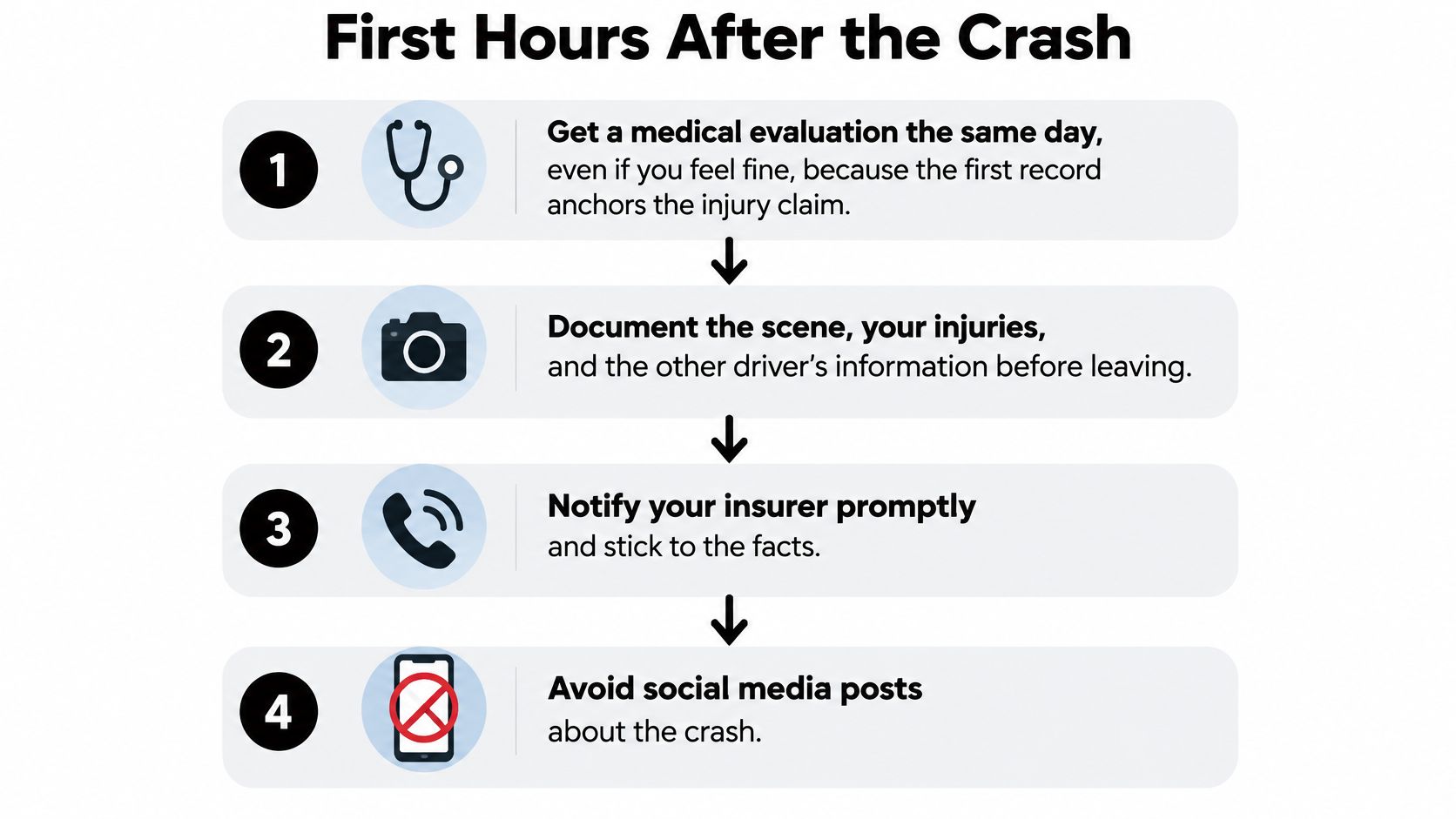
Our steps to take after a car accident can help organize the broader follow-up. Avoid social media commentary about the collision while the facts and your medical condition remain unsettled.
Restraints, Injuries and the Medical Record
A buckled seat belt does not rule out a serious injury. NHTSA’s occupant-protection publication estimated front-seat passenger-vehicle seat-belt use at 91.3% in 2023. It also cites research indicating that lap-and-shoulder belts reduce fatal-injury risk by 45% and moderate-to-critical injury risk by 50% for the relevant passenger-car occupants. A belt reduces risk, but it cannot prevent every concussion, neck injury, internal injury, or psychological effect.
Vehicle damage does not reliably show how badly a passenger is hurt. Photos can record the impact, but only a medical assessment can evaluate your symptoms and injuries. Your position in the vehicle and how your body moved can help clinicians assess what happened.
Describe how your body moved
Tell the treating clinician where you sat, whether you were belted, whether your head struck anything, and whether you lost consciousness. Describe the direction of impact, any rollover or intrusion into the passenger compartment, airbag deployment, and whether you were partly or completely ejected. These details help distinguish your experience from the driver’s, even when you were in the same vehicle.
NHTSA’s crash-severity analysis examines severe-injury outcomes for drivers and passengers and considers factors such as rollover, roadway departure, and nighttime crashes. Those findings provide context for why crash mechanics matter, but they do not determine an individual passenger’s diagnosis or establish how a particular injury occurred.
Rear seating, child restraints, pregnancy, older age, and proximity to an airbag may affect an injury assessment. Tell the clinician about these circumstances and make sure your account accurately reflects where you were seated. An insurer should not assume every occupant experienced the same forces just because they were in the same crash.
For a wheelchair user, distinguish positioning support from equipment approved for transport in a motor vehicle. Information about secure seating support for wheelchair users concerns wheelchair seating support. It does not establish that a product replaces a vehicle occupant restraint or a wheelchair tiedown system. Keep the labels and instructions for the equipment used during transport.
Build a record that follows your recovery
Organize records by the care you received. Keep EMS run sheets showing scene complaints, observations, and transport details. Gather emergency-department notes, discharge instructions, imaging reports, and relevant images, then add records from specialists, rehabilitation, and primary-care visits. Keep treatment recommendations with those records so the timeline is easy to follow.
A dated symptom journal can help you describe headaches, neck stiffness, dizziness, disrupted sleep, mood changes, and activities you cannot comfortably manage. New symptoms need medical attention, not just a diary entry. Delayed concussion symptoms, cervical strain, and internal injury call for clinical assessment. This overview of seat belt syndrome injuries explains why belt-related injury patterns should not be dismissed as superficial bruising.
Keep appointments and note any treatment gaps. If transportation, cost, or scheduling makes care difficult, record the reason rather than leaving the gap unexplained. A clear record can help an insurer understand why treatment paused, but it cannot replace medical advice.
Connect the injury to actual losses
Keep bills, prescription receipts, travel mileage, and records of paid help at home. If you miss work, save pay stubs and ask your employer for a letter identifying missed dates and any reduced duties. These documents help connect the passenger’s injury to specific financial effects.
Retain the crash-report diagram and information about airbag deployment. If the report’s restraint checkbox conflicts with what happened, document the discrepancy and preserve supporting evidence. A checkbox does not by itself settle whether you wore a belt or what caused your injuries.
Evidence warning: Mild initial symptoms do not prove a minor injury. Missing details about seating and restraint use can also make an injury assessment harder.
Not wearing a seat belt may affect compensation under applicable law, but it does not automatically erase a claim against a negligent driver. Give an accurate account of restraint use, and avoid guessing about details you do not remember.
Talking to Insurers and a Driver You Know
Notify your own insurer promptly, even though another driver’s insurer may ultimately be the main payment source. Ask about notice requirements, available benefits, and the documents needed to open the appropriate claim. Don’t wait for the drivers to settle their vehicle-damage dispute.
The first insurer you notify and the first policy you pursue for compensation aren’t necessarily the same. When multiple policies may apply, obtain each insurer’s position in writing rather than assuming they agree about payment priority.
Give facts without filling gaps
Tell the adjuster where you were seated, when the collision happened, and what you observed. It’s appropriate to say you don’t know another vehicle’s speed or couldn’t see the traffic signal.
- Recorded statements: Before giving one to another party’s insurer, understand its purpose and consider legal advice. Your own policy may impose cooperation duties, so don’t ignore requests.
- Medical descriptions: Avoid saying you’re fine if you mean only that you haven’t been evaluated. Describe current symptoms without predicting recovery.
- Authorizations: Read the scope before signing permission for medical records. An unrestricted authorization can reach far beyond the injuries being investigated.
- Offers: Don’t accept payment because an adjuster says the claim is straightforward.
Keep a log with the insurer, adjuster, claim number, date, and a short summary of every call or letter. Ask for written explanations when insurers disagree about which coverage applies.
Protect the relationship without sacrificing accuracy
If your friend was driving, explain that you need their insurance information to address your injuries. Keep that conversation factual rather than debating blame or promising you won’t make a claim.
A claim isn’t a personal accusation, but don’t promise your friend that it can never affect them financially or require a lawsuit. Responsibility disputes, exclusions, limits, and allegations that you contributed to your injuries can complicate payment even when you weren’t driving.
Settlements, Coverage Checks and Your Next Step
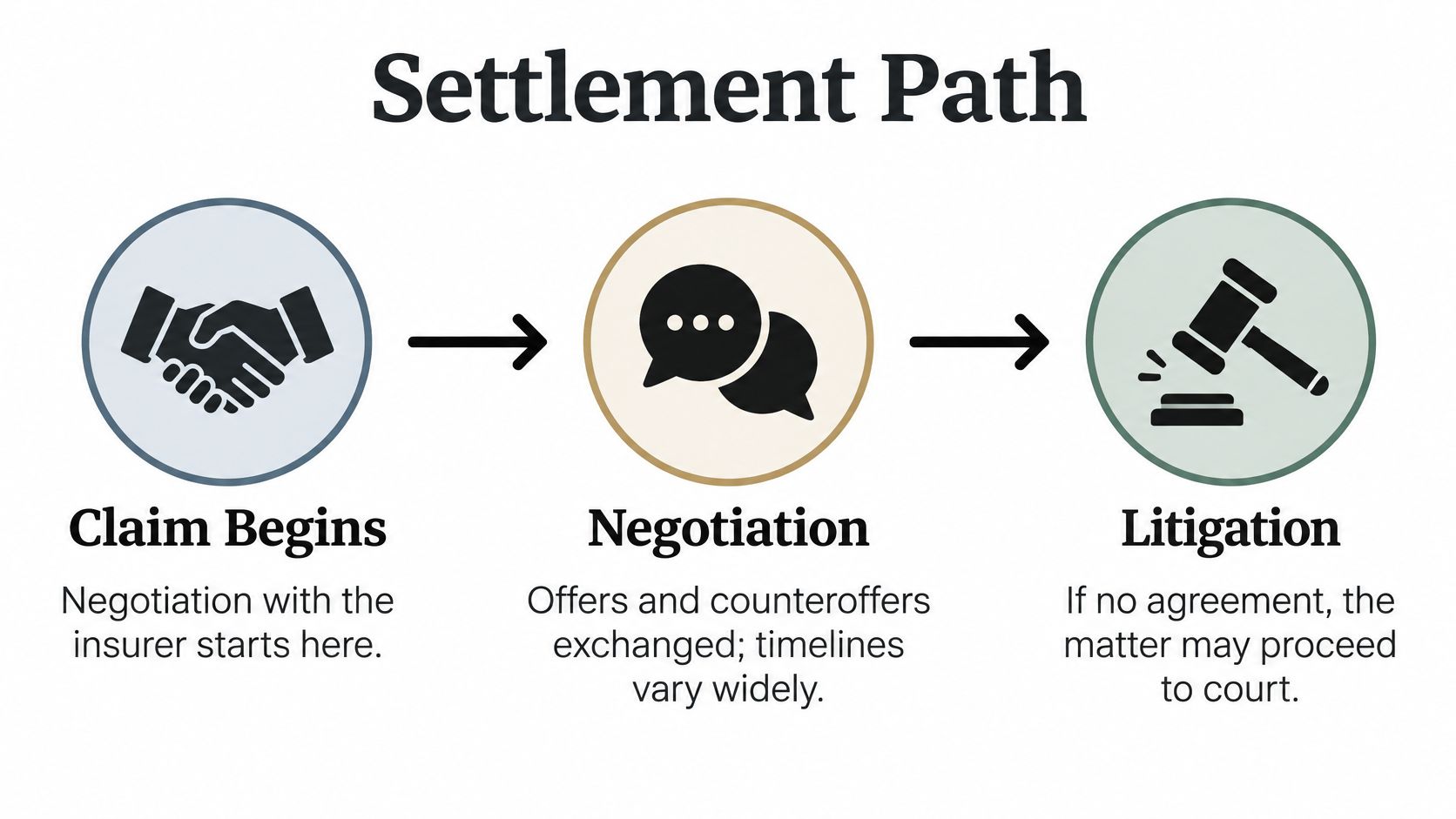
A passenger’s settlement should reflect the documented injury and recoverable losses, not the first amount an insurer offers. Begin with a claim supported by medical records, expense documentation, and evidence of responsibility. Negotiation involves evaluating the insurer’s response, addressing genuine gaps, and deciding whether an offer justifies closing the claim.
When clients work with LA Law Group, APLC’s personal injury lawyers, we first negotiate with the insurance company. We seek reimbursement for economic damages such as medical and surgical bills, recovery costs, and lost wages. If we can’t reach an agreement, the matter may proceed to litigation.
Evaluate timing and the amount you keep
Many personal injury cases handled by our firm take six months to reach settlement, and some lawsuits could take up to three years. Those are descriptions of case timing, not a deadline or promise for your claim. Disputed responsibility, incomplete treatment, and coverage questions can change the path.
Before accepting an offer, distinguish the settlement amount from your net recovery, the amount remaining after applicable deductions. Health-insurer reimbursement rights, Medicare repayment obligations, medical liens, attorney fees, and case expenses can affect what you keep. A lien is a claim against settlement funds for an amount owed.
A release is the agreement giving up specified claims in exchange for payment. Signing before your medical outlook is understood can close a claim while future treatment remains uncertain. Don’t confuse a quick check with a complete resolution.
Verify rideshare coverage for the actual trip
Uber’s published California insurance summary states that, beginning January 1, 2026, passenger trips carry $1 million in liability coverage for injuries or property damage caused by the rideshare driver, plus UM/UIM coverage of $60,000 per individual and $300,000 per accident when another driver is at fault.
These are Uber’s published California terms, not universal rideshare limits. Confirm the platform, crash date, trip phase, responsible driver, and actual policy before treating a published amount as available compensation.
Assemble a coverage checklist
Before an initial substantive insurer conversation, gather what you can without delaying required notice:
- Drivers and vehicles: Names, insurance details, vehicle ownership, and the police report number.
- Your policy: Declarations page, endorsements, and any written UM acceptance or rejection.
- Rideshare evidence: Trip receipt, app screenshots, and information establishing the driver’s status.
- Injury records: Medical documentation collected so far, bills, prescriptions, and employment-loss records.
This article is for informational purposes only and is not to be construed as legal advice. Reviewing it creates no attorney-client relationship, and none of its information is legal advice.
This week, write your coverage checklist and gather the available records into one folder. Mark missing items so you can request them instead of trying to reconstruct everything during an adjuster’s call.
LA Law Group, APLC offers a free, confidential injury consultation to review your options after a passenger or rideshare crash. Visit LA Law Group, APLC to discuss what happened, the potentially applicable insurance, and whether you need help dealing with insurers.
Attorney Advertising. This article is general information, not legal advice, and does not create an attorney-client relationship. Prior results do not guarantee a similar outcome.