
Injured in Uber Accident: Who Pays and What to Do
The ride was supposed to be routine. You’re in the back seat of an Uber, three blocks from home, when a sedan clips the front of the car and everyone feels that sick jolt before they hear the metal. Nobody looks badly hurt at the scene. By evening your shoulder has stiffened, the emergency room is asking for an insurance card, and the trip is already fading from your phone.
The question that shapes what happens next isn’t only who caused the crash. It’s which insurance policy was on the hook for your ride at the instant of impact. California answers that by looking at the driver’s app, not at job titles, and the difference between two of those app states is the difference between a $50,000 policy and a $1 million one.
This guide walks through it the way a passenger meets it: the coverage table by trip phase, the first-day steps that protect your records, the evidence that proves your trip status, who can be responsible, how arbitration terms fit in, how to deal with an adjuster, the deadlines, and when to call an attorney.
One thing before anything else. This article is for informational purposes only and is not legal advice. Reading it does not create an attorney-client relationship, and none of the information below should be treated as legal advice about your specific crash.
Which Insurance Applies at Each Stage of an Uber Trip
Take the scenario above. The crash is over, the ambulance has come and gone, and the practical question lands: which policy pays for the emergency room visit, the follow-up scans, the weeks you can’t drive or lift anything? In California, the answer comes from a table with three rows, and your trip sat in exactly one of them when the collision happened.
The California Public Utilities Commission’s summary of TNC insurance rules ties required coverage to the driver’s activity phase. Each phase carries its own limits, so the map matters before anything else.
| Trip phase | Primary liability minimums | Uninsured/underinsured motorist coverage |
|---|---|---|
| Driver logged in, awaiting or traveling to pickup | $50,000 per injured person, $100,000 per accident, $30,000 property, plus $200,000 excess | Not set by California’s rideshare rules for this phase |
| Passenger in vehicle, pickup to drop-off | $1 million for death, personal injury and property damage | $60,000 per person, $300,000 per incident |
| Trip ended, passenger out of vehicle | $50,000 per person, $100,000 per accident, $30,000 property, plus $200,000 excess, if the driver is still logged in and waiting for another ride | Not set by California’s rideshare rules for this phase |
Before you’re in the car. While the driver is logged in and awaiting a request, or traveling toward your pickup, California requires the lower primary limits of $50,000 per injured person, $100,000 per accident and $30,000 for property damage, plus at least $200,000 in excess liability coverage. That’s real protection, and it’s the thinnest layer in the stack.
From the door closing to the door opening. During the passenger-transport period, the CPUC’s TNC insurance requirements call for primary commercial liability of at least $1 million covering death, personal injury and property damage. It runs from the moment you enter the vehicle until you exit. The same window also carries uninsured and underinsured motorist coverage of at least $60,000 per person and $300,000 per incident, which is what keeps a claim alive when the driver who hit you has no policy or a minimal one. Instead of collapsing, the claim shifts to that UM/UIM layer.
After you step out. Once the ride ends, the higher passenger layer no longer applies by default. If the driver is still logged in and awaiting the next request, the lower pre-pickup limits come back into play. The minutes right after drop-off are the murkiest part of the timeline, so confirm the driver’s exact app status at that moment rather than assuming it.
The record that decides the row: your pickup timestamp next to the collision time in the police report. That gap tells the adjuster which phase was running.
This table doesn’t settle fault, and it doesn’t tell you what a claim is worth. It tells you which policy an adjuster should be reading.
First-Day Steps After an Uber Crash
The first day is mostly clerical work. You’re collecting and preserving, not building a case, and the small actions you take while you’re still shaken are the ones that are hardest to reconstruct later.
- Get examined the same day. Some injuries, whiplash and concussion among them, don’t announce themselves until hours or a day later. The common slip is skipping the exam because you feel fine, which leaves a gap between the crash and your first medical record that an adjuster will point at for months.
- Call 911 and ask for a report. An official report records who was where, what both drivers said at the scene, and the time of the collision. Leaving before an officer arrives removes the only neutral account of what happened.
- Photograph everything before it moves. Vehicles, damage, the road surface, traffic signals, lane markings, weather, and any visible injury on yourself. A phone photo of a shattered signal light is worth more than a clear memory six weeks later.
- Screenshot the trip screen. Keep the ride active view showing the driver was matched and en route, plus the receipt with exact pickup and drop-off times. The full trip-status checklist follows in the next section.
- Collect the other side’s details. Name, phone number, license plate, insurer and policy number for the other driver, and names and numbers for anyone who watched it happen. Witnesses move, change numbers, and forget.
- Report the crash through the Uber app. The in-app report creates a platform record tied to your trip. Do it the same day, before the trip scrolls off your history.
- Start a symptom and expense diary. Note pain levels, what you couldn’t do that day, treatment dates, and money spent on rides, prescriptions and parking. Contemporaneous notes carry weight that a summary written months later cannot.
Here’s the routine on one page.
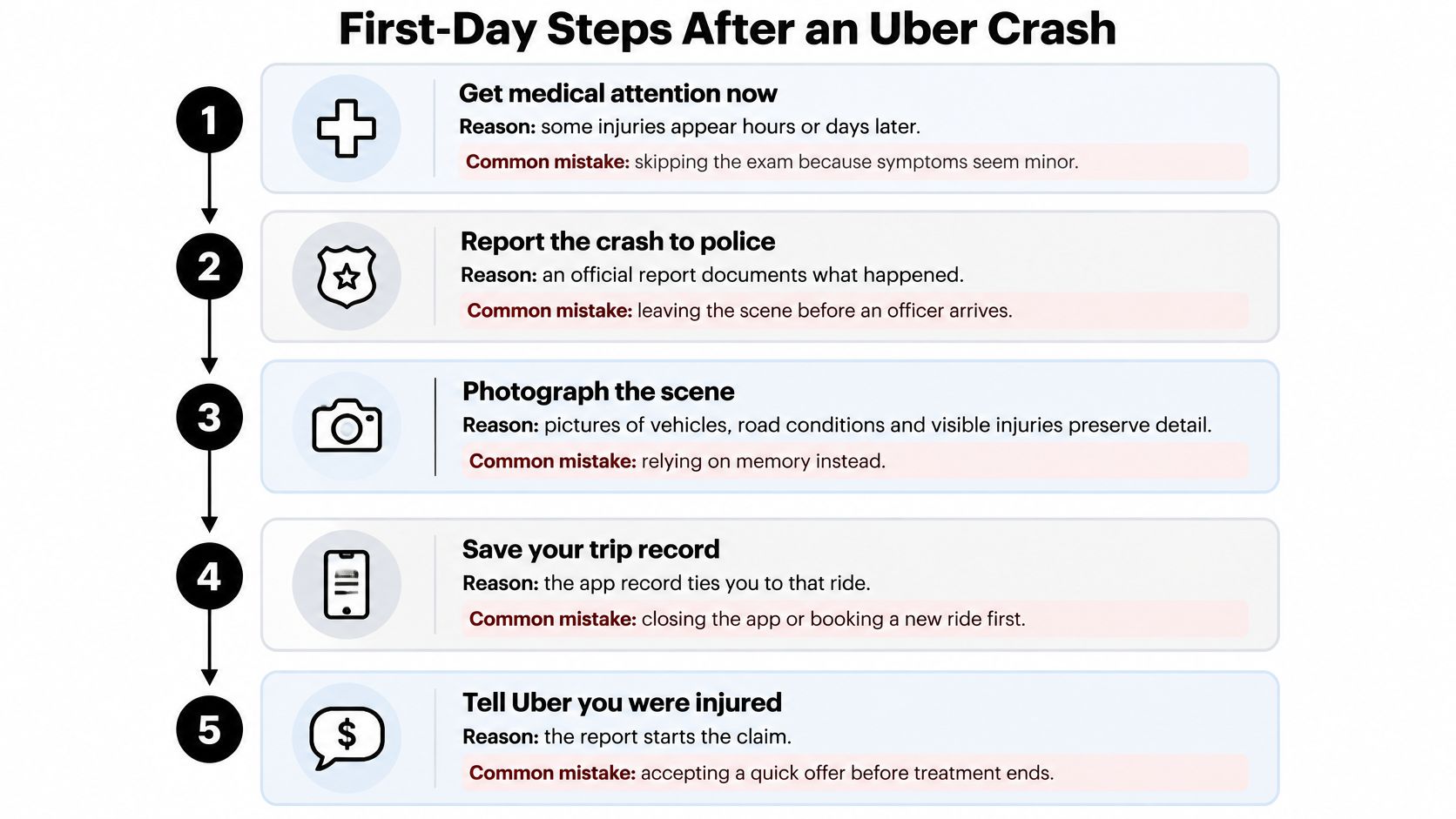
None of these steps decides fault or fixes the value of a claim. What they do is keep the raw material intact for whoever evaluates the crash later, whether that’s an adjuster, a lawyer, or a jury.
Evidence That Proves Your Trip Status and Injuries
Two questions decide most Uber injury claims: was the app in a paying phase, and what did the crash do to your body? Build the file in two matching parts so neither question gets answered with guesses.
Trip status evidence establishes which coverage row applied.
- The trip receipt, showing request time, pickup time, drop-off time and the fare.
- Driver status information from the app, including whether a driver was matched and en route.
- Pickup and drop-off timestamps, compared against the collision time in the police report.
- Vehicle identifiers, meaning make, model, color and plate, so the car in the photo matches the car on the account.
- Messages or notifications that show whether a passenger was already inside at the time.
- The police report, which fixes the location, the parties and the stated time.
Injury evidence establishes what the crash cost you.
- Emergency and follow-up records, including imaging, treatment notes and prescriptions.
- Dated photographs of injuries, taken the day of the crash and again over the following days as bruising develops.
- Work-absence records, such as employer letters or pay stubs showing missed shifts.
- The diary from day one, tracking pain, sleep, mobility and out-of-pocket costs.
File discipline beats filing volume. Export app screens as PDFs, drop originals into one folder, and write the date you obtained each item. Records get harder to pull as weeks pass, and a screenshot with no date is a screenshot someone can question.
Store scene photos, witness contacts, and every letter or message exchanged with an insurer in the same place. The earliest records matter most because they show what existed before any dispute started.
What the public record doesn’t tell you
You might assume a company this large keeps a tidy public accounting of injuries in its vehicles. It doesn’t. The U.S. Government Accountability Office reported in 2026 that Uber, Lyft and HopSkipDrive had not reported 2023 through 2025 assault totals or nonfatal physical-assault data, and that available information largely came from rider or driver reports, law-enforcement agencies or insurers.
Assault data isn’t crash-injury data, but the underlying problem carries over: public reporting on nonfatal rideshare injuries is fragmented, which makes comparison with taxis or private cars difficult. That gap doesn’t prove Uber is unsafe. It does mean your own records are the most reliable evidence about your own crash.
Who Can Be Responsible for Your Uber Injuries
A passenger sits in the back seat on the way to a drop-off when a car runs a red light and hits the Uber in the intersection. Her knee slams the seat back. Who answers for that injury? The honest answer is that two questions decide it: who caused the impact, and what the driver’s app showed at that second. The same person behind the wheel is a private motorist with the app closed and a commercially insured driver the moment a passenger is aboard, so responsibility can shift with a status change that took half a second.
Several parties can carry responsibility, and they aren’t mutually exclusive.
- The Uber driver, if speed, distraction or a bad turn caused or contributed to the collision.
- Another motorist, whose negligence triggered the crash and whose liability policy may respond first.
- An uninsured or underinsured driver, which moves the claim toward the UM/UIM coverage tied to the ride.
- The platform itself, through the insurance layers it’s required to maintain. That is a coverage question, separate from whether the company was negligent.
The trip record is what fixes the driver’s status in place after the fact. The ride ID, the accept timestamp and the passenger’s trip receipt show whether the app was off, waiting for a request, heading to a pickup or carrying a rider when the light turned.
Where crashes happen in the aggregate adds useful context, even though it can’t name the person who ran the light. A U.S. study comparing National Highway Traffic Safety Administration data across 2,955 cities found that ridesharing’s arrival was associated with an approximately 2% to 3% increase in fatal crashes involving vehicle occupants and pedestrians, as Science reported on the study. A New York City analysis of 2017 and 2018 trip and crash data found that more rideshare trips in an area were associated with more injury crashes, and that the pattern involved motorist and pedestrian injuries but not cyclist injuries.
Both findings describe populations, not your trip. Neither one identifies who ran the light.
The video below walks through how these crash scenes get sorted out in practice.
Fault gets decided by the physical facts of the collision: position in the intersection, who had the signal, speed, lane discipline, whether a passenger was aboard, and whether a pedestrian stepped off the curb. Those facts come from the evidence file, not the coverage table. If you were riding rather than driving, the guide to passenger injury claims explains how that role changes the analysis. LA Law Group helps injured people with car accidents, rideshare crashes, pedestrian and bicycle injuries, and premises claims.
Arbitration Terms and Your Options Against Uber
Two different processes get collapsed into one in most explanations of what to do after a crash. Sending a bodily-injury claim to an insurer and litigating against a rideshare platform are separate tracks, and moving down one doesn’t automatically close the other.
Uber’s user terms may require individual arbitration for disputes connected to use of the service, according to this 2026 guide to Uber injury claims, while enforceability can turn on the claimant’s relationship with Uber, the signup or update flow that presented the terms, how the claim is worded, and the jurisdiction. Contacting an insurer or filing a claim doesn’t by itself mean you’ve given up a court option.
Which relationship you have with Uber decides how much the arbitration language even reaches you.
- A passenger who accepted the app terms likely agreed to them at signup or at a later terms update, subject to California defenses.
- A non-user third party, such as a pedestrian or the occupant of another car, never created an account, so the agreement doesn’t obviously bind them.
- An Uber driver works under separate driver agreements with their own dispute provisions.
- A claimant pursuing only the at-fault driver’s insurer has no dispute with the platform at all, and arbitration language never enters the picture.
What changes if arbitration applies? An arbitrator rather than a jury decides the outcome, discovery tends to be narrower, and the proceedings are private rather than public. Those are real consequences for how evidence gets gathered and how a case gets valued.
In California, contract formation, notice, unconscionability and waiver arguments can shift the result either way, which is why the analysis is fact-specific rather than automatic. When a client works with our personal injury lawyers, we first negotiate a settlement with the insurance company, and if no agreement is reached, the matter may proceed to litigation.
The principle to hold onto: arbitration is a question about a contract and whether you assented to it. It doesn’t erase the injury claim underneath.
Dealing With the Insurer Before You Settle
An adjuster will usually call within days, often before you know the full extent of your injuries. That timing is the point.
If you’re asked for a recorded statement, you can ask to schedule it once you have your medical records and trip timestamps in hand, and you can ask for the request in writing. That isn’t evasion. It’s making sure your account is accurate rather than approximate, especially on times, which are the facts that decide coverage.
Early settlement offers tend to arrive before the treatment course is known. Note the date of any offer and whether the number accounts for care you still need. Before signing a release, confirm that every symptom and every provider is accounted for, because a signed release generally ends the claim.
Ask one question before you sign anything: does this number cover the treatment I still need, or only the treatment I’ve already had?
Keep a log of every call with the representative’s name, the date and a reference number, and keep copies of letters and any payment checks. Notify your health insurer if you use it for treatment, and check whether your own auto policy carries uninsured motorist or medical payments coverage that may apply on top of the rideshare layers.
Answer questions about the ride from the records you already saved, not from memory. If the insurer disputes trip status or makes an offer that looks low, the guidance on working with insurance adjusters covers the escalation path, and that dispute is a fair trigger for the consultation discussed at the end.
Claim Deadlines and How Long Settlements Take
Deadlines are the one part of this process that can’t be repaired afterward. The table below sets out the windows and the typical pace of each route.
| Item | Duration | What it governs |
|---|---|---|
| Personal-injury lawsuit | Generally 2 years from the injury date | Filing a lawsuit under Code of Civil Procedure section 335.1 |
| Claim against a government entity or public employee | Generally 6 months after the cause of action accrues | Presenting a claim under Government Code section 911.2 |
| Negotiated settlement | About 6 months in many cases we handle | Time to reach a settlement with the insurer |
| Litigated case | Up to 3 years in some cases | Time to resolve a lawsuit after filing |
The California Courts’ self-help guidance on statutes of limitation lists personal-injury accidents, wrongful acts and negligent acts among the claims covered by the two-year period under Code of Civil Procedure section 335.1. Government Code section 911.2 sets a far shorter clock, generally six months, when a government entity or public employee is involved.
That second row is the one people miss. A crash involving a city bus, a public works vehicle or a road defect maintained by a municipality runs on the six-month government-claim timeline, and a claim presented late is often barred no matter how strong the injuries are.
On the settlement side, many personal injury cases we handle reach a settlement in about six months, while some lawsuits could take up to three years. Compensation sought in those cases can include economic damages such as medical and surgical bills, recovery costs, and lost wages. More detail on how the California auto accident statute of limitations applies to crash claims sits alongside these general rules.
Both clocks start from the date of the injury or the date the cause of action accrues, which is why noting those dates in your evidence file on day one pays off later. These are general rules, and exceptions apply to specific facts, including cases involving minors or delayed discovery.
When to Talk With a California Rideshare Injury Attorney
An injured passenger doesn’t need a lawyer to collect a police report or photograph a dented door. The signals that call for one show up when the case stops being straightforward.
- The trip status is unclear or disputed, such as a driver insisting they were offline when the app suggests otherwise. Because coverage turns on the app status at the exact moment of impact, a dispute over that one fact changes which insurer answers.
- The at-fault driver is uninsured or underinsured, so the claim depends on stacking coverage layers correctly.
- A government entity might be involved, which brings the tighter claim deadline into play.
- Your injuries are serious or still developing, particularly anything involving the spine, head or surgery.
- An insurer has made an offer or asked for a recorded statement, especially early.
- The app terms may push the dispute into arbitration, which changes the forum and the rules of evidence.
A consultation is a review of your options. LA Law Group offers a free consultation in which an attorney reviews the injured person’s options, and consultations with the firm are confidential.
After you engage the firm, it can review what happened, explain injury claim options in plain language, and talk with insurers on the client’s behalf. For clients who can’t travel, the firm can come to a home or hospital. Bring the evidence file described earlier: the trip receipt, the timestamps, the medical records, the diary, and the dates you noted. Those records are what prove which app status applied when the crash happened.
The next step is small and concrete: write down the trip times tonight, keep the records in one place, mark the deadlines on a calendar, and schedule a free consultation.
This article is for informational purposes only and is not legal advice, and no attorney-client relationship is created by reading it.
If you were injured as a passenger in a rideshare and the coverage question is still unresolved, LA Law Group, APLC offers a free, confidential consultation where an attorney reviews what happened and explains your injury claim options in plain language. The firm can also talk with the insurers on your behalf, so you aren’t matching phase rules and adjuster requests on your own. Visit LA Law Group, APLC to schedule a consultation, and bring your trip receipt, medical records and the dates you noted.
Attorney Advertising. This article is general information, not legal advice, and does not create an attorney-client relationship. Prior results do not guarantee a similar outcome.