
Insurance Dispute Lawyer: When and How to Hire One

You open the insurer’s letter expecting a payment date. Instead, you find a denial. The adjuster says your Inland Empire home’s fire damage resulted from “wear and tear,” even though the fire started suddenly and you reported it immediately. Or you’re a rideshare driver recovering from an accident, and the insurer has reduced the injury offer by 60 percent, without explaining how it valued your medical treatment, lost income, or continuing symptoms.
Before you rely on anything in this article, understand its limits. This article provides general educational information about insurance dispute lawyers and California claim procedures. It isn’t legal advice, no attorney-client relationship exists based on your review of it, and none of the information here is legal advice. Your policy, facts, deadlines, and applicable law may change the analysis.
A denial doesn’t automatically mean the insurer acted unlawfully, but delay can make a difficult claim harder to prove. Statutes of limitation, California Department of Insurance complaint windows, which are typically discussed as two years for bad-faith claims, and policy suit-limitation clauses can operate independently. Don’t assume that an open conversation with an adjuster pauses any of them.
The practical path usually starts with the denial letter, the policy language, and a complete claim chronology. From there, you can decide whether a written reconsideration, regulator complaint, appraisal, negotiation, or an insurance dispute lawyer makes sense. The denial scenario above will return at each stage, with concrete guidance on when self-advocacy remains useful and when it stops working.
A Denial, a Deadline, and What Comes Next
The first mistake many policyholders make is treating a denial as a final answer rather than as a position the insurer must explain. Read the letter slowly. Identify the exact exclusion, condition, limitation, or factual finding the carrier relies on. “Wear and tear” may sound decisive, but the actual question is whether that language applies to the loss described in the policy and supported by the evidence.
That is where contract interpretation principles become useful. A plain-language resource on contract interpretation principles can help you understand why courts read the policy as a whole rather than isolating one unfavorable sentence. You should also preserve the envelope, email headers, portal message, and attachments showing when the decision reached you.
Start with the clock
California insurers generally must acknowledge a claim, provide necessary forms and instructions, offer reasonable assistance, and begin any necessary investigation immediately and no later than 15 calendar days after receiving notice. After receiving proof of claim, an insurer generally must accept or deny the claim immediately and no later than 40 calendar days, subject to exceptions described by the California Department of Insurance claim guidance.
If the insurer needs more time, it generally must explain the reason in writing. California guidance states that written notices should continue every 30 days while additional time is needed, so retain every extension letter and compare its explanation with what the claim file shows. A missed deadline isn’t automatically bad faith, but unexplained inactivity, repetitive requests for immaterial documents, or shifting reasons can matter.
Practical rule: Don’t wait for the insurer to remind you about a policy deadline. Put every date in a calendar and ask a lawyer to review the file promptly if litigation may be necessary.
A regulator complaint or internal appeal may resolve a dispute without a lawsuit. But if the carrier invokes fraud, misrepresentation, a serious exclusion, or a limitation period, get legal advice before making a recorded statement or signing a release. A useful overview of what to do when insurance denies a claim can help you organize the immediate response, but it can’t replace advice about your particular policy.
What an Insurance Dispute Lawyer Actually Does
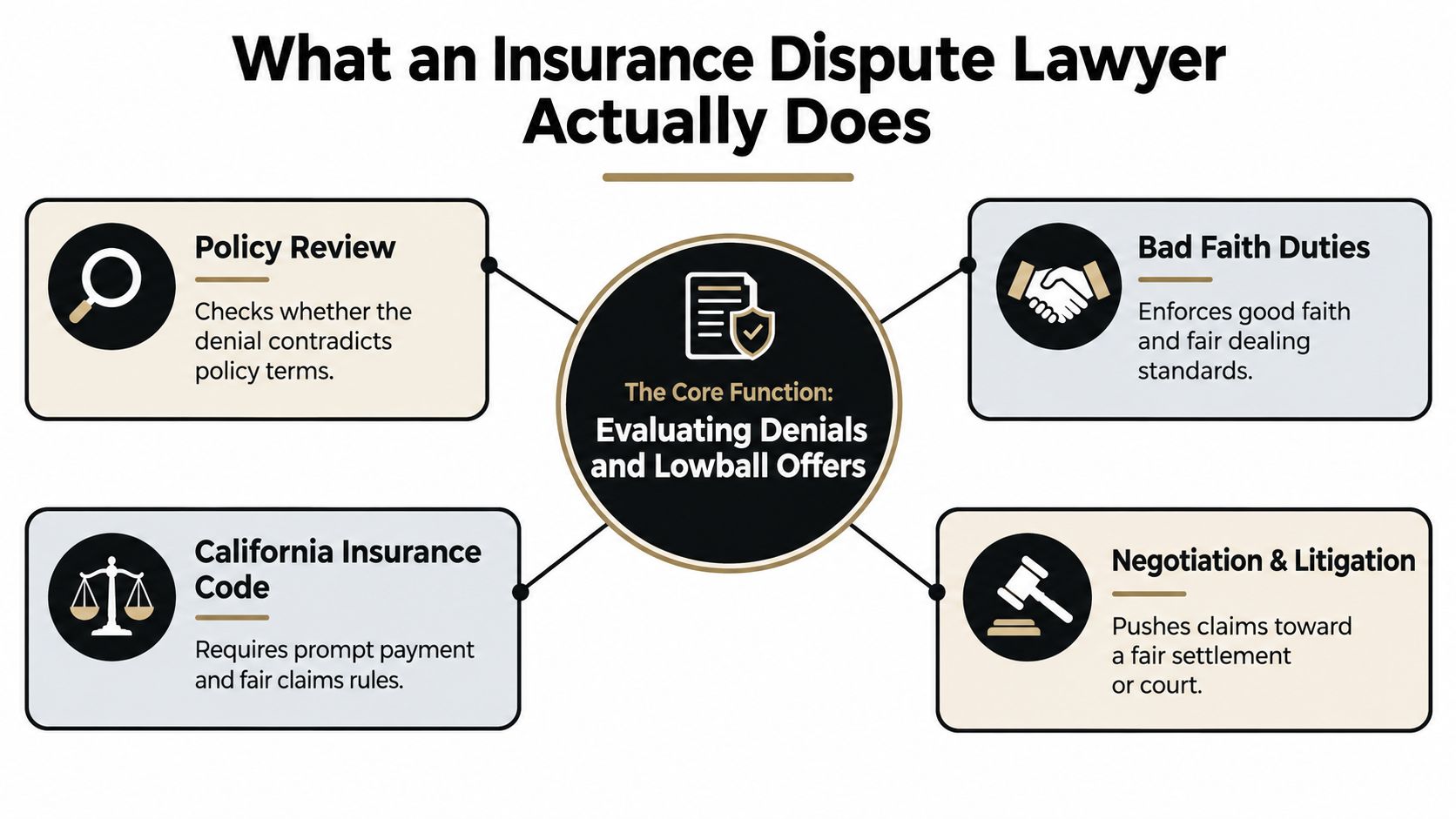
An insurance dispute lawyer starts by testing the insurer’s position against the policy and the claim record. The lawyer asks whether the loss falls within the insuring agreement, whether an exclusion applies, whether the carrier investigated reasonably, and whether the payment reflects the covered damage. In California, a coverage disagreement and a bad-faith claim aren’t the same thing. A lawyer must separate a defensible interpretation from conduct that unreasonably interfered with the policyholder’s rights.
The work extends beyond the denial letter
Clients may include homeowners, automobile policyholders, commercial policyholders, business owners with business-interruption losses, and life or disability beneficiaries. The dispute may involve a delayed investigation, a denial of coverage, an unsatisfactory settlement offer, a premium disagreement, or suspected misconduct by an underwriter or insurance producer.
NAIC complaint data shows why these categories matter. In a major U.S. complaint dataset reported through May 30, 2019, claim delays represented 17.77%, unsatisfactory settlements or offers represented 16.46%, and denials represented 13.70% of listed complaint reasons. Together, those categories represented 47.93% of listed reasons, including 12,411 delay complaints, 11,498 complaints about unsatisfactory settlements or offers, and 9,566 complaints involving denials. The NAIC complaint dataset provides the underlying figures.
A lawyer may review:
- Coverage: The declarations page, endorsements, insuring agreement, exclusions, conditions, and definitions.
- Handling: Adjuster notes, inspection records, requests for information, expert assignments, and decision dates.
- Value: Repair estimates, medical records, wage evidence, business records, and competing valuations.
- Strategy: A demand, internal appeal, Department of Insurance complaint, appraisal, mediation, or lawsuit.
Lawyer, public adjuster, or general litigator
A public adjuster can help document and value certain property losses, and an adjuster may negotiate with the carrier on the amount of damage. A lawyer can do more when the dispute involves legal interpretation, privilege, statutory remedies, discovery, or litigation. Counsel can send a demand that preserves legal theories, pursue contractual and potentially extra-contractual remedies, take depositions, and file suit. A public adjuster cannot represent you in court.
Many matters an insurance dispute lawyer evaluates never reach trial. The first useful answer may be that the denial is supported by a clear exclusion, the damages cannot yet be proved, or the policy’s deadline creates an urgent problem. That answer can save money and prevent a weak argument from damaging a stronger one. For broader bad-faith considerations, readers may also review this discussion of a bad-faith insurance attorney in Los Angeles.
First Moves After a Denial or Lowball Offer
During the first thirty days, discipline matters more than indignation. Start with the denial letter and read every page, including attachments and reservation-of-rights language. Mark the policy provision the insurer cites, then write a short summary of the carrier’s factual reasoning in your own words. If the insurer says the fire resulted from wear and tear, identify what evidence supposedly proves that conclusion and what evidence the adjuster ignored.

Build the file before arguing the merits
Save the complete policy, including the declarations page and endorsements. Create a folder containing photographs, videos, repair estimates, invoices, medical records, correspondence, recorded statements, inspection reports, and a communication log. Preserve portal messages and download documents rather than relying on continued online access.
Then send a written request for reconsideration. Keep it concise. Identify the policy language, explain the factual error, attach the evidence that addresses the stated reason, and request a written response. A long emotional narrative usually gives the adjuster more material to disregard. A short, indexed package makes the disputed issue easier to evaluate.
A complaint to the California Department of Insurance may provide another administrative path. The complaint record can require the insurer to explain its position and may expose a gap between the denial letter and the claim file. It doesn’t guarantee payment, and the Department isn’t a substitute for a court, but it can create a useful, time-stamped record. California’s fair claims regulations, including Regulation 2695.9, may become relevant when the complaint concerns investigation, documentation, or settlement conduct.
Know when the informal process has ended
Self-advocacy usually stops being productive when the insurer cites a complicated exclusion, alleges fraud or misrepresentation, threatens a rescission, refuses to identify the evidence supporting its decision, or repeats a conclusion without addressing your rebuttal. It also stops working when you’re being asked to sign a release while medical treatment or property investigation remains incomplete.
Don’t guess at the meaning of a recorded statement. Before responding, consider reviewing how to deal with insurance adjusters and getting advice about what the policy requires. A demand letter can be valuable, but it should match the evidence to each denial reason and avoid unsupported threats. That paper trail may later help establish what the insurer knew, what you supplied, and whether the carrier meaningfully reconsidered its position.
Evidence and Documentation That Move the Needle
Evidence matters because each document answers a different legal question. The policy declarations page addresses what coverage was purchased. The insuring agreement and exclusions address whether the loss falls within coverage. The claim correspondence addresses what the insurer knew and when it acted. A repair estimate addresses value, but it may not prove the cause of damage.
Match the document to the issue
For a coverage dispute, provide the complete policy, endorsements, photographs from before and after the loss, inspection reports, and the precise denial language. If the insurer relies on an exclusion, locate the definitions and exceptions around it rather than quoting one sentence in isolation.
For a bad-faith analysis, the claim file and communication history become central. Preserve emails, letters, portal messages, adjuster logs, inspection dates, expert assignments, document requests, reservation-of-rights notices, payment decisions, and denial rationales. The NAIC model framework calls for detailed documentation sufficient to reconstruct claim activity and identifies claim data such as claim number, coverage line, loss date, payment date, denial date, or closure without payment. The NAIC Unfair Property/Casualty Claims Settlement Practices Model Regulation is a model framework, not automatically binding law in every jurisdiction, but it offers useful benchmarks for organizing the chronology.
For damages, connect each number to a source. Photographs and contractor estimates may establish physical loss. Invoices may show completed work. Medical records may connect treatment to an accident, while wage and business records may support income loss. A sworn proof of loss and a recorded statement can materially affect credibility, so read them carefully for omissions or inconsistencies.
Watch for California complications
A Department of Insurance complaint record may show how the carrier explained its conduct to a regulator. A prior-claims objection may require you to separate old damage from the present loss. An SIU referral warning can change the tone of the claim and requires careful handling because careless statements may later be characterized as misrepresentations.
A lawyer re-reads the denial after reviewing the documents. The task is not to collect more papers. It is to build a point-by-point rebuttal: the insurer says the damage is excluded, the policy and photographs address the exclusion; the carrier says the medical treatment is unrelated, the records address causation; the carrier says the amount is unsupported, the estimates and invoices address value.
The strongest file is chronological, indexed, and honest about unfavorable facts.
Incomplete documentation is one of the most common reasons a potentially valid claim becomes difficult to prove. Organizing the evidence before counsel reviews it can shorten the initial evaluation, reveal missing items, and reduce the cost of reconstructing what happened. General principles of preserving and organizing records are also discussed in this guide to evidence documentation for law enforcement, although insurance claims require additional policy and damages materials.
How Insurance Dispute Lawyers Charge and Get Paid
The fee arrangement should match the work the dispute requires. A first-party claim with clear coverage and well-supported damage may fit a contingency agreement. A disputed bad-faith case can require investigation, discovery, expert review, and motion practice before the likely recovery becomes clear. A limited assignment, such as reviewing a release or preparing a demand, may be better suited to a flat fee.
The common arrangements
With a contingency fee, the lawyer receives an agreed share of the recovery rather than charging attorney fees as the case develops. The client usually pays less at the beginning, but the firm receives part of any settlement or judgment. The written agreement should explain whether the percentage changes if the matter proceeds to litigation and what happens if there is no recovery.
Hourly billing works differently. The client pays for the lawyer’s time as work is performed, which may include calls, document review, legal research, negotiations, discovery, and court appearances. This can give the firm a predictable way to staff a difficult case, but it can also create significant client expense before the insurer pays anything.
A flat fee fits defined work, such as a policy review, demand letter, or release analysis. It is usually a poor match for an unpredictable lawsuit unless the agreement identifies exactly what the fee covers, what it excludes, and how additional work will be billed.
| Fee Type | Typical Structure | Best Suited For | Client Cost Risk |
|---|---|---|---|
| Contingency | Agreed share of recovery | Clear coverage and provable loss | Less upfront payment, but the firm receives part of the recovery |
| Hourly | Payment for time worked | Contested coverage, bad faith, and litigation | Fees can accrue before recovery |
| Flat fee | Set charge for defined work | Policy review, demand letter, or release review | Scope is clearer, but added work may cost more |
Case expenses require their own discussion. Filing fees, depositions, expert work, medical records, inspections, and other costs may be advanced by the firm and deducted from a settlement, but that arrangement is not automatic. Ask whether expenses are deducted before or after the attorney fee is calculated, who pays them if the case loses, and whether expert services require separate approval.
California fee agreements must comply with Rules of Court rule 1.5. Read provisions addressing conflicts, settlement authority, arbitration, costs, and the lawyer’s right to withdraw. Ask for the agreement in writing before work begins.
Some firms track claim deadlines and client communications in case-management software, including tools discussed in these top CRM solutions for attorneys. Those tools can support administration, but they do not replace a clear fee agreement that explains the lawyer’s compensation, expenses, and responsibilities.
Negotiation Appraisal or Lawsuit Choosing the Right Path
Negotiation, appraisal, and litigation are best understood as rungs on one strategic ladder. The first rung is a strong demand package. It should identify the policy language, answer each reason for denial or reduction, attach organized evidence, and state the relief sought. A carrier that receives a credible package may revise its position without a lawsuit, particularly when the original decision overlooked material information.
Appraisal answers a narrower question
An appraisal clause can provide a built-in mechanism for certain first-party property disputes. Each side selects an appraiser, and the appraisers choose a neutral umpire. The panel determines the amount of loss, but it generally doesn’t decide whether the policy covers the loss.
That distinction is critical. Appraisal can be strategically useful when the insurer accepts that a covered event occurred but disputes the amount of damage. It may be a poor fit when the underlying conflict concerns causation, an exclusion, fraud, policy interpretation, or whether the loss falls within coverage at all. Winning a higher valuation doesn’t answer whether the carrier must pay it.
Litigation changes the leverage
A lawsuit begins with a complaint and service of process. The parties then address pleadings, written discovery, document production, depositions, expert analysis, and settlement. California cases can occupy a one-to-two-year board, depending on the court, the parties, the issues, and the degree of discovery. Mediation commonly becomes a serious settlement opportunity after both sides understand the evidence, although no mediator can force a resolution.
A filed suit can strengthen the position of the policyholder because the insurer must defend its handling under formal discovery rather than informal correspondence. But filing also creates costs, deadlines, and risks. The right decision depends on the carrier’s posture, the size and proof of the loss, the strength of the coverage argument, the availability of appraisal, and the California venue.
The Inland Empire homeowner’s chronology should therefore support the next rung. First, identify why the carrier called the fire wear and tear. Next, rebut that conclusion with policy language and evidence. Then evaluate negotiation, appraisal, or suit based on whether the disagreement concerns coverage or value. Each step should preserve the record for the one that follows.
When an Algorithm Denied Your Claim
An automated claim platform can sort submissions, flag selected files, recommend a valuation, or generate language that appears individualized. The presence of automation doesn’t automatically make a denial unlawful, and a human signature doesn’t necessarily make the reasoning transparent. The legal question remains whether the insurer applied the policy fairly, investigated reasonably, and explained a defensible basis for its decision.
The regulatory environment is evolving. The NAIC insurance-AI analysis identifies underwriting, pricing, and claims as areas requiring significant regulatory attention. It reports that Texas Senate Bill 815, enacted in 2025, prohibits an automated AI system from making wholly or partly an adverse determination, while proposed Rhode Island legislation would require disclosures concerning AI use in claims management, training data, algorithms, and resulting determinations. Those rules aren’t uniform across states.
Ask questions that create a record
Request the complete claim file, claim-handling logs, valuation outputs, portal messages, and the specific policy provision supporting the decision. Ask whether an automated tool was used, what role it played, whether a human reviewed the result, and what facts the reviewer considered. Preserve screenshots because an online portal may later change.
A lawyer may use discovery to identify the vendor, instructions supplied to the system, data inputs, exception rules, and communications between the insurer and technology provider. The objective isn’t to accuse the insurer merely because software was involved. It is to connect the decision to the policy and determine whether the carrier considered contrary evidence.
The opaque system may also produce boilerplate language. Repeated phrases, unexplained scores, missing individualized facts, and a valuation that ignores submitted records can justify more detailed inquiry. California bad-faith doctrine focuses on unreasonable conduct and lack of proper cause, so an “AI denial” alone doesn’t establish liability. It may, however, expose an investigation that never meaningfully addressed the claim.
Before litigation, request human review in writing and ask the insurer to identify the factual basis for each disputed conclusion. If the carrier refuses to explain the decision, changes its rationale, or relies on information you can’t test, an insurance dispute lawyer can evaluate whether regulatory complaints, discovery, or a bad-faith theory is appropriate.
California Practice Notes and Common Questions
California claim handling depends on the policy, the type of claim, and the facts. The Department of Insurance can receive consumer complaints, and the Fair Claims Settlement Practices Regulations can help organize questions about acknowledgment, investigation, communications, and payment. The regulations are evidence of handling standards, but a regulatory violation doesn’t automatically prove bad faith.
California policyholders should also ask about notice obligations under Proposition 103, the policy’s suit-limitation clause, and the applicable limitation period for breach of policy. A commonly cited California limit for breach of an insurance policy is two years, but the policy wording, accrual rules, tolling issues, and claim type can change the analysis. Don’t wait until the deadline is close to investigate it.
Local practice can matter after filing. LA Law Group’s familiarity with Los Angeles Superior Court filing procedures and local mediation programs may be relevant to a claimant deciding whether a negotiated resolution or lawsuit is practical. Venue, available evidence, the carrier’s conduct, and the likely cost of litigation should drive that decision rather than anger about the denial.
Common questions
Can I handle a claim without a lawyer?
Sometimes. A complete policy review, organized evidence package, written reconsideration request, and Department of Insurance complaint may improve the carrier’s response before litigation. Self-advocacy becomes riskier when the carrier alleges fraud, relies on complex exclusions, demands a release, or refuses to explain its reasoning.
What contingency fee should I expect?
A lawyer may quote a contingency percentage, an hourly rate, or a flat fee depending on the assignment. The agreement should explain the percentage, whether it changes after filing suit, how costs are treated, and what happens if there is no recovery.
Can I recover my insurance premiums as damages?
Premium payments alone don’t automatically become recoverable damages. Whether they matter depends on the legal theory, policy, loss, and proof. Ask counsel to distinguish contract damages, consequential damages, and any available bad-faith remedies.
What should I bring to the first consultation?
Bring the policy and declarations page, denial or offer letter, photographs, estimates, invoices, medical records, correspondence, recorded statements, proof-of-loss materials, and a date-based claim chronology. Include unfavorable documents too. A lawyer needs the complete record, not only the documents supporting your position.
How long does an insurance dispute take?
A demand or internal review may move faster than litigation. Appraisal can be narrower than a lawsuit, but disputes over coverage or bad faith may require discovery, experts, mediation, and trial preparation. No lawyer should promise a fixed schedule before reviewing the policy and claim file.
This article is for informational purposes only and is not to be construed as legal advice. No attorney-client relationship exists based on review of this article, and none of the information in this article is legal advice. California deadlines and remedies are fact-specific, so obtain advice promptly if a denial, threatened foreclosure, medical bills, limitation clause, or suspected bad-faith conduct affects you.
LA Law Group, APLC offers California policyholders assistance with reviewing policies, claim files, insurer correspondence, and damages evidence, along with pre-suit demands, negotiations, and insurance dispute litigation when appropriate. If your claim was denied, delayed, or underpaid, visit LA Law Group, APLC to request an initial consultation and discuss the next practical step.
Attorney Advertising. This article is general information, not legal advice, and does not create an attorney-client relationship. Prior results do not guarantee a similar outcome.