
Los Angeles Traumatic Brain Injury Lawyers Guide

A discharge slip that says “normal scan” can leave a family with the wrong impression. The brain can stop working the way it did before, even when there’s no cracked skull and no dramatic image to point to. If you’re looking for Los Angeles traumatic brain injury lawyers, you’re usually looking for someone who can turn scattered medical notes, missed work, and changes at home into a clear, provable claim.
Why a Los Angeles TBI Claim Outlasts the ER
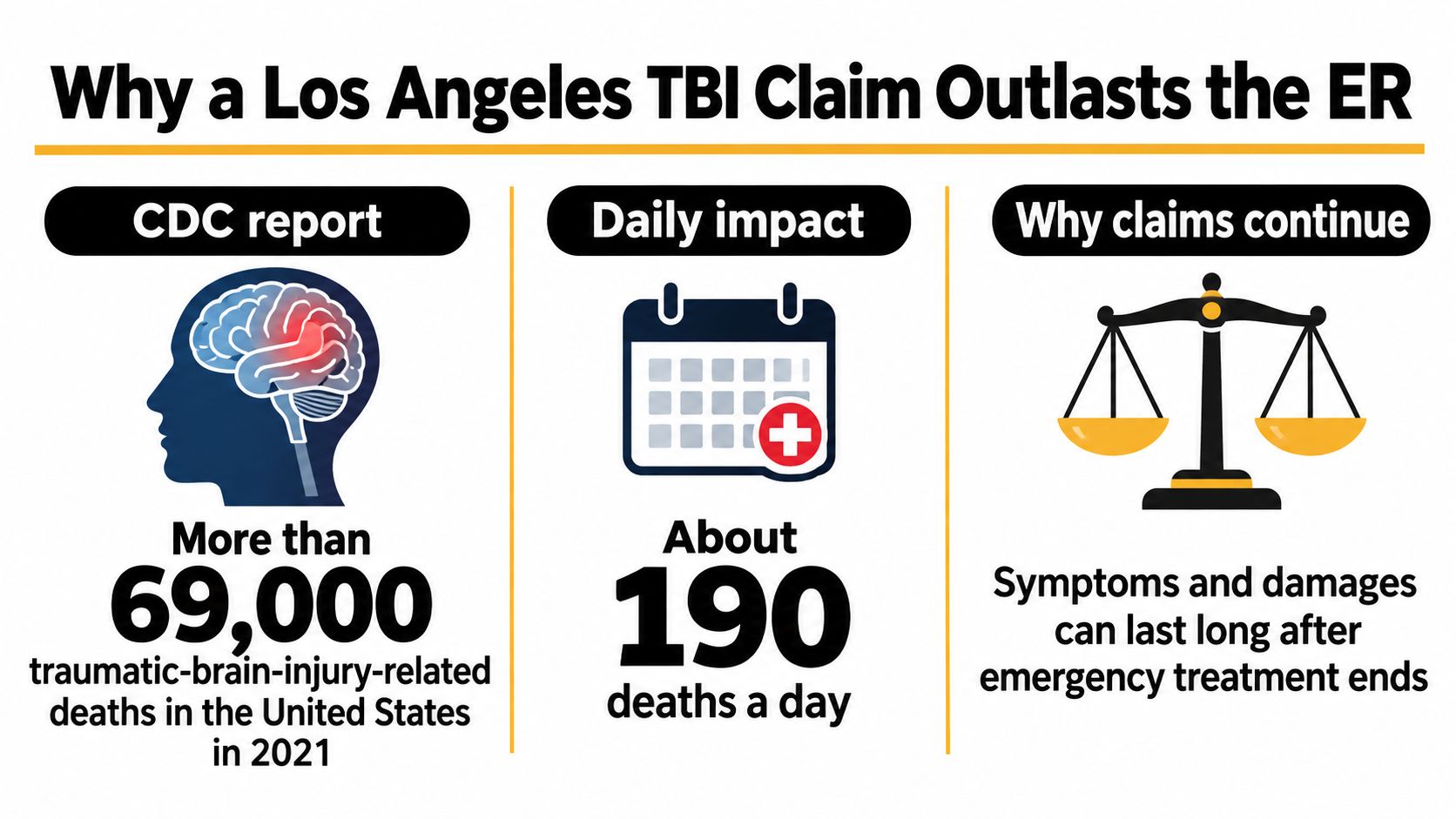
The Centers for Disease Control and Prevention TBI facts page reported more than 69,000 traumatic-brain-injury-related deaths in the United States in 2021, averaging about 190 deaths per day, and reports that falls account for nearly half of TBI-related hospitalizations. Those are national public-health totals. They don’t prove what happened in one Los Angeles crash, fall, or workplace incident, but they explain why an emergency-room visit is rarely the whole story.
Say a delivery driver is rear-ended, scanned, and sent home the same night. A week later, she’s forgetting routes she knew by heart, snapping at her kids, and sleeping through alarms. Nothing on the discharge papers predicts that slide, yet it’s the slide, not the first bill, that shapes the claim.
What counts as a TBI
A TBI isn’t limited to a visible skull injury. It’s an injury that affects how the brain works, and it can follow a bump, blow, jolt, or penetrating wound to the head. That’s why the mechanism of injury matters as much as the wound you can see. A hard jolt in a collision can disrupt memory and balance without breaking skin.
Families often ask how long recovery takes, and honest answers vary by severity and treatment. Orange Neurosciences offers recovery timelines for patients and caregivers that can help you frame questions for your own doctors, though no general timeline replaces your treatment records. What matters legally is the documented gap between how you functioned before and how you function now.
An ER discharge means you’re stable enough to leave. It doesn’t mean you’re recovered.
If you’re comparing Los Angeles traumatic brain injury lawyers, four questions organize everything else. What should you verify before hiring anyone? How is a claim built when imaging looks normal? Which damage categories can a survivor prove in California? And how do filing deadlines and case length usually run?
This article is for informational purposes only and is not to be construed as legal advice. No attorney-client relationship exists based on review of this article, and none of the information in this article is legal advice. Population numbers show why a claim can outlast the ER. Only your own records, neurological findings, imaging, and treatment history can connect a specific accident to specific losses.
What to Verify Before Hiring a TBI Lawyer
What to verify in a Los Angeles TBI lawyer
| Check | Why it matters in a TBI claim | Weak signal |
|---|---|---|
| Medical record fluency | Connects ER notes, coma scores, imaging, and rehab to daily limits | Talks only about the crash and not the brain |
| Expert plan | Lines up neuropsychology, life-care, vocational, or economic proof when symptoms last | Says a normal scan ends the case |
| Negotiation and lawsuit path | Tries settlement, then files if future care is ignored | Pushes a fast release before treatment stabilizes |
| Deadline analysis | Flags the usual two-year lawsuit period and shorter public-entity notice issues | Gives a generic anytime answer |
| Access and language | Can meet at home or hospital and explain options in the client’s language | Requires travel the injured person cannot make |
| Damages beyond the ER bill | Asks about wages, earning capacity, supervision, and household help | Values the case from the first medical bill alone |
Medical record fluency is the first filter. A capable lawyer reads emergency records, Glasgow Coma Scale scores, serial neurological exams, and rehab notes, not only the police report. Ask how they’d explain a gap between a normal scan and failing memory tests. If the answer stays on vehicle damage, they haven’t reached the brain injury yet.
Expert planning comes next, because symptoms that outlast imaging need a different kind of proof. A neuropsychologist can measure memory and executive function, a life-care planner can price future help, and a vocational specialist or economist can address work losses. You don’t need every expert in every case. You do need a lawyer who can tell you which one fits your facts and why.
Settlement first, court if needed
Most claims start with negotiation. The question is whether the lawyer is ready to file suit if an insurer’s offer ignores future care. A weak signal sounds like speed for its own sake, such as pushing a signed release before treatment stabilizes enough to measure what’s ahead. A stronger answer describes what must be known before any number makes sense.
Deadline judgment protects everything else. The ordinary personal-injury lawsuit period is two years, and a case involving a city, county, or other public entity can follow a shorter notice path. A lawyer who gives you a vague “don’t worry about timing” answer is asking you to carry a risk they should be spotting. Ask which deadline fits your facts and what could change it.
Access is practical, not cosmetic. Brain injuries make travel, paperwork, and long phone calls hard. We can travel to a client’s home or hospital if needed, and we serve clients throughout California in English, Spanish, and Farsi from our office in Chatsworth. Whichever firm you consider, confirm the language your family speaks and where meetings can happen.
What to bring and what to get in writing
Bring the accident date, discharge papers, a symptom log, and a short list of missed work or school. Those four items let a lawyer test the timeline and the functional story in one sitting. Then ask how fees, case costs, and any medical-lien reductions are explained, and request those terms in writing before signing anything.
Plain terms test: If a lawyer won’t state fee and cost terms clearly, treat that as part of the comparison, not a detail to sort out later.
Treat the table as questions to ask, not a score that proves any firm is right for your case. A promise of a dollar figure before records are read is a weak signal. So is advice to wait and see while memory fades and work records disappear.
When a Normal Brain Scan Still Leaves a Claim
A CT or standard MRI works like a photo of the roads, while a mild TBI can be a traffic jam the photo does not show. The structure can look intact while the flow of signals is disrupted. Insurers often treat the photo as the whole answer, so the proof problem begins exactly where the imaging stops.
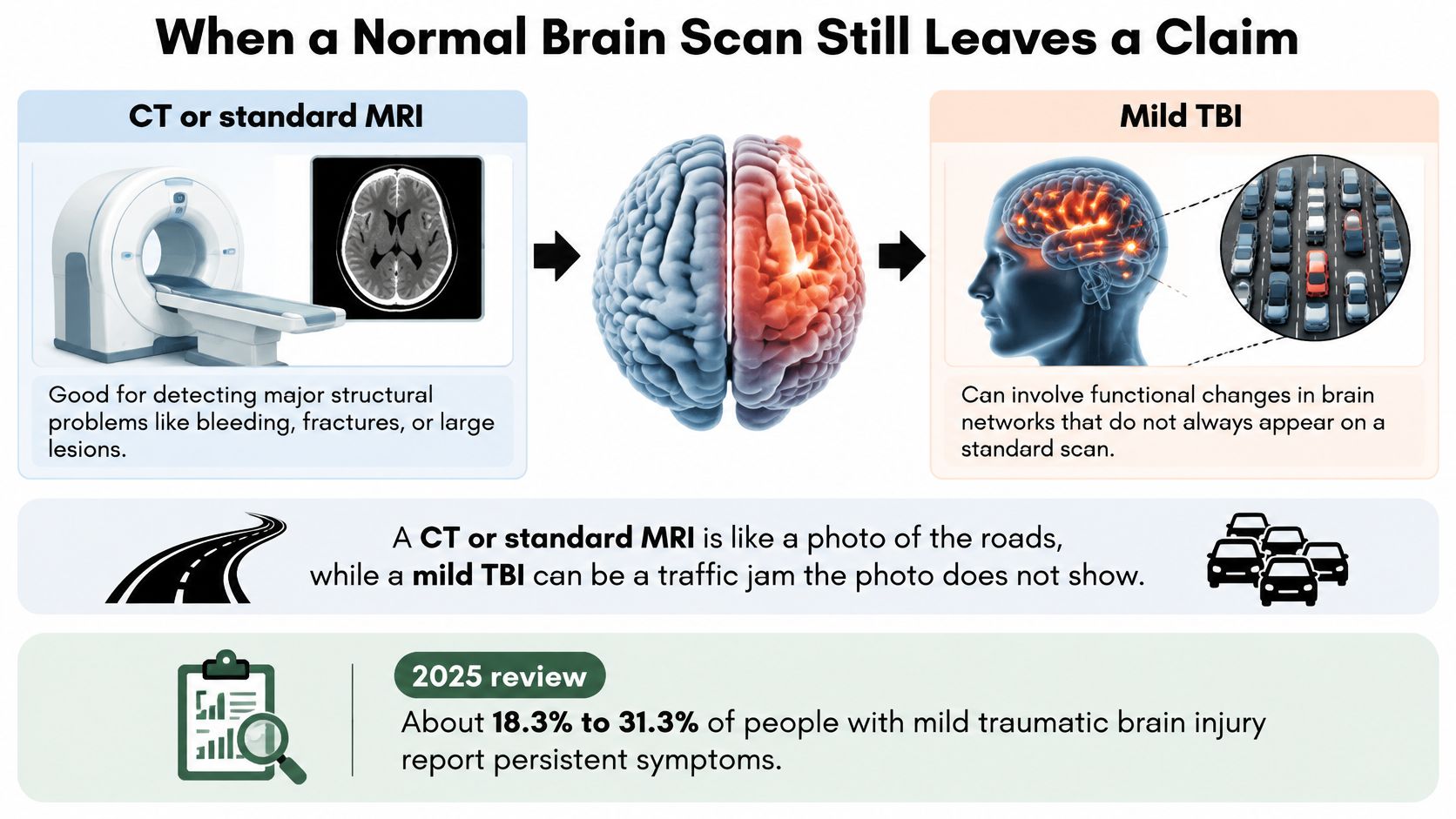
A 2025 review indexed on PubMed reports that approximately 18.3% to 31.3% of people with mild TBI continue to experience symptoms three to six months after injury despite normal imaging, including cognitive, visual, and other functional problems. That range describes groups of patients, so it can never prove any single person’s case. A claim has to be built from one person’s records. In plain terms, no single test settles the question.
Neither extreme proves the case
A normal scan does not end a claim, and a persistent headache by itself does not establish fault or a dollar loss. Both halves of that sentence matter. Los Angeles traumatic brain injury lawyers who skip the second half leave you unprepared for how the other side will argue, because alternative causes and preexisting conditions will be raised and the record has to answer them.
Our overview of the signs and symptoms of brain injuries can help you name what you are noticing at home. Naming a symptom is a start. Documenting when it began, how often it happens, and what it stops you from doing is what gives it weight.
The records that carry the story
- Same-day symptom notes: Headache, confusion, nausea, or sensitivity to light recorded close to the event, before memory gets fuzzy.
- Serial exams and coma scores: Repeated neurological checks showing whether function improved, stalled, or declined.
- Witness observations: A spouse, coworker, or teacher describing confusion, personality change, or repeated questions.
- Work or school performance: Reviews, grades, attendance, or error rates from before and after the injury.
- Neuropsychological testing: Measured results tied to memory, executive function, balance, impulse control, or fatigue.
Advanced testing needs a caution. Functional MRI and similar tools are not routinely ordered for every mild TBI case, and a specialized scan does not automatically prove cause. Blood markers such as GFAP and UCH-L1 are acute-care and research tools that can speak to severity and prognosis; they were never designed to establish who is responsible for an injury. What usually carries a claim is the functional record above, which abilities changed, how they limit work and daily life, and what care is reasonably certain to continue. That is why a documented pattern of limits tends to drive the value of a Los Angeles TBI case far more than the emergency-room bill does.
New treatments raise similar questions. If you are reading about regenerative options, Dream Body Clinic’s summary of the evidence behind stem cells for TBI is background reading to discuss with your treating doctors, not a basis for valuing a claim. The legal chain stays the same either way: impairment first, then activity limitation, then a work or care consequence.
California Damages a TBI Survivor Can Prove
Some losses are easier to show because they arrive with invoices. Emotional harm is real, but its monetary value is harder to measure than a hospital bill. A credible damages claim keeps those two kinds of proof separate instead of blending them into one large, unexplained number.
TBI damage categories and the proof they need
| Category | What it covers | Proof that usually carries it |
|---|---|---|
| Past medical care | ER, hospital, surgery, medication, and early rehab bills | Bills, records, and proof the care relates to the injury |
| Lost wages | Pay missed during treatment | Payroll, tax records, and employer confirmation |
| Future care | Therapy, medication, cognitive rehab, follow-up, transport, equipment | Medical necessity, frequency, duration, and market cost |
| Earning capacity | Lower future pay or a narrower job path | Vocational comparison of duties, skills, and restrictions |
| Attendant and household help | Supervision, chores, and care the person can no longer do safely | Care logs, family testimony, and life-care assumptions |
| Emotional harm | Pain, distress, and loss of ordinary enjoyment | Treatment history and testimony; value is harder to measure than bills |
We seek reimbursement for economic damages such as medical and surgical bills, recovery costs, and lost wages. Those are the foundation, not the ceiling. Our discussion of brain injury settlement amounts explains why two cases with similar first bills can end at very different values once future limits are documented.
The reasonably certain test
Future care needs more than a possibility. The Judicial Council of California civil jury instructions state that a plaintiff must prove future harm is reasonably certain to occur and must prove the amount of future damages. That single standard shapes how Los Angeles traumatic brain injury lawyers build the money side of a case.
The working sequence runs in four steps. First, a medical expert identifies the diagnosed impairment. Second, testing and daily records show the activity limitation it causes. Third, that limitation is translated into a work or care consequence, such as fewer hours or daily supervision. Fourth, the consequence becomes a dollar figure with stated assumptions.
A life-care planner can price therapies, medication, cognitive rehabilitation, attendant care, adaptive technology, transportation, and neurologic or psychiatric follow-up by frequency and duration. An economist can then convert those projected costs and lost earnings into present-value figures. Diminished earning capacity follows the same logic, comparing pre-injury education, job duties, earnings trajectory, and transferable skills against post-injury restrictions through vocational evidence.
A radiology report can establish injury. It can’t, by itself, establish what the injury costs over a lifetime.
Emotional harm deserves its own evidence, not a guess. For background on how trauma can persist, reVIBE Mental Health’s guide to understanding the long-term effects of PTSD helps families recognize symptoms worth raising with treating providers. For some cases, we determine non-economic damages by applying a multiplier to the client’s economic damages. A multiplier is a presentation method, not a rule that sets the result, and it still needs treatment history and testimony behind it.
Household help belongs in the analysis because discharge isn’t independence. A survivor may be medically stable and still unsafe to manage money, drive, cook, or stay alone. Care logs and family testimony document that supervision before it gets dismissed as ordinary family help. Keep money already spent separate from money still ahead, because speculative round numbers fail when clinical records, market rates, and assumptions are missing.
Falls Crashes and Other Injury Examples
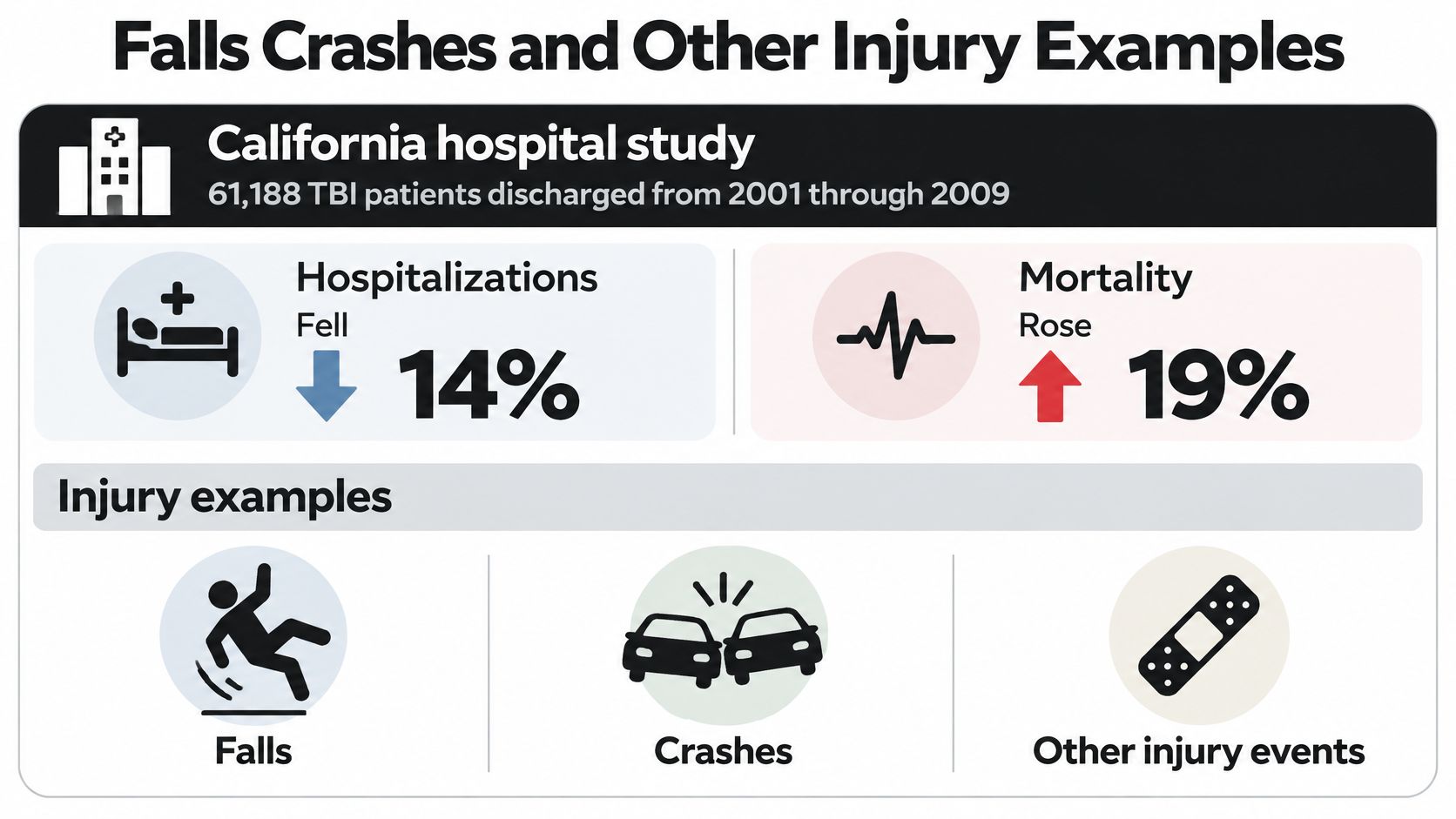
A peer-reviewed California study in hospital discharge data covering 61,188 TBI patients from 2001 through 2009 found TBI-related hospitalizations declined by 14% while mortality increased by 19%. Falls accounted for approximately 31.5% of TBI hospitalizations, motor-vehicle accidents for 19.6%, and other causes for 38.4%. Read those years carefully. This is historical context for how claims arise, not a snapshot of today’s caseload.
The same study found about 65.1% of admissions were classified as serious to critical, with an average hospital stay of 5.9 days and a median stay of 3 days. It also found 37.2% of hospitalizations involved people aged 75 or older, 58.9% involved males, and 44.0% involved Medicare patients. A three-day median stay is a warning against treating discharge as recovery. People go home because the hospital phase ended, not because thinking and balance returned.
Three typical Los Angeles scenarios
Say a shopper falls on a wet stairwell with a broken handrail. The evidence that matters includes photos of the hazard, lighting, footwear, witness timing, and whether confusion after the fall is new or tied to a prior condition. Our guide to California premises liability law explains the property-owner side of that analysis. For an older adult, even a short fall can lead to inpatient care, rehabilitation, and supervision at home, so age works as vulnerability context rather than proof of fault.
Say a passenger in a rideshare is thrown forward in a freeway collision and never strikes anything directly. The mechanism of injury, emergency neurological findings, and accident facts carry the early record. Later, work limits do the heavier lifting, such as an accountant who can no longer track multi-step reconciliations. Accident reconstruction and employment records often matter as much as the scan.
Say a cyclist is clipped at an intersection, or a warehouse worker is struck by falling stock. These other-cause cases often turn into arguments about a different medical explanation, such as a prior concussion or an unrelated condition. Baseline records from before the event, plus rehabilitation notes and family caregiver accounts, help separate what changed from what was already there.
Matching the example to the evidence
- Fall on unsafe property: Hazard photos, incident reports, witness timing, and proof the confusion is new.
- Vehicle or rideshare crash: Mechanism evidence, neurological findings, reconstruction where needed, and documented work limits.
- Workplace, bicycle, pedestrian, or blow to the head: Baseline health records, treating-provider notes, and caregiver observations that rebut an alternate-cause argument.
The high share of serious-to-critical admissions supports looking hard for permanent cognitive, physical, and emotional effects. It doesn’t assign a value to any one case. Each example still has to run through the same chain, impairment, activity limitation, then a documented work or care consequence.
Deadlines and How Long a TBI Case Runs
Two different clocks confuse people. One is the deadline to file. The other is how long a case takes once it starts, and they don’t move at the same speed.
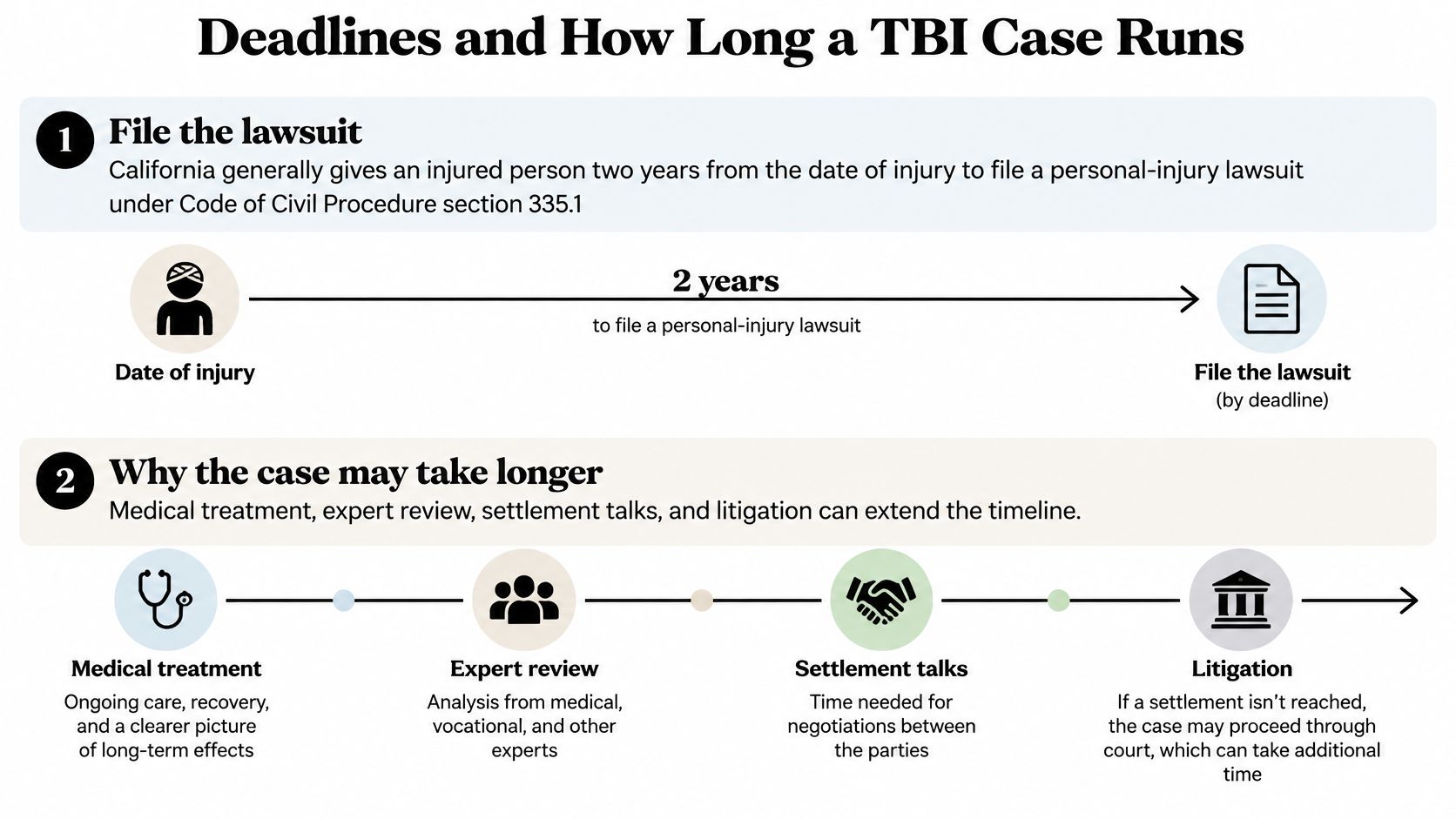
The California Courts statute of limitations guide reflects that California generally gives an injured person two years from the date of injury to file a personal-injury lawsuit under Code of Civil Procedure section 335.1. California Courts identifies personal injury as including harm caused by negligent or intentional conduct, such as an accident, assault, battery, or negligent infliction of emotional distress. Missing the applicable deadline can bar the claim. Exceptions may apply depending on the facts, including when the injury wasn’t immediately discovered or when a public entity is involved.
Why delay is risky with a brain injury
TBI symptoms can start subtly. Memory, concentration, employment performance, and daily functioning may decline weeks after the event that caused them. Prompt medical documentation protects your health first, and it also anchors the timeline if someone later argues the problems came from something else. A government claim can carry a much shorter notice period, so cases involving a public entity need case-specific review right away, not at month twenty.
Timing rule: Get the deadline identified for your specific facts early, even if settlement talks come much later.
The stages of a typical claim
- Get medical care and save records: Treatment notes create the timeline everything else hangs on.
- Identify the deadline that fits the facts: Private defendant and public entity cases don’t follow identical paths.
- Present the claim to the insurer: Documented damages go in with the demand, not after it.
- Negotiate after treatment stabilizes: Future care can’t be measured responsibly before the medical picture settles.
- File suit if the offer leaves future harm unpaid: Litigation becomes the tool when negotiation stalls.
When a client works with our personal injury lawyers, we first negotiate a settlement with the insurance company. If we cannot reach an agreement with the insurance company, the matter may proceed to litigation. Many personal injury cases we handle take six months to reach a settlement, and some lawsuits could take up to three years. Your case will depend on medical recovery, the insurer’s position, court schedules, and discovery, so treat any timeline as an estimate tied to your facts. This article is for informational purposes only and is not legal advice.
Start a Confidential Case Review
Schedule a review if headaches, memory gaps, mood change, or missed work followed a fall, crash, rideshare ride, pedestrian or bicycle impact, or premises incident in California. You don’t need a dramatic scan to justify the conversation. You need a documented change and questions about what it means.
Bring the injury date, photos, insurance letters, and discharge papers. Add a symptom log and the names of people who saw changes at home or work. Those items let a lawyer test the timeline, the functional limits, and the deadline in a single meeting.
LA Law Group, APLC offers this review. Our personal injury practice covers automobile accidents, bicycle accidents, pedestrian accidents, slip and fall, premise liability, traumatic brain injuries, and wrongful death, among other matters. The first consultation is free and confidential, and it is held with the attorney who will handle the matter. We can review what happened, explain injury claim options in plain language, and talk with insurers on the client’s behalf. Confirm consultation terms, fee arrangements, languages offered, and meeting options directly with the firm, because this article does not describe them. This article is for informational purposes only and is not to be construed as legal advice. No attorney-client relationship exists from reading it, and none of the information in it is legal advice. The consultation, not this page, is where the deadline and the facts of one injury get a real answer.
If a fall, crash, or blow to the head left you or a family member with memory trouble, mood changes, or missed work, don’t let a normal scan or a fast insurance offer close the conversation. We review what happened, explain your claim options and deadlines in plain language, and deal with insurers on your behalf. Visit LA Law Group, APLC to request your free, confidential consultation with the attorney who will handle your matter.
Attorney Advertising. This article is general information, not legal advice, and does not create an attorney-client relationship. Prior results do not guarantee a similar outcome.