
Lyft Accident Lawyer Los Angeles: Insurance and Next Steps
You’re home after a Lyft crash, your neck hurts, and an insurance adjuster has already called. Your trip still appears in the app, but you don’t know whether to contact Lyft, the driver’s insurer, or the insurer for the car that hit you.
This article is for informational purposes only and is not to be construed as legal advice. None of the information in this article is legal advice, and reviewing it creates no attorney-client relationship.
Why Los Angeles Lyft Crashes Create Complex Claims
A Lyft crash leaves you with three separate questions: who caused the collision, which insurance policy responds, and what losses the evidence supports. Settling one question does not settle the others, and that gap is where injured passengers get stuck.
According to LAPD figures reported by the City of Los Angeles, more than 1,500 people suffered severe injuries in city traffic collisions in 2024, and 302 people died, compared with 241 fatalities in 2015, an increase of approximately 25.3%.
Those numbers describe the road conditions around your claim, not your odds of recovering anything. What makes a Lyft claim harder than an ordinary fender bender is that the driver’s status in the app at the moment of impact decides which layer of coverage applies, and the driver’s own status may be disputed. On top of that, the driver who hit you may carry no insurance at all, which pushes your claim toward uninsured and underinsured motorist coverage, a layer shaped by a reported change to California’s UM/UIM limits arriving in 2026. Each of those forks creates its own investigation, its own paperwork, and its own potential denial.
Who may have a claim
- Passengers: Someone riding in the Lyft may have a claim against the rideshare driver, another driver, or both.
- People outside vehicles: A pedestrian, cyclist, or bystander may be injured during a turn, pickup, or drop-off.
- Other vehicle occupants: Someone hit by a Lyft driver may need platform records even though they never booked a ride.
Notice the pattern in that list. Two people injured in the same crash can end up filing against entirely different policies, because coverage follows each person’s relationship to the collision rather than the collision itself.
The diagram below summarizes the overlapping traffic, insurance, and evidence issues.
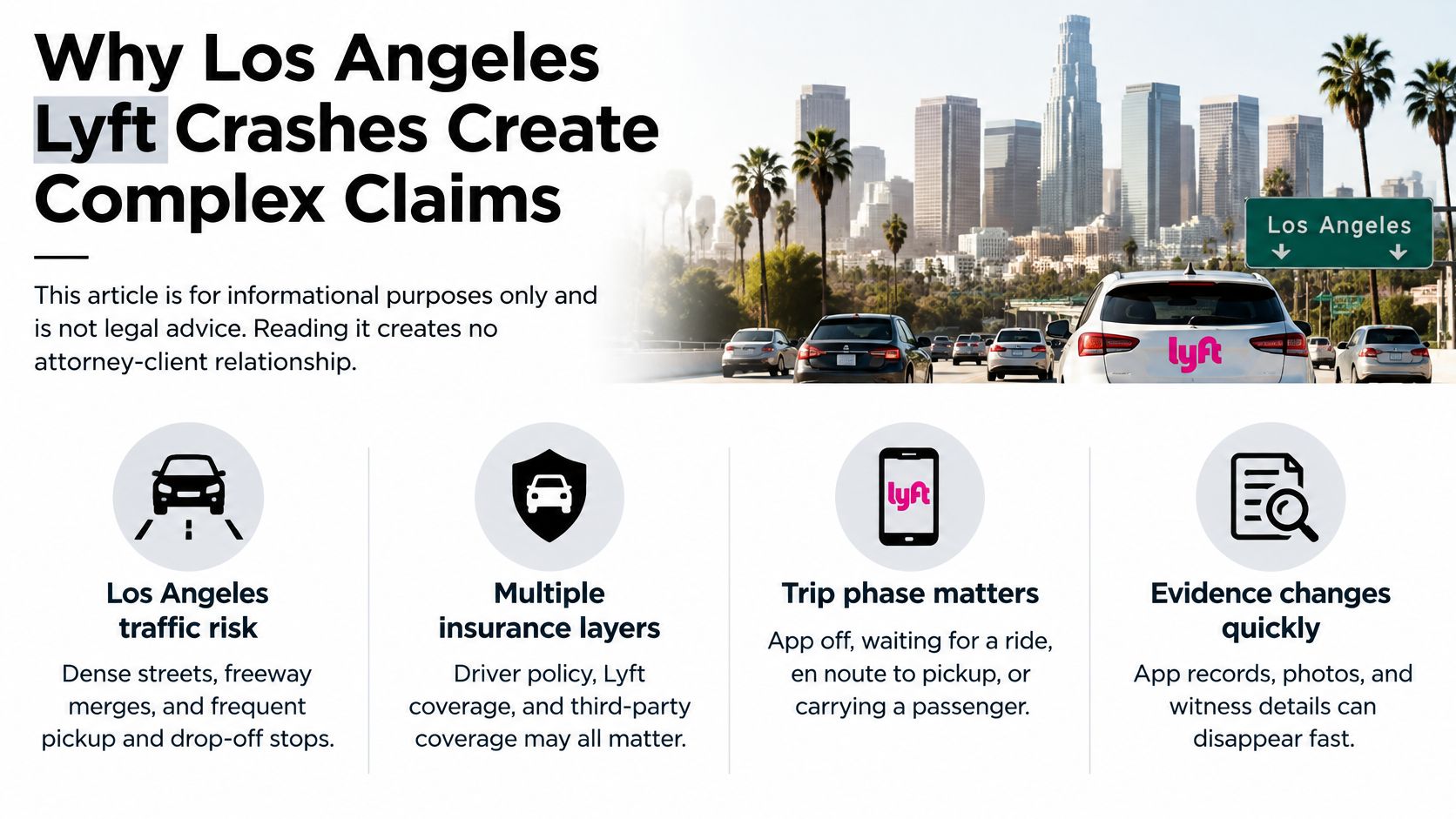
For an injured passenger, the workable order is to establish coverage first, investigate uninsured-driver protection second, preserve evidence third, and confirm deadlines last. That sequence matters because an early settlement offer can arrive before you know which coverage applies or whether the at-fault driver has any insurance at all. Everything in this article is general information, not legal advice, and the specifics of your crash can shift which of these questions matters most.
Lyft Insurance Limits by Driver Status
A Lyft driver’s insurance position works like a gear shift: each app status engages a different policy, and the wrong assumption about which gear was engaged can send a claim to the wrong insurer entirely.
Lyft Coverage by Driver Status in California
| Driver status | Third-party bodily injury | Property damage | Notes |
|---|---|---|---|
| Driver logged in, no ride accepted | $50,000 per person, $100,000 per accident | $30,000 per accident | Lyft’s general insurance disclosure lists these limits when personal insurance doesn’t apply; confirm California-specific policy terms. |
| Ride accepted or passenger on board | At least $1,000,000 third-party liability | The applicable liability policy’s property-damage limit governs | Lyft’s California driver information identifies this active-trip liability tier. |
| App off, personal driving | Personal policy’s bodily-injury limits | Personal policy’s property-damage limits | Personal auto policy governs ordinary personal driving; a Lyft decal alone doesn’t establish platform coverage. |
The waiting-for-a-request phase is where explanations often become misleading. It isn’t personal driving, but it also isn’t an accepted passenger trip, so it sits in a middle tier with lower limits than many passengers expect.
California’s AB 2293, effective July 1, 2015, established primary third-party liability requirements and $200,000 in excess liability coverage for the logged-in, available period, as described in Lyft’s statutory coverage explanation. That excess layer belongs to the waiting phase specifically, and the general contingent-coverage language in the table shouldn’t be read as a complete statement of which insurer must respond first under California law.
Read the table as a starting point
Once a driver accepts a request, the analysis changes even if the passenger hasn’t entered the car. A driver heading toward pickup isn’t necessarily in the same insurance position as a driver waiting for work, which is why the moment of acceptance matters as much as the moment of impact.
When the app is off and the driver is making a personal trip, start with the personal policy. Conversely, a personal policy may exclude rideshare activity while the driver is working, so an insurer’s name on an insurance card doesn’t establish coverage for the collision.
Coverage limits aren’t promised settlement amounts. A limit is a ceiling on what a policy may pay, and reaching it still requires evidence of fault, injury, and loss. The applicable policy can also contain conditions or exclusions that narrow recovery below the headline figure.
For a pedestrian hit near a pickup area, the important question isn’t whether the car displayed a Lyft sticker. It’s whether platform records place the driver in a covered phase at impact.
Coverage checkpoint: Establish whether the app was on, whether a request had been accepted, and the exact impact timestamp before treating an insurer’s coverage position as final.
This table addresses liability coverage for harm the Lyft driver causes. It says nothing about protection when someone else caused the crash, a gap covered separately in our explanation of California rideshare coverage changes.
The coverage descriptions above are general information, not legal advice about any specific claim.
When the At-Fault Driver Has No Insurance
Say you’re riding in a Lyft when another driver runs a red light. Your Lyft driver appears to have done nothing wrong, and the other driver has no insurance.
That’s not automatically a claim against the rideshare driver’s liability coverage. Liability insurance addresses covered harm attributable to an insured’s responsibility. Uninsured and underinsured motorist coverage, often shortened to UM/UIM, addresses qualifying injuries involving a driver with no insurance or insufficient insurance.
“If I was a Lyft passenger injured by an uninsured driver, why might my recovery be capped far below $1 million?”
A Walch Law explanation of California Lyft claims reports that, under SB 371, mandatory TNC UM/UIM coverage fell from $1 million to $60,000 per person and $300,000 per incident, effective January 1, 2026. Because that account is a secondary legal summary, have counsel verify the statute, the collision date, and the actual policy before relying on those limits.
Why the distinction matters
The headline liability limit doesn’t automatically become uninsured-driver protection. A passenger can have serious injuries during a covered ride and still face a substantially different coverage analysis when an uninsured third party caused the crash.
Nor does a policy limit necessarily establish the ceiling for every possible recovery. Another applicable policy or another party’s responsibility may change the available options, but neither should be assumed.
Before discussing a final settlement:
- Identify the potentially primary insurer: Ask which policy the carrier believes responds first and why.
- Request the coverage position in writing: Ask whether the carrier is evaluating liability, UM/UIM, or another benefit.
- Check other possible coverage: Provide your attorney with household auto-policy information and every policy exchanged after the crash.
Our guide to an accident with an uninsured driver explains related claim issues. Don’t accept an early payment as a complete resolution until you understand which coverage the payment uses and what rights the release would end.
Evidence to Preserve After a Lyft Crash
A Lyft claim often turns on a single question: what was the driver’s app doing at the moment of impact? App status is established through records, because a decal on the windshield or a passenger’s memory cannot show whether the ride was accepted, underway, or already finished. That distinction controls which insurance layer applies, and it matters even more when the driver who caused the crash carried no insurance.
Get medical help and move to safety first. Evidence collection should never delay care or put you back in traffic. Once you are safe, work through the records below, because several of them become hard to obtain quickly.
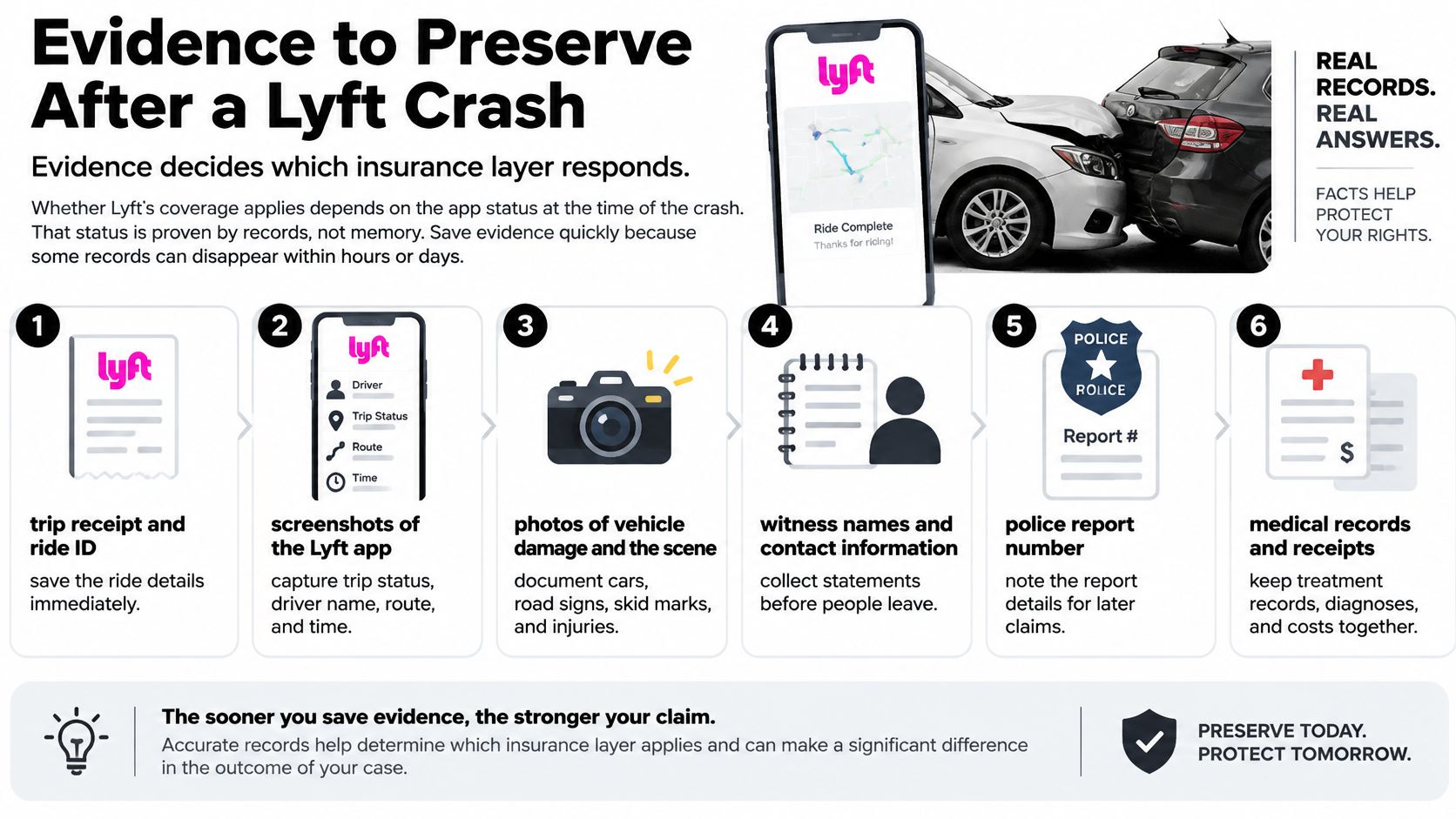
Save the records most likely to become unavailable
- Trip receipt and ride ID: Save the receipt email and export or screenshot the ride details. The app may not display the same trip screen later.
- App screenshots: Capture the driver profile, route, and visible trip status. A screenshot taken days later may show a different screen than the one displayed at impact.
- Request, acceptance, and impact timestamps: Preserve messages, call logs, and original photo timestamps. If you can only estimate the crash time, label it as an estimate instead of forcing it to match the receipt.
- Police report number and scene notes: Record the agency and report identifier. Write down what you remember, separating what you saw from what you assumed.
- Vehicle identification and photographs: Save plates, vehicle details, damage, road signs, and the wider scene. Close-up damage pictures alone can leave out the intersection layout.
- Witness contacts: Get names and contact details before people leave, if it is safe. An unnamed witness mentioned in your notes can be hard to locate later.
- Medical documentation: Keep treatment records, imaging, and work restrictions together. Bills alone may not explain the diagnosis or tie it to the collision.
- Insurance information: Save readable images of the exchanged cards and claim details. Never assume the other driver kept copies.
- Written insurer correspondence: Preserve emails, letters, and attachments, including the dates each one arrived.
An evidence folder works like a chain of custody: every item should show where it came from and when. A dated symptom and appointment log belongs in it too, covering interrupted sleep, missed work, and practical limitations. Record each entry accurately, because an inflated symptom can cast doubt on the honest ones.
For organizing the digital side of that file, the preservation guidance from AI Video Detector offers a supplementary organizational resource. Keep original files unedited, store a backup in a second location, and avoid cropping photos you may later need to authenticate.
The following video provides an additional viewing resource.
Bring the whole folder to your consultation. LA Law Group holds a free, confidential first meeting with the attorney who would handle the matter, and a complete file lets that attorney identify missing records rather than reconstruct basic facts. This section is general information, not legal advice, and your own crash may raise questions only a review of the records can answer.
Deadlines and Timelines for Injury Claims
Key Injury Claim Deadlines and Timelines
| Milestone | Typical timing | What it means for the reader |
|---|---|---|
| Filing deadline for ordinary personal injury | Two years from the date of injury, according to California Courts | Missing it can bar the claim; check earlier for public-agency claims. |
| Negotiated settlement | About six months in many cases handled by LA Law Group | Time is needed to gather treatment records and proof of lost wages; this isn’t a promised completion date. |
| Lawsuit if no agreement is reached | Some LA Law Group lawsuits could take up to three years | Litigation may follow unsuccessful negotiations; this isn’t a universal maximum. |
A filing deadline and a settlement timeline serve different purposes. The deadline concerns preserving your ability to sue. The settlement timeline concerns how long investigation, medical documentation, negotiation, or litigation may take.
An open insurance claim doesn’t mean you can stop tracking the court deadline. Claims involving a public agency can also involve different, shorter notice requirements, so flag a possible roadway-maintenance or public-vehicle issue early.
Treatment and negotiations run on separate tracks
Insurers evaluate whether the medical account fits the collision and whether treatment was continuous and reasonable. Attend recommended appointments, follow documented work restrictions, and tell your provider when symptoms change.
If cost, transportation, or another barrier interrupts care, document it and discuss alternatives with your provider. An unexplained gap can leave an adjuster with an incomplete picture of your recovery.
Timing rule: Don’t confuse pressure to pay today’s bills with having enough information to value tomorrow’s treatment.
A long recovery can make an early offer attractive. Before agreeing, understand the diagnosis, expected care, work impact, and unresolved medical questions.
Our guide to the California auto accident statute of limitations provides additional deadline context. Put the collision date and a deadline-review reminder on your calendar immediately, then have the applicable filing and notice dates confirmed.
How a Rideshare Lawyer Supports Your Claim
A Lyft accident lawyer in Los Angeles should explain the claim in terms you can follow: what must be proved, which records are missing, and which insurer is being approached. Hiring counsel doesn’t establish liability or guarantee compensation.
At LA Law Group, we can review what happened, explain injury-claim options in plain language, and speak with insurers on a client’s behalf. A confidential consultation gives the attorney an opportunity to assess the facts rather than guess from an insurance limit.
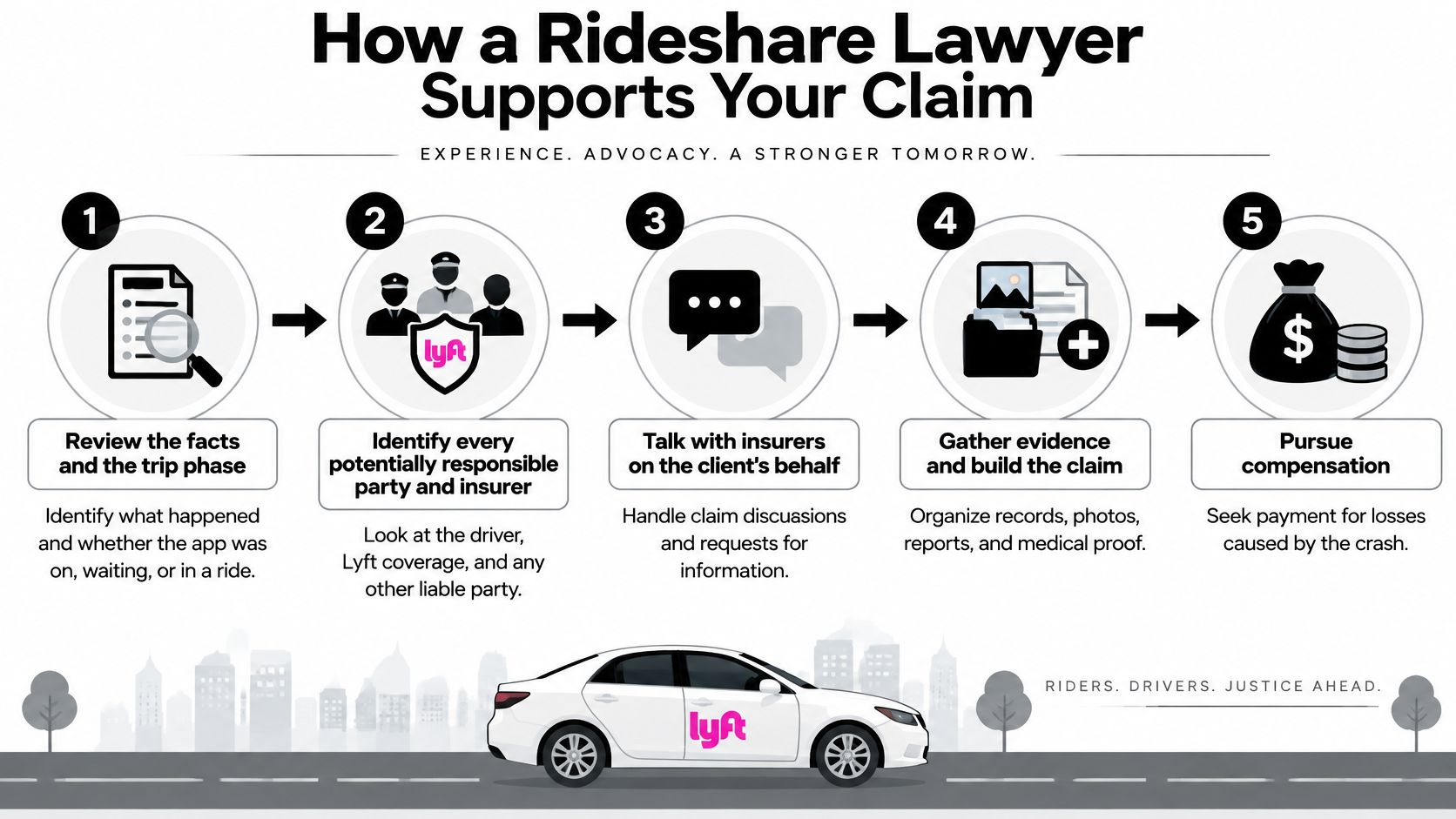
The visual below summarizes the work involved.
From factual review to resolution
- Review the facts and trip phase. The attorney compares your account with receipts, timestamps, photographs, and the collision report. Bring the original records, including anything that seems inconsistent.
- Identify responsible parties and insurers. Counsel examines the conduct of the drivers and any other supported source of responsibility. Provide all insurance information, not only the carrier that contacted you first.
- Handle insurer communications. Your lawyer can address document requests and coverage questions on your behalf. Forward correspondence promptly and tell counsel about any statement you’ve already given.
- Negotiate a supported settlement. We first negotiate with the insurance company. Treatment records, wage documentation, and a clear loss calculation support that discussion.
- Consider litigation if agreement isn’t reached. If we can’t reach an agreement with the insurer, the matter may proceed to litigation. That decision requires attention to disputed facts, available coverage, costs, and deadlines.
Document losses without treating a formula as a promise
We seek reimbursement for economic damages, including medical and surgical bills, recovery costs, and lost wages. Give the attorney itemized bills, pay records, and physician restrictions so the demand reflects documented losses.
In some cases, we use a multiplier applied to economic damages to estimate non-economic damages. That’s a valuation method, not a guaranteed award or a substitute for showing how pain and limitations affected your life.
Many personal injury firms work on contingency, meaning an attorney fee is owed only if a recovery is obtained. Confirm the percentage, treatment of case costs, and deduction order in a written agreement before representation begins.
Useful consultation questions include:
- Coverage strategy: Which insurer would you pursue first, and why?
- Trip-phase dispute: What additional records would resolve uncertainty?
- Communication: Who will update me, and how should I send new treatment records?
Confirm Your Options Before You Accept an Offer
An offer can arrive before your treatment ends. Signing the release attached to it closes the claim for good: the app-status question, the fight over which insurer owes coverage, and any gap left by an uninsured driver all become settled facts you cannot reopen. Work through three confirmations before you decide:
- Confirm the trip phase. Match the offer to what the trip receipt and app records show. The driver’s app status decides which Lyft policy applies and how much coverage stands behind the number.
- List the insurers. Note which carrier accepts responsibility: Lyft’s policy, the driver’s personal insurer, or your own uninsured motorist coverage. A reported 2026 change to California’s UM/UIM limits makes your own policy worth confirming when the at-fault driver carries nothing.
- Verify the deadline. Confirm the filing date and any earlier notice requirement before reading pressure or patience into the offer’s timing.
This article is for informational purposes only and is not legal advice. Reading it creates no attorney-client relationship, and none of its information should be construed as legal advice.
Contract-review habits still help at signing. Documind’s guide explains how to check contract parties and dates, which can surface drafting errors in a release. Have an attorney read any proposed release before you sign, since a signature waives claims you may not know you have.
Our first consultation is free and confidential, and you will meet with the attorney who will handle the matter. Bring your evidence folder so we can discuss the specifics of your case and what to expect; we serve clients throughout California in English, Spanish, and Farsi from our Chatsworth office.
Wait to sign until the coverage questions are answered and you understand what the release takes away.
LA Law Group, APLC offers a free, confidential attorney consultation to review your Lyft collision, discuss injury-claim options, and identify questions about the applicable insurance. Visit LA Law Group, APLC to arrange your consultation, and bring your trip receipt, medical records, and insurer correspondence.
Attorney Advertising. This article is general information, not legal advice, and does not create an attorney-client relationship. Prior results do not guarantee a similar outcome.