
Non Incapacitating Injury
A non-incapacitating injury is a visible, nonfatal injury, such as bruises, abrasions, or minor cuts, that doesn’t prevent you from walking, driving, or continuing normal activities. In one 2025 study, 29.3% of people with mild traumatic brain injury still met the study’s persistent-symptom threshold 30 days later, showing why a scene label doesn’t always tell the whole medical story.
You may be in that uncomfortable middle ground right now. You left a California crash on your own feet, the police report mentioned bruising or another visible injury, and everyone initially treated the incident as minor. Then the headaches appeared. Your neck tightened. You started forgetting things, sleeping poorly, or struggling to finish ordinary work.
That experience can feel confusing because “non-incapacitating injury” describes what was observable at the crash scene, not necessarily what a doctor will later diagnose. This guide explains the label, its place in the KABCO system, the gap between police observations and medical findings, and the records that can help show how an injury affected you over time.
This article is for informational purposes only and isn’t to be construed as legal advice. No attorney client relationship exists based on the review of this article, and none of the information in this article is legal advice.
Why Your Crash Report Label Matters More Than You Think
You walk away from a collision in California. Your car is damaged, your arm has visible bruising, and you can speak with the officer, exchange information, and drive home. The report later uses the phrase non-incapacitating injury. At that moment, the wording may seem like routine paperwork.
A few days later, headaches and dizziness begin. Turning your head hurts. You can still get out of bed and go to work, but your normal day now takes more effort. The report’s label hasn’t changed, yet your medical reality has become clearer.
The National Highway Traffic Safety Administration defines a non-incapacitating evident injury as an injury, other than a fatal or incapacitating injury, that people at the crash scene can observe. NHTSA lists examples such as a lump on the head, abrasions, bruises, and minor lacerations in its explanation of the classification (NHTSA’s definition of a non-incapacitating evident injury).
A scene observation is only the beginning
The officer is documenting an event under conditions that may be chaotic, rushed, and limited to what can be seen or reported at that time. The officer isn’t conducting a neurological examination, reviewing later imaging, or observing how symptoms affect your work several weeks afterward.
That distinction matters because insurers, attorneys, and courts may first encounter your situation through the crash report. A B designation can become an early reference point, even though it doesn’t answer every question about diagnosis, treatment, causation, prognosis, or losses.
Practical rule: Treat the police classification as an important piece of evidence, not as the final word on your health.
The rest of the evidence develops through medical visits, treatment records, symptom notes, work restrictions, and documentation of daily activities. If you need help understanding possible post-crash rehabilitation options, a rehabilitation resource can also help you identify appropriate follow-up questions for a healthcare professional.
A careful claim doesn’t try to exaggerate a visible bruise. It explains the complete timeline. You may have looked functional at the roadside and still developed a concussion, soft-tissue pain, or other symptoms that became apparent only after the initial adrenaline wore off.
What a Non-Incapacitating Injury Actually Means
Think of the crash-report label as a triage tag, not a medical chart. At an emergency scene, a responder may use a tag to organize what appears urgent. That tag helps create order, but it doesn’t replace a physician’s examination or later testing.
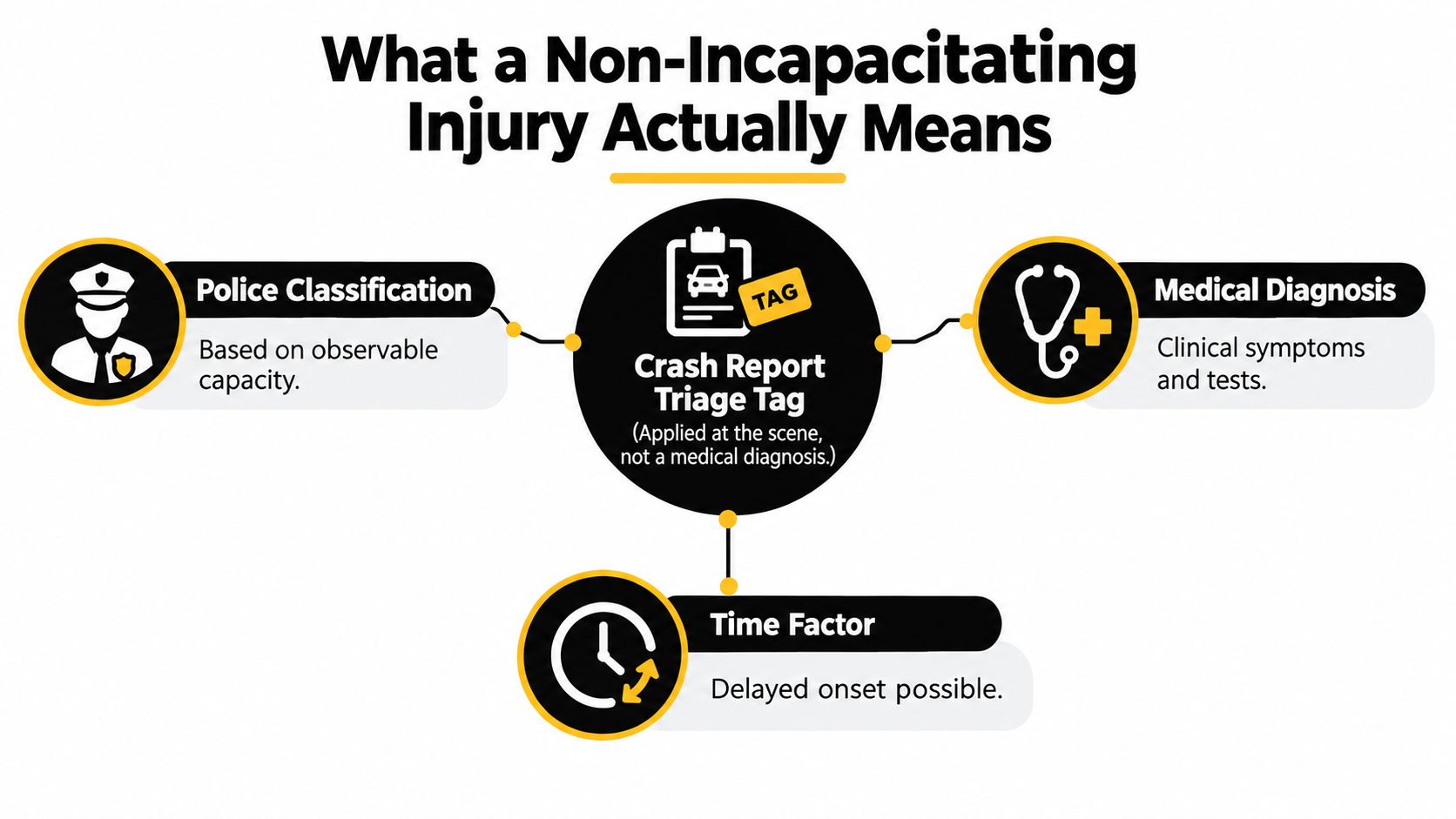
In the KABCO framework, a non-incapacitating injury is an injury other than a fatal or incapacitating injury that is observable to an officer or another person at the scene. The framework is functional and evidentiary rather than purely medical, meaning it focuses on what could be observed and how the person appeared to function at that point (FHWA’s KABCO injury-severity table).
What the label usually captures
A person with this classification generally can walk, drive, or continue ordinary activities. The injury may not prevent normal movement, and hospitalization is usually unnecessary. The category can include:
- Bruises and contusions: Discolored or tender areas caused by impact.
- Abrasions: Scraped skin, sometimes called road rash.
- Minor lacerations: Small cuts that are visible but don’t substantially impair function.
- A bloody nose or lump on the head: Observable signs that may follow impact.
- Other evident trauma: Injuries that an officer or scene observer can see without knowing the eventual clinical outcome.
The category excludes fatal injuries and incapacitating injuries. An incapacitating injury generally involves a level of impairment that requires assistance from the crash scene or prevents ordinary activities. The dividing line is therefore practical: could the person function independently as the officer observed them?
That doesn’t mean the person felt normal. Pain, confusion, dizziness, or fear can exist even when the person can stand and answer questions. Symptoms that become more apparent later may need a medical assessment, including guidance about diagnosing acute and chronic pain.
The label exists so law-enforcement agencies can record injury severity consistently across crash reports. It helps standardize data, but standardization comes with limits. A police classification records the scene. A medical diagnosis considers symptoms, examination findings, testing, treatment response, and the passage of time.
Where It Sits on the KABCO Injury Scale
The letter B makes more sense when you see the entire KABCO scale. The system separates fatal injuries, serious functional impairment, visible non-incapacitating injuries, possible injuries, and incidents without an injury designation.
| Code | Category | What It Means | Typical Examples |
|---|---|---|---|
| K | Killed | A fatal injury | A death resulting from the crash |
| A | Incapacitating injury | An injury that prevents ordinary activity or requires assistance from the scene | Severe impairment requiring help to move |
| B | Non-incapacitating injury | A visible injury that doesn’t prevent walking, driving, or continuing normal activities | Bruises, abrasions, minor cuts, a bloody nose, or a lump on the head |
| C | Possible injury | A reported injury or symptom that isn’t visibly confirmed at the scene | A complaint of pain without an observable injury |
| O | No injury or property damage only | No injury is recorded | Vehicle damage without a reported injury |
NHTSA’s coding materials identify B as the code for a non-incapacitating injury. The same materials use K for killed, A for incapacitating injury, C for possible injury, and O for no injury or a property-damage-only crash (NHTSA’s KABCO coding manual).
Why B and C are easy to confuse
Suppose you tell an officer that your back hurts, but there is no visible mark and you can move normally. The report may record a possible injury, or C, because the symptom is reported but not observable. If the officer sees a cut on your forehead, that visible injury may fall under B, even if you also report pain.
The categories don’t rank every medical condition with perfect precision. They describe what the officer can establish at the scene. A visible injury can be medically less significant than an invisible concussion symptom, while still receiving a different code because the evidence available roadside is different.
An A classification marks a more obvious loss of function. The person may need help leaving the scene or may be unable to carry on ordinary activity. A B classification marks visible harm without that observed level of functional limitation. That boundary is useful for reporting, but it isn’t a substitute for a clinical evaluation.
When the Police Label and the Medical Chart Disagree
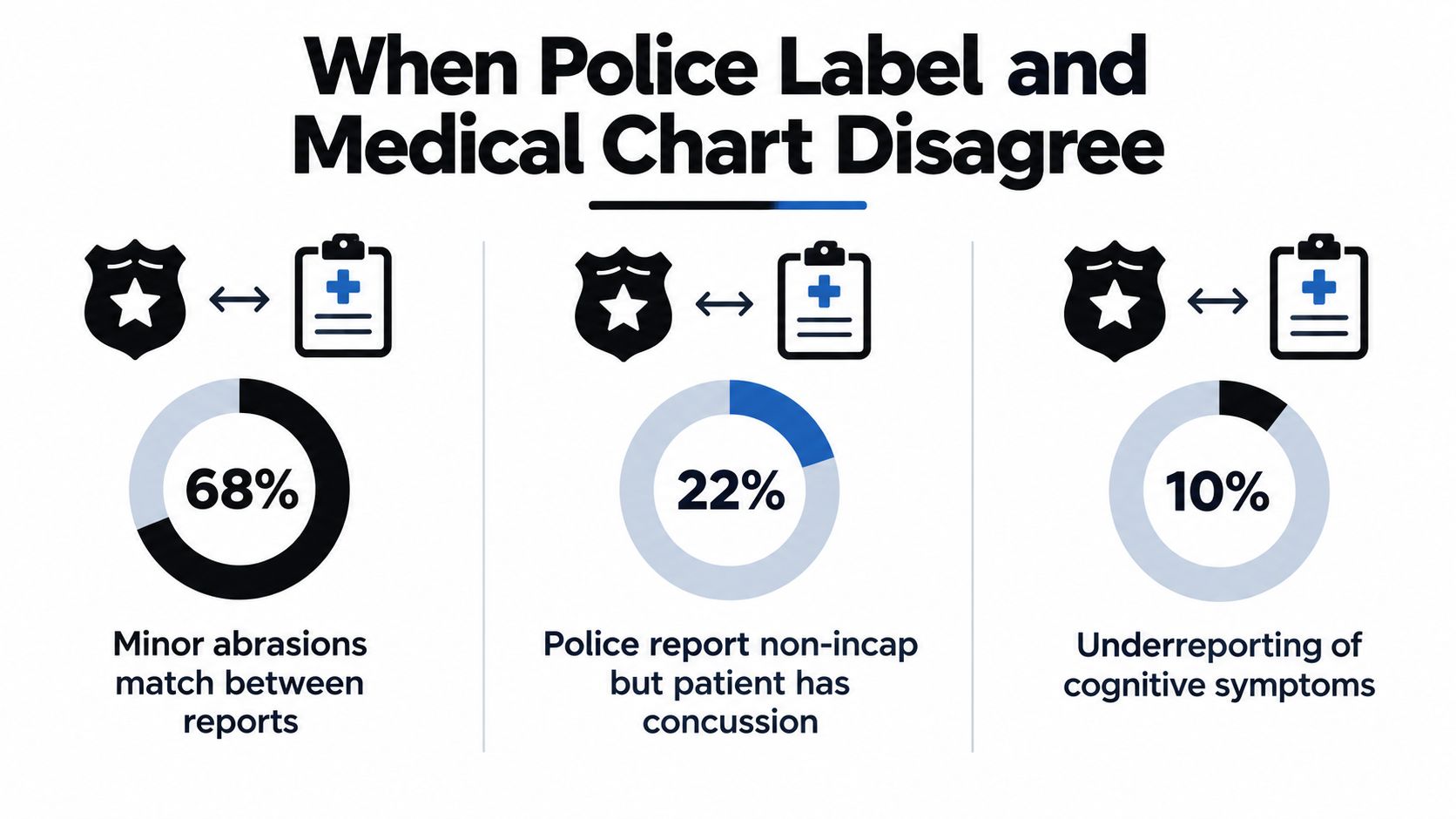
The police report and the medical chart answer different questions. The report asks what was observable at the scene. The chart asks what symptoms, findings, and functional limitations appear through clinical evaluation.
NHTSA technical material found that KABCO non-incapacitating injuries corresponded to AIS/NASS MAIS 1 or MAIS 2 injuries approximately 93% of the time (NHTSA technical material on KABCO and AIS or MAIS agreement). That is substantial agreement, but it also means the categories don’t match perfectly in every situation.
Why the mismatch happens
The AIS system assigns injuries by body region and severity, while MAIS records the highest AIS level for an occupant. KABCO, by contrast, relies on scene observation and functional appearance. Those systems may point in the same direction, but they aren’t measuring the same thing.
A concussion can become easier to recognize after emergency evaluation. Soft-tissue pain may intensify as swelling and muscle guarding develop. Internal problems may require diagnostic testing before a clinician can understand their significance. A person may also minimize symptoms during the first conversation because they are frightened, disoriented, focused on children or passengers, or eager to leave the scene.
For case assessment, the B designation is a starting point, not a ceiling. Relevant evidence can include:
- Imaging and diagnostic findings: Tests may reveal information unavailable to an officer at the roadside.
- Physician diagnoses: A clinician can connect symptoms and examination findings to a medical condition.
- Treatment chronology: The order and consistency of visits can show how symptoms developed.
- Work limitations: Restrictions, missed duties, reduced performance, or modified work can demonstrate functional impact.
- Daily-activity records: Difficulty sleeping, driving, exercising, caring for family, or concentrating can add context.
If the report contains an error or omits important observations, readers may also benefit from a practical guide to fixing a flawed police accident report. Correcting a report doesn’t automatically establish a claim, but an accurate record gives later reviewers a sounder starting point.
Why Non-Incapacitating Does Not Mean Minor
The word non-incapacitating can sound like a synonym for harmless. It isn’t. The classification says that the injury didn’t prevent ordinary function as observed at the scene. It doesn’t promise that symptoms will be brief, painless, or irrelevant to a person’s life.
Mild traumatic brain injury is one reason the difference matters. A person may not lose consciousness or require hospitalization and may still develop headaches, dizziness, balance problems, memory difficulty, anxiety, sleep disruption, emotional changes, or reduced work performance. Symptoms can emerge or become clearer days or weeks after the event.
A 2025 cohort of 803 emergency-department patients found that 29.3% still met the study’s persistent-symptom threshold 30 days after mild traumatic brain injury, even though participants presented a median of about 90 minutes after injury (2025 study of factors associated with persistent symptoms after mild traumatic brain injury).

Normal imaging doesn’t settle every question
A normal scan can be reassuring, but it doesn’t automatically explain away every symptom. Medical professionals evaluate the whole picture, including the history of the incident, reported symptoms, neurological or physical examination, changes over time, and functional effects.
That doesn’t mean every mild injury becomes chronic. It means the initial label can’t determine the outcome in advance. A person who could walk from the scene may later struggle to read, drive, work at a computer, remember conversations, or sleep through the night.
Keep a clear record of changes rather than waiting for symptoms to become dramatic. Write down what you feel, when it occurs, what makes it worse, how it affects ordinary tasks, and whether treatment changes the pattern. This information can help a healthcare professional evaluate the progression and can help distinguish a brief complaint from an ongoing functional problem.
Medical classification and legal damages are separate questions. The term non-incapacitating injury doesn’t by itself establish causation, prognosis, treatment needs, or compensation eligibility. It also doesn’t defeat those issues. The evidence must address them directly.
How the Classification Affects Your Injury Claim
An insurer may read the police report before reviewing the full medical history. When the report uses B, that code can frame an early conversation about the apparent seriousness of the incident. If your medical records show continuing symptoms or meaningful restrictions, the claim needs evidence that connects the scene event to the later functional impact.
Build the evidence in sequence
Start with what happened at the scene. Preserve the crash report, photographs, witness details, visible-injury photographs, and your own description of how you felt. Then preserve the medical story, including appointments, diagnoses, referrals, treatment plans, prescriptions, test results, and follow-up recommendations.
Work-related evidence can be just as important as a diagnosis. Keep copies of restrictions, modified-duty notices, attendance records, and communications showing that symptoms affected your responsibilities. A daily-activity log can document changes that won’t appear on a billing statement, such as difficulty lifting, driving, concentrating, sleeping, or caring for someone else.
The strongest timeline connects four points: the event, the symptom, the treatment, and the functional loss.
Delayed care deserves a careful explanation, not an automatic assumption of failure. A delay doesn’t automatically defeat an injury claim. The person may have lacked access to care, believed the symptoms would resolve, faced scheduling problems, or initially misunderstood what was happening. The important questions become why care was delayed, whether symptoms remained consistent, whether other causes could explain them, and what records connect the condition to the crash.
A 2025 prospective study reported that approximately 39% of participants who said at two weeks that they could manage problems on their own nevertheless had incomplete recovery at 12 months (2025 prospective study on self-management confidence and recovery after mild traumatic brain injury). Feeling capable early on isn’t a reliable guarantee that follow-up is unnecessary.
What a reviewer may look for
The practical value of a claim depends on evidence of injury and loss, not merely the letter on the report. A reviewer may consider:
- Medical support: Do clinical records document symptoms, diagnoses, treatment, and progression?
- Consistency: Do the records, personal notes, and statements describe a reasonably coherent timeline?
- Functional effects: Can the evidence show what changed at work, home, or during ordinary activities?
- Reasonable treatment: Did the person follow recommendations, seek appropriate follow-up, or document why access was delayed?
- Independent context: Do employment records, appointment histories, photographs, or witness accounts support the reported impact?
For a practical discussion of evaluating a soft-tissue injury claim, focus on the evidence behind the injury rather than assuming the police code determines value.
A visual overview of the claim-evaluation process appears below.
Documenting Your Non-Incapacitating Injury the Right Way
Good documentation closes the distance between a roadside observation and the medical reality that develops afterward. Begin with visible evidence, then preserve the timeline.
- Photograph injuries: Take clear photographs of bruising, swelling, abrasions, and cuts as they appear and change.
- Obtain the report: Request the crash report and review whether it accurately reflects the visible injuries and your account. A guide to getting a police report may help.
- Arrange medical evaluation: Seek appropriate professional care and explain every symptom, including headaches, dizziness, pain, memory problems, sleep disruption, and concentration changes.
- Preserve records: Keep appointment confirmations, medical records, treatment instructions, work restrictions, and related communications.
- Track progression: Use a simple daily journal to record symptoms, triggers, activities you couldn’t complete, and changes after treatment.
- Follow up: Arrange primary-care or specialist follow-up when symptoms persist, worsen, or interfere with ordinary life. If treatment is delayed, preserve the reason and maintain records of your attempts to obtain care.
In California, prompt case assessment and strategic development can help organize the medical and factual record, but no document guarantees a particular legal result. This article is for informational purposes only, isn’t legal advice, and doesn’t create an attorney-client relationship.
If you were injured in a crash, premises incident, rideshare trip, or another accident, LA Law Group, APLC offers personal injury representation and free consultations. The firm can review how the police classification fits with your medical records, treatment history, and documented losses, then discuss possible next steps.
Attorney Advertising. This article is general information, not legal advice, and does not create an attorney-client relationship. Prior results do not guarantee a similar outcome.