
Parking Lot Accident Lawyer: Who Pays and How to Claim
You’re standing beside a damaged car outside a grocery store, or sitting at home after a pedestrian collision, trying to understand what happens next. The driver says they couldn’t see you. The store says the parking lot belongs to someone else. Meanwhile, you’re dealing with pain, repair estimates, and insurance calls.
A parking lot accident lawyer looks beyond which vehicle struck whom. The investigation also asks who controlled the space, whether an unsafe condition contributed, and what evidence could disappear before anyone examines it. Those questions can determine which people, businesses, and insurance policies belong in a claim.
Who Can Be Liable in a Parking Lot Accident
Say a driver reverses out of a grocery-store space and strikes a pedestrian walking between rows. The driver blames an obstructed view, the store blames the cleaning contractor for leaving equipment nearby, and the contractor says the store chose where to put it. That’s not one liability question. It’s several questions about carelessness, control, and causation.
Ownership isn’t the whole test
California premises cases distinguish ownership from actual responsibility for a dangerous condition. The California parking-facility decisions discussed in Rogers v. Jones include Burroughs v. Ben’s Auto Park, Inc. (1950), which recognized a lessor’s duty to use reasonable care to make premises intended for public admission reasonably safe before transferring possession, while Martinez v. Pacific Bell (1990) explains that a party generally doesn’t owe the same premises duty for a lot it neither owns nor controls.
A lease can allocate maintenance work without necessarily eliminating a legal duty. But a store isn’t automatically liable because an accident happened outside its entrance. A claim needs a connection between that party’s responsibility, an unsafe condition, and the injury.
Who is likely responsible in common parking lot scenarios
| Scenario | Likely responsible party | Evidence that decides it |
|---|---|---|
| Driver backs out and strikes a pedestrian | Driver, plus vehicle owner if a legal basis applies | Vehicle camera or surveillance footage, sight-line photos, driver statement |
| Pedestrian struck at an unmarked or poorly lit crossing | Driver, and property owner if inadequate markings or lighting contributed | Lighting records, marking photos, maintenance logs |
| Fall on cracked, icy or unmarked pavement | Property owner, manager or maintenance contractor | Prior complaints, inspection logs, incident photos |
| Shopping cart or barrier causes injury | Store operator or property owner | Cart retrieval logs, barrier condition records |
| Two vehicles collide while parking | Either or both drivers, with comparative fault assessed | Vehicle damage, direction of travel, witness accounts |
| Injury in a lot owned by a public entity | Public agency if a legal basis exists, subject to early notice rules | Claim notice records, agency inspection history |
These are investigation starting points, not automatic findings of fault. Our explanation of California premises-liability law provides context for claims involving unsafe property conditions.
Three questions help organize the investigation: Who owned the lot? Who managed it? Who knew, or reasonably should have known, about the hazard?
This article is for informational purposes only, none of its information is legal advice or should be construed as legal advice, and reviewing it creates no attorney-client relationship.
Steps and Evidence to Preserve
Protecting your health comes first. Once immediate safety needs are addressed, preserve the details that distinguish a driver’s mistake from a property-management failure.
The immediate steps
-
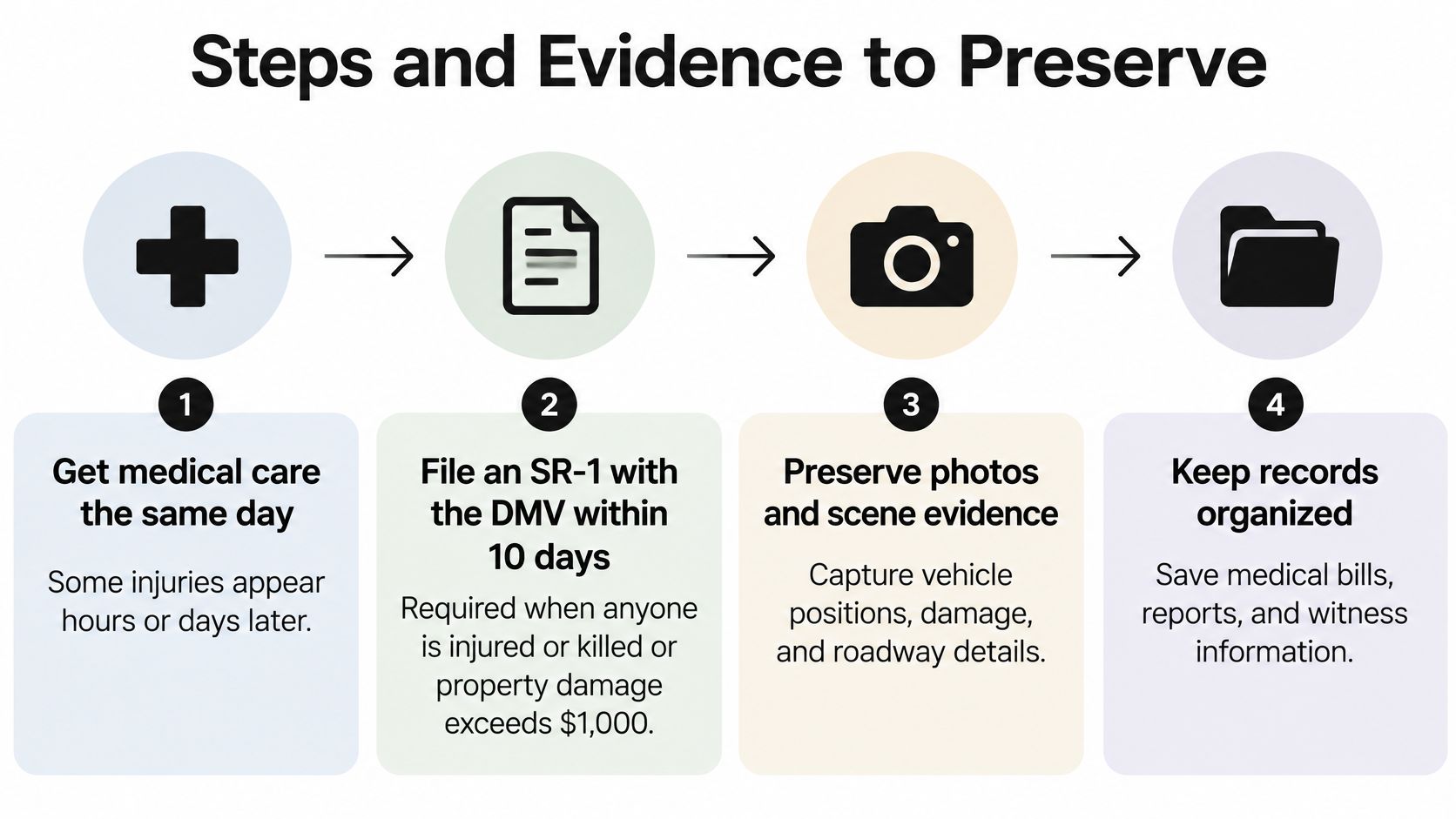
Get medical care the same day. Some injuries become noticeable hours or days later. Describe whether you were struck, twisted, fell, or hit the pavement, and tell the clinician about symptoms rather than trying to diagnose yourself. Emergency symptoms need urgent attention, not an insurance discussion.
-
Check the DMV reporting requirement. The California DMV collision guide says a driver must submit an SR-1 within 10 days when anyone is injured or killed or property damage exceeds $1,000, regardless of fault; qualifying private-property collisions are included. A report to store security or an insurer isn’t the same filing.
-
Photograph the scene and its surroundings. Capture vehicle positions, damage, the impact location, signs, painted arrows, crossings, lighting fixtures, cart corrals, and obstructions. Take wide views and close-ups. If you return, use similar angles and the same time of day so the photographs help explain visibility.
-
Record identification and witness details. Exchange driver and insurance information when possible. If the vehicle leaves, record plate fragments, color, body style, distinguishing damage, and direction of departure. Ask witnesses for contact information and what they personally observed, without suggesting an answer.
-
Document the vehicle before movement or towing. Photograph its position if it’s safe, but don’t obstruct emergency access. Under California Vehicle Code §22953, free private parking open to the public generally has a one-hour restriction on removal after parking, with exceptions including fire lanes, blocked entrances or exits, designated disabled-person spaces, and parking within 15 feet of a hydrant. This isn’t permission to leave a dangerous obstruction in place.
-
Request preservation of surveillance footage in writing. Identify the date, approximate time, exact area, and nearby entrances. Ask the business to preserve footage covering the approach, collision, and aftermath, not just the impact. Keep a copy of your request; asking for preservation doesn’t guarantee the business will release footage directly to you.
-
Keep a single claim folder. Save medical bills, prescription receipts, repair estimates, incident reports, insurer correspondence, and missed-work documentation. Keep original digital photographs and videos rather than only compressed copies sent through messaging apps.
The following visual summarizes the main preservation tasks.
Sort evidence by who holds it
Vehicle evidence includes damage patterns, bumper and hood height, travel direction, rear-camera and sensor functionality, and available event data. A federal pedestrian-safety literature review reports that, in non-roadway pedestrian collisions, SUVs were 41% more likely and pickups 97% more likely than passenger cars to cause serious pedestrian injury. That finding makes vehicle characteristics worth documenting, not a substitute for proving this collision’s cause.
Don’t repair, discard, or alter a potentially important component before discussing inspection needs. For an explanation of onboard recording equipment, Audio Jam Inc.’s resource on dash cam footage for insurance claims offers context. Preserve the original recording and surrounding footage, not just an edited clip.
- Lot evidence: Scaled photographs, surface measurements, sight distances, nighttime visibility, faded markings, and blocked pedestrian routes.
- Business evidence: Inspection schedules, lighting repairs, earlier complaints, cart-retrieval records, barrier maintenance, and contracts identifying who performed each task.
- People evidence: Independent witness accounts and medical records explaining how the reported event relates to the injury.
Preservation priority: Once footage is overwritten, you may lose the only neutral view of when a vehicle started moving or whether an obstruction blocked the driver’s view.
In a hospital-based Federal Highway Administration study of injured pedestrians and bicyclists, 53% of injured pedestrians were hurt in non-roadway locations, including parking lots, sidewalks, and off-road trails. A traffic report alone may therefore leave important premises conditions unexplained.
Our car accident injury claim guidance adds practical context for organizing documentation. Each preserved item helps answer a different question: what happened, why it happened, or what harm followed.
How a Parking Lot Claim Moves Toward Settlement
Consider a pedestrian who needs treatment after being struck outside a shopping center. The driver’s insurer questions visibility, while the property manager says the driver alone caused the collision. The claim needs a supported explanation of both the event and the resulting losses.
At LA Law Group, we begin by reviewing what happened and explaining injury-claim options in plain language. Once we represent a client, we can communicate with insurers on their behalf. If needed, we can travel to a client’s home or hospital.
From investigation to negotiation
The claim file develops as treatment records, bills, employment documentation, and incident evidence become available. The attorney evaluates potential responsibility and coverage, while the medical records help clarify recovery needs. A settlement request should explain not just that someone was hurt, but how the evidence supports the requested compensation.
Our personal injury lawyers first negotiate a settlement with the insurance company. Bell Law’s overview of negotiating fair compensation after a crash provides additional context for understanding that stage, although the issues and procedures depend on the particular claim.
If an agreement can’t be reached, the matter may proceed to litigation. Filing a lawsuit isn’t the same as going immediately to trial. It can create a formal process for obtaining records, questioning witnesses, and resolving disputed facts.
A settlement timetable should follow the medical and evidentiary needs of the case, not an assumption that every parking-lot claim is quick.
Timing varies with the injury, disagreements about responsibility, available coverage, and whether litigation becomes necessary. During that period:
- Keep insurer communications factual: Don’t guess about speed, distances, diagnoses, or what another person saw.
- Route substantive questions to your lawyer: Once represented, coordinate requests for statements, records, and settlement discussions.
- Update the expense folder: Add new treatment bills, work restrictions, and income records as they arise.
Missing drivers and public-property claims
If the driver leaves before identification, the investigation and insurance review can continue. Potentially relevant policies may include household auto insurance and uninsured-motorist provisions, rather than only the missing driver’s coverage.
A public-entity claim requires a different procedural check. Special notice requirements can be substantially shorter than ordinary lawsuit deadlines, so identify public ownership early. Ask an attorney to confirm the applicable notice and filing requirements instead of assuming a routine insurance negotiation protects every deadline.
What Compensation Covers and What Limits It
California minimum auto liability limits
| Coverage type | Minimum required limit | What it means for your claim |
|---|---|---|
| Injury or death to one person | $30,000 | Required per-person coverage minimum, not a guaranteed payment |
| Injury or death to multiple people in one collision | $60,000 | Shared bodily-injury limit when the policy carries only the minimum |
| Property damage | $15,000 | Separate coverage for vehicle or property damage, not bodily injury |
The California DMV insurance requirements list minimum liability limits of $30,000 for one person’s injury or death, $60,000 for multiple people in one collision, and $15,000 for property damage. A driver may carry higher coverage, so the actual policy must be checked.
These amounts aren’t a valuation of your injuries. They describe required minimum coverage, not what an insurer automatically owes. Damages can exceed available insurance, and several injured people may be seeking payment from the same policy.
Separate the losses from the available coverage
Economic damages are documented financial losses. We seek reimbursement for medical and surgical bills, recovery costs, and lost wages. Records should show what was charged, why the expense relates to the collision, and how an injury affected the person’s ability to work.
Non-economic damages address harms such as pain and suffering. For some cases, we assess these damages by applying a multiplier to economic damages. That’s a valuation shorthand, not a formula California law sets or a guarantee that an insurer will agree.
For a hypothetical arithmetic example, economic damages of $10,000 multiplied by 2 produce a proposed $20,000 in non-economic damages. Those assumed numbers illustrate the calculation only. They don’t predict a settlement, and the non-economic amount is separate from the underlying economic losses.
Coverage isn’t case value: A well-documented loss and an insurance policy capable of paying that loss are different things.
Check the policy, not just the insurance card
Reviewing California minimum car insurance requirements helps explain the coverage floor. An individual claim also requires checking policy terms, exclusions, applicable limits, and whether another responsible party has separate coverage.
A pedestrian shouldn’t assume their own auto insurance is irrelevant because they weren’t inside a car. Household uninsured-motorist provisions may warrant review when the striking driver is uninsured or unidentified, subject to the policy’s conditions. Vehicle damage coverage should also be evaluated separately from bodily-injury coverage so repair costs aren’t confused with medical losses.
When to Call a Lawyer and When to Wait
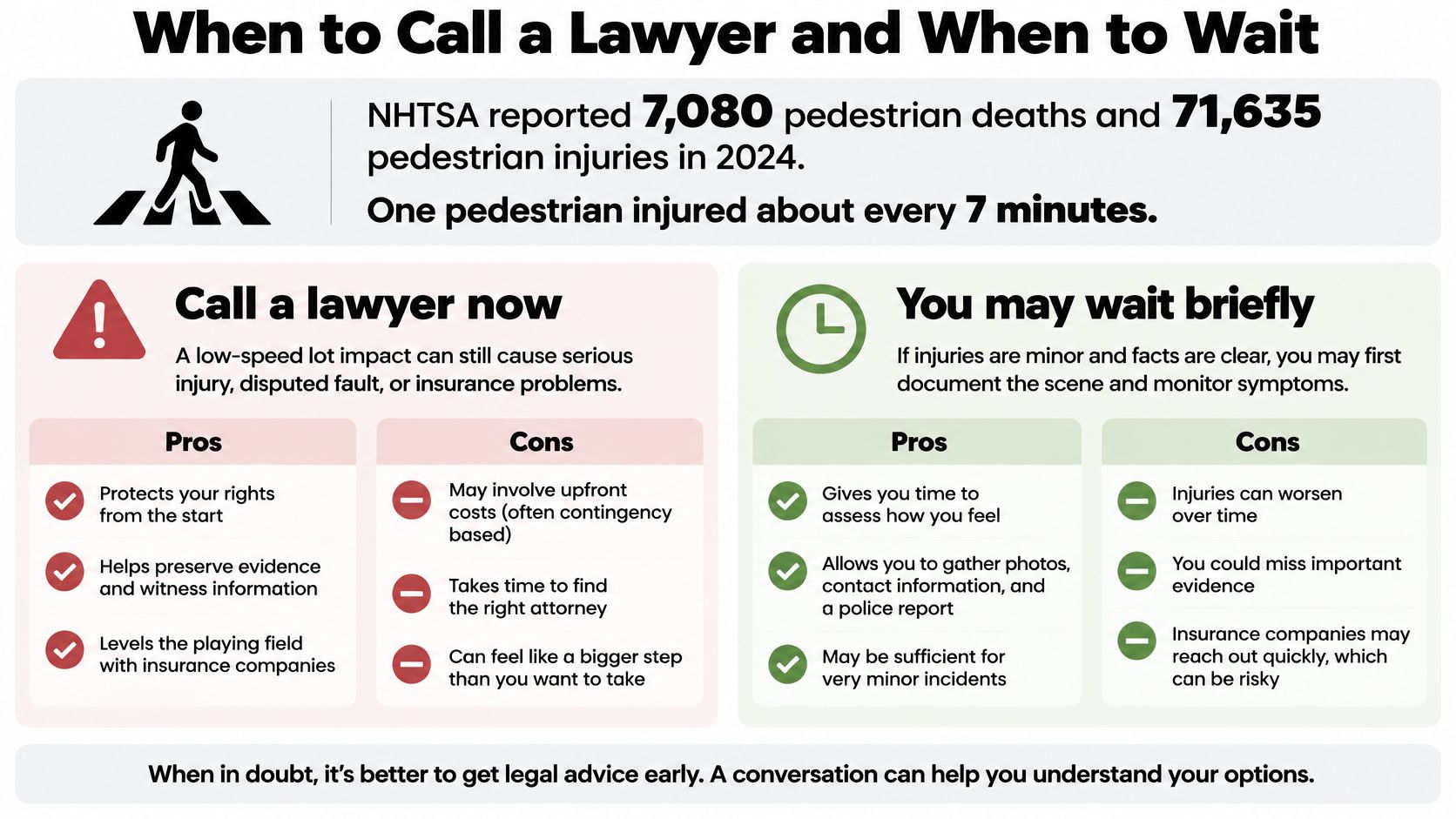
The National Highway Traffic Safety Administration reported 7,080 pedestrian deaths and 71,635 pedestrian injuries in traffic crashes during 2024, averaging one pedestrian injury every 7 minutes. Those national figures cover public-road traffic environments, not parking lots alone, but they underscore why a low-speed impact shouldn’t be dismissed without assessing the person’s condition.
Use the following comparison as a starting point, not a medical assessment or a substitute for individual legal guidance.
Reasons to seek a prompt review
A parking lot accident lawyer is particularly useful when resolving the claim requires more than exchanging repair estimates.
- An injury needs continuing care: You may not yet understand the treatment needs or work restrictions.
- Someone disputes fault: Conflicting accounts can affect both responsibility and settlement negotiations.
- The driver fled or lacks insurance: Identifying a recovery route may require a broader coverage review.
- A business or public entity may be involved: Ownership and operational responsibilities can complicate the claim.
- You were a rideshare passenger: The vehicle’s activity and applicable policies need examination.
The benefit of an early review is clarity before you make consequential decisions. The tradeoff is that not every small property-damage dispute needs full representation, so the consultation should address whether legal involvement is proportionate to the problem.
When handling matters directly may be reasonable
A property-damage-only collision may be manageable without a lawyer when no one is injured, the facts are clear, and the responsible insurer accepts liability in writing. Even then, confirm what the proposed payment and release cover.
A private lot doesn’t automatically eliminate reporting duties. The exception involving damage only to the driver’s own property is narrow, so check the reporting rules rather than treating private ownership as an exemption.
This video provides an additional viewing resource alongside the decision points above.
Location also matters when choosing guidance. For an incident in Singapore, The Lawyer Guide’s directory of personal injury lawyers Singapore is a jurisdiction-specific starting point, not a guide to California law.
The practical decision rule is straightforward: Has anyone been hurt, or is someone disputing who is responsible? If either answer is yes, a prompt consultation can help clarify whether waiting would create avoidable problems.
Confirm Your Options With a Free Consultation
You don’t need a complete claim file to ask for an initial review. Bring what you have, identify what’s missing, and explain any urgent concerns, such as a pending vehicle repair or a request to sign a release.
Our first consultation is free and confidential, and it’s held with the attorney who will handle the matter. That gives you an opportunity to ask direct questions about your circumstances rather than relying on general descriptions of parking-lot claims.
What to bring
- Incident details: The crash date, time, exact location, and SR-1 report if filed.
- Scene information: Photographs, available recordings, witness names, and incident-report details.
- Insurance documents: The other driver’s information, your relevant policies, and insurer correspondence.
- Injury and income records: A medical summary, bills, work restrictions, and lost-income documentation.
Questions worth asking
Ask who the attorney believes may be responsible, which evidence is at risk now, and which insurance policies might pay. Also explain what outcome you need help understanding, whether that’s medical expenses, missed work, or a disputed account of the collision.
We serve clients throughout California in English, Spanish, and Farsi from our Chatsworth office. Information clients share with us is protected by attorney-client privilege and remains confidential.
This article is for informational purposes only. None of the information is legal advice or should be construed as legal advice, and reading or reviewing it creates no attorney-client relationship. Decisions about your own claim should be based on advice from a licensed attorney who has reviewed your circumstances.
LA Law Group, APLC offers a free, confidential consultation to review a parking-lot injury and explain potential claim options. Visit LA Law Group, APLC to discuss who may be responsible, what evidence needs attention, and how the firm can help with insurer communications and the claims process.
Attorney Advertising. This article is general information, not legal advice, and does not create an attorney-client relationship. Prior results do not guarantee a similar outcome.