
Rear Ended by Truck: What to Do in California
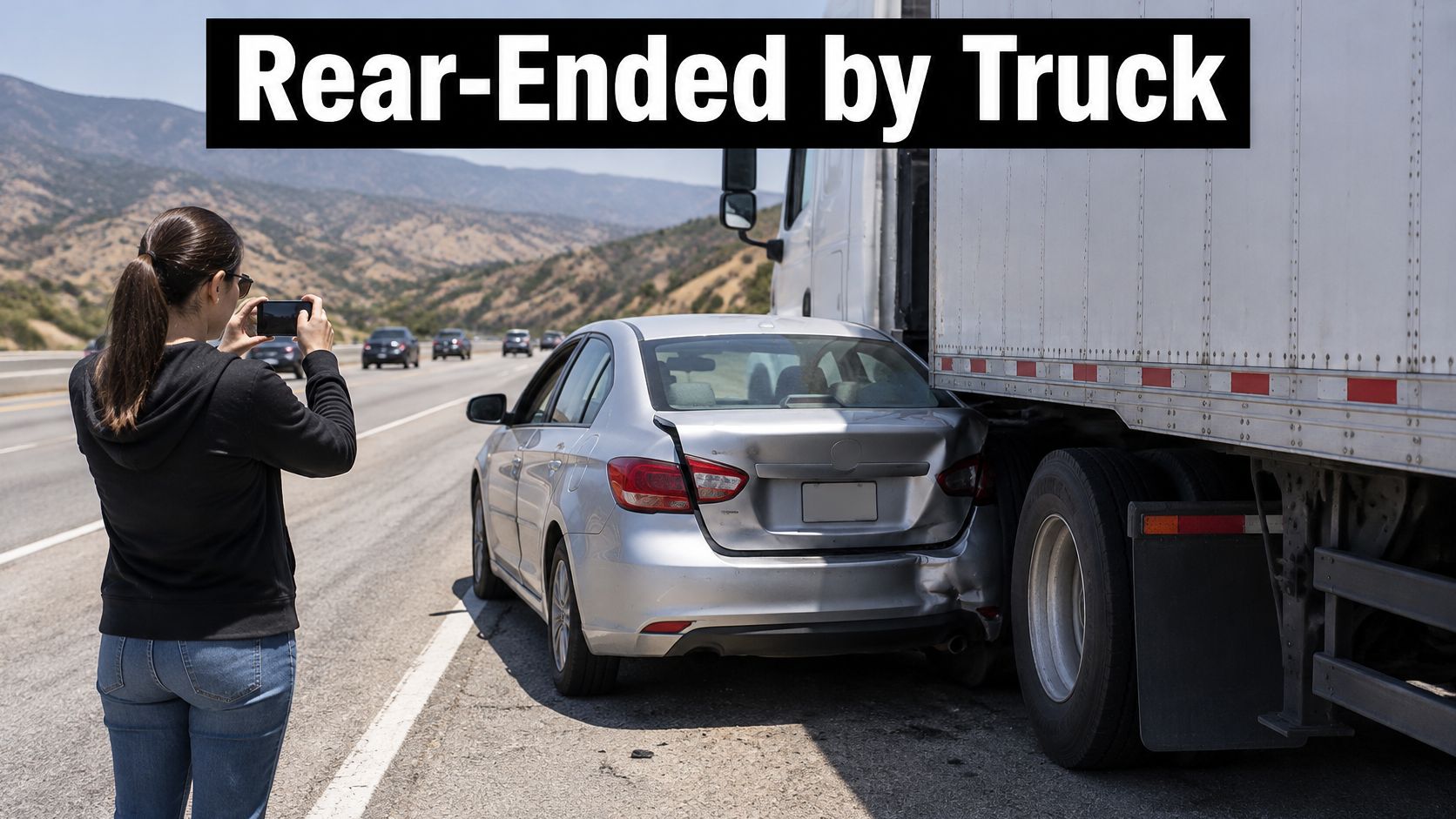
You’re stopped in California freeway traffic when you look up and see a truck filling your mirror. After the impact, you’re left checking on passengers, trying to get out of traffic, and wondering whether the ache in your neck matters more than the damage to your bumper. If you’ve been rear-ended by a truck, start with safety and medical care, not an argument about fault.
Why a Truck Rear-End Is Not a Normal Fender Bender
From the driver’s seat, the collision may feel like a sudden shove followed by confusion. But a commercial truck introduces questions that an ordinary bumper-to-bumper crash might not: how much it weighed, how its brakes responded, and which parts of the vehicles met.
The Federal Motor Carrier Safety Administration’s Large Truck Crash Causation Study found that approximately 23.1% of large-truck crash involvements were rear-end events, about 33,000, compared with approximately 25,000 run-off-road or lane-departure involvements, representing 17.8%. That rear-end category included trucks striking non-trucks, non-trucks striking trucks, and trucks striking other trucks.
The vehicle filling your mirror is only part of the story.
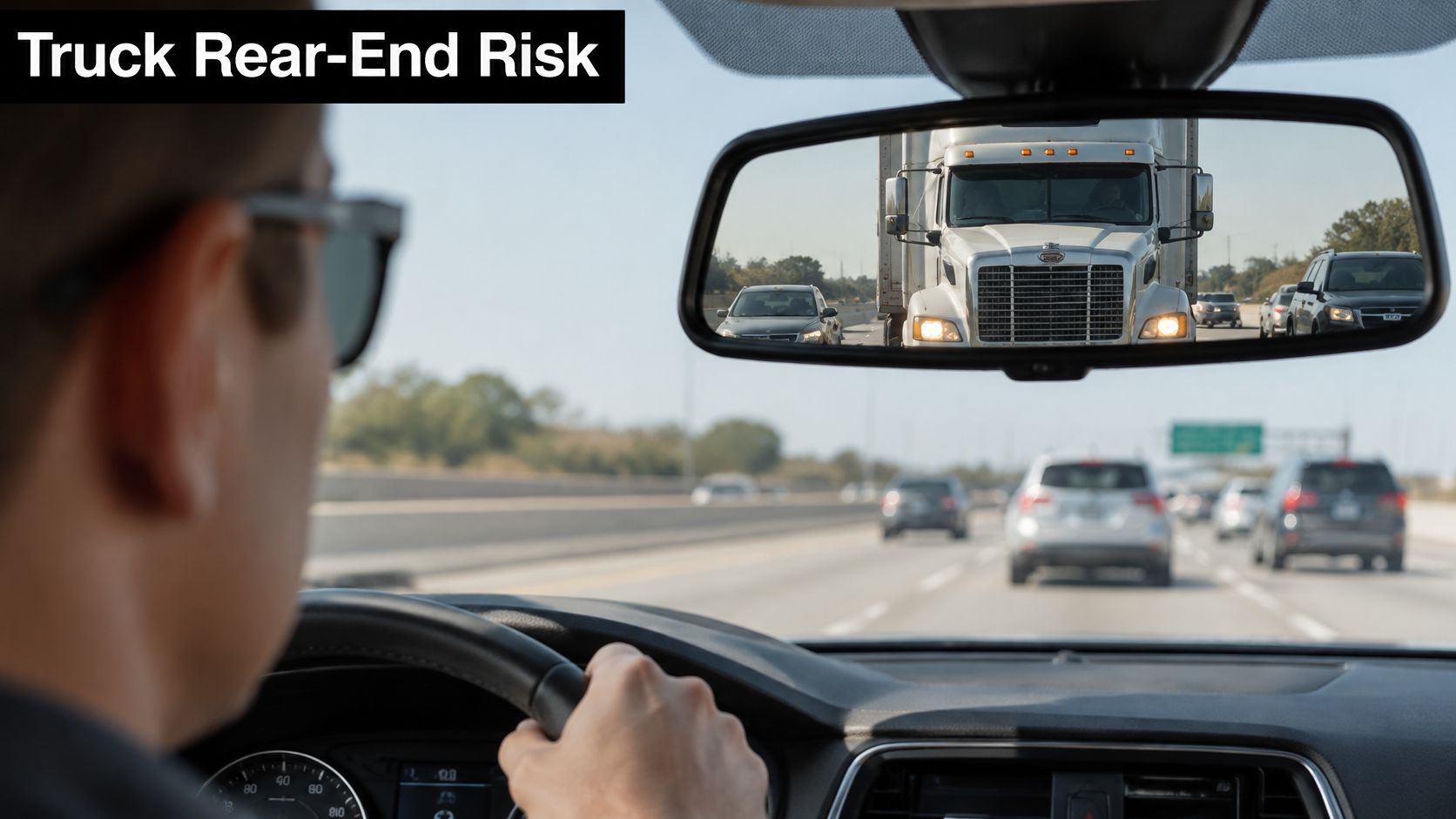
Mass changes the questions
Pushing an empty shopping cart isn’t like pushing a loaded one. Likewise, the same closing speed doesn’t make a car-to-car impact equivalent to an impact involving a loaded combination vehicle. Vehicle movement can load a person’s neck, back, or head without leaving damage that neatly explains their symptoms.
For a broader truck-versus-car comparison, Law Office of Bryan Fagan, PLLC offers a resource on understanding serious Texas truck accidents. Its geographic context matters: California fault must be evaluated under California rules.
Start with evidence, not assumptions: Neither a repairable car nor the position of the vehicles answers every injury or liability question.
This article is for informational purposes and is not to be construed as legal advice. No attorney-client relationship exists based on review of this article, and none of the information in this article is legal advice.
Before vehicles are towed, prioritize the following safety and documentation steps.
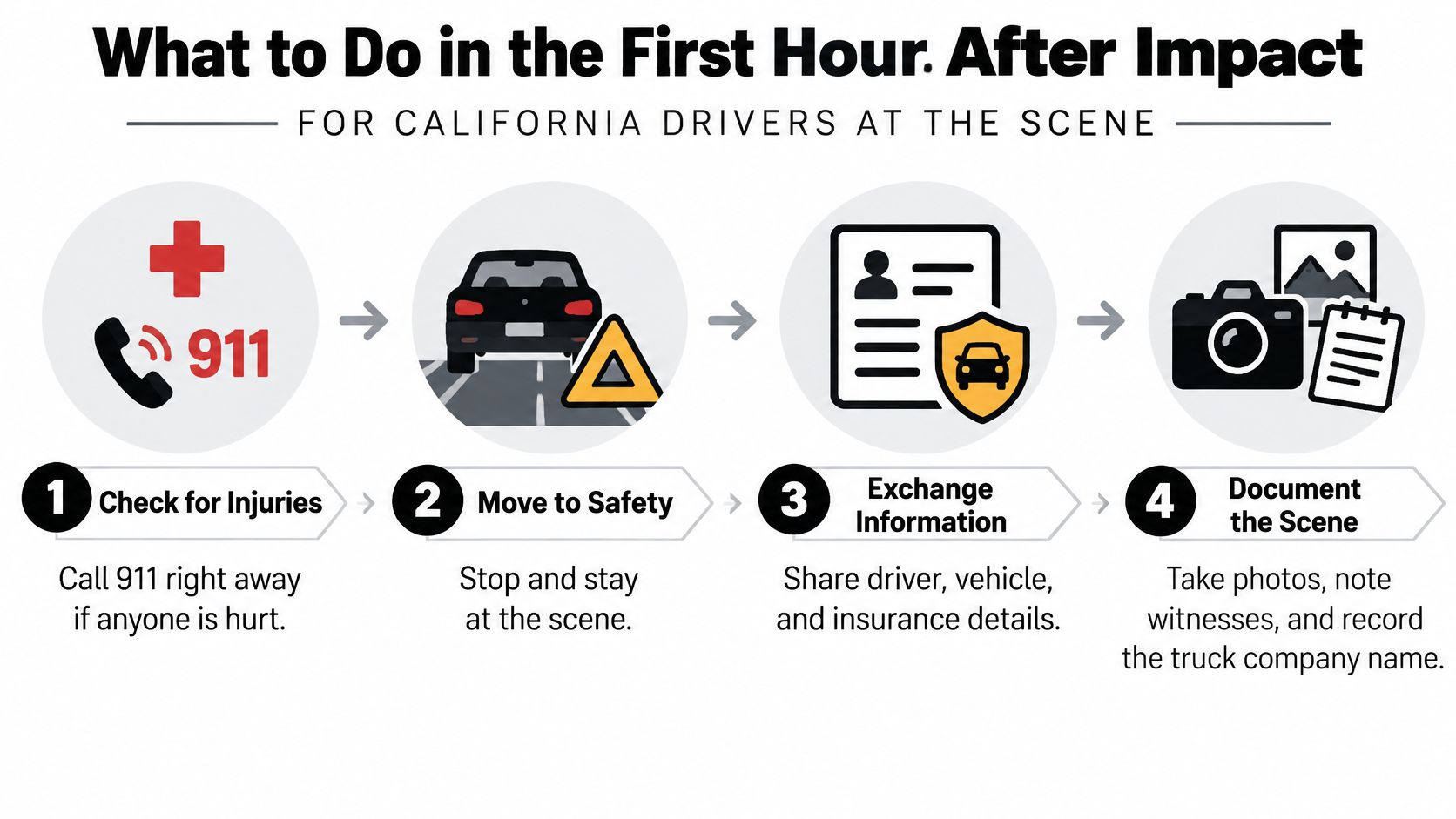
What to Do in the First Hour After Impact
You don’t have to investigate the collision yourself while shaken or injured. Do what you safely can, and let responders handle dangerous conditions.
This scene checklist keeps the immediate priorities visible.
Put people and vehicle identity first
-
Check for injuries and call 911. Explain your location, whether anyone is hurt, and whether vehicles are blocking traffic. For an injury collision, the California Highway Patrol’s guidance says drivers must stop and fulfill the obligations imposed by Vehicle Code §§20004 and 20005.
-
Move only when doing so is safer. A drivable vehicle may be moved to the shoulder or another position out of the roadway for safety. After moving, notify the other involved party and/or law enforcement, and follow responders’ directions rather than stepping into traffic to protect a photograph.
-
Accept an offered ambulance evaluation. Tell responders where you hurt, whether you struck your head, and whether you feel dizzy or confused. Don’t dismiss symptoms because you can walk or because someone says the collision looked minor.
-
Photograph the scene without exposing yourself to traffic. Capture both vehicles from all sides, the trailer rear and any guard, license plates, USDOT and MC numbers, visible cargo, roadway marks, lanes, signals, and lighting. Ask a passenger to help only if it’s safe.
-
Identify the people and businesses involved. Collect the driver’s name, carrier name, insurance information, and witness contacts. Photograph identifying markings on both tractor and trailer because they may belong to different businesses.
Record facts while they’re fresh
-
Write down the sequence. Include direction of travel, lane, estimated speed, highway, location, and what each driver did before impact. Separate what you personally observed from what someone else told you.
-
Don’t guess fault on a recorded call. Give accurate facts, but don’t speculate about speed, injury prognosis, or legal responsibility. You can express concern for someone without accepting blame for events you haven’t reconstructed.
-
Ask how to obtain the crash report. Get the investigating agency and report number if available. Proper parties of interest can include involved drivers, passengers, owners, legal representatives, and insurers with a valid claim or policy number.
-
Create a dated timeline that day. Record the crash and every symptom you notice, then log medical visits and missed follow-ups. If you couldn’t attend an appointment, note why rather than leaving an unexplained gap.
The accompanying video provides another format for reviewing immediate crash-response considerations.
Your photographs should make the impact direction clear. A truck pushing your car forward raises different investigative questions from your car striking the back of a trailer.
When the Truck Hits You or You Hit the Trailer
2020 rear-end crashes between large trucks and passenger vehicles
The following approximate counts and severity-category shares come from FMCSA’s large-truck and passenger-vehicle crash table.
| Who struck whom | Fatal crashes | Injury crashes | Property-damage only | Share of that severity |
|---|---|---|---|---|
| Large truck rear-ended a passenger vehicle | 118 | 7,000 | 18,000 | 5.0% fatal, 14.0% injury, 10.6% property damage |
| Passenger vehicle rear-ended a large truck | 400 | 9,000 | 20,000 | 17.1% fatal, 16.4% injury, 12.0% property damage |
In that federal classification, a large truck has a gross vehicle weight rating above 10,000 pounds; passenger vehicles include cars and light trucks such as pickups, vans, and SUVs. The same FMCSA table records 105 fatal crashes in 2018, 86 in 2019, and 118 in 2020 in which a large truck rear-ended a passenger vehicle, illustrating annual variation rather than a fixed yearly count.
Different mechanisms, different evidence
Think of stopped freeway traffic. If a truck strikes your car from behind, investigators examine whether its driver had enough stopping room, responded to traffic, and operated properly maintained equipment.
If your car strikes a trailer, investigators also examine a different problem: whether the vehicles’ heights allowed the trailer to enter the passenger compartment. The stopping question doesn’t disappear, but vehicle geometry becomes especially important.
For broader context, NHTSA’s 2024 large-truck crash publication reports rear-end impacts in 22.1% of fatal two-vehicle crashes involving large trucks for the large-truck category, compared with 6.8% for other vehicle types. That context shouldn’t be treated as a prediction of what happened in your collision.
Crash counts describe groups of collisions. They don’t establish which driver caused an individual crash.
Why the higher fatal-crash count isn’t a fault rule
The car-into-truck row doesn’t mean the car driver was automatically responsible. A reconstruction may need to address trailer visibility, roadway conditions, the truck’s movements, and whether another vehicle forced an evasive maneuver.
Likewise, a truck-into-car impact doesn’t eliminate questions about a sudden lane change or an unsafe stop. Investigators need the sequence before contact, not a photograph showing where the vehicles ended up.
The practical distinction is straightforward: truck-into-car investigations emphasize speed, separation, braking, and load, while car-into-trailer investigations add guard coverage, impact overlap, and occupant-compartment intrusion. Neither row decides fault.
How Much Distance a Loaded Truck Needs to Stop
The FMCSA guide on following too closely gives this comparison at 55 mph under ideal conditions and warns that wet, icy, snowy, debris-covered, or otherwise degraded surfaces can substantially increase braking distance.
| Vehicle | Approximate stopping distance under those conditions |
|---|---|
| Passenger vehicle | 133 feet |
| Loaded tractor-trailer | 196 feet |
These are reference conditions, not a reconstruction of your crash. An investigator can’t apply the table mechanically without considering the actual truck, load, road, and braking sequence.
Why the truck needs more room
A loaded truck’s stopping requirements involve more than driver reaction time. Mass, brake-system response, tire-road friction, grade, load distribution, and maintenance condition all matter.
A downhill approach in rain isn’t equivalent to level, dry pavement. Nor should an investigator assume that a truck with worn tires or compromised brakes performed like properly maintained equipment.
To test whether adequate room existed, investigators compare speed and following distance with traffic movement, visibility, available sight distance, and the distance needed under the actual conditions.
Useful records include:
- Engine or event data: ECM or EDR downloads, when available, may help establish recorded speed and braking activity.
- Video: Dash cameras and nearby surveillance may show when traffic slowed and whether another vehicle entered the gap.
- GPS and telematics: These can help establish vehicle movement and timing.
- Mechanical files: Inspection and maintenance records can identify brake or tire issues.
- Cargo documents: Weight and securement records help explain the truck’s operating condition.
- Physical evidence: Scene measurements, roadway marks, and skid or ABS evidence help test competing accounts.
Legal speed doesn’t guarantee a safe gap
Say a truck is traveling within the posted limit but remains too close to slowing traffic. Its speed alone doesn’t establish that the driver left enough room to stop.
Now change the scenario: a car abruptly enters the space ahead of the truck and brakes hard. Investigators must determine how much separation existed before and after that maneuver, and whether the truck driver had a realistic opportunity to respond.
Practical rule: Ask what stopping room was available, not just whether the truck was speeding.
Those measurements provide the factual foundation for applying California’s following-distance rules.
California Following Rules That Can Affect Fault
California’s default rule is conditions-based. Vehicle Code §21703 prohibits following more closely than is reasonable and prudent, considering the lead vehicle’s speed, surrounding traffic, and roadway conditions.
The statute doesn’t supply a universal distance for ordinary vehicles. A gap that appears workable on a dry, open freeway may be inadequate in congestion, poor visibility, or rain on a grade.
Keep the special truck rule separate
The California Vehicle Code’s speed-law provisions establish a 300-foot minimum when a vehicle subject to §22406 follows another vehicle subject to that restriction outside a business or residence district.
Apply that rule only after checking its limits:
- Following vehicle: It must be subject to the referenced speed restriction.
- Location: Operation must be outside a business or residence district.
- Lead vehicle: It must also be subject to that restriction.
A delivery truck in a city business district, or a truck following an ordinary passenger car, shouldn’t automatically be judged against that special minimum. The general reasonable-and-prudent rule remains important.
Match the rule to the evidence
Neither statute automatically assigns liability for every rear impact. Compare the applicable rule with speeds, lane positions, traffic, photographs, witness observations, electronic records, and the crash investigation.
When both drivers’ actions are disputed, The Law Office of John P. Sherman, PLLC offers a general resource to explore comparative negligence rules. The governing California framework still needs to be applied to the particular facts.
The CHP Crash Investigation Manual identifies CHP 555 as the basic crash report and CHP 555D as the truck/bus supplement for qualifying vehicles, describes forwarding injury and fatal crash reports under Vehicle Code §20008, and calls for retaining crash reports for at least four years.
A report may document reported injuries, vehicle information, and an officer’s findings. It’s a record, not a verdict, and it may not contain every electronic record or measurement needed to resolve a disputed account.
Underride Photos and Data That Vanish Quickly
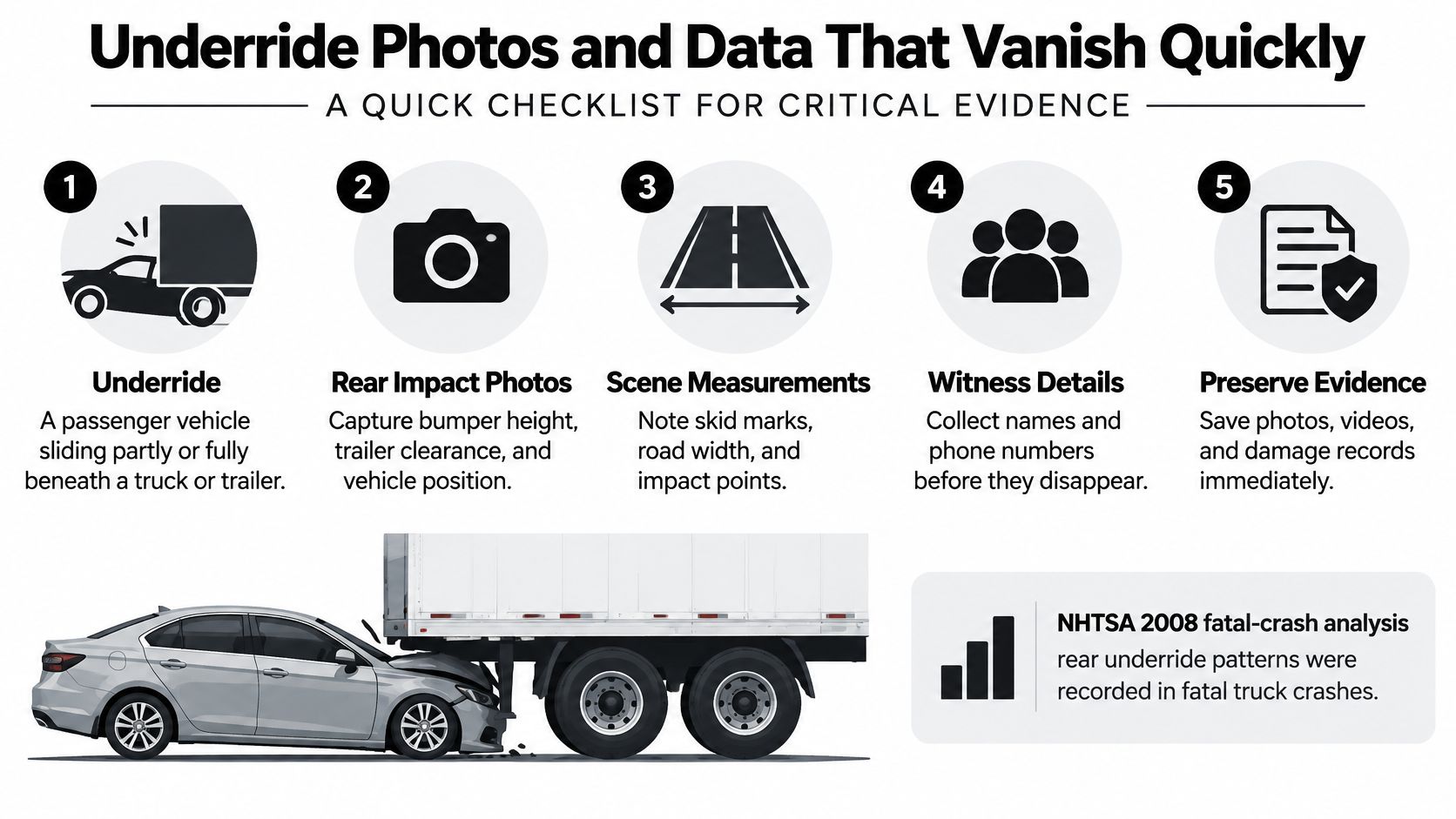
A trailer can resemble a low shelf that a shorter vehicle can pass beneath. Underride occurs when a passenger vehicle slides partly or completely under a truck or trailer, potentially exposing the occupant compartment to intrusion.
In NHTSA’s analysis of 2008 fatal-crash data, rear underride occurred in approximately 63% of rear-end-struck truck involvements, and in about 26%, intrusion reached the windshield or farther. Those findings concern fatal-crash involvement, not all truck rear-end collisions.
The checklist highlights evidence to protect before vehicles are altered.
Preserve geometry and visibility separately
From a safe position, photograph what you can. Leave hazardous access and technical measurements to qualified investigators.
- Rear geometry: Document guard presence, height and width, cargo overhang, tire-to-cargo-body distance, and equipment below the cargo body.
- Guard connections: Capture the entire truck and close-ups of the guard and mounting points.
- Impact evidence: Preserve vehicle crush measurements, roadway marks, lighting conditions, and electronic event data.
An offset impact deserves particular attention. A guard may perform adequately when a car strikes centrally yet fail when only a narrow portion of the car meets the trailer corner.
Lighting and conspicuity answer whether a driver could perceive the trailer. Following distance answers whether that driver left sufficient room; they’re related but distinct questions.
Request preservation in writing
Repairs, cleanup, equipment reuse, or routine overwriting can change evidence. A written preservation request should identify relevant dashcam footage, logs, inspection files, and electronic braking records, though a request doesn’t guarantee preservation.
When fatigue is a potential issue, understanding California truck accidents involving hours-of-service violations helps explain why duty records deserve attention. Measurements and records support an investigation; they don’t establish fault on their own.
How Injury Claims and Insurer Talks Usually Move
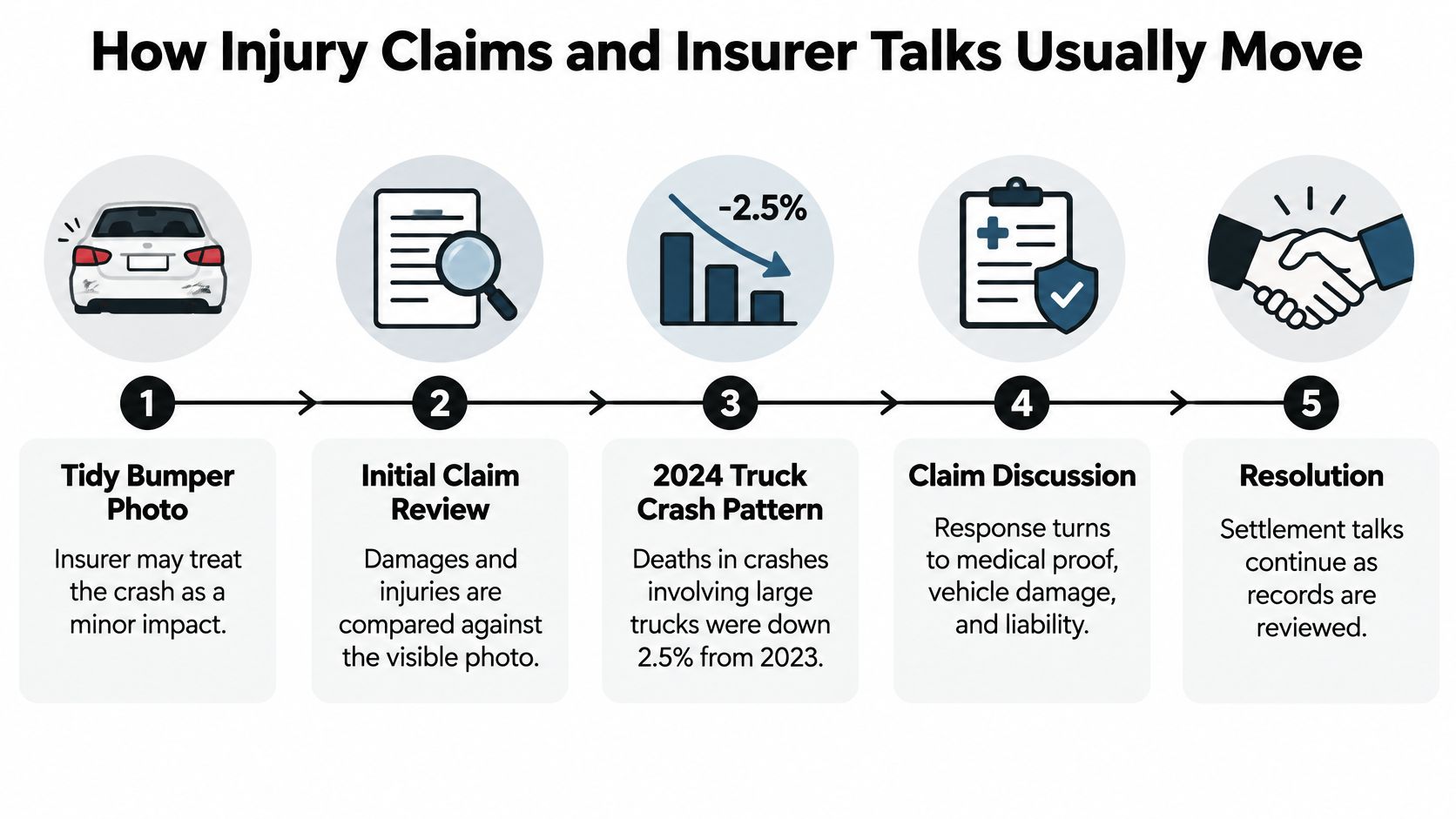
A tidy bumper photograph isn’t a medical assessment. Visible damage is a poor stand-in for injury, because a clinician must evaluate symptoms, examination findings, history, and the collision mechanism together.
NHTSA’s reported 2024 figures show deaths in crashes involving large trucks decreased 2.5% from 2023, while estimated injuries increased 5.0%; large-truck drivers had a fatal-crash involvement rate of 1.6 per 100 million miles, compared with 1.4 for passenger-vehicle drivers. These population figures don’t prove any individual collision caused serious injury.
Build the medical timeline
Neck, back, concussion, and soft-tissue symptoms may become noticeable after the scene. Seek prompt evaluation, describe when each symptom began, and tell your clinician about preexisting conditions rather than trying to hide them.
Early records help distinguish new symptoms from earlier problems. Explain missed appointments and report changes candidly, including improvement.
The claim process should connect medical evidence with the actual collision.
Who may be examined in a California truck rear-end claim
| Possible party | What they may control | Records often requested |
|---|---|---|
| Truck driver | Speed, attention, and following gap | Statement, hours-of-service logs, electronic logs |
| Motor carrier | Hiring, dispatch, and insurance | Liability policy, driver qualification file, dispatch records |
| Maintenance contractor | Brakes, tires, and inspections | Inspection and repair files |
| Shipper or loader | Weight and load securement | Bills of lading, scale tickets, loading instructions |
| Separate trailer owner | Rear guard and trailer condition | Lease, guard specifications, maintenance history |
Move from notice to a supported demand
The usual path includes reporting the claim, obtaining the official report, developing the medical picture, and presenting a demand connecting the mechanism to documented treatment and losses. Negotiation follows, but unresolved medical questions or disputed responsibility can prevent a reliable final evaluation.
Recorded statements can freeze an incomplete early account. Broad medical authorizations can expose unrelated history, so understand what you’re being asked to provide before signing.
California applies pure comparative negligence: an injured person’s recovery is reduced by their own share of fault rather than barred outright. A motor carrier may face vicarious liability for its driver’s negligence and direct claims involving its own hiring or maintenance conduct, depending on the employment relationship and evidence.
A sudden stop or an already-inadequate following gap may become part of a shared-fault argument, not an automatic conclusion. Ask an attorney to identify the applicable filing deadline promptly; ongoing treatment doesn’t necessarily extend it.
For planning purposes, the car accident settlement timeline explains stages worth discussing. No settlement range can substitute for assessing injuries, available coverage, and fault in your file.
When a Free Case Review Is Worth Requesting
A review is worth considering when pain appears or worsens after the collision, your vehicle went beneath a trailer, or different companies appear on the tractor, trailer, and insurance documents. It’s also useful when an adjuster calls the crash minor before reviewing your medical records.
Don’t wait for perfect paperwork. The truck may be repaired or returned to service while you’re still arranging treatment, and a lawyer can identify evidence holders before every factual question has been answered.
Bring a usable starting file
You don’t need an elaborate presentation. Organize what you already have:
- Scene material: Original photos, video, witness contacts, and carrier and plate details.
- Report information: The investigating agency and crash report number, if one exists.
- Medical chronology: Symptoms, evaluation dates, treatment recommendations, and changes in your ability to work or manage daily activities.
- Insurance communications: Letters, emails, claim numbers, and any proposed authorization or release.
A personal injury lawyer consultation is an opportunity to ask what remains unknown, which records matter, and what representation would involve. If you’re comparing resources, The Law Offices of Attorney Angel Lugo also provides information to help readers find legal help for injury claims; confirm that any lawyer you consider handles the relevant jurisdiction.
This article is for informational purposes and is not to be construed as legal advice. No attorney-client relationship exists based on review of this article, and none of its information is legal advice.
At LA Law Group, APLC, we handle automobile accidents, truck accident cases, and catastrophic injuries, and we offer a free consultation in which an attorney reviews your options. If you’ve been rear-ended by a truck in California, visit LA Law Group, APLC to request a consultation, and bring your crash photos, truck identification details, and medical timeline.
Attorney Advertising. This article is general information, not legal advice, and does not create an attorney-client relationship. Prior results do not guarantee a similar outcome.