
Rideshare Accident Settlement Guide for Injured Passengers
You’re sitting in the back seat on the way to LAX when another car slams into the rideshare vehicle from behind. Your neck hurts, your phone is damaged, and an insurance adjuster is already asking whether you’re ready to discuss a quick payment. You want one answer: what is your rideshare accident settlement worth?
The answer doesn’t begin with a headline insurance limit. It begins with the driver’s app status at the exact moment of impact, the evidence proving fault, the medical record connecting the collision to your injuries, and the policy layer that responds. This article is for informational purposes and not to be construed as legal advice. No attorney client relationship exists based on the review of this article and none of the information in this article is legal advice.
What a Rideshare Accident Settlement Really Means
A rideshare accident settlement is a negotiated resolution between an injured passenger and one or more responsible parties. In most cases, payment flows through one or more insurance policies rather than directly from Uber or Lyft. The company may be involved in identifying coverage, preserving platform records, or defending a claim, but the settlement check usually comes from an insurer responsible for the applicable policy layer.
The first question isn’t, “Was this an Uber or Lyft crash?” It’s, “What was the driver doing in the app when the collision occurred?” If the app was off, the driver’s personal auto policy generally controls. If the driver was logged in and waiting, a limited rideshare layer may apply. If the driver had accepted a ride or was carrying you, the commercial rideshare layer commonly becomes available.
The commonly described commercial liability limit applies when the driver is on an active trip, but the claim still depends on liability, injury severity, medical proof, available coverage, and the number of injured people competing for the same policy.
The four questions that control value
- Who caused the crash? A police report helps, but it isn’t the entire liability file. Photos, witness accounts, vehicle damage, traffic footage, and vehicle data can matter more than an initial narrative.
- What injury did the crash cause? A diagnosis alone isn’t enough. Treatment, prognosis, work restrictions, future care, and documented daily limitations give the insurer a basis to value the claim.
- Which policy responds? The driver’s app records, trip receipt, GPS timestamps, and insurance declarations can identify the correct coverage period.
- What can you prove before negotiating? Adjusters pay documented losses. They discount unsupported descriptions of pain, missing treatment records, unexplained gaps in care, and uncertain causation.
Don’t let a rideshare company’s advertised insurance figure set your expectations. Settlement value comes from matching the facts to the correct policy and building proof before the insurer decides how little it can offer.
How Uber and Lyft Insurance Tiers Change Settlement Value
Uber and Lyft claims generally fall into three practical coverage periods. The periods aren’t interchangeable, and the same physical collision can produce a very different recovery depending on whether the driver was offline, waiting for a request, or already matched with a passenger.
When the app is off, the driver is generally using the vehicle for personal purposes, so the driver’s personal auto policy is the primary starting point. When the driver is logged in but hasn’t accepted a ride, contingent liability commonly applies at $50,000 per person, $100,000 per accident, and $30,000 for property damage. Those minimums come from California Public Utilities Code section 5433.
Once the driver accepts a ride or has a passenger onboard, the commercial policy commonly expands to about $1,000,000 in liability coverage, often with uninsured or underinsured motorist protection. Uber’s published insurance information also distinguishes coverage by the driver’s activity rather than treating every logged-in minute as an active passenger trip.
Uber and Lyft Insurance Coverage by App Status
| App Status | Policy in Effect | Coverage Limit | Trigger Requirement |
|---|---|---|---|
| App off | Driver’s personal auto policy generally applies | Personal policy limits | Rideshare app is not active |
| App on, no accepted request | Contingent rideshare liability may apply | $50,000 per person, $100,000 per accident, and $30,000 property damage | Driver is available but hasn’t accepted a ride |
| Accepted trip or passenger onboard | Commercial rideshare policy commonly applies | About $1,000,000 in liability coverage, with UM/UIM often available | A ride has been accepted or a passenger is being transported |
The headline figure doesn’t automatically translate into a large payment. An injury claim must still establish fault and medical causation, and multiple injured people may share the same policy. A modest claim during an active trip may resolve for far less than the available limit. A serious claim during the waiting period may face a hard coverage ceiling before the full damages are paid.
The driver’s personal insurer may also deny primary coverage when the driver was engaged in rideshare activity, forcing a dispute over whether the personal policy, contingent policy, or commercial policy pays first. That is why the trip receipt and platform records should be preserved before anyone accepts the insurer’s classification.
For another perspective on the interaction between platform responsibility and insurance coverage, review whether Uber covers accidents. The important point is simple: app status is not a technical detail. It is a settlement-value issue.
Who Bears Liability in a Rideshare Crash
You are riding in a Lyft when another driver runs a red light and hits the vehicle. The rideshare driver may have done nothing wrong, yet the other motorist can bear primary fault. The available settlement then depends on that driver’s insurance, the rideshare policy’s applicable layer, and whether your own coverage fills any gap.
Liability follows conduct, not the logo on the driver’s phone. App status still matters because it identifies which policy may respond, but it does not by itself make Uber or Lyft responsible for every collision.
If the rideshare driver rear-ends another vehicle while carrying you, the driver is the immediate negligent actor, and the active-trip rideshare policy is usually the first serious source of recovery. If the driver was only waiting for a request, a different coverage layer may apply. If the app was off, the personal auto policy may be the starting point, although a personal insurer may dispute coverage after learning the driver was using the vehicle for rideshare work.
Fault must be separated from coverage
A third-party motorist may carry primary responsibility even while the rideshare driver is transporting a passenger. The rideshare policy can still matter when that motorist has inadequate insurance or no available insurance. Your own uninsured or underinsured motorist coverage may also provide protection, subject to the policy and applicable state law.
Chain collisions require a precise reconstruction. The first impact may push the rideshare vehicle into you, while a later impact worsens the injury. Investigators should examine each driver’s movement, following distance, visibility, and timing separately. Insurers often blame the entire injury on one impact, a pre-existing condition, or an alleged failure to mitigate damages.
The parties usually fit into the claim this way:
- The rideshare driver: Potentially liable for distraction, speeding, unsafe lane changes, failure to yield, or following too closely.
- The third-party motorist: Potentially the primary wrongdoer, even when you were a rideshare passenger.
- The rideshare platform: A direct claim depends on the facts and legal theory. The driver’s independent-contractor status may limit vicarious-liability arguments.
- The personal insurer: Potentially responsible when the app was off, but likely to challenge coverage during platform activity.
- Your own insurer: A possible source of uninsured or underinsured motorist benefits.
Preserve the trip receipt, app-status records, driver’s information, photographs, witness contacts, police report, and complete medical file. Do not volunteer a fault conclusion before those facts are assembled. For broader context on balancing rideshare risks and safety, and for the legal analysis of whether you can sue Lyft for an accident, focus on the same question: which conduct caused the injury, and which policy layer pays?
Rideshare Settlement Amounts in Real-World Examples
A settlement range becomes useful only when tied to the policy that pays and the evidence supporting the injury. Consider three patterns, not as guarantees, but as practical illustrations of how claims are evaluated.
A passenger suffers documented soft-tissue injuries in a clear active-trip collision. The driver admits fault, the police report supports the account, treatment is consistent, and the passenger returns to normal activity. That claim may fall within the lower end of ordinary rideshare injury settlements. The commercial limit may be high, but the injury evidence doesn’t justify demanding the entire policy.
A passenger develops a herniated disc, receives injections, misses work, and faces ongoing treatment. A claim with consistent medical records, a clear crash mechanism, and reliable wage documentation can support a materially higher valuation. Outcomes vary with severity, treatment, liability, and coverage.
A catastrophic injury presents a different problem. The claim may involve permanent impairment, future care, substantial wage loss, and several injured occupants competing for the same policy. Severe cases can exceed $500,000, but even a large commercial limit may be insufficient when multiple victims and additional responsible parties share the available insurance.
How Injury Severity Affects a Rideshare Claim
| Injury Severity | At-Fault Driver Scenario | What Affects Value | Key Value Drivers |
|---|---|---|---|
| Minor injury | Clear rideshare-driver fault during an active trip | Varies with evidence and coverage. | Treatment records, quick recovery, clear liability |
| Moderate injury | Accepted trip or passenger onboard, with continuing treatment | Varies with evidence and coverage. | Medical causation, injections or rehabilitation, wage loss, treatment consistency |
| Severe injury | Catastrophic harm involving the commercial policy | Varies with evidence and coverage. | Permanency, future care, earning capacity, policy allocation, additional defendants |
The mistake is treating the insurance limit as the value of the injury. The insurer values the medical proof, liability evidence, future damages, and collectability. A strong active-trip policy helps, but it doesn’t replace a complete damages file.
The Rideshare Settlement Timeline From Crash to Release
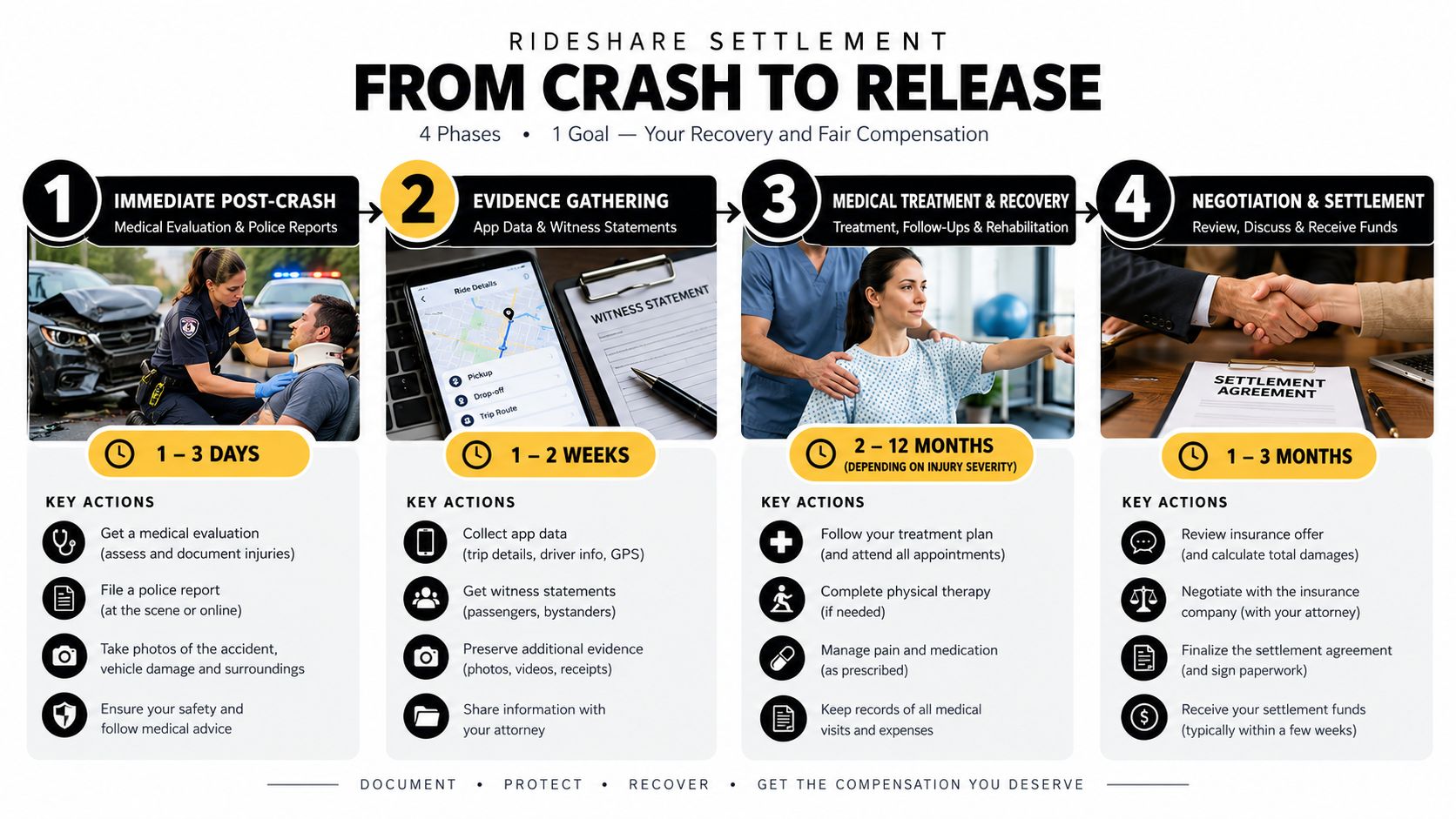
The first stage begins at the crash scene and continues through the initial medical evaluation. Get treatment for symptoms, report the collision, photograph the vehicles and surroundings, save the trip receipt, and record the driver’s name and platform. Don’t assume that a later request for app records will replace evidence you could preserve immediately.
The investigation stage follows. Insurance notices are opened, the police report is obtained, witnesses are contacted, and the insurer’s coverage position is tested against trip logs, GPS timestamps, and platform records. A claim often turns. A driver may describe the app status one way while the digital record shows another.
What builds the medical file
Medical records and bills should tell a coherent story from the collision through recovery. Tell each provider how the injury occurred, follow the treatment plan, attend recommended appointments, and explain any unavoidable gap in care. A demand package should connect diagnosis, treatment, restrictions, lost income, future needs, and daily limitations.
The insurer may request a recorded statement. Treat that request seriously. Answer accurately, but don’t guess about speed, timing, prior symptoms, or the driver’s app status. A careless estimate can become an argument against liability or causation.
Demand, negotiation, and release
The demand letter gives the adjuster a structured basis for valuation. It should identify the responsible parties, explain the applicable policy layer, summarize liability evidence, document medical damages, and state the amount sought with support. Negotiation then tests whether the insurer will pay a fair amount or force litigation.
Some matters resolve after treatment stabilizes. Others require further investigation, lien resolution, or litigation preparation. A signed release usually ends the claim, so read its scope before accepting payment. A release can affect unknown future treatment, related claims, and rights against other responsible parties.
Use the Uber accident settlement process as a general reference point, but don’t treat any online timeline as a promise for your claim. Medical complexity, disputed app status, multiple insurers, and lien issues can all extend resolution.
Negotiation Tips for Your Settlement
An adjuster may claim the driver was only waiting for a request, placing the claim under a thinner policy layer. Your ride receipt, trip records, and app-status evidence can show the driver had already accepted your trip. That distinction often matters more than repeating a headline coverage limit.
Preserve the ride receipt, pickup and drop-off details, driver profile, platform messages, cancellation notices, and screenshots. Ask that the platform preserve trip logs, GPS breadcrumbs, acceptance timestamps, and status records. The demand should identify which policy layer applies and connect that coverage to the evidence, rather than treating every rideshare crash as if the same insurer must pay.
Evidence that strengthens your negotiating position
- Crash documentation: Photograph vehicle damage, road conditions, traffic controls, visible rideshare markings, and your physical symptoms.
- Independent witnesses: Get names and contact details. Do not rely only on the driver’s account.
- Dashcam or surveillance footage: Identify nearby businesses, vehicles, residences, and intersections that may have recorded the collision.
- Medical baseline: Prior records can distinguish your pre-crash condition from the new injury and prevent the insurer from making that argument without context.
- Treatment compliance: Follow medical recommendations and keep appointments. An unexplained treatment gap gives the adjuster a straightforward causation argument.
- Income proof: Preserve wage statements, employer restrictions, schedules, and records of missed work.
Medical timing controls negotiation quality. If doctors are still deciding whether you need injections, surgery, rehabilitation, or continuing care, an early demand can undervalue the claim. Once you sign a release, you may lose the right to seek payment for later treatment.
Negotiation rule: Reject a low first offer with reasons, not emotion. Identify missing evidence, correct the policy classification, and explain the damages the offer ignores.
Check your own auto policy for uninsured and underinsured motorist coverage. An active-trip rideshare policy may include UM/UIM protection, and your policy may also matter when another driver caused the crash or had inadequate insurance. Whether coverage stacks depends on the policy language and applicable law. Do not assume stacking is automatic, and do not assume it is unavailable.
Base the demand on documented damages and a defensible valuation. Before accepting payment, read the release carefully. Broad language may waive future medical claims, claims against another driver, or rights tied to an unresolved lien.
Common Myths and Mistakes in Rideshare Settlement Offers
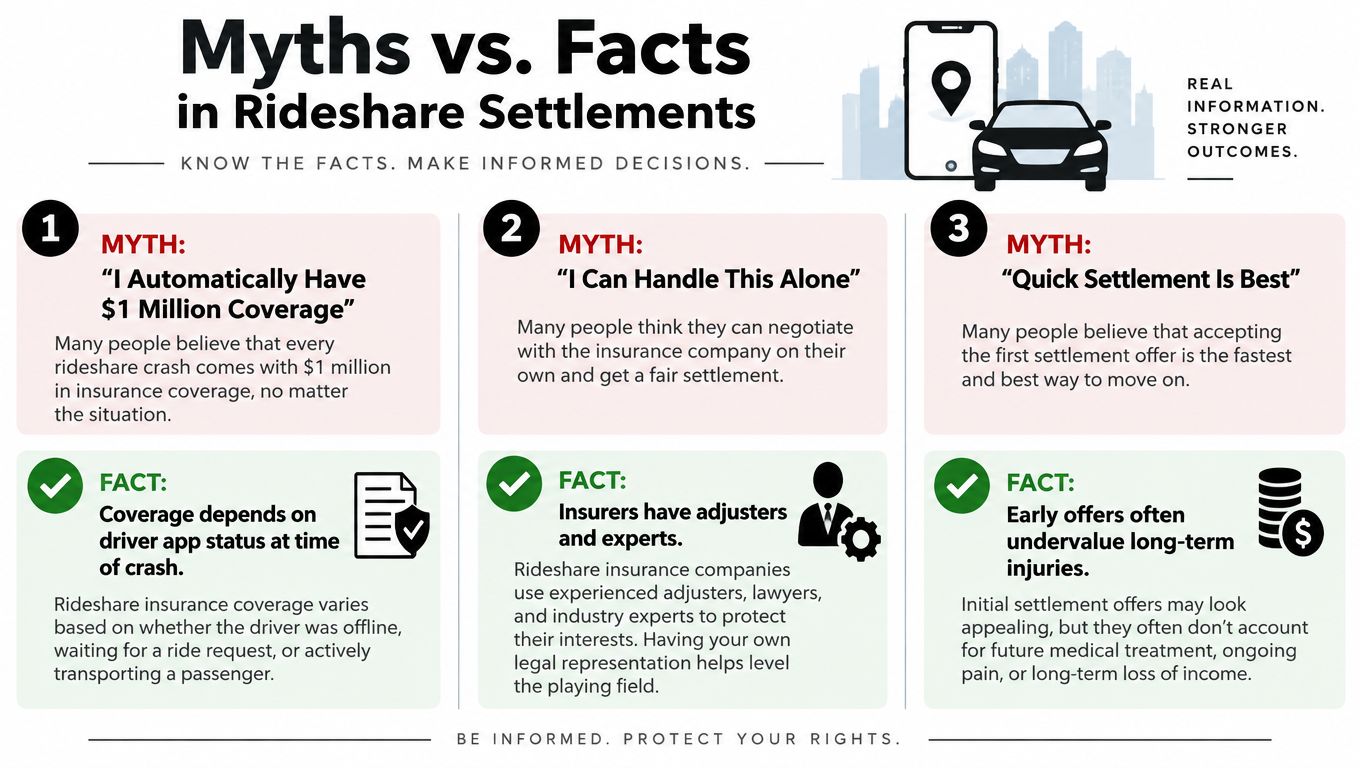
An app screen can determine which insurer pays. The familiar $1,000,000 in coverage figure generally applies to an active trip, not every rideshare crash. If the driver was offline, the personal auto policy usually comes first. During a waiting period, contingent rideshare coverage may apply, often with lower limits. Preserve the trip receipt, status, and timestamps before the insurer disputes the policy layer.
The first settlement offer is a starting position, not a valuation. Adjusters may push for a release while treatment is incomplete, before delayed symptoms, scarring, emotional harm, or future care can be assessed. Once signed, that release can end the claim.
Pressure tactics that reduce settlement value
- Recorded statements: Give accurate basic facts, but do not guess about speed, impact force, or prognosis before reviewing the evidence.
- Social media requests: Do not provide unrestricted access. Posts and photographs can be stripped of context and used against pain complaints, activity limits, or emotional distress.
- UM/UIM coverage: Check it when another motorist caused the crash or carried inadequate insurance. The rideshare driver need not be at fault for this coverage to matter.
- Broad releases: Read every clause. The payment amount is only part of the deal; the release may eliminate future medical claims or claims against another responsible party.
- Online averages: Reject generic settlement figures. They cannot account for app status, the applicable policy, comparative fault, or the medical course.
Insurers commonly argue for the cheapest coverage period and shortest injury timeline. Counter with the digital trip record, a documented policy analysis, complete medical evidence, and damages supported by records. Settle only after you understand what rights the release removes.
Key Takeaways and Next Steps for Injured Passengers
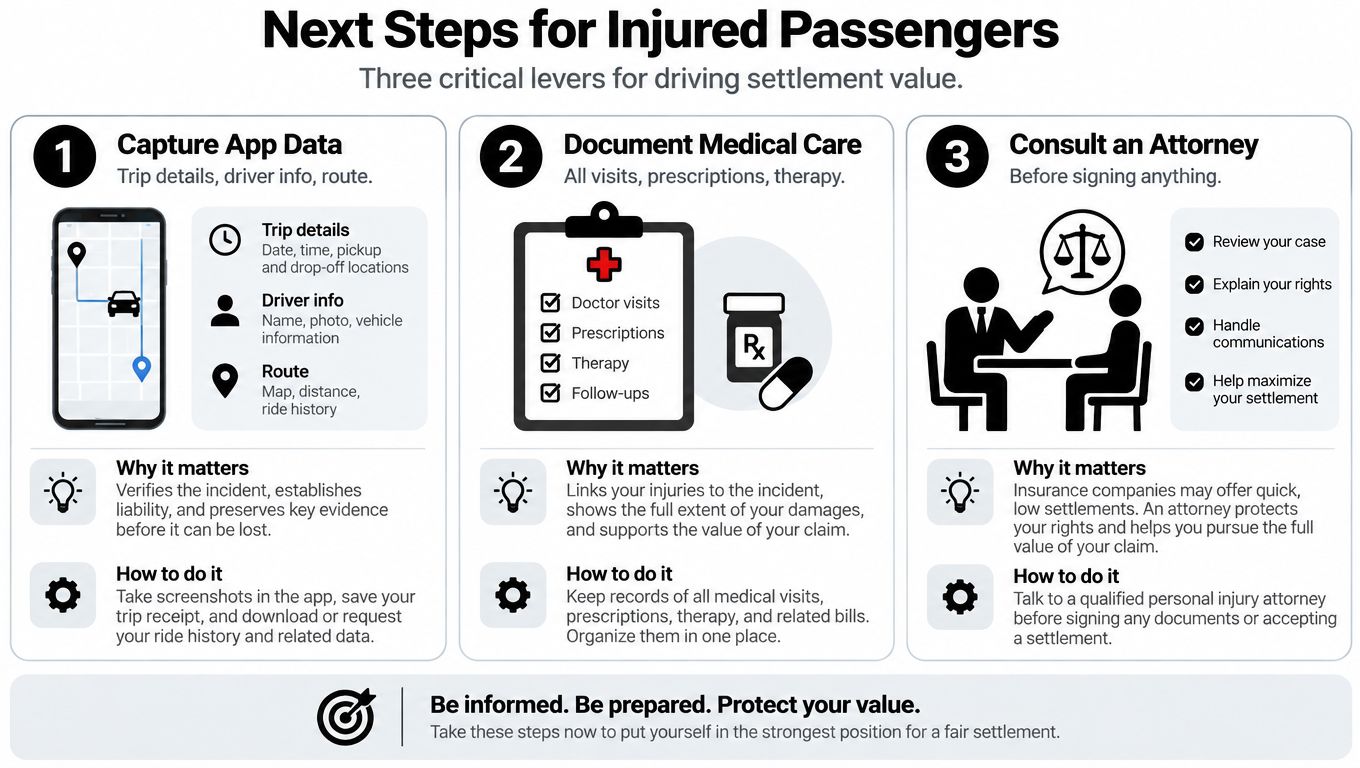
Three levers control most passenger claims. First, capture the app evidence before the platform status becomes a disputed memory. Second, identify which insurance tier applies before sending a demand. Third, assemble the liability and medical file before negotiating a number.
That sequence matters. A passenger with clear injuries but no proof of the active trip may fight over the available policy. A passenger with a strong policy but incomplete treatment records may face a low valuation. A passenger who wins a settlement but signs an overbroad release may lose the ability to pursue future care or another responsible party.
Take these actions now
- Preserve records: Save the trip receipt, driver details, app communications, photos, police information, witness contacts, medical records, bills, prescriptions, and wage documentation.
- Control communications: Avoid early recorded statements, don’t speculate about fault or recovery, and direct coverage questions to a qualified professional.
- Request coverage information: Ask for the applicable Certificate of Insurance and determine whether the claim involves personal auto, contingent rideshare, commercial, UM, or UIM coverage.
- Wait for medical clarity: Don’t sign a release while doctors are still evaluating ongoing symptoms or future treatment.
- Get California-specific advice: Consult a licensed California personal injury attorney with Uber and Lyft experience before accepting a settlement or filing suit.
This article is for informational purposes and not to be construed as legal advice. No attorney client relationship exists based on the review of this article and none of the information in this article is legal advice. Every claim depends on jurisdiction, policy language, app records, fault allocation, and injury-specific evidence.
LA Law Group, APLC offers rideshare accident consultations, evaluates which insurance policies apply, and develops claims involving Uber and Lyft crashes. Visit LA Law Group, APLC to discuss your evidence, coverage tier, medical documentation, and settlement options before signing a release.
Attorney Advertising. This article is general information, not legal advice, and does not create an attorney-client relationship. Prior results do not guarantee a similar outcome.