
Uber Accident Settlement: How California Claims Work

In California, an Uber accident settlement for a passenger almost always draws from Uber’s $1,000,000 commercial liability policy when the driver is on an active trip, but the actual payout depends on injury severity, fault clarity, and which insurance tier applies. Settlements commonly range from about $10,000 for minor soft-tissue injuries to well over $1,000,000 for severe or wrongful-death cases.
You may be sitting in the back seat with a sore neck, a damaged phone, and a growing stack of medical bills. The adjuster may call quickly and offer money before you know whether your injury will resolve or require months of treatment. That first number can feel helpful, but it can also conceal the most important question in the case: which policy was active when the crash happened?
California Uber claims turn on three facts: the driver’s app status, how clearly fault can be proven, and the full medical outlook. The coverage framework is described in Uber’s California driver insurance information, and it’s far more important than the label “Uber accident” by itself. A serious injury during an inactive app period may face a smaller insurance pool, while a moderate injury during an accepted passenger trip may have access to the commercial policy.
What Happens Right After an Uber Crash in California
Airbag dust hangs in the cabin. The Uber driver pulls onto the shoulder of a California freeway, and the app still shows the trip in progress. You’re shaken, your neck hurts, and someone has called an ambulance. Before the vehicles move, the evidence is already beginning to disappear.
If you’re physically able, photograph the vehicles, license plates, road layout, traffic signals, visible injuries, and the Uber vehicle’s damage. Ask for the driver’s name and insurance information, but don’t argue about fault or speculate about how the crash happened. Request the Uber trip receipt as soon as it becomes available, and preserve the pickup, route, and destination information.
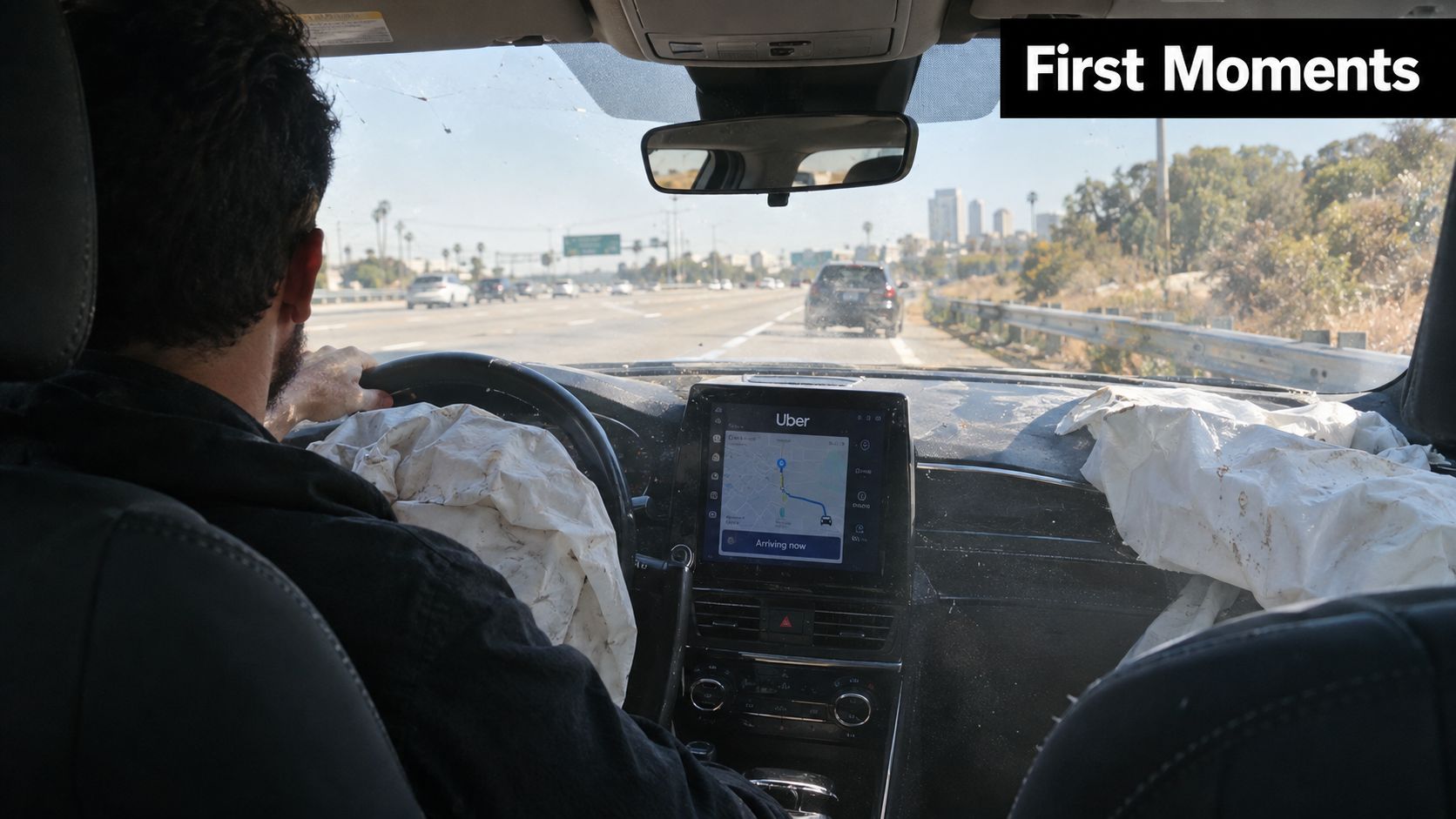
The first decisions affect the entire claim
Call 911 when anyone is injured or the collision presents a safety risk. Cooperate with emergency personnel, then obtain the police report number. A report can preserve driver statements, witness information, vehicle positions, citations, and the responding officer’s observations. It won’t decide the case by itself, but it can become valuable when an insurer later disputes what happened.
Report the collision through Uber’s in-app safety tools. Keep your description factual. Say where you were seated, what you felt, what treatment you received, and whether you noticed symptoms. Don’t give a recorded statement to an insurer before understanding the claim, and don’t sign a release because an adjuster says the offer is time-sensitive.
Practical rule: Preserve the trip screen and receipt before you rely on anyone else to prove the driver’s status.
The first adjuster call often comes quickly, sometimes within the first day. The adjuster may sound helpful while asking questions designed to establish that the driver wasn’t on an active trip, that your symptoms were minor, or that another person caused the collision. Direct the call to counsel once you’ve decided to retain representation.
Everything downstream depends on three questions. Which insurance tier applies? How will fault be proven? How serious are the injuries, including future care and work limitations? The rest of the claim is evidence supporting those answers.
The Three App-Status Stages That Decide Who Pays
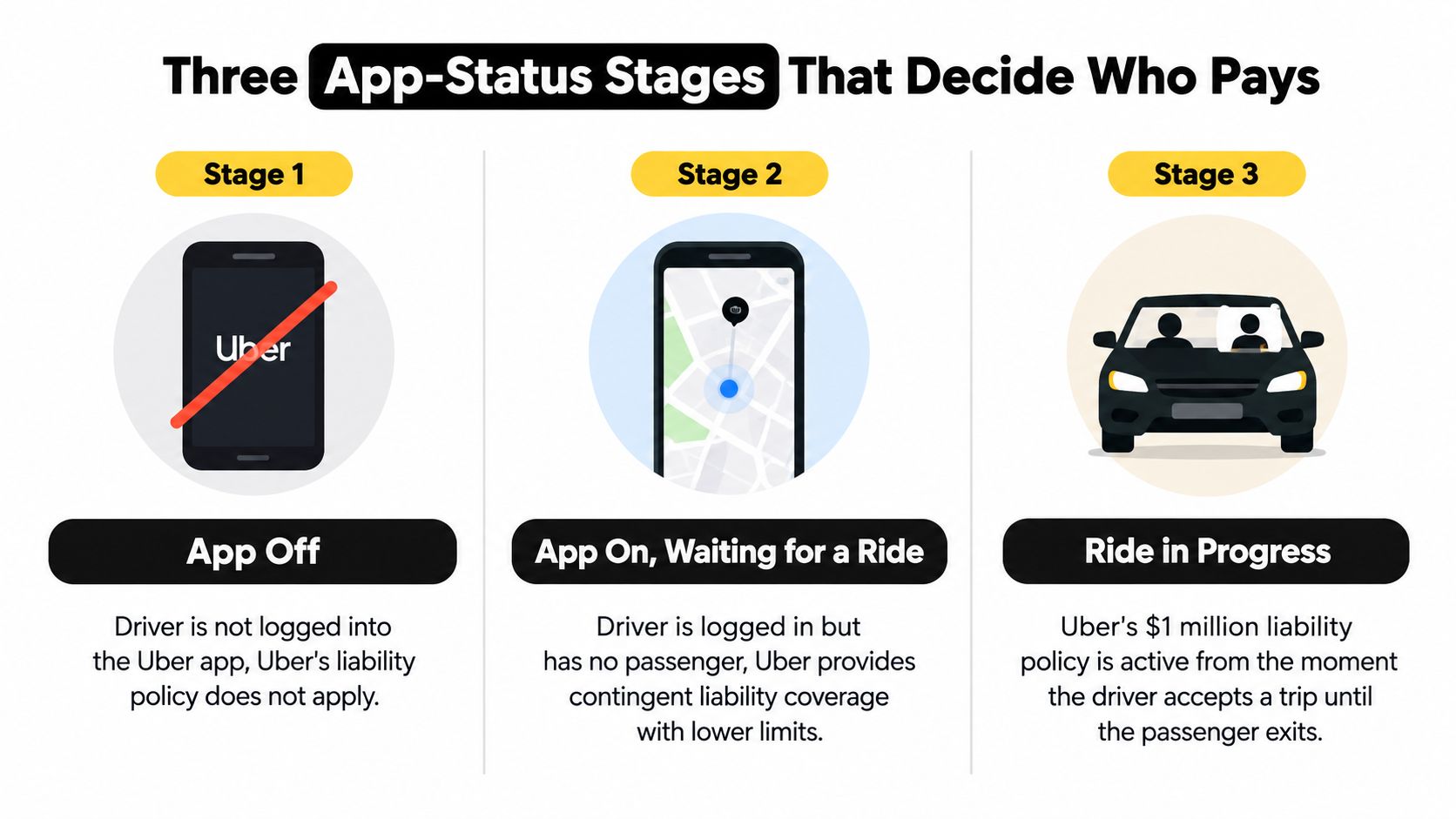
The same Uber vehicle can trigger different insurance coverage depending on what the driver’s app showed at the moment of impact. That status often decides whether the claim starts with the driver’s personal policy, Uber’s limited contingent coverage, or Uber’s commercial policy. I would obtain the trip record before discussing settlement with any insurer.
Stage one: the app is off
If the driver was offline, the driver’s personal auto policy generally applies. Uber’s commercial liability policy usually is not the primary coverage when the vehicle was being used for personal purposes. If that policy cannot cover the loss, the claim may require an examination of other available insurance and any additional at-fault driver.
The dispute is often factual. A driver may say the app was off while a passenger remembers seeing Uber open. Preserve the trip receipt, screenshots, text messages, and other timestamped records. The relevant question is what the driver was doing at the time of impact, not whether the driver normally works for Uber.
Stage two: the driver is online and waiting
When the app is on and the driver is waiting for a request, Uber’s contingent liability coverage is commonly described as $50,000 per injured person, $100,000 per accident, and $25,000 for property damage, according to Uber’s published insurance overview. The driver’s personal policy may also enter the coverage analysis.
This tier creates frequent disputes because the status can change within minutes. Was the driver only available, had a request been accepted, or was the driver already traveling to a passenger? Insurers will examine trip records, app activity, and timestamps. Those records can determine whether the claim remains subject to limited coverage.
Stage three: an active trip
After the driver accepts a ride or a passenger is inside the vehicle, Uber’s commercial liability coverage can reach $1,000,000 for injuries and damages. That limit can expand the settlement options for a passenger with serious injuries. The active-trip record, rather than the severity of the collision alone, is what opens access to the million-dollar policy.
California’s framework began with Assembly Bill 2293. Senate Bill 371 later changed rider coverage rules. The required uninsured and underinsured motorist coverage for passenger trips was reduced from $1,000,000 to $60,000 per person and $300,000 per incident, a 94% reduction. That reduction can sharply limit recovery when the at-fault driver lacks adequate insurance, even if the Uber vehicle was carrying a passenger.
For a broader explanation, review how Uber coverage applies to accidents. Then demand the actual trip data. I would not value an Uber accident settlement until the app status, available policies, and any uninsured-motorist issues are confirmed.
Key Factors That Drive the Settlement Amount
An adjuster doesn’t value an Uber claim by multiplying a medical bill by a convenient number. The adjuster scores proof. The strongest claims connect the crash, the injury, the treatment, the work loss, and the future consequences in a consistent record.
The factors that matter most
Liability clarity comes first. A rear-end collision involving a stopped Uber vehicle may be easier to prove than a disputed lane change with conflicting witnesses. Clear fault gives the insurer fewer arguments to discount the claim.
Injury severity comes next. Short-lived soreness and documented whiplash are not evaluated like a herniated disc requiring injections or surgery. Objective imaging, neurological findings, fractures, surgery recommendations, and persistent restrictions carry more weight than a claimant’s description alone.
Medical documentation supports the value. Records should show diagnoses, treatment recommendations, work restrictions, symptom progression, and future-care opinions. The key issue isn’t the total of the bills. It’s whether the treatment makes medical sense and whether the records connect it to the collision.
Future earning capacity can change the model. A younger claimant who can’t return to the same occupation may have a substantial future-loss claim. Hourly wages, commission-based income, self-employment records, and professional restrictions require different proof.
Pain and suffering scale with the recovery. Ongoing pain, sleep disruption, emotional distress, and loss of normal activities matter, but they don’t rescue weak liability proof. A persuasive daily-impact record helps show what the injury has taken away.
Permanent impairment affects the ceiling. A treating physician’s impairment opinion, lasting range-of-motion loss, visible scarring, or chronic functional limitation can support a higher valuation than a temporary injury.
| Settlement Factor | Typical Weight | Example |
|---|---|---|
| Liability clarity | Very high | A documented rear-end collision with consistent witness accounts |
| Injury severity | Very high | Herniated disc with surgery or lasting neurological symptoms |
| Medical documentation | High | Complete records, imaging, treatment notes, and future-care opinions |
| Future earning capacity | High when supported | Restrictions prevent a return to the claimant’s prior occupation |
| Permanent impairment | High | Treating physician documents lasting functional loss |
| Lost wages | Proportional | Employer records establish missed work and reduced capacity |
| Pain and suffering | Proportional | Ongoing limitations and documented impact on daily activities |
The technical overview of Uber settlement variables identifies the same core categories: injury severity, medical costs, lost wages, future earning capacity, pain and suffering, permanent impairment, and liability clarity.
The adjuster is asking one question: “What can this claimant prove that will survive a serious challenge?”
Send a demand package that answers that question before making a demand. A high gross number without causation proof invites a low counteroffer.
Realistic Settlement Ranges for Uber Injury Claims
Settlement ranges are useful only when you place them beside the injury and coverage facts. Public Uber settlement guidance describes minor-injury cases around $10,000 to $50,000, moderate cases around $50,000 to $250,000, and severe cases from $250,000 to well above $1,000,000. Another published estimate places the average Uber accident settlement at about $75,000, with a span from roughly $6,000 for minor whiplash to $25,000,000 or more for wrongful-death claims, as summarized in published Uber and Lyft settlement ranges.
Those figures aren’t formulas. A separate published range reports average injured-party settlements around $29,700, with minimums of $1,000 to $5,000 and severe-injury outcomes of $100,000 or more. The gap between these figures proves why a national “average” tells you very little about an individual California claim.
| Injury Tier | Typical Injuries | App-Status Layer Used | Settlement Range | Key Drivers |
|---|---|---|---|---|
| Minor | Sprains, whiplash, soft-tissue injuries, brief treatment | Personal policy or contingent coverage, depending on status | About $10,000 to $50,000 | Prompt care, clear fault, documented recovery |
| Moderate | Herniated discs, injections, months of treatment, extended work limits | Often active-trip commercial coverage when proven | About $50,000 to $250,000 | Imaging, treatment intensity, lost income, prognosis |
| Severe | Surgery, traumatic brain injury, spinal cord damage, permanent disability | Active-trip commercial coverage may apply | $250,000 to well above $1,000,000 | Permanent impairment, future care, earning capacity |
| Wrongful death | Fatal crash and survivor claims | Depends on app status and responsible parties | Can reach $25,000,000 or more in published summaries | Liability, survivors’ losses, applicable policy limits |
The moderate and severe bands shouldn’t be treated as promises. A claim can remain low despite substantial bills if fault is disputed, treatment is inconsistent, or the active-trip coverage can’t be established. Conversely, a well-documented injury with lasting impairment can move beyond the ordinary range.
Review Uber passenger accident settlement amounts for additional context, but focus your own evaluation on medical proof, liability, coverage, and future loss. The headline average isn’t the case value.
How the Claims Process Actually Unfolds
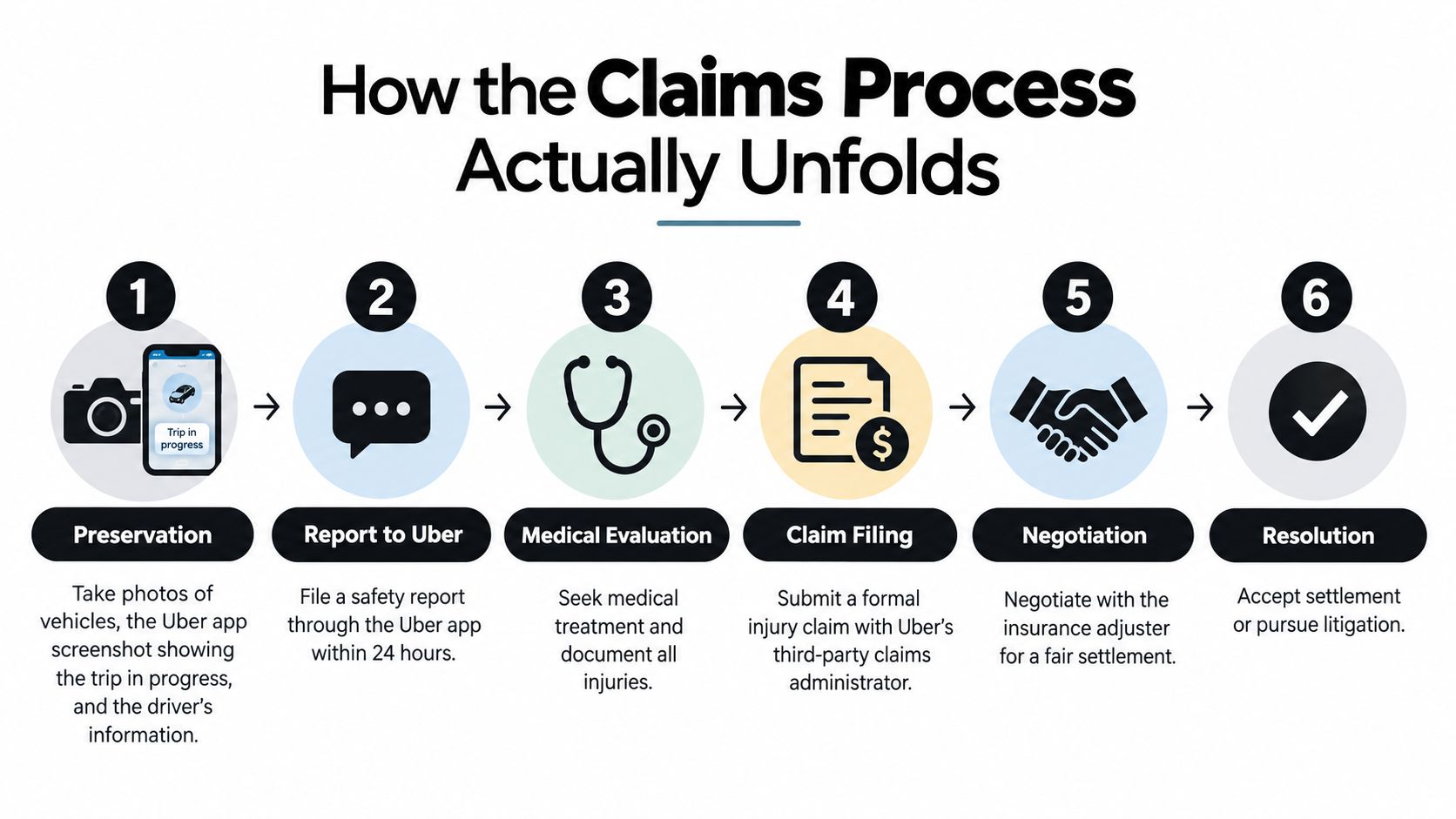
A strong claim develops in a sequence. Skip the early evidence work, and the insurer may control the narrative before your medical prognosis is clear.
Preserve proof before it disappears
Start with photographs of every vehicle, the roadway, traffic controls, visible injuries, and the Uber app screen showing the trip. Save the trip receipt and driver information. Collect witness names and contact details, and obtain the police report number.
Seek medical evaluation promptly, preferably within the first 24 to 72 hours when medically appropriate. That timing helps create a record linking symptoms to the collision. Continue care based on medical advice, and explain every symptom rather than minimizing pain because you’re worried about appearing dramatic.
Notify the right parties without giving away leverage
Report the crash through Uber’s in-app help or safety process and submit a formal written claim to the applicable insurer. The active-trip policy becomes central once the company or its claims administrator confirms the driver’s status. Preserve all emails, claim numbers, letters, and calls.
The investigation often lasts 30 to 90 days. During that period, insurers may request medical records, bills, employment information, photographs, and a recorded statement. You don’t have to provide an uncontrolled narrative. Have counsel review requests before you respond.
Build the demand around the whole loss
A demand package should include:
- Medical specials: Bills, records, imaging, prescriptions, and treatment chronology.
- Work losses: Wage statements, employer verification, missed shifts, and restrictions.
- Future needs: Physician opinions about additional treatment, impairment, and prognosis.
- Liability narrative: Police materials, witness accounts, photographs, and trip-status proof.
- Human impact: A clear explanation of pain, activity limitations, and changes to daily life.
Negotiation may take six to twelve months, especially when future care or coverage is disputed. If the offer stalls, litigation may be necessary. Trial verdicts can occur 18 to 36 months after filing, depending on the court, parties, discovery, and case complexity.
For a related overview of claim handling, see the Uber accident claim process. Don’t settle until the release, liens, future treatment, and available policy layers have been examined.
Why a Big Settlement Can Still Mean a Small Net Payout
The gross settlement is not the amount you keep. Fees, case costs, medical reimbursement claims, and policy rules can reduce the final recovery substantially.
California’s current rideshare debate adds another layer. Reporting on the 2026 California fight describes an Uber proposal that would have required crash victims to retain 75% of settlement awards while limiting medical-expense recovery. Later reporting described a compromise framework focused on transparency and claims handling rather than a simple continuation of the earlier model, as reported by CalMatters’ coverage of California rideshare ballot initiatives and reporting on Uber crash litigation and robotaxis.
The gross number doesn’t answer the net-recovery question
Take a hypothetical $300,000 settlement. If the contingency fee is 40%, attorney fees would be $120,000. Subtract $18,000 in case costs and a $40,000 Medi-Cal lien, and the claimant receives roughly $122,000, before considering any other reimbursement or distribution issue.
That example isn’t a prediction of what any particular client will pay. It demonstrates why you should demand a written closing statement showing the gross recovery, attorney fee, litigation costs, medical liens, health-insurance reimbursement, and final net amount.
SB 371 also matters when the responsible driver is uninsured or underinsured. The verified coverage history describes a reduction in mandatory passenger-trip UM/UIM coverage from $1,000,000 to $60,000 per person and $300,000 per incident, a 94% reduction, making the available protection much narrower in those circumstances.
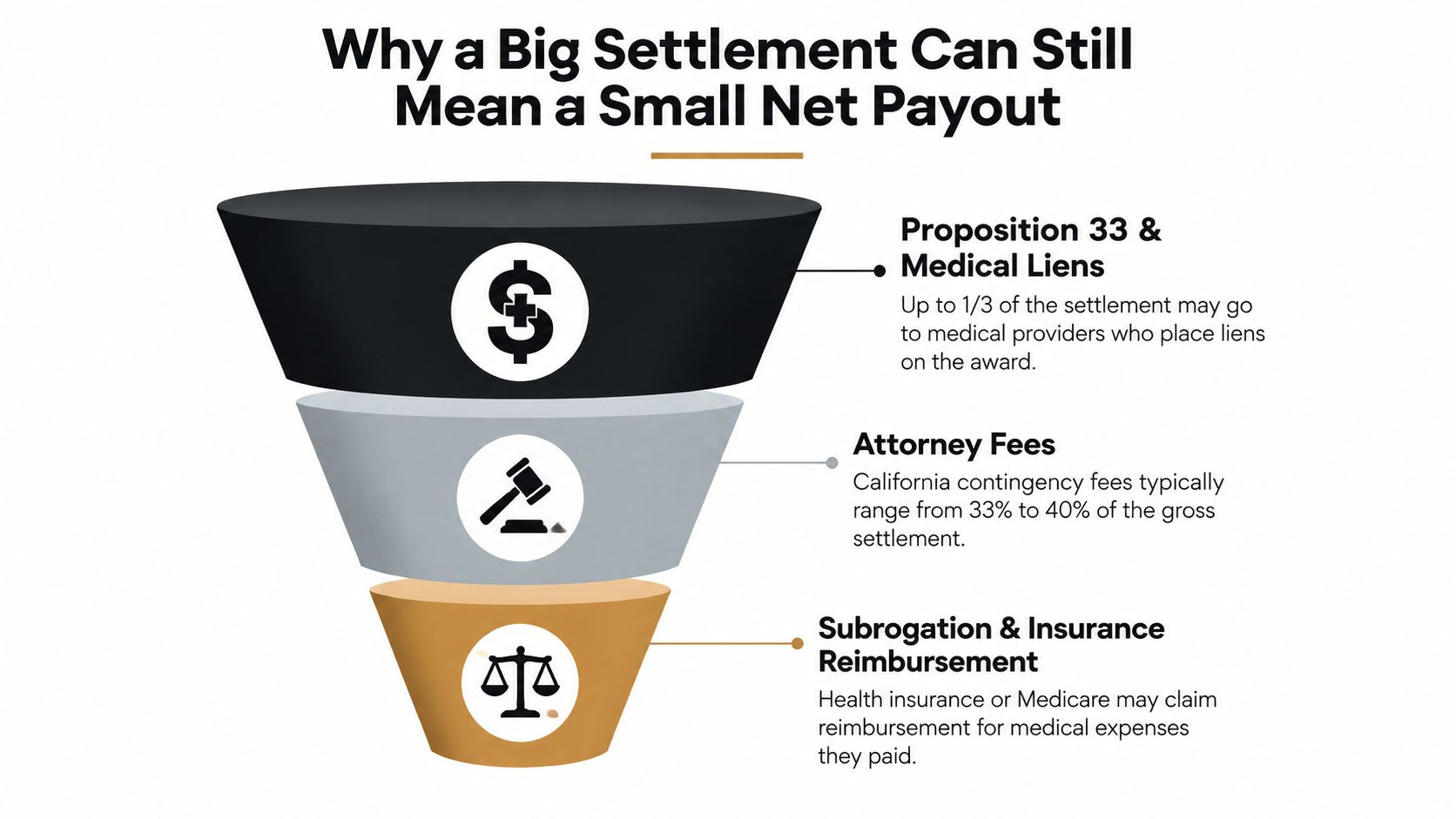
Review lien rights early. A large settlement can still leave a disappointing net recovery if the distribution is handled only after negotiations finish.
Practical Strategies to Maximize Your Recovery
Treat the first 30 days as an evidence-preservation period, not a settlement race.
Your immediate action list
- Call 911: Request medical and law-enforcement assistance when anyone is injured or the scene is unsafe.
- Photograph everything: Capture the vehicles, roadway, signs, lighting, injuries, and driver information.
- Save trip proof: Request the Uber receipt and preserve any visible app-status screen.
- Get the report number: Follow up for the police report and keep the identifying information.
- Start medical care: Use urgent care or an emergency department first when appropriate, then follow referrals to an orthopedist, pain-management physician, or therapist.
- Keep treatment continuous: Explain new symptoms and follow medical recommendations. Gaps make causation easier to attack.
- Preserve work records: Save pay records, employer statements, schedules, commission information, and restrictions.
- Control social media: Don’t post crash details, physical activities, travel, or photos that can be taken out of context.
- Keep a daily journal: Record pain, sleep disruption, medication effects, missed work, and activities you can’t perform.
Don’t give a recorded statement or accept a release before you understand the coverage tier and medical outlook. Match the demand to the evidence, including medical specials, future-care projections, permanent impairment, and lost earning capacity.
Your settlement position comes from accuracy. Prove the active trip, establish liability, document treatment, and calculate the net recovery before you negotiate. LA Law Group, APLC offers California Uber accident claim representation, including case assessment and negotiations concerning rideshare coverage and injury damages.
This article is for informational purposes only and isn’t legal advice. No attorney-client relationship exists based on the review of this article, and none of the information in this article is legal advice. The facts of your crash, app status, responsible parties, medical prognosis, and applicable policies can change the result, so consult a licensed California attorney for individualized guidance.
If you were injured as an Uber passenger or in a crash involving an Uber driver, contact LA Law Group, APLC for a case evaluation focused on app-status evidence, insurance coverage, injury documentation, liens, and your likely net recovery. Bring your trip receipt, police report information, photographs, medical records, and insurer communications so the firm can assess the claim directly.
Attorney Advertising. This article is general information, not legal advice, and does not create an attorney-client relationship. Prior results do not guarantee a similar outcome.