
Sideswipe Car Accident in California: What You Need to Know
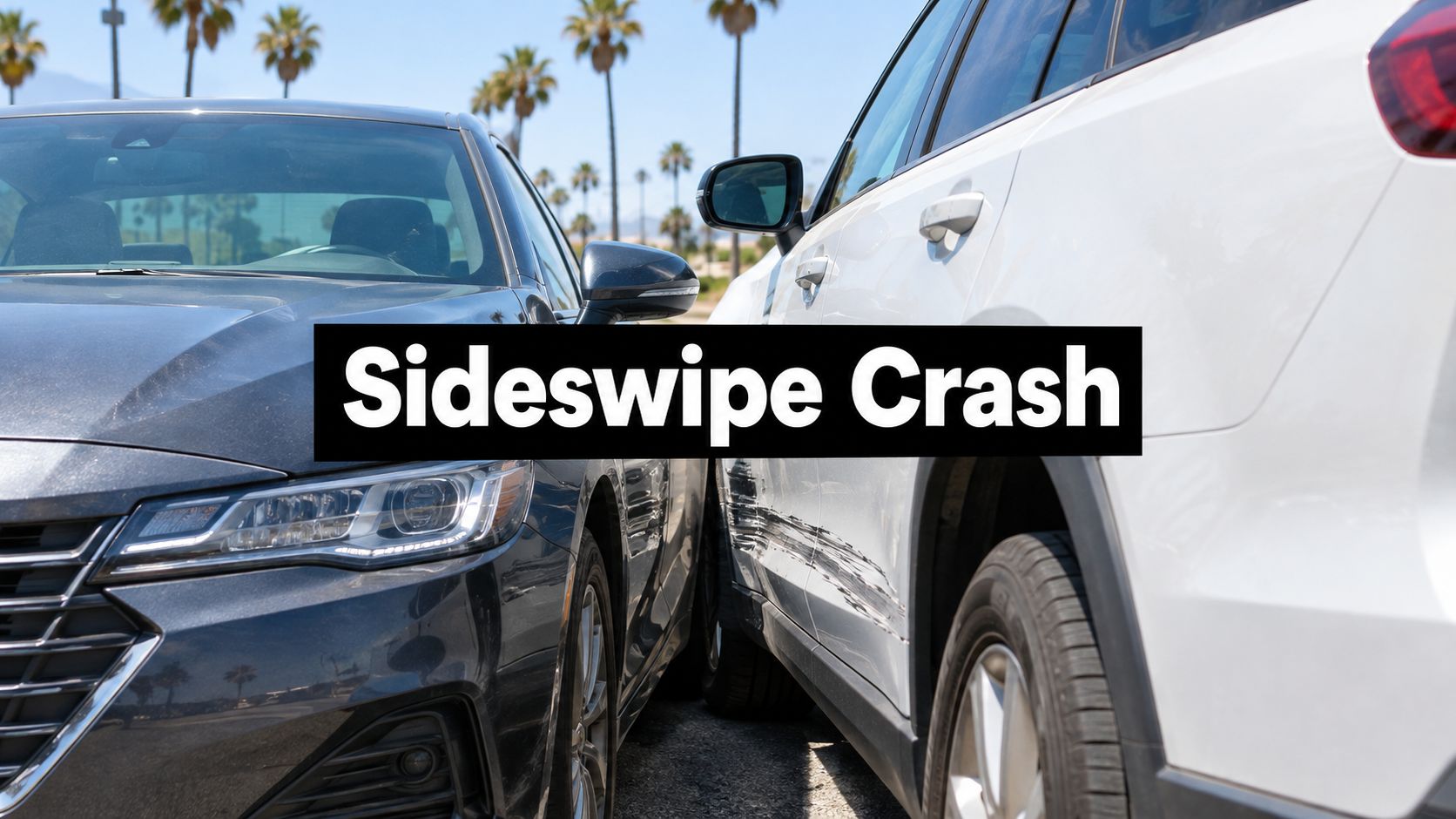
You’re driving through California traffic when another vehicle suddenly moves toward you. There’s a sharp scrape, your car shudders, and both vehicles stop with paint streaks along their sides. The other driver says you moved first. You remember staying in your lane. In a sideswipe car accident, that disagreement is common because the damage may look minor while the evidence needed to determine who crossed the lane boundary can disappear quickly.
A sideswipe claim usually turns on lateral movement, not just on which vehicle has more visible damage. Photos, lane markings, scrape direction, mirror damage, vehicle positions, witness accounts, and driver-assistance data can help show what each vehicle was doing immediately before contact. The steps below explain how to preserve that evidence, understand California’s shared-fault rules, and handle insurance reporting after a collision.
Understanding Sideswipe Collisions
The sound is often more startling than the initial impact. Your door or mirror catches another vehicle, both cars pull apart, and the other driver may insist that the collision happened because you drifted. A sideswipe is more than a superficial scrape. It occurs when the sides of vehicles make contact while they travel either in the same direction or in opposing directions.
A same-direction sideswipe commonly develops during a lane change, merge, pass, or simultaneous lateral movement. One driver may accept a gap that’s too small, fail to see a vehicle in a blind area, or move across the lane line while the neighboring vehicle is also maneuvering. An opposite-direction sideswipe can occur when a vehicle crosses or approaches the centerline, particularly on an undivided road. Federal highway-safety materials distinguish these categories because traffic direction and roadway design affect how investigators interpret the event. Federal crash classification research treats same-direction and opposite-direction sideswipes as separate event types.
Why a sideswipe matters
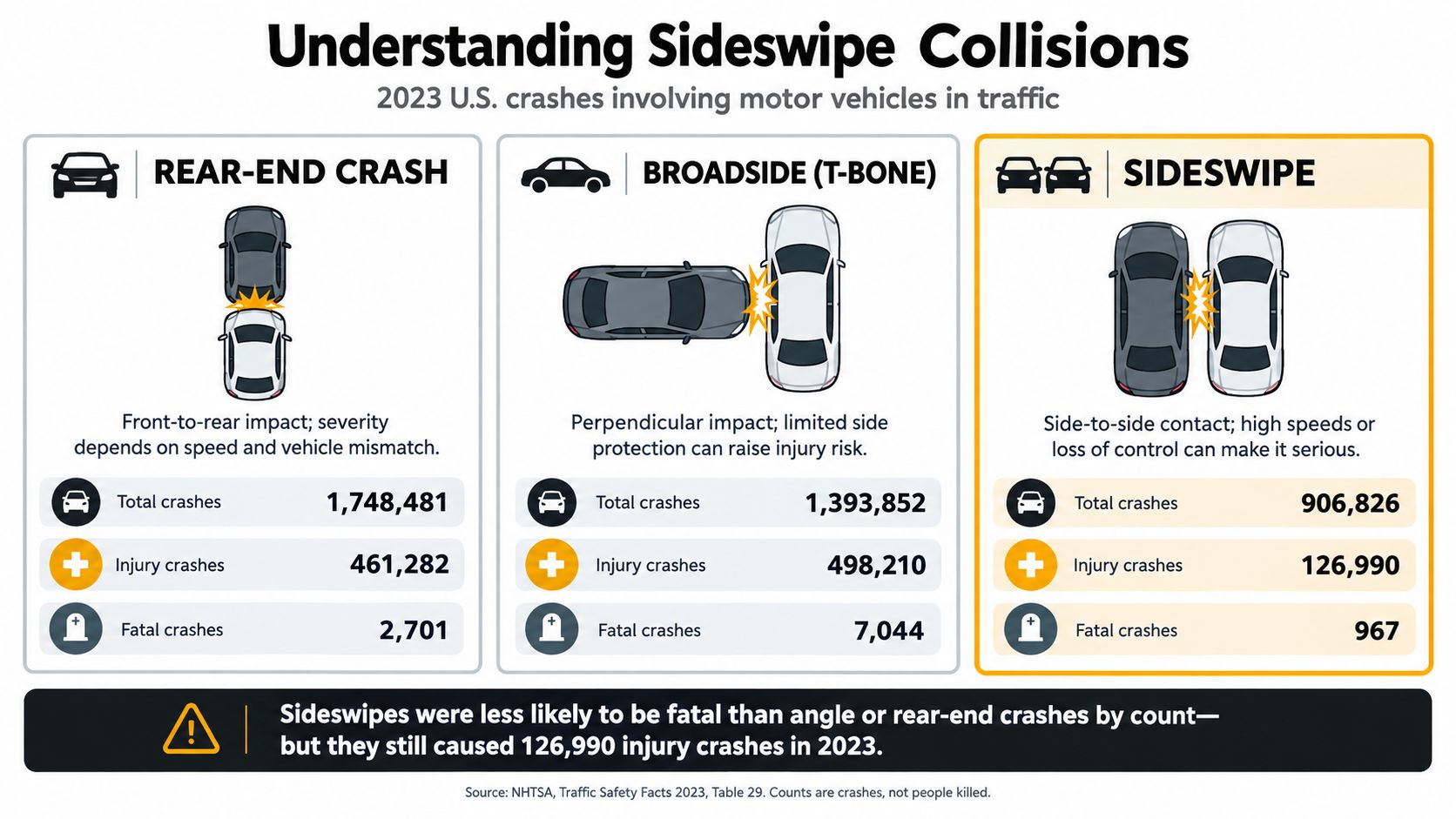
A National Highway Traffic Safety Administration analysis of 1999 crash data identified approximately 539,000 two-vehicle lane-change crashes nationwide, including about 233,000 crashes involving an angle or sideswipe maneuver. Those figures come from NHTSA’s lane-change crash analysis, and they show why lane position, mirror use, signaling, and blind-spot awareness matter far beyond parking-lot scrapes.
The physical story is usually straightforward: one vehicle occupies or enters the other vehicle’s path laterally. The legal story requires more care. A scrape alone doesn’t prove which driver moved, so understanding blind areas and mirror limitations can help before and after a crash. Drivers looking for practical information about vehicle visibility can review T1A Auto blind spot solutions.
Immediate Steps After a Sideswipe Crash
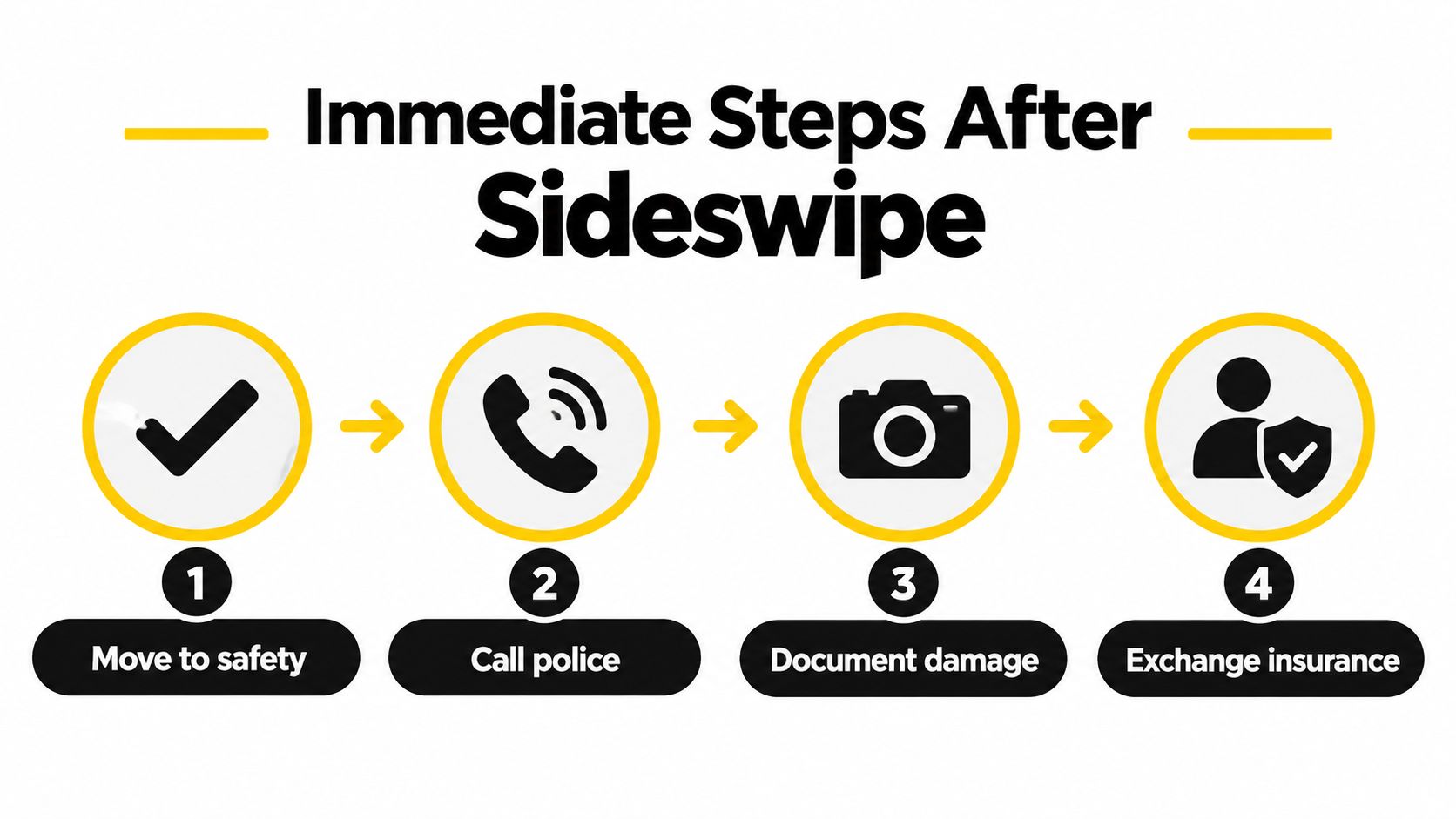
Your first responsibility is safety, not proving fault at the roadside. Check yourself and passengers for pain, dizziness, bleeding, or other symptoms. If anyone needs medical attention, call emergency services. If the vehicles can move safely, get out of active traffic, but don’t leave the scene or move evidence unnecessarily when doing so would create another hazard.
Once everyone is safe, work through the scene in a deliberate order:
-
Call for assistance. Report the collision to law enforcement and request medical care when appropriate. A police report may document road conditions, statements, visible damage, and the apparent positions of the vehicles.
-
Photograph the roadway before conditions change. Capture lane lines, traffic signs, nearby vehicles, debris, skid or scrape marks, barriers, and the direction of travel. Take wide photographs that show the road layout and closer photographs that show the contact area.
-
Document lateral damage. Photograph parallel scrape marks, paint transfer, damaged mirrors, door edges, fenders, wheel areas, and any damage extending along the side of either vehicle. Don’t wash or repair the vehicle before these details are preserved.
-
Record final resting positions. If the vehicles were moved, photograph where they stopped before moving them if it was safe. Note each vehicle’s position relative to lane markings, shoulders, medians, or other fixed features.
Preserve the human evidence
Exchange names, contact information, driver’s license details, vehicle information, and insurance information. Ask witnesses for contact information rather than relying on memory. Write down what you recall while the sequence is fresh, including which vehicle was changing lanes, whether a signal was visible, and whether another vehicle forced evasive movement.
Avoid arguing about fault or making a confident statement about facts you can’t verify. You can describe what you observed without guessing about speed, distance, or the other driver’s intent.
Practical rule: Preserve the scene as a sequence, not just as a collection of dents. A sideswipe claim often depends on showing where each vehicle was and how each one moved.
Seek medical evaluation if symptoms develop after the crash. Tell the provider how the collision occurred and keep records of treatment, restrictions, and expenses. Preserve dashcam footage, phone photographs, insurance messages, repair estimates, and any vehicle warnings displayed after the impact.
How Liability Is Determined in Lane Change Accidents
The central question is usually simple to state: which vehicle crossed, occupied, or approached the lane boundary at the moment of contact? The answer may not be obvious from the final damage. A vehicle can suffer more visible damage even when the other driver initiated the lateral movement, and both vehicles can be moving when the sides touch.
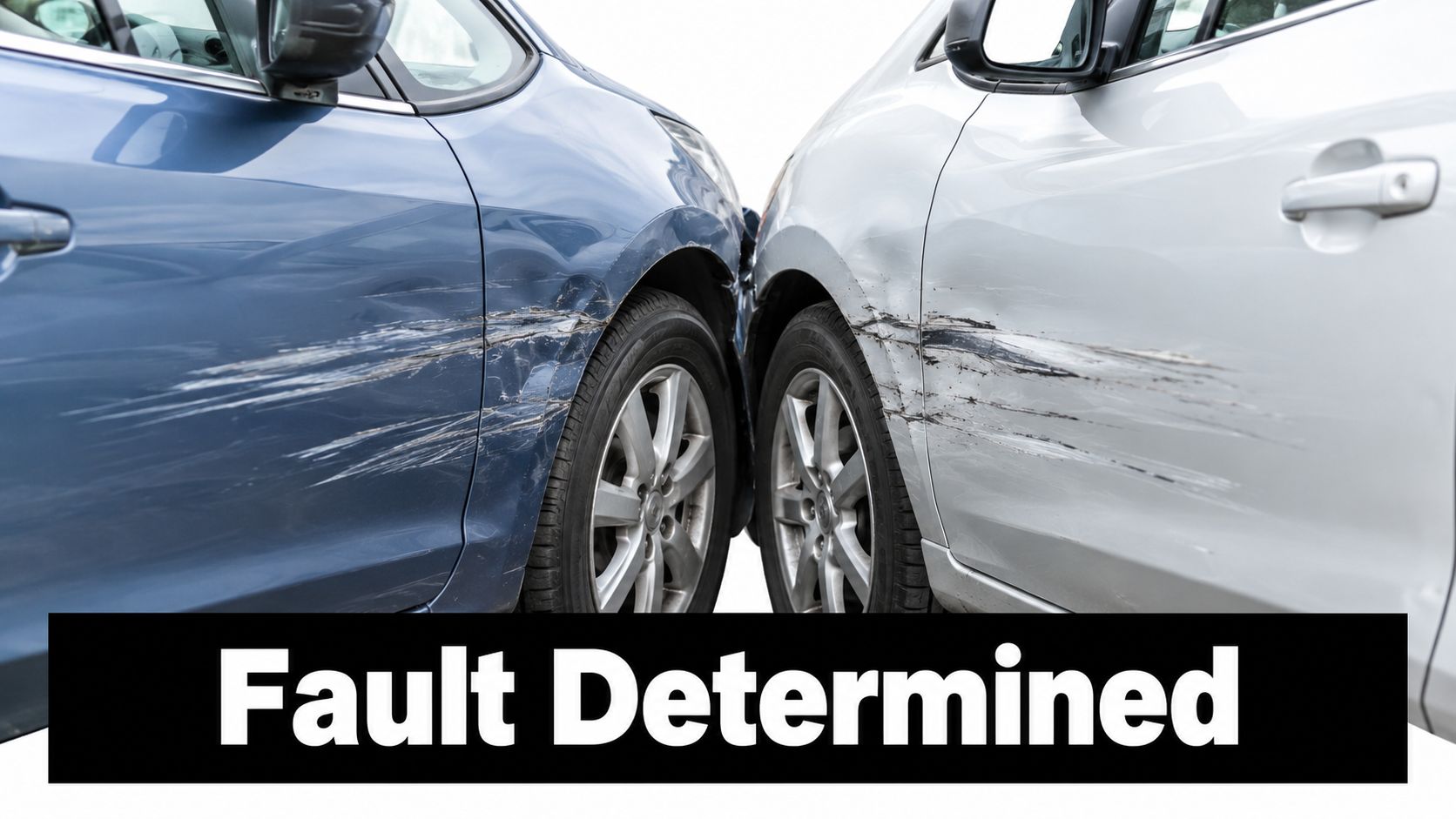
NHTSA research on lane-change events found that 39% of observed lane-change near-crashes fit a scenario in which the subject vehicle sideswiped another vehicle. The research highlights a detection and judgment problem, namely, a failure to recognize or correctly judge the adjacent vehicle’s position, rather than merely a failure to control forward speed. NHTSA’s lane-change research also identifies the importance of lateral movement and visibility in reconstructing these events.
Reading the physical evidence
Investigators, insurers, and attorneys may compare:
- Paint transfer: Matching colors or transferred material can show where the vehicles touched.
- Parallel scrape marks: Continuous marks along a door, quarter panel, or bumper may indicate a gradual lateral contact.
- Damage direction: The angle and length of deformation can help indicate whether one vehicle moved across the other’s path.
- Mirror and door damage: These areas may establish relative vehicle alignment at impact.
- Lane markings and resting positions: Photographs can show whether a vehicle ended up across or near a lane boundary.
- Witness and video evidence: Dashcam footage, traffic-camera footage, and consistent witness accounts can support or challenge each driver’s description.
Damage should not be used in isolation. A reconstruction must account for vehicle dimensions, roadway geometry, the sequence of movements, and any evasive steering. For example, a driver may remain in the original lane but steer away after contact, changing the final resting position. Conversely, both vehicles may drift at once, creating shared responsibility.
A claim involving a disputed lane change may benefit from a focused explanation of the applicable driving rule, such as the discussion in this guide to improper lane changes. The useful question isn’t just whether someone changed lanes. It’s whether the movement was made with adequate awareness, space, and control.
This video can provide additional visual context for how side contact and lane position are analyzed:
A driver’s statement also matters, but it isn’t conclusive. Statements such as “I never saw the other car” may support a visibility issue, while “I was already moving over” may establish that a lane change was underway. Preserve texts, recorded calls where lawful, photographs, and repair records that may help establish the sequence.
California Comparative Negligence Rules
California doesn’t require every sideswipe claim to end with one driver receiving all the blame. California uses comparative negligence, meaning responsibility may be divided when both drivers contributed to the collision. The California Department of Insurance explains comparative negligence as the allocation of fault among drivers whose conduct contributed to the accident.
Consider a simple example. Driver A begins moving into an adjacent lane without confirming that it’s clear. Driver B remains near the lane boundary but also makes a lateral movement or fails to respond reasonably to an obvious hazard. An insurer or court may evaluate both actions rather than treating the case as an automatic win for either driver.
How shared fault affects a claim
The assigned percentages can affect the amount recovered for injury or property-loss claims. If evidence shows that another driver caused most of the collision but your conduct contributed, the amount attributed to your claim may be reduced according to your share of responsibility. The exact allocation depends on the evidence, not on a general assumption that the vehicle changing lanes is always responsible.
Adjusters may examine:
- Lane position: Which vehicle occupied the lane and where the contact occurred.
- Movement: Whether one driver merged, drifted, passed, or changed direction.
- Warnings: Whether a turn signal, horn, brake light, or blind-spot warning provided notice.
- Visibility: Whether mirrors, vehicle size, weather, darkness, or obstructions affected detection.
- Reaction: Whether either driver accelerated, braked, or steered after recognizing danger.
Shared fault is a factual conclusion. It isn’t a shortcut for assigning blame based only on the location of a dent.
Be cautious with early settlement discussions. An insurer may ask for a recorded statement or suggest that your failure to avoid contact proves fault. Explain what you observed accurately, but don’t adopt a speculative version of events only because the other driver has offered one. A more detailed discussion of the doctrine appears in this explanation of pure comparative negligence.
Your photographs and notes should therefore preserve uncertainty as well as confidence. If you don’t know whether the other vehicle signaled, say that you didn’t see a signal. Accurate limits strengthen credibility and leave room for physical evidence to answer the disputed question.
The Role of Driver-Assistance Technology
A vehicle equipped with blind-spot monitoring or lane-departure warning can still be involved in a sideswipe. These systems support the driver, but they don’t automatically decide who was responsible, and they don’t transfer legal responsibility from the person behind the wheel to the vehicle.
Technology can still provide important evidence. Start by identifying the system, its settings, and the vehicle’s condition. Ask whether the feature was active, whether a warning appeared, whether the driver heard or felt an alert, and whether automatic steering or braking intervened. Preserve the owner’s manual, dashboard photographs, diagnostic information, repair records, and any available event-data material before repairs or replacement.
In an IIHS evaluation, blind-spot detection reduced all lane-change crash rates by 14% and lane-change injury-crash rates by 23%, while lane-departure warning reduced single-vehicle sideswipe crashes by 11%. These findings appear in the IIHS evaluation of lane-departure warning and blind-spot detection. They show that assistance systems can reduce relevant crash scenarios, not that they prevent every collision.
What can go wrong with ADAS evidence
A warning system may not detect a vehicle in every circumstance. Blocked or damaged sensors, poor weather, difficult detection angles, motorcycles or bicycles, rapid lane movements, and driver behavior can affect performance. A driver may also accelerate into a neighboring lane after receiving a warning or misunderstand what the warning means.
For that reason, preserve:
- System status: Whether blind-spot monitoring or lane guidance was turned on.
- Alerts: Dashboard messages, audible warnings, or steering interventions.
- Sensor condition: Photographs of radar and camera areas before repair.
- Vehicle records: Diagnostic reports, calibration records, software information, recall history, and repair invoices.
- Driver testimony: The driver’s explanation of what feature was active and what occurred.
Traditional evidence remains central. A warning doesn’t prove that a driver crossed the line, and the absence of a warning doesn’t prove that no vehicle was present. ADAS data should be combined with paint transfer, lane markings, vehicle positions, video, and witness accounts.
Insurance Claims and the SR-1 Filing Requirement
Insurance and DMV duties are separate tracks. You may report a collision to police, the California Highway Patrol, or an insurer and still have a separate filing obligation with the California Department of Motor Vehicles.
California requires an involved driver to submit an SR-1 Report of Traffic Accident Occurring in California within 10 days when the accident causes an injury or death, or property damage exceeding $1,000. The California DMV SR-1 instructions state that the requirement applies regardless of fault and that police, CHP, or insurance reports don’t satisfy the DMV filing requirement.
A practical reporting sequence
- Address urgent medical needs. Emergency care and follow-up treatment should come before claim strategy.
- Report the collision through the appropriate channels. Obtain the police report information and notify your insurer according to the policy.
- Complete the SR-1 when required. Keep a copy, confirmation, and supporting documents.
- Organize the claim file. Include photographs, witness contacts, medical records, repair estimates, towing records, and communications.
- Answer adjuster questions carefully. Give accurate facts, but don’t guess about speed, distance, or fault.
The SR-1 instructions identify minimum financial-responsibility limits of $15,000 for injury or death to one person, $30,000 for injury or death to two or more people, and $5,000 for property damage in one accident. Those limits describe financial responsibility requirements, not the value of your claim or the amount an insurer must automatically pay.
A police report may help, but it isn’t the entire case. Officers may arrive after vehicles have moved, and a report may omit the precise scrape pattern or blind-spot evidence that later becomes important. Keep your own record, and review guidance on reporting an accident to the police as part of the broader documentation process.
Settlement vs. Trial for Resolving Your Claim
Settlement and trial are different ways to resolve the same underlying dispute. A settlement is negotiated with an insurer or opposing party. A trial asks a court to decide disputed facts and legal responsibility after each side presents evidence.
| Settlement | Trial |
|---|---|
| Usually offers more control over timing and outcome | Places the decision with a judge or jury |
| Can resolve the claim without testimony in court | Requires formal evidence and witnesses |
| May reduce uncertainty and litigation expense | Can address sharply disputed liability |
| Requires careful evaluation before acceptance | Can take substantial preparation and patience |
A settlement may make sense when the lane evidence is clear, medical treatment is understood, and the offer reasonably reflects the documented losses. It may be less satisfactory when an insurer relies on an unsupported claim that you crossed the lane or minimizes injuries because the visible vehicle damage appears limited.
Trial becomes more relevant when the parties cannot agree about lateral movement, shared fault, the significance of ADAS evidence, or the extent of injury. A court can consider photographs, video, testimony, expert analysis, medical records, and vehicle data, but trial also brings uncertainty. No outcome is guaranteed.
Evaluate the offer, not just the speed
Before accepting a settlement, identify what it covers and what rights you would release. Consider medical expenses, continuing treatment, lost income, vehicle damage, pain, and the evidence supporting responsibility. Do not assume an early offer is fair just because it arrives quickly, and do not reject every offer without comparing it with the strength and cost of continued litigation.
A careful evaluation should account for the actual facts of your sideswipe car accident, including whether the evidence shows one vehicle crossed the boundary or both drivers contributed. Once a release is signed, pursuing additional compensation may become difficult, so obtain advice suited to your circumstances before making a final decision.
Get Help From LA Law Group
A sideswipe claim can become difficult when both drivers insist they stayed in their lanes. The most useful case file connects the physical story, parallel scrapes, paint transfer, mirror or door damage, lane markings, resting positions, witness accounts, and video, with the legal story, including comparative negligence and insurance obligations.
LA Law Group, APLC handles personal injury matters and can assist with case evaluation, evidence gathering, liability analysis, damages analysis, and representation in an injury claim arising from a sideswipe collision. The firm also offers Spanish-language services, which may help California clients communicate clearly about medical treatment, insurance communications, and the events leading to the crash.
Important notice: This article is provided for informational purposes only and must not be construed as legal advice. No attorney-client relationship exists based on review of this article, and none of the information in this article constitutes legal advice.
If you were injured, preserve your photographs, medical records, vehicle evidence, insurance correspondence, and ADAS information before they are lost or overwritten. A prompt review can help identify what evidence matters and what steps should come next.
LA Law Group, APLC offers case evaluations, evidence gathering, liability and damages analysis, and representation for California personal injury claims, including sideswipe collisions. Visit LA Law Group, APLC to discuss your accident and the evidence that may support your claim.
Attorney Advertising. This article is general information, not legal advice, and does not create an attorney-client relationship. Prior results do not guarantee a similar outcome.