
Stairway Accident Lawyer in California: Your Claim Guide
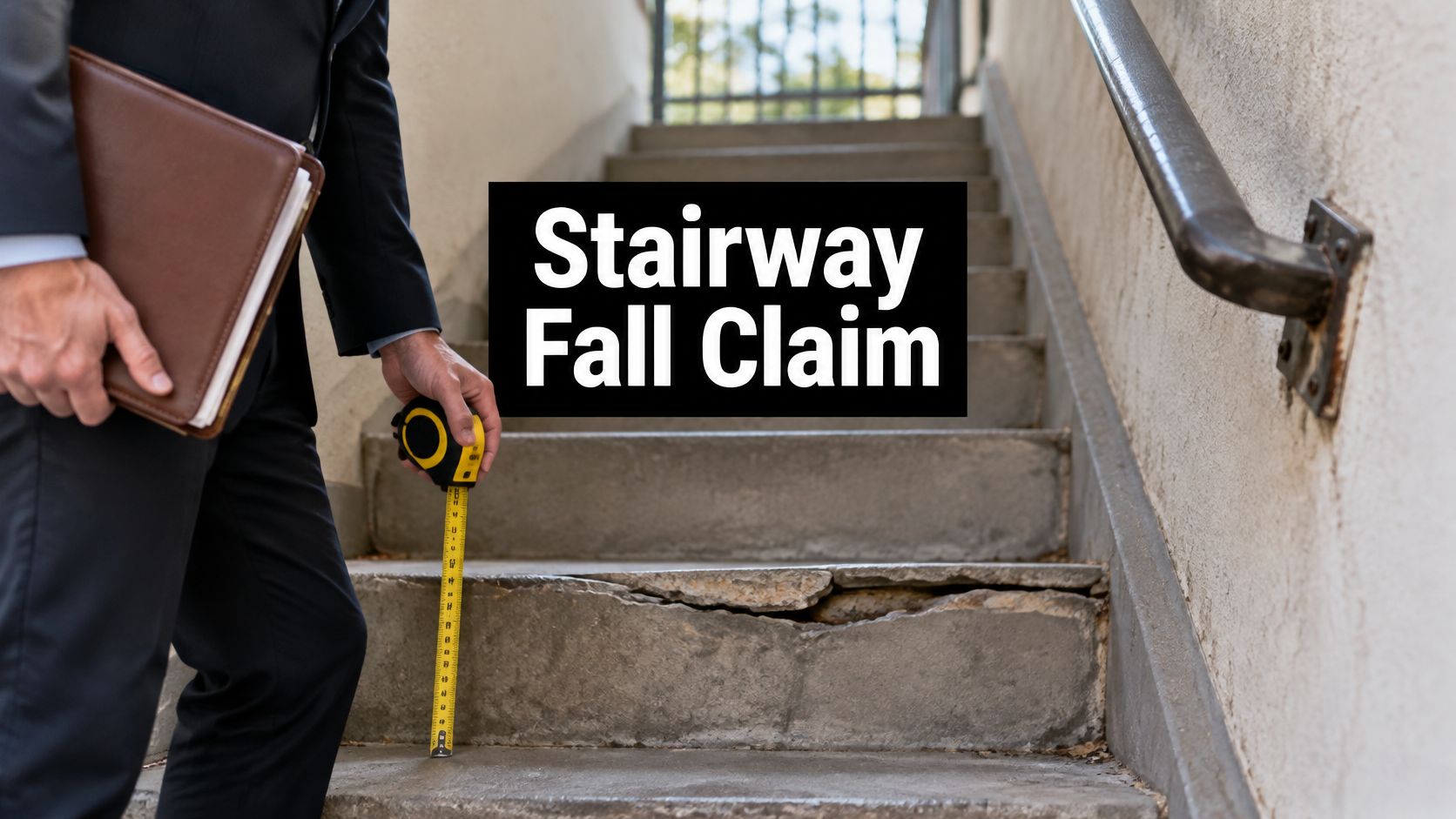
You’re home from the hospital after slipping on a worn apartment step, but you’re still trying to understand what happened. The stairs looked familiar, perhaps even ordinary. Now you have medical paperwork, missed work, and a question: was this a misstep, or did someone fail to keep the stairs reasonably safe?
A stairway accident lawyer looks beyond whether a step was visibly broken. Responsibility can turn on who controlled the stairway, how it was designed, what inspections would have revealed, and whether the evidence connects a particular condition to your injury.
Whether a Stairway Fall Can Support a Claim in California
A fall at a rental apartment, store entrance, or construction site can lead to a premises liability or negligence claim. An injury alone, however, doesn’t establish that someone else is legally responsible. The central question is whether a party responsible for the stairs failed to act reasonably and caused harm.
Start with control, not just ownership. A property owner might assign maintenance to a manager, while a commercial tenant might control the entrance customers use. Agreements, repair requests, and inspection records help identify who had responsibility.
Who may be responsible for a stairway fall
| Setting | Possible responsible party | Key question |
|---|---|---|
| Rental home or apartment | Landlord or property manager | Did they maintain, repair or warn about the stairs? |
| Store, restaurant or office | Business owner or operator | Was the defect known or discoverable with reasonable inspection? |
| Construction or renovation site | General contractor or subcontractor | Were temporary stairs and railings installed and kept safe? |
| Condo or apartment common area | HOA or building management | Who had maintenance responsibility for the stairs? |
| Public stairway | Government entity | Was a government claim notice filed within the required short deadline? |
Ownership doesn’t answer every question
Say a shop leases space in a larger building. The shop might manage its entrance, while building management handles a shared stairwell. A lawyer would examine the lease, maintenance arrangements, and actual practices rather than assume the business name on the door identifies the only potential defendant.
A fall on your own stairs can involve different questions, including whether someone else designed, installed, or repaired the condition. Shared spaces also require careful investigation. California’s broader premises liability framework provides context for evaluating those responsibilities.
Public property requires particular urgency. Claims against public entities generally require a formal government claim notice on a much shorter schedule than an ordinary private-property lawsuit, so don’t assume the usual filing process applies.
First practical step: Write down the exact location and identify who controlled the stairs when you fell, before signs, personnel, or property arrangements change.
This article is for informational purposes and must not be construed as legal advice. Reviewing it creates no attorney-client relationship, and none of the information in this article is legal advice.
Common Stairway Hazards and What Investigators Check
Unsafe walking surfaces create a substantial injury burden. In the United States, stairs, ramps, landings, and floors collectively account for more than 3.0 million emergency-department-treated injuries and over 7.7 million medically attended injuries annually, according to the U.S. Consumer Product Safety Commission’s injury report. These are broad walking-surface estimates, not a stair-only injury count.
Investigators need more than a statement that the stairs felt slippery or unusually steep. They need observations and measurements that can be compared with the rules applicable to that property.
Stairway hazards and the evidence to record
| Hazard | What to check | Evidence to record |
|---|---|---|
| Uneven or inconsistent risers | Uniform riser height and tread depth throughout the run. The OSHA marine-terminal fixed-stairway standard specifies a 30–50-degree slope for stairs installed after October 3, 1983. | Measurements of every riser and tread, plus photos with a tape in frame |
| Missing or loose handrail | Under OSHA’s construction stairway standard, at least one handrail for four or more risers or a rise exceeding 30 inches, whichever is less; handrail height generally 30–37 inches; resistance to at least 200 pounds of downward or outward force | Photos of continuity, height and anchorage, plus repair records |
| Stair strength | The marine-terminal standard cited above specifies support of at least 100 pounds per square foot plus a 300-pound concentrated load at the center of a tread | Inspection notes and photos of deflection, cracking or damage |
| Poor lighting | Light at the top and bottom, shadows across steps, and switch location | Photos taken at the time of day of the fall and bulb status |
| Worn, slick or wet treads | Surface finish, coating and moisture | Photos, weather records and cleaning logs |
| Low-contrast or hidden nosing | Edge marking and whether a small level change is visible from the approach | Photos from the approach angle |
| Obstructed or low-clearance steps | Objects on the stairs and clearance above the treads | Photos and clearance measurements |
| Missing warnings or closures | Signs, tape and whether an alternate route was blocked | Signage history and photos |
Measurements matter more than impressions
A riser is the vertical part of a step. A tread is the surface you stand on, and the nosing is its front edge. Measure the entire stair run because an inconsistent step can interrupt the foot placement established by the preceding steps.
The OSHA provisions above are context-specific standards, not universal requirements for every California home or public entrance. A qualified professional must separately identify the controlling state and local building requirements, construction history, and property use. Don’t attempt a handrail load test or structural test yourself.
For a practical introduction to repair-related concerns, the Binks Balustrades staircase safety guide can help readers recognize components worth documenting. It isn’t a substitute for a California code inspection.
Photographs taken before repairs, with a tape measure visible where safe, can be especially valuable. Include wider views so a close-up can be located within the stairway.
When Ordinary-Looking Stairs Can Still Support a Claim
Stairs don’t have to look broken to present a hazard. New Zealand’s official accessible-building guidance on stairs discusses air-step falls, where someone doesn’t perceive a small level change; UK government research described in that guidance reports that increasing tread depth from 250 mm to 300 mm could reduce stair-fall risk by up to 80%. That’s a design finding, not a prediction about an individual claim.
Age can also distract from the evidence. A CPSC report citing CDC figures found more than 18 million unintentional, nonfatal emergency-department-treated injuries among adults aged 65 and older during 2017–2020, approximately 4.6 million annually, with falls accounting for nearly two-thirds.
An ordinary appearance doesn’t establish safe design, and a person’s age doesn’t establish negligence.
A UK Health and Safety Executive report summarizes a U.S. analysis in which people aged 11–60 accounted for 67.2% of stair-related emergency-department visits, alongside Australian figures recording 16,316 hospitalizations for falls on stairs and steps, commonly involving hip or lower-limb injuries.
A working-age adult with a sprain, concussion, or missed work can still have meaningful losses. The inspection should examine perception, geometry, lighting, and handrail placement rather than stop at whether anyone previously complained.
This article is informational only, isn’t legal advice, and creates no attorney-client relationship.
How to Prove Negligence After a Stairway Fall
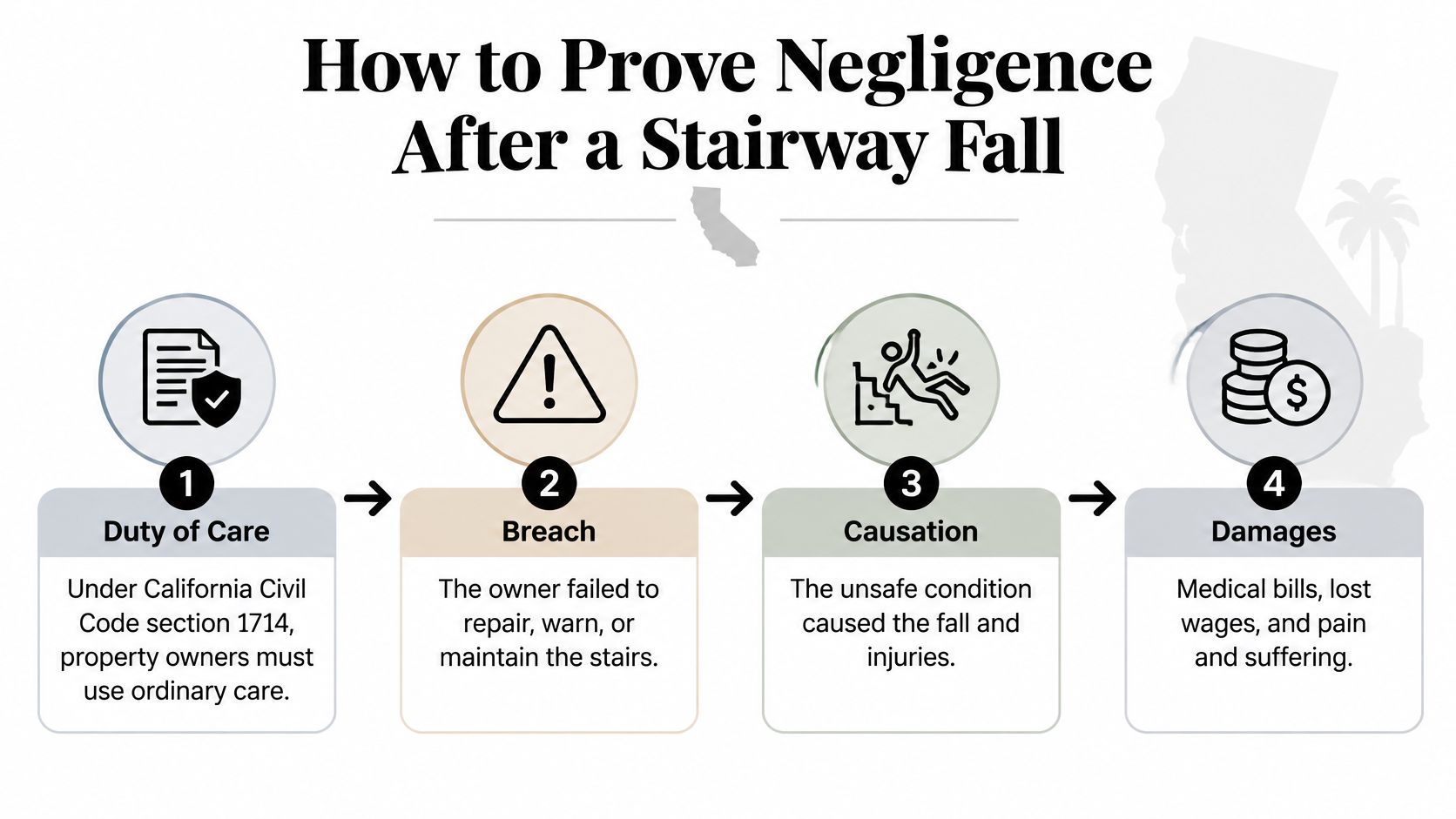
Under California Civil Code section 1714, people are generally responsible for injuries caused by a lack of ordinary care or skill in managing their property or themselves, while the injured person’s contributing conduct also matters. The statute supplies a general principle, not a stair-specific checklist.
The legal framework connects responsibility, unreasonable conduct, causation, and loss.
Build the proof in a clear sequence
-
Establish the duty. Identify who owned, occupied, controlled, or undertook maintenance of the stairway. A common gap is naming the building owner without investigating whether another party handled the relevant work.
-
Identify the dangerous condition. Describe the exact issue, such as an inconsistent riser, loose rail, shadowed landing, or slippery coating. A photograph showing only the staircase as a whole may miss the condition that matters.
-
Show knowledge or constructive knowledge. Prior complaints, repair requests, inspection records, and evidence of how long a condition existed can show what the responsible party knew or reasonably should have discovered. A missing complaint isn’t necessarily decisive, particularly when the claim concerns original construction or a condition the defendant created.
-
Connect the condition to the fall. Explain how your foot slipped, caught, or missed support and how that movement matches the physical evidence. Witness accounts and expert measurements help address gaps when nobody photographed the step before repair.
-
Document the damages. Connect the incident to diagnosed injuries, treatment, work restrictions, and other losses. Missing follow-up records can leave unanswered questions about whether continuing symptoms resulted from the fall.
Separate a safety violation from a complete case
A code violation may support an argument that someone failed to use reasonable care. It doesn’t automatically prove that the violation caused your injury or establish every other element. Conversely, code compliance doesn’t necessarily resolve whether the conduct was reasonable under the circumstances.
The same distinction explains why an engineering inspection can matter even when photographs look unremarkable. Ask the lawyer whether technical analysis is warranted, who would advance inspection costs, and how those expenses would be treated under the representation agreement.
For additional context, this explanation of proving negligence in a slip-and-fall claim describes how evidence supports the legal elements. This article provides information only, not legal advice, and reviewing it creates no attorney-client relationship.
Evidence to Preserve in the First 30 Days
Start with medical care and personal safety. Don’t return to dangerous stairs, climb while injured, or delay treatment to collect photographs. A trusted person can help document the scene when it’s safe and lawful.
Repairs, replaced bulbs, and unavailable witnesses can make an investigation harder. The first month is an organizing window, not a reason to postpone action or a substitute for checking legal deadlines.
Keep the scene and treatment records together
-
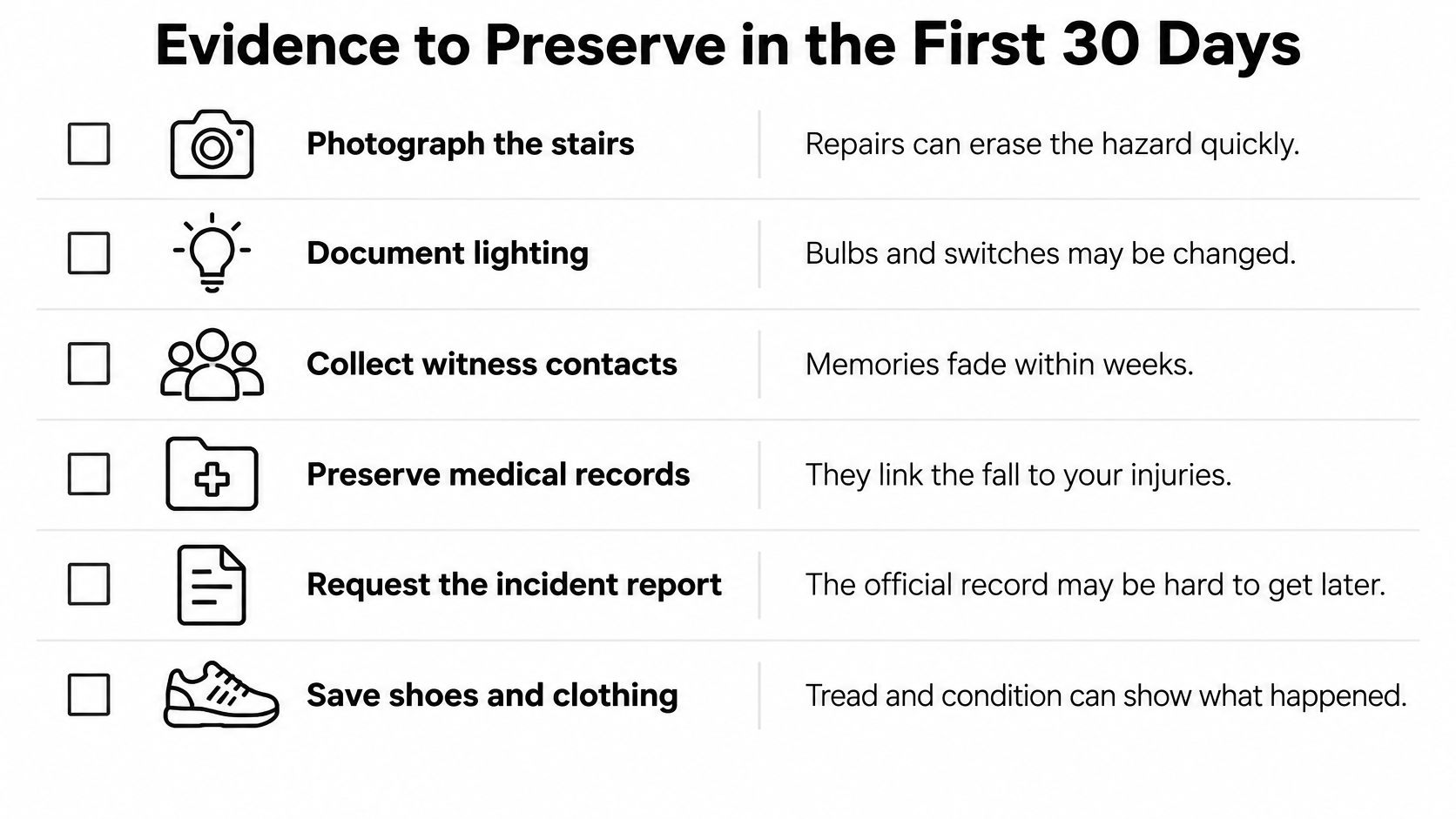
Photograph the stairs from the approach, top, and bottom. Include the defect, handrail, lighting, and safe tape-measure views, because close-ups taken after repairs may not establish the original condition.
-
Write down the circumstances. Record the exact time, weather, footwear, clothing, and anything you were carrying so later recollections don’t omit details relevant to balance or visibility.
-
Collect witness and staff contacts. Get names and reliable contact information, since a description such as the cashier on duty may not identify someone later.
-
Request the incident report. Keep your copy or note who declined to provide it, rather than assume reporting the fall guarantees access to the business’s records.
-
Preserve medical paperwork. Save urgent-care records, prescriptions, bills, discharge instructions, and follow-up notes because a bill alone may not explain the diagnosis or restrictions.
-
Save shoes and clothing. Keep them in their post-fall condition without cleaning or repairing them, so their condition remains available for inspection.
-
Keep a factual daily journal. Note pain, sleep problems, missed tasks, and work limitations; vague summaries written much later are less useful than specific contemporaneous notes.
-
Request preservation in writing. Ask for maintenance, inspection, prior-complaint records, and relevant surveillance footage to be preserved, and save replies; a request doesn’t guarantee voluntary production.
-
Avoid altering the evidence or publishing detailed accounts. Don’t repair or clean the stairs yourself, and don’t post speculation online that could create unnecessary factual disputes.
The visual checklist highlights the core items to organize.
Preservation habit: Keep original image files and messages, not just cropped screenshots. Store a backup and retain the dates attached to the files.
How Comparative Fault Can Reduce Your Recovery
An insurer may argue that you ignored a visible condition, used the stairs improperly, or failed to follow a warning. An allegation isn’t proof, and contributing to an accident doesn’t automatically mean you have no claim.
How someone used the handrail and approached the steps can become part of that factual dispute.
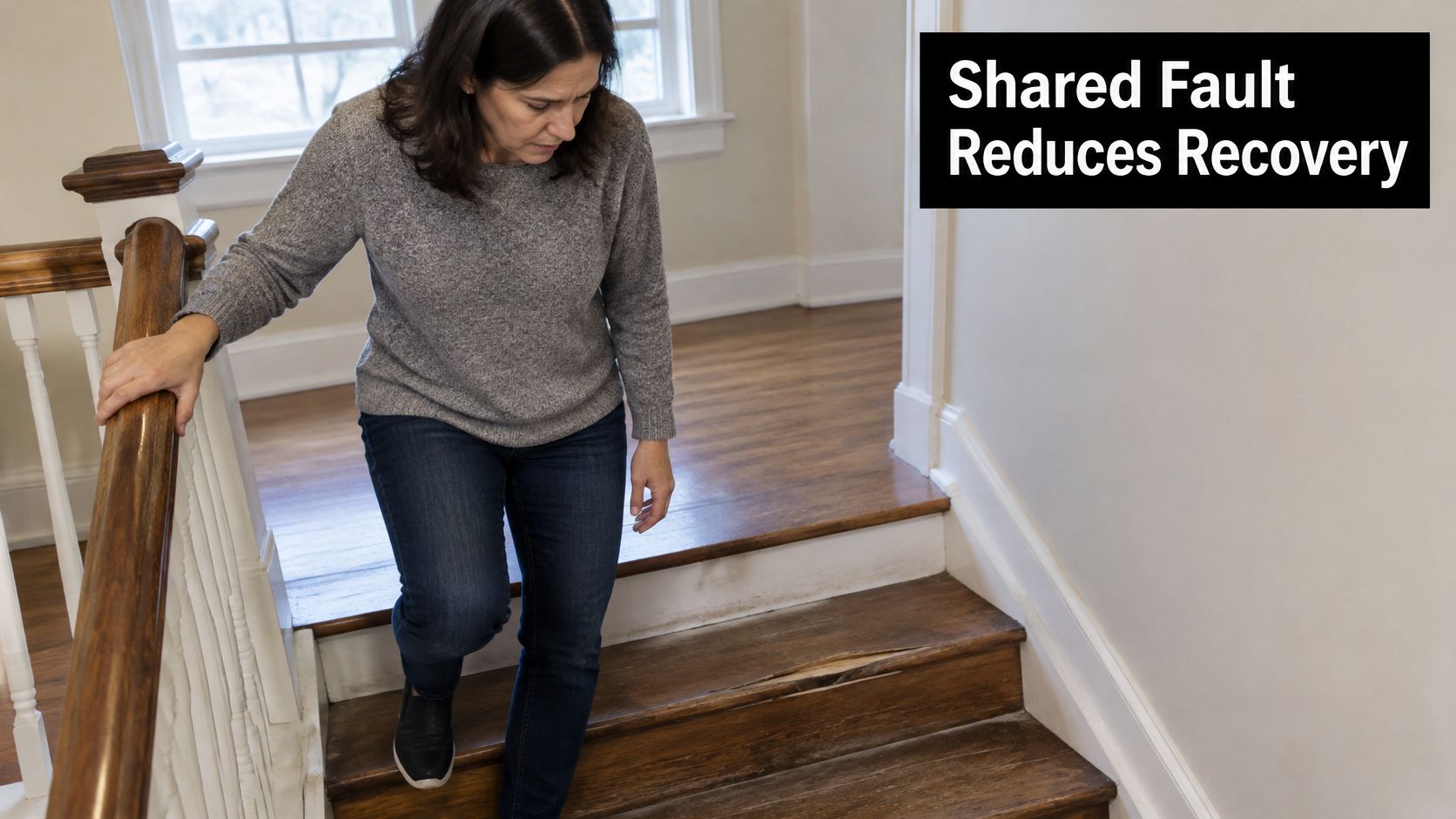
Under the Judicial Council’s civil jury instructions, CACI No. 405, the defendant must prove that the injured person was negligent and that this negligence was a substantial factor in causing the harm; proven responsibility reduces damages proportionately, while CACI No. 406 addresses related apportionment involving multiple responsible parties.
A hypothetical reduction
Suppose damages are assessed at $100,000, and the injured person is assigned 20% responsibility. The hypothetical reduction is $20,000, leaving $80,000, before any other applicable adjustments. These figures illustrate the calculation, not an expected recovery.
A warning’s presence also doesn’t settle what happened. Its location, visibility, wording, and relationship to the actual hazard matter. A sign at another entrance may tell a different story from a clearly visible closure at the stairway.
For video context, consider these issues alongside the specific evidence from your fall.
Give a complete account, including difficult details
Bring the lawyer an honest description of what you saw, where you were looking, whether you used a handrail, and what warnings were present. Don’t omit a phone, carried item, or distraction because you’re worried it will end the case. Your lawyer needs those facts to evaluate the opposing argument.
California’s pure comparative negligence framework makes the allocation of responsibility important, rather than treating any personal mistake as an automatic bar. This article is informational, isn’t legal advice, and creates no attorney-client relationship.
What Compensation May Cover in a Stairway Case
Compensation depends on the injury, the proof, and the case’s facts. A stairway accident lawyer can evaluate supported losses, but no outcome or settlement amount can be promised.
Damage categories and the proof that supports them
| Damage category | What it covers | Proof that supports it |
|---|---|---|
| Medical bills | Emergency care, surgery, hospital stays and follow-up visits | Itemized bills, treatment notes and receipts |
| Rehabilitation and devices | Physical therapy, prescriptions, crutches or mobility aids | Therapy records, pharmacy receipts and device invoices |
| Lost wages | Missed work and reduced earning ability | Pay stubs, employer letter and tax records |
| Future medical care | Expected treatment needed after the claim is resolved | Medical opinion on future needs and costs |
| Pain and suffering | Physical pain, emotional distress and reduced quality of life | Daily journal, testimony from family and treating doctors |
| Property damage | Damaged phone, glasses, clothing or other personal items | Receipts, photos and replacement estimates |
Match each loss to its supporting record
Economic damages concern financial losses, including treatment expenses and lost earnings. Keep the bill and the related treatment note together: the bill shows the charge, while the note helps explain why care was needed.
Reduced earning capacity requires more than showing that you missed a shift. Evidence may need to explain how lasting restrictions affect the work you can perform. Future care likewise needs a medical basis, not a personal estimate of what treatment might eventually cost.
Non-economic damages address experiences such as physical pain, emotional distress, and reduced quality of life. Concrete examples help: needing assistance to shower, being unable to carry groceries upstairs, or giving up a routine activity because of symptoms.
Don’t dismiss symptoms that become clearer later
Concussion symptoms, back problems, and nerve complaints may not be fully understood during the initial visit. Seek appropriate medical assessment for new or worsening symptoms and accurately describe when they began. Prompt documentation helps clinicians evaluate the condition and helps distinguish accident-related complaints from unrelated problems.
An insurer may point to limited emergency treatment or an early return to work as evidence that an injury was minor. Records explaining modified duties, persistent symptoms, and ongoing treatment can provide a fuller picture.
Claim value turns on causation, documentation, and impairment, not age or hospitalization alone. This information isn’t legal advice, and reviewing it doesn’t create an attorney-client relationship.
Decide When to Contact a Stairway Accident Lawyer
California generally applies a two-year filing deadline from the injury date to personal-injury claims under Code of Civil Procedure section 335.1, according to the California courts’ statute-of-limitations guidance. Exceptions and specialized procedures can change the analysis, and a public-entity case requires prompt attention to its separate government claim deadline.
Don’t wait for treatment to finish before asking about deadlines. Missing a required filing can prevent an otherwise supportable case from proceeding.
Reasons to seek an early review
- Ongoing or serious injuries: You need help evaluating medical documentation and potential future losses.
- A recorded-statement request: An insurer wants a detailed account before you understand the condition or your injuries.
- Disputed responsibility: The owner blames you or another contractor.
- Missing records: Management refuses information or repairs the stairs before inspection.
- Public property: A government entity may control the location.
Bring photographs, witness names, the incident report, medical records, bills, and a short written account to the first meeting. Include any messages identifying who handled repairs or received complaints.
LA Law Group, APLC is one option. Our first consultation is free and confidential, and it’s held with the attorney who will handle the matter. Submitting our website contact form doesn’t create an attorney-client relationship.
Gather your evidence, write down the injury date and the deadline that needs legal confirmation, and arrange a consultation. This article is for informational purposes only, must not be construed as legal advice, and creates no attorney-client relationship.
At LA Law Group, APLC, we offer a free, confidential attorney consultation to review a stairway fall and explain your claim options in plain language. Bring your photographs, treatment records, and account of what happened so we can discuss responsibility, evidence, and the next steps.
Attorney Advertising. This article is general information, not legal advice, and does not create an attorney-client relationship. Prior results do not guarantee a similar outcome.