
U Turn Accidents
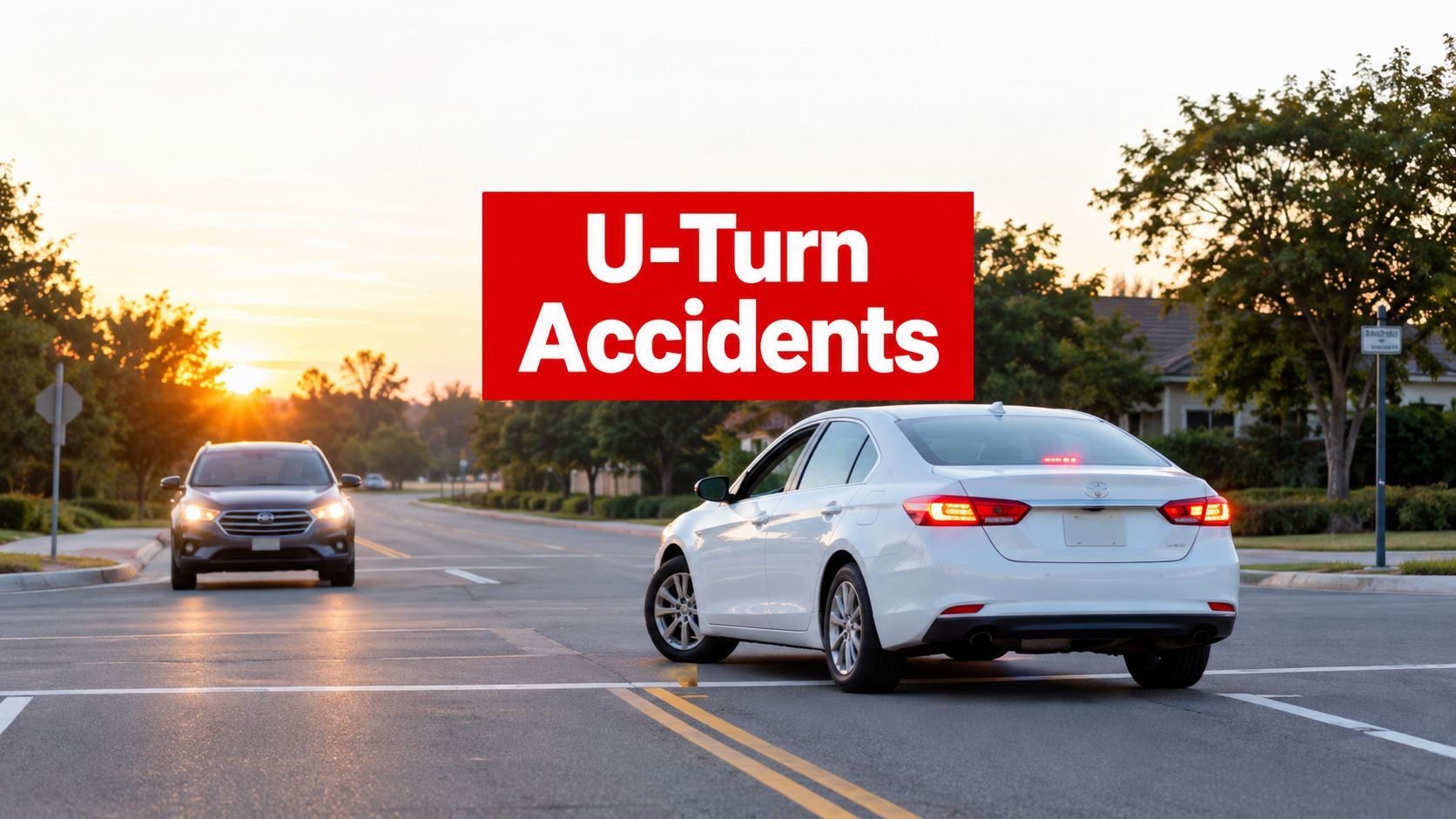
You’re probably reading this with a damaged vehicle, a sore neck, and an insurance adjuster asking for your version of events. The other driver may be insisting that you “came out of nowhere.” Your own insurer may be treating the crash as a simple right-of-way dispute. That summary is often wrong.
In U-turn accidents, the turning driver frequently faces the strongest initial presumption of fault. But the presumption isn’t the final answer. Speed, distraction, visibility, lane position, signage, road design, braking, and the quality of the evidence can shift responsibility between drivers. The practical question isn’t merely who had the right of way. It’s which driver created which part of the danger, and what proof establishes it.
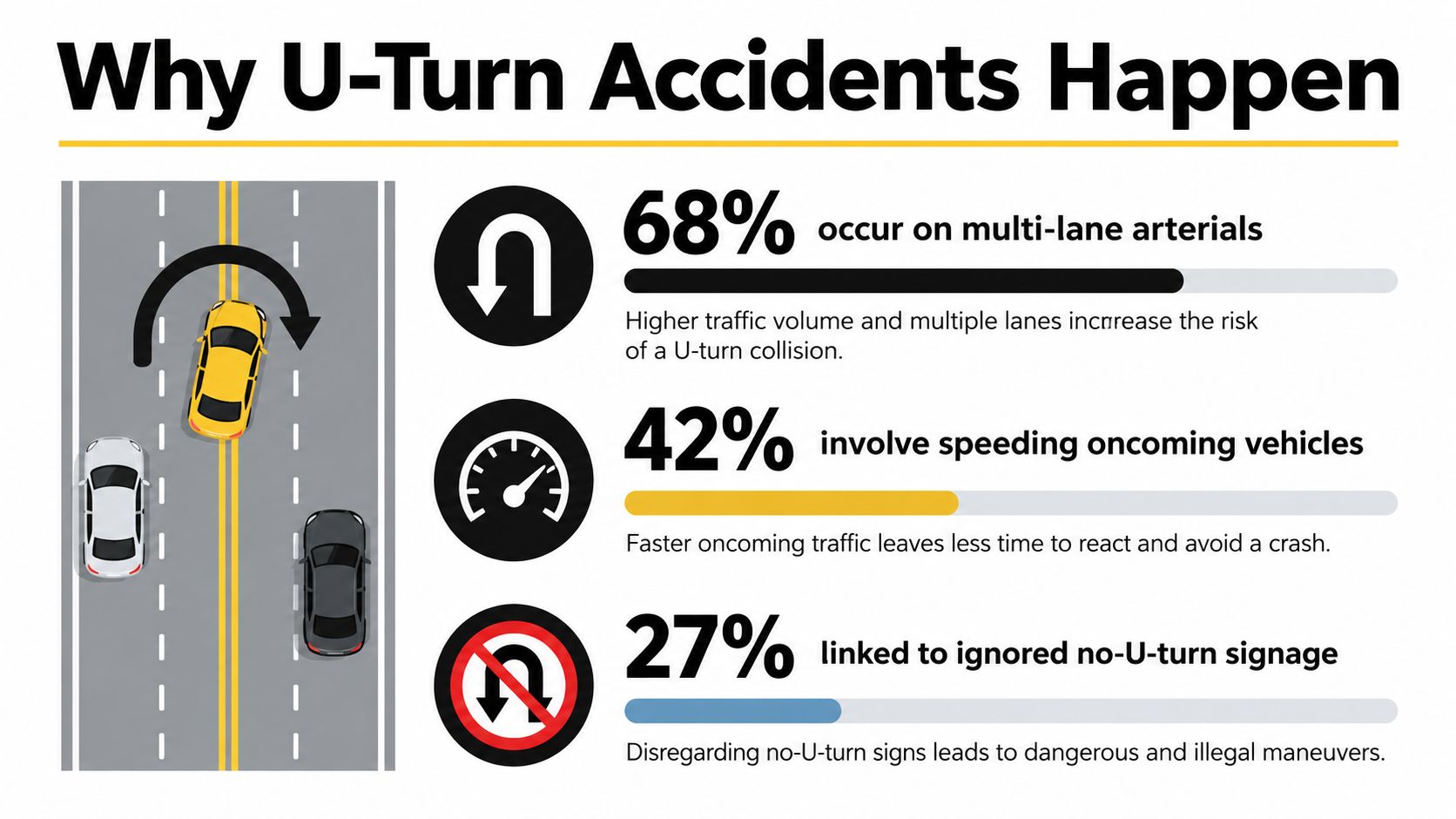
Why U-Turn Accidents Happen the Way They Do
A driver begins swinging across a busy arterial, believing the approaching gap is large enough. An oncoming vehicle reaches the turn sooner than expected and strikes the turning car’s side or front corner. Another driver behind the oncoming vehicle brakes hard and collides with the vehicle ahead. A third vehicle may be clipped when the U-turn arc drifts into an adjacent lane.
Those are different crash mechanisms, and they can produce different liability arguments.
The impact pattern matters
Angle impacts often happen when the turning driver crosses into the path of oncoming traffic. The turning vehicle may be moving slowly, but the approaching vehicle’s speed and the angle of contact can create substantial forces. Damage to a front corner, side doors, or a rear quarter panel can help reconstruct where each vehicle was during the turn.
Rear-end collisions are more complicated than they first appear. A vehicle making a U-turn may slow or stop in an unexpected location. The following driver still has a duty to maintain a safe following distance and react reasonably, but the turning driver may also have created an unusual obstruction by beginning an unsafe maneuver.
Sideswipes commonly occur when a turning vehicle swings wide, crosses lane lines, or fails to complete the arc within the available roadway. The damage may show that the vehicles were traveling beside one another rather than approaching head-on.
A major study of signalized intersections found that 65 of 78 sites had no U-turn collisions during a 3-year observation period. The 13 sites that did have crashes recorded 41 U-turn collisions, including 22 angle crashes, 11 rear-end crashes, and 8 sideswipes. Sites with double left-turn lanes, protected right-turn overlap, or high conflicting volumes recorded significantly more U-turn crashes.
Road design can change the risk
The maneuver isn’t automatically the villain. A roadway with poor sight distance, tight turning space, closely spaced driveways, or heavy conflicting traffic creates a different risk than a purpose-built median opening. A Texas A&M Transportation Institute presentation on U-turn safety reports that the presence of a U-turn wasn’t a critical variable in crash frequency, while crash risk fell as turning radius increased and as the distance to the nearest downstream driveway increased.
That’s why a proper investigation compares the turn to the actual roadway. A useful overview of broader causes of car accidents can provide general context, but a U-turn claim requires scene-specific analysis.
What to Do in the Minutes After a U-Turn Crash
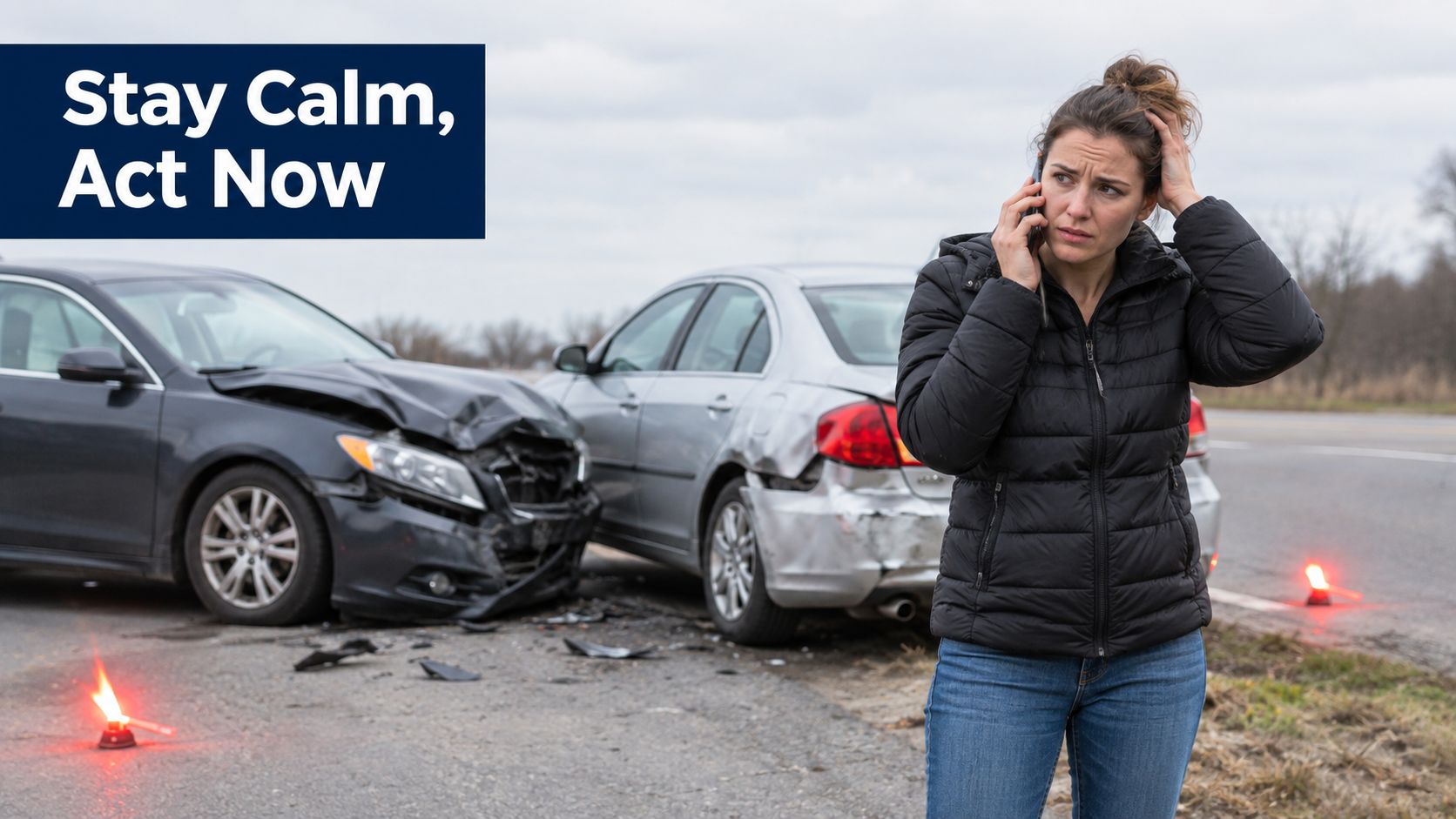
Your first job is safety, not building a legal case. If the vehicles can be moved without exposing anyone to traffic, move them to a safe location. If someone is injured, traffic is moving quickly, or the vehicles are disabled, stay put unless emergency personnel direct you otherwise.
Call 911. Ask for medical assistance if anyone has pain, dizziness, bleeding, numbness, confusion, or difficulty moving. Even if the damage looks minor, report the collision and request an evaluation. A person who feels fine at the scene may develop symptoms later, and refusing care can give an insurer an argument that the injury wasn’t serious or wasn’t related to the crash.
Protect the scene without creating another hazard
If it’s safe, photograph the vehicles before they’re moved. Capture the intersection, median opening, lane lines, traffic signs, debris, skid marks, and each vehicle’s position. Don’t stand in a live lane to get a better picture. Ask a passenger or witness to help if you’re hurt.
A police report matters in U-turn cases because the officer may document the turning path, vehicle positions, visibility, traffic controls, and signage before the scene changes. The report isn’t automatically the final word on civil liability, but it can become an important early record.
A foundational access-management study identified 7,717 median-opening-related accidents at 668 median openings. Only 79 crashes, or 1.1%, specifically involved U-turns, while U-turns accounted for 18% of three-leg intersection accidents and 23% of four-leg intersection accidents in the analyzed sample. The point is practical: the precise location can matter as much as the maneuver.
Keep your statements narrow
Exchange names, contact details, insurance information, driver’s license information, and vehicle details. Don’t apologize, speculate, or say, “I didn’t see you,” even if you’re shaken. Tell the other driver and the officer what you know, not what you’re guessing.
At the scene: Say that you’re willing to provide factual information, but don’t decide fault while injured, frightened, or standing beside damaged vehicles.
Evidence That Decides U-Turn Accident Claims
Insurance companies decide U-turn claims through evidence, not confidence. The driver who speaks most forcefully at the scene doesn’t necessarily have the stronger case. Your goal is to preserve proof of legality, visibility, movement, impact, and injury.
Build the liability file immediately
Start with scene photographs. Take wide images showing the full intersection and closer images showing signs, lane markings, the median opening, obstructions, lighting, and sight lines. A sign proving that U-turns were prohibited can support a negligence argument. A photograph showing that a sign was hidden, missing, or positioned away from the driver’s approach can change the analysis.
Save dashcam footage in its original format. Don’t rely on a clip stored only in an app that may overwrite older files. Look for nearby businesses, apartment buildings, traffic cameras, or homes that may have captured the approach and impact. Request preservation quickly because surveillance systems routinely overwrite footage.
Match each item to the question it answers
- Scene photos: Establish signage, road markings, visibility, lane configuration, debris, and vehicle positions.
- Video: Shows timing, turn-signal use, speed, braking, lane changes, and whether a driver entered the roadway suddenly.
- Witness details: Provide independent accounts of the gap, approach speed, visibility, and impact sequence.
- Vehicle damage: Helps identify the direction and angle of contact. Photograph damage before repairs and retain detailed repair records.
- Medical records: Connect symptoms, treatment, and functional limitations to the collision. Seek evaluation promptly and describe symptoms accurately.
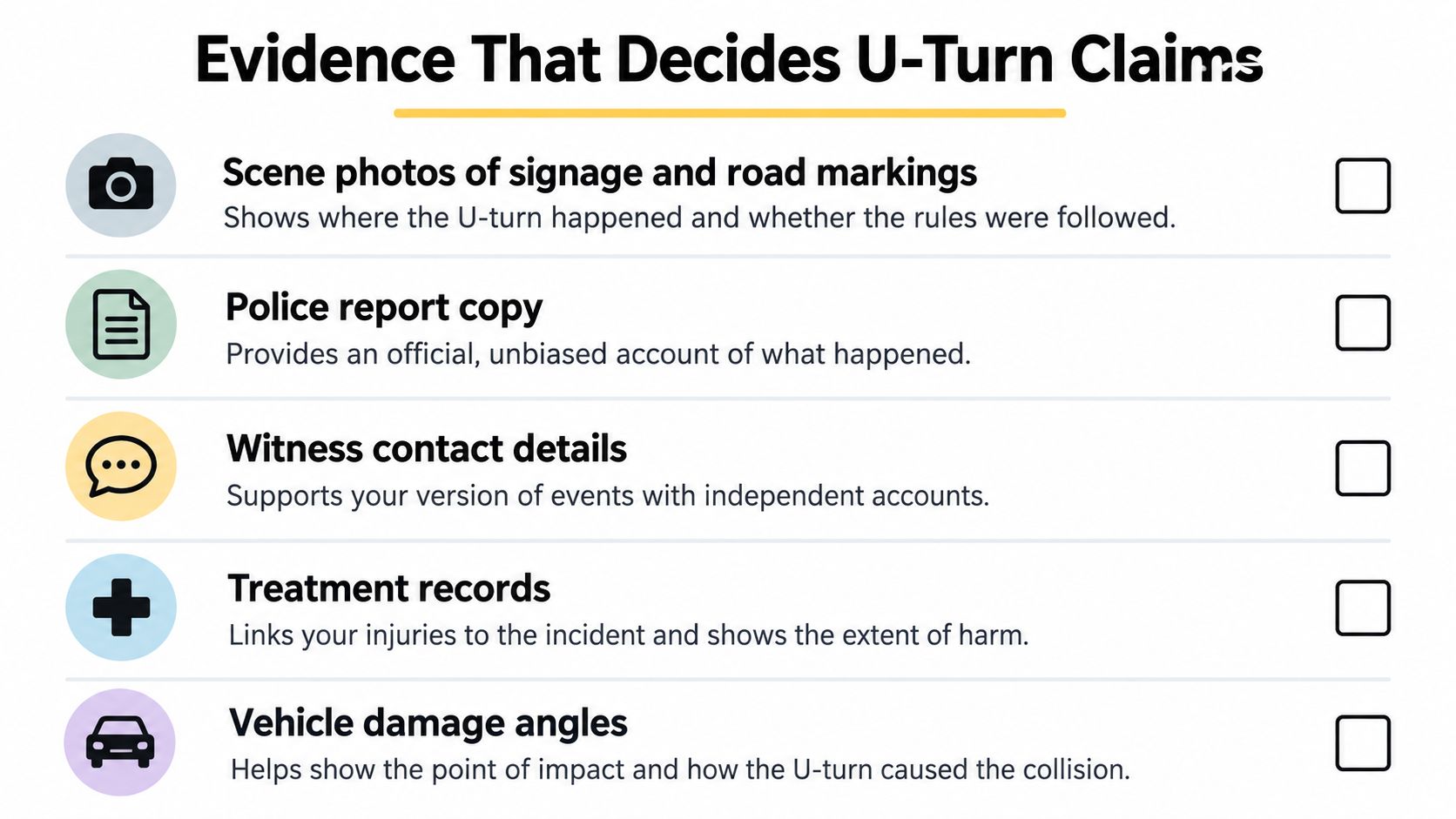
Request the police report and read it carefully. If it contains a material error about the lane, traffic control, impact location, or your statement, ask how to submit a correction or supplement. Don’t assume an inaccurate diagram will fix itself.
You can use this guide on how to get a police report to identify the correct agency and request process. Keep copies of the report, photographs, videos, witness information, towing records, repair estimates, medical bills, treatment notes, and wage documentation in one chronological file.
Evidence priority: Preserve disappearing evidence first. A nearby camera may erase footage, but your medical provider can continue documenting treatment.
Who Is Really at Fault in a U-Turn Collision
The honest starting point is that the U-turning driver is often presumed mostly at fault. That driver chose to cross or reverse direction through traffic and generally must confirm that the movement is safe. But a presumption isn’t a substitute for a comparative-negligence analysis.
California claims can involve fault assigned to more than one person. An approaching driver who was speeding, distracted, following too closely, or failed to brake or evade may have contributed to the collision. A U-turn can also be technically permitted and still negligent if the driver had inadequate visibility, entered an unsafe gap, or interfered with traffic.
Right of way is only part of the analysis
Consider a turning driver who begins the maneuver with a reasonable gap, then an approaching motorist accelerates substantially and reaches the opening sooner than expected. Video, event data, independent witnesses, and damage patterns may support shared responsibility.
Now change the facts. The turning driver starts from a hidden driveway, crosses several lanes without a clear view, and is struck by a vehicle traveling at an ordinary speed. The legal location may not save the turning driver. The unsafe execution is the central issue.
A rear-end collision requires the same care. The following driver must watch traffic and maintain control, but the turning driver may bear responsibility if the vehicle stopped unexpectedly in a travel lane without a safe reason. The answer depends on timing, signals, lane position, braking distance, and what each driver could reasonably observe.
It also emphasizes that legality varies by state, municipality, signage, and intersection design.
How Fault Typically Shifts in U-Turn Crashes
| Crash Scenario | Typical Fault Allocation | Deciding Evidence |
|---|---|---|
| Turning driver crosses into visible oncoming traffic | Greater responsibility usually falls on the turning driver | Dashcam footage, sight distance, lane positions, impact damage |
| Approaching driver speeds up or drives while distracted | Responsibility may be shared | Video, witness accounts, phone evidence when lawfully obtained, vehicle data |
| U-turn is permitted but begins from a blind or obstructed position | Turning driver may remain responsible despite legal location | Photographs, measurements, road design, obstruction evidence |
| Following driver hits a slowing turning vehicle | Liability depends on both drivers’ reactions | Brake marks, signal evidence, spacing, video, vehicle damage |
| Another vehicle changes lanes into the turning arc | Fault may shift toward the lane-changing driver or be divided | Surveillance, lane markings, witness accounts, damage location |
The insurer’s question shouldn’t be “Who had the right of way?” It should be, “What did each driver see, what did each driver do, and what action would have prevented the impact?”
Where U-Turns Are Legal and Where They Are Not
U-turn rules depend on the state, city, signs, intersection design, and roadway markings. Don’t assume that the absence of a “No U-Turn” sign makes the maneuver safe or lawful. A permitted location still requires a safe turn that doesn’t interfere with traffic.
Common prohibitions include U-turns where a sign bans them, on one-way streets, near fire stations, at railroad crossings, and on divided highways unless a designated opening or lane permits the movement. The summary of common U-turn restrictions is useful for general orientation, but local law controls your claim.
California’s rules create concrete questions
In California, a driver attempting a U-turn must yield to oncoming traffic and pedestrians.
Those requirements create evidence questions:
- Was the driver in the far-left lane?
- Could the driver see approaching vehicles for the required distance?
- Did a hill, curve, landscaping, parked vehicle, sign, or large truck block the view?
- Was a pedestrian already crossing?
- Did the driver yield before beginning the turn?
- Did the other vehicle approach at a speed that made the gap misleading?
A violation can strengthen the other driver’s negligence argument, but it doesn’t automatically decide every civil claim. The violation still must connect to the collision and the claimed injuries. Likewise, compliance with a sign or lane rule doesn’t excuse a turn that was visibly unsafe in the circumstances.
Lawful doesn’t mean automatically careful
A driver may have permission to make a U-turn at a particular opening and still misjudge traffic. Conversely, an approaching driver may have the right to continue forward but still share responsibility for excessive speed, distraction, or an unreasonable failure to react. Photograph the actual roadway rather than relying on memory. Rules apply to the roadway that existed at the time, including temporary construction, altered lanes, and obstructed signs.
Filing a Claim After a U-Turn Accident
Notify your insurer promptly, but keep the first report limited to the basic facts. Identify the date, location, vehicles, and known injuries. You don’t have to guess about fault, estimate distances, or give a recorded statement before you understand the evidence and your medical condition.
An adjuster may ask for a recorded interview or broad medical authorization early. Don’t sign away unrestricted access to your medical history without understanding what records are being requested and why. A request that reaches unrelated medical information can create unnecessary disputes about conditions that have nothing to do with the crash.
Organize the claim around proof
Create a chronology beginning with the collision. Include emergency care, follow-up visits, prescriptions, therapy, work restrictions, missed work, vehicle repairs, towing, storage, rental transportation, and out-of-pocket expenses. Keep receipts and identify the provider, date, charge, and reason for each expense.
Use this guide on filing a personal injury claim as a general organizational reference. A demand package should connect the facts rather than attach a pile of records. Explain where each vehicle was, why the turn was unsafe or why the approaching driver contributed, what treatment followed, and how the injuries affect daily activities.
Expect the predictable arguments
The insurer may argue that you should have seen the turning vehicle, had enough time to brake, or caused the crash by changing lanes. Those arguments may matter, but they require factual support. Ask what evidence proves the claimed sight distance, speed, reaction time, and lane position.
Don’t accept a quick settlement before your medical condition and liability evidence are reasonably understood. Once you sign a release, you may lose the ability to pursue additional compensation connected to the collision. Write down every call, preserve every letter, and communicate important facts in writing.
Practical rule: Don’t negotiate a shared-fault claim from memory alone. Build the timeline, preserve the scene evidence, and respond to each liability argument with a document or witness.
Getting Legal Help and Moving Forward With Confidence
Some claims can be handled without a lawyer when the injuries are minor, fault is clear, the insurer accepts responsibility, and the damages are easy to document. That changes quickly when the other driver blames you, the insurer disputes causation, treatment continues, or the crash involves serious injuries or a commercial vehicle.
An attorney earns a role by testing the fault story. That may involve inspecting the intersection, preserving surveillance, reviewing the police report, analyzing vehicle damage, identifying witnesses, gathering medical records, and negotiating the percentage of fault assigned to each driver. The lawyer also handles communications that can otherwise pressure an injured person into an incomplete statement or premature settlement.
Use this decision checklist
- Review the scene: Confirm the signs, lanes, median opening, sight distance, and traffic controls.
- Preserve the proof: Save video, photographs, witness details, reports, repair records, and medical documentation.
- Track the harm: Record treatment, symptoms, work restrictions, expenses, and changes to daily life.
- Assess the dispute: Get legal advice if the insurer denies liability, assigns fault to you, or offers a settlement before your condition is clear.
- Protect deadlines: Local filing deadlines and procedural requirements can control your rights, so don’t wait until evidence has disappeared.
Ask for those terms in writing before hiring anyone.
This article is for general informational purposes only. It isn’t legal advice and shouldn’t be construed as legal advice. The law may change, local rules may differ, and no attorney-client relationship exists based on your review of this article.
If you were injured in a California U-turn collision, LA Law Group, APLC offers personal injury representation that includes investigating the crash, dealing with insurers, negotiating shared-fault disputes, and pursuing litigation when appropriate. Visit LA Law Group, APLC for a free initial consultation and a direct assessment of your accident claim.
Attorney Advertising. This article is general information, not legal advice, and does not create an attorney-client relationship. Prior results do not guarantee a similar outcome.