
Uber Passenger Accident Claim: California Guide
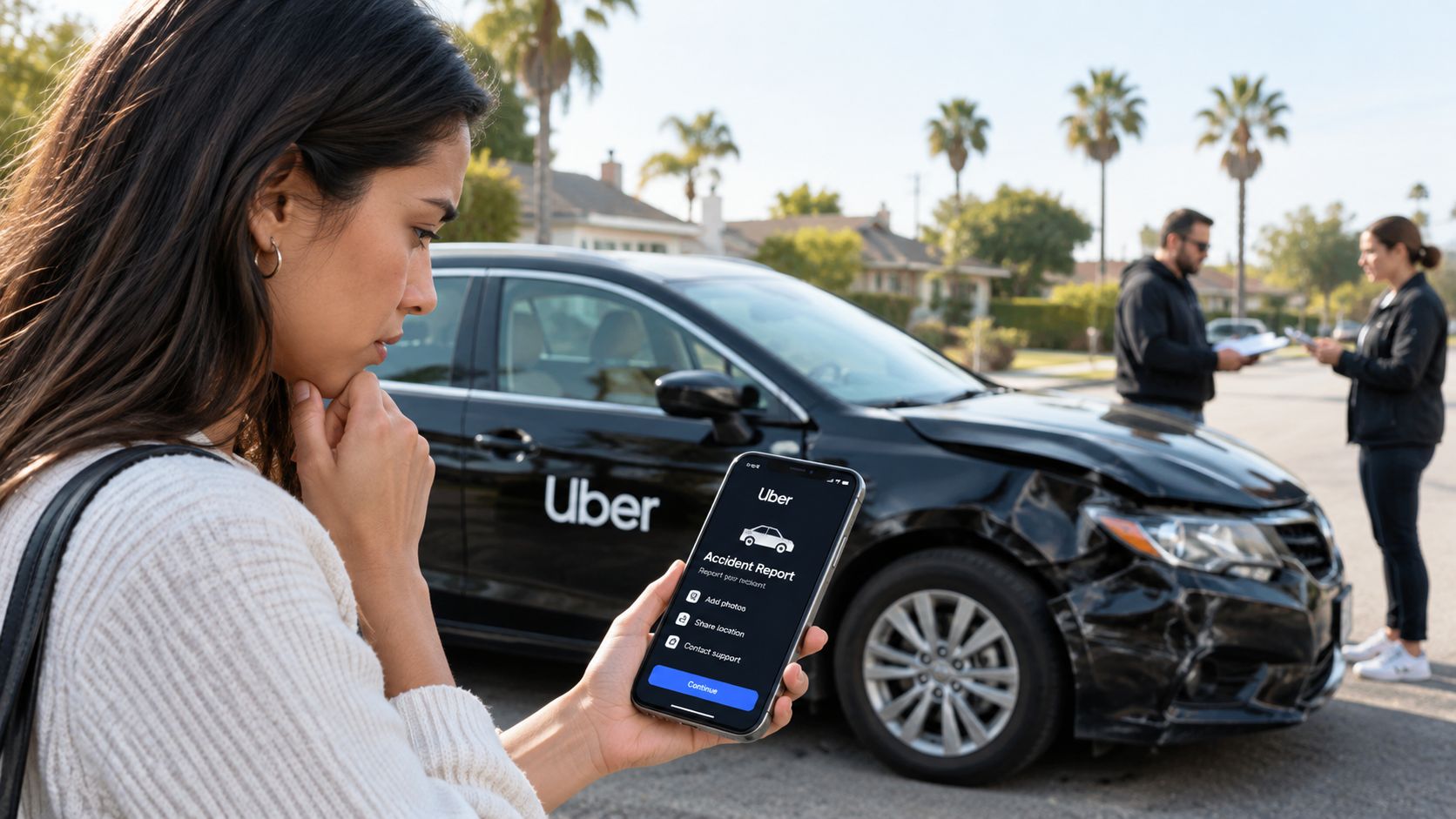
You’re sitting in the back seat when another car hits your Uber. Your neck hurts, the driver is asking whether you’re okay, and your phone is filling with questions you can’t answer. Reporting the crash in the Uber app feels like the obvious next step. It’s necessary, but it isn’t the same as pursuing an injury claim.
A California Uber passenger accident claim turns on details most passengers never see, especially the driver’s exact app status when the collision occurred. The available insurance can change sharply between a driver waiting for a request and a driver transporting you. Preserve the evidence, get medical care, and treat the insurer’s process as a legal claim, not a customer-service ticket.
Immediate Actions After an Uber Crash
Safety comes first. If you can move without worsening an injury, get out of immediate traffic danger. Call 911, request medical assistance, and make sure law enforcement receives an accurate account of the collision. A police report creates an official record, but it doesn’t decide fault or guarantee compensation.
You should also report the crash through Uber’s app or Safety Toolkit. Uber’s guidance tells riders to call 911, report the incident, and submit a claim through its reporting channels. Keep the police report number, because the insurer will use the initial incident information to begin its investigation.
What to collect at the scene
Gather information before witnesses leave and before vehicles are moved, if doing so is safe:
- Driver details: Record the Uber driver’s name, vehicle information, license plate, and insurance information.
- Other motorists: Obtain the names, contact details, and insurance information for every other driver involved.
- Witnesses: Ask independent witnesses for their names and phone numbers. Their observations may matter if the drivers later tell conflicting stories.
- Photographs: Photograph the damage to every vehicle, the roadway, traffic controls, visible injuries, and the surrounding conditions.
- Trip records: Save the Uber receipt, pickup and drop-off information, route, and timestamps. Don’t assume Uber will preserve every detail indefinitely.
Don’t argue about fault at the scene. Don’t tell the driver, “I’m fine,” if you’re shaken or hurt. Use accurate, limited language such as, “I’m experiencing pain and I’m going to be evaluated.” Avoid posting about the crash or your injuries on social media.
Practical rule: Cooperate with emergency personnel, but don’t speculate about speed, fault, or the seriousness of your injuries.
Seek medical evaluation promptly, even if the pain seems manageable. Some injuries become more apparent after the adrenaline wears off. Follow the treatment plan and tell each provider that the symptoms began after the collision.
For a broader checklist of early decisions, review the first 72 hours after a car accident. Understand this disclaimer: this article is for informational purposes only and is not to be construed as legal advice. No attorney client relationship exists based on the review of this article, and none of the information in this article is legal advice.
Gathering Evidence and Documenting Medical Care
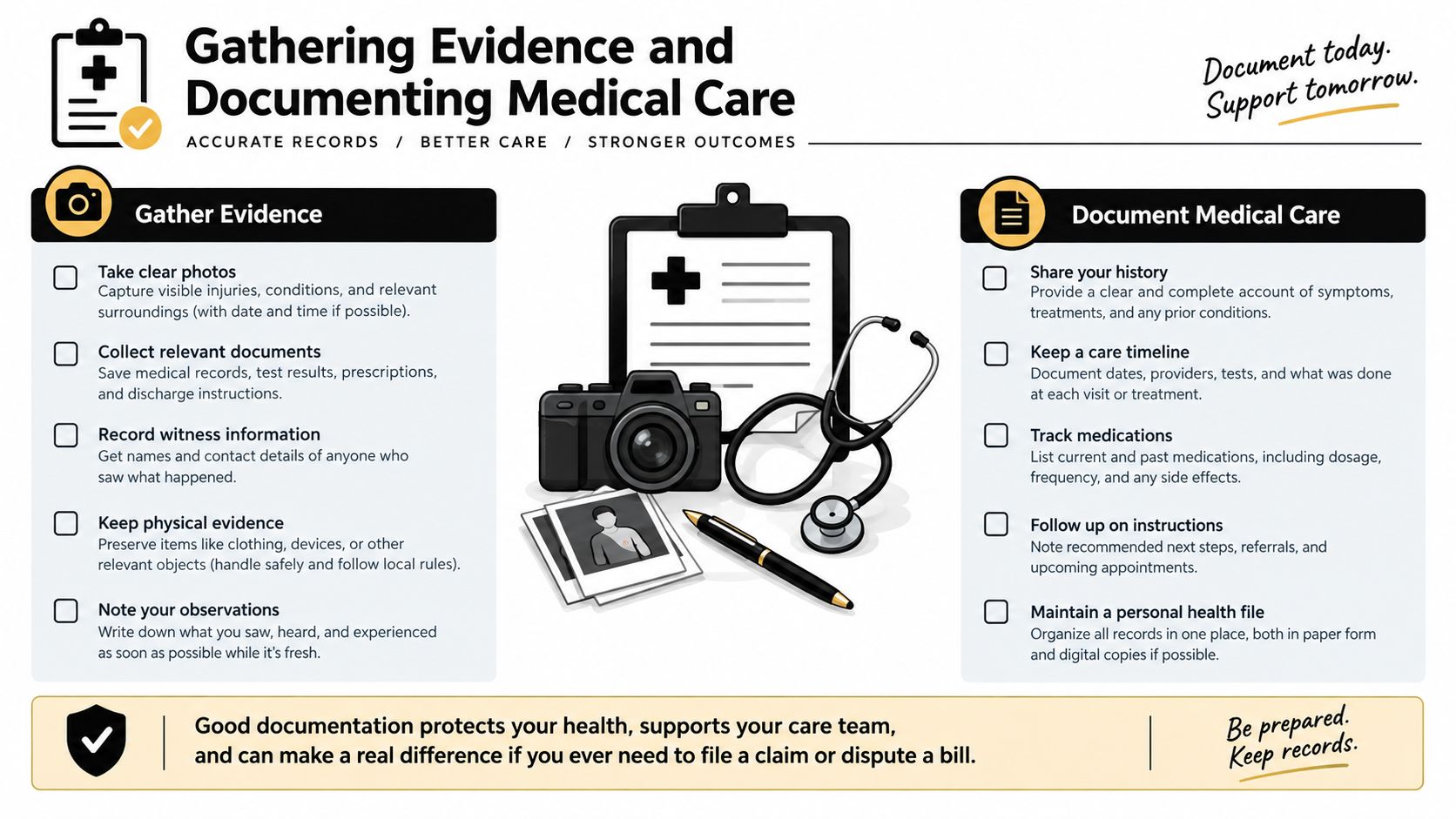
The strongest claim file connects three things clearly: what happened, when it happened, and what injuries followed. A rideshare case adds a digital layer because the driver’s app status may determine which insurance tier applies. A photograph of a dented bumper proves damage, but the Uber trip receipt and timestamp can help establish whether a ride was active.
Build the digital record
Save screenshots and downloads from the Uber app showing the trip receipt, route, pickup time, destination, driver information, and any in-app messages. Preserve emails, text messages, and notifications related to the ride. Write down the approximate collision time and location while your memory is fresh.
Uber’s passenger guidance emphasizes saving the police report number, photographing vehicle damage, collecting contact and insurance information, and submitting the crash report through the app or Safety Toolkit. You can also request a physical claim form by phone at any time if the app process fails. For help locating a report, use this guide on how to get a police report.
Traditional evidence still matters. Keep photographs in their original form, avoid editing them, and save copies in more than one location. Ask witnesses to describe what they saw in their own words rather than coaching them toward a conclusion.
Medical records must tell a continuous story
Tell every medical provider about the crash, your symptoms, and any limitations affecting work, sleep, driving, or ordinary activities. Keep appointment summaries, diagnostic results, prescriptions, invoices, mileage records, work restrictions, and receipts for related expenses.
A gap in treatment gives an adjuster an opening to argue that the injury was minor, unrelated, or pre-existing. That argument may be wrong, but incomplete records make it harder to disprove. If you can’t attend an appointment, ask the provider how to reschedule and document the reason.
Maintain a simple daily record of pain, mobility limits, sleep disruption, medication effects, and activities you can no longer perform. Don’t exaggerate. Accurate details are more useful than dramatic descriptions, especially when they match the medical records.
A notification tells Uber that a collision occurred. Evidence shows why the collision caused compensable harm.
Navigating Uber Insurance Coverage in California
The central coverage question is not just whether the vehicle displayed an Uber logo. It’s what the driver was doing in the app at the moment of impact.
Uber’s California coverage disclosure states that, beginning January 1, 2026, every passenger trip carries $1 million in liability insurance for injuries or property damage caused by the rideshare driver. It also identifies $60,000 per individual and $300,000 per accident in uninsured and underinsured motorist coverage when another driver causes the crash. See Uber’s California insurance reform disclosure for the stated coverage framework.
The basic tiers are:
| Driver Status | Bodily Injury, Per Person | Bodily Injury, Per Accident | Property Damage |
|---|---|---|---|
| Logged in and waiting for a ride | $50,000 | $100,000 | $25,000 |
| Accepted trip or passenger onboard | At least $1 million | At least $1 million | Not specified in the cited Uber passenger coverage guidance |
The waiting-period limits come from Uber’s accident-reporting guidance and are also reflected in independent rideshare insurance coverage guidance. The higher tier applies after the driver accepts a trip or while completing it with a passenger onboard, according to Uber’s maintained coverage information.
Why status disputes matter
If you were a passenger inside the Uber, the active-trip question should be straightforward, but insurers still need the trip data. If another vehicle caused the collision, the available uninsured or underinsured motorist coverage may become important. If the driver was only logged in and waiting, the lower contingent limits may apply instead.
Do not guess about the status. Preserve the receipt, timestamps, route information, and any evidence showing that you were being transported. Misclassifying the trip can route the claim to the wrong insurer or lead to an inaccurate assessment of available coverage.
The coverage tier doesn’t automatically establish liability. You still must show that another party caused the crash and that the crash caused your injuries and losses. For a practical discussion of the insurance question, see whether Uber covers accidents.
Filing Your Claim and Handling Insurance Adjusters
Reporting the crash in the Uber app is a notice of an incident, not a completed demand for compensation. The app report starts a process, but it doesn’t calculate your medical losses, document your pain, preserve every claim, or negotiate a settlement for you.
Uber says carriers generally contact a claimant within 2 to 3 business days after receiving the crash report, as described in its accident-reporting guidance. That contact is an investigation step. It isn’t proof that the insurer accepts fault or agrees that your claim has a particular value.
Treat the adjuster carefully
An adjuster may ask how the collision happened, whether you felt pain immediately, whether you’ve had prior injuries, and what treatment you’ve received. Answer truthfully, but don’t speculate or minimize your symptoms. You’re not required to provide a casual, open-ended account that lets the insurer frame the claim before your medical picture is clear.
Be especially careful with:
- Recorded statements: Don’t agree automatically. Ask what the statement is for and consider getting legal advice first.
- Medical authorizations: Don’t sign a blanket release giving access to unrelated medical history without understanding its scope.
- Early offers: Don’t accept money before you know the extent of your treatment, future care, work loss, and other damages.
- Written descriptions: Review every statement for accuracy. A careless phrase such as “I’m feeling better” can be presented as a complete recovery.
Uber says a physical claim form can be requested by phone around the clock if the app route doesn’t work. Submit the required information, retain copies, and record when you sent each document. The independent claim remains your responsibility. A crash report alone doesn’t create a settlement.
Build the demand from proof
A formal claim should explain liability, identify the applicable coverage period, summarize treatment, and attach supporting records. Include medical bills, wage documentation, photographs, police information, receipts, and records describing your limitations.
Don’t rush to value the claim while treatment is still developing. Once you sign a release, you may lose the ability to seek additional compensation for injuries that later become more serious. A lawyer can help decide when the record is complete enough to negotiate and whether filing suit is necessary.
Statute of Limitations and Common Pitfalls
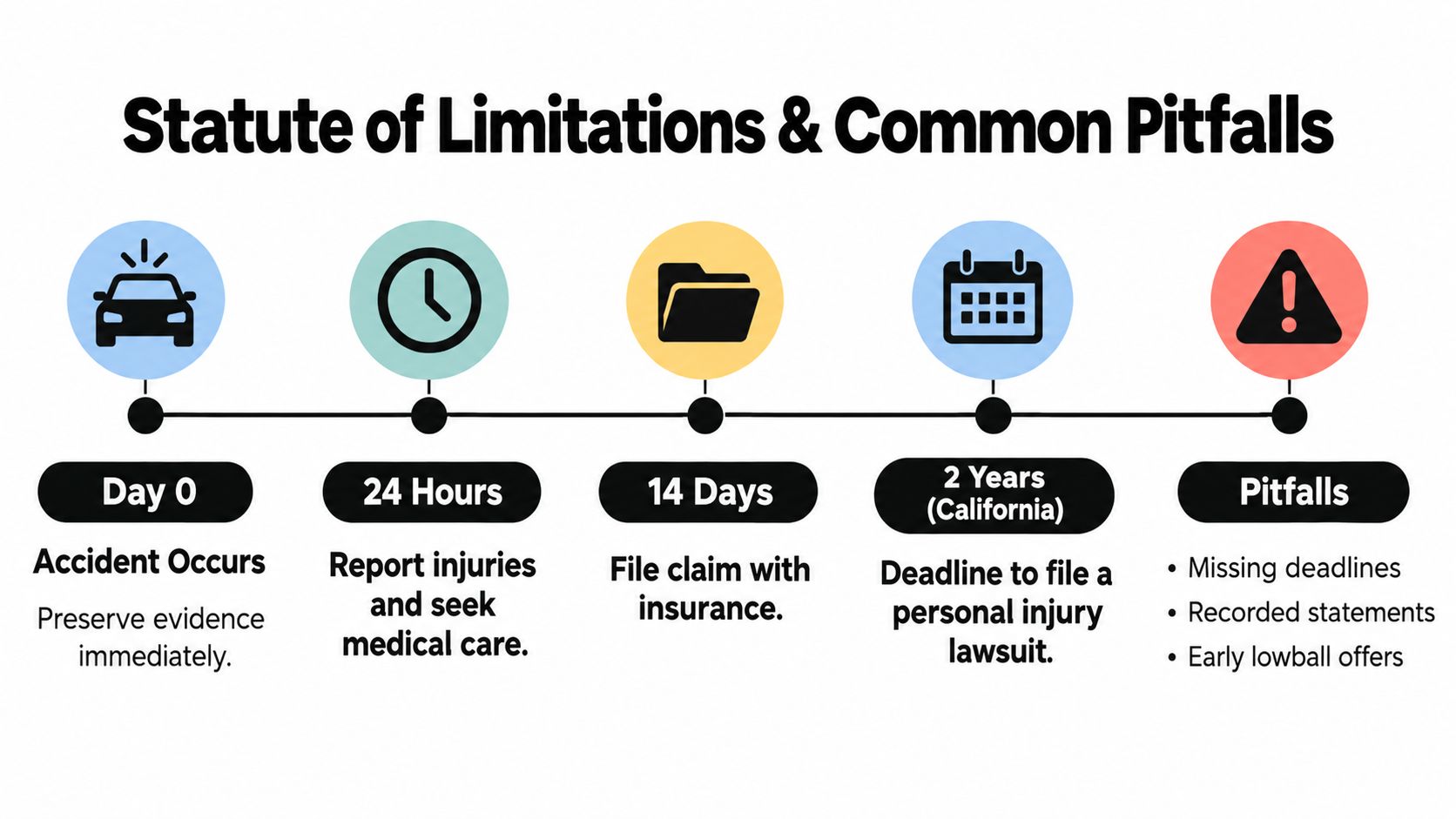
A serious injury doesn’t protect a claim from a missed deadline. In California, the research materials identify two years as the general period to file a personal injury lawsuit after an accident. That deadline is not a reason to wait. Investigation, medical care, insurance negotiations, and litigation preparation all take time.
The timeline below is a practical preservation plan, not a substitute for reviewing your specific deadlines with a lawyer.
Don’t let the insurer set the pace
Adjusters may move slowly while you wait for treatment records, liability decisions, or a settlement response. Delay can feel harmless, but it gives evidence time to disappear and brings the filing deadline closer. Start preserving records and evaluating the claim immediately.
The most damaging mistakes are usually practical:
- Waiting to seek care: Delayed treatment can make causation harder to prove.
- Ignoring trip status: Without app records, the insurer may apply the wrong coverage analysis.
- Giving a recorded statement: A rushed answer can become a permanent piece of the claim file.
- Accepting a quick settlement: Early money may close the claim before future treatment and losses are known.
- Missing the lawsuit deadline: Negotiations with an adjuster don’t necessarily preserve your right to sue.
The settlement rule: Never trade away a claim until you understand the medical outlook, financial losses, applicable insurance, and filing deadline.
A government entity, roadway defect, or unusual defendant may involve different notice rules and deadlines. Don’t assume the general two-year period applies to every possible claim. Have counsel identify all potential parties early, especially when another driver, a public agency, or a separate insurance policy may be involved.
Securing Specialized Legal Representation
An Uber passenger claim is difficult because several issues must line up at once. You need evidence of negligence, proof that the crash caused your injuries, accurate trip-status information, the correct insurance carrier, complete damage documentation, and timely legal action. A general settlement conversation won’t address all of those pieces.

What focused representation should provide
Look for a personal injury lawyer who understands rideshare insurance and can explain the plan in plain English. Direct attorney access matters because your case may turn on a narrow question, such as whether the trip had been accepted, whether another driver caused the collision, or whether the medical records support a future-care claim.
A capable lawyer should be prepared to:
- Preserve app evidence: Request trip data and identify the driver’s status at impact.
- Identify every coverage source: Review the driver’s policy, Uber coverage, and applicable uninsured or underinsured motorist protection.
- Document damages: Organize medical records, bills, lost income, property damage, and non-economic harm.
- Control communications: Handle adjusters and prevent casual statements from weakening the file.
- Protect the deadline: Track filing requirements while negotiations continue.
- Prepare for litigation: Build the claim as though the insurer may refuse a fair resolution.
Spanish-speaking passengers in California should be able to communicate directly and understand every major decision. Ask whether the firm offers Spanish-language support, who will answer your questions, and whether an attorney, rather than only a case manager, will remain accessible.
The practical financial question is also important. Many personal injury firms offer a free initial consultation and handle qualifying matters through a contingency-fee arrangement, meaning the fee is tied to recovery rather than an upfront payment. Confirm the fee terms, case expenses, and any obligations in writing before signing.
For a visual overview of the consultation process, watch the video below.
LA Law Group, APLC handles California injury matters, including rideshare claims, with direct attorney access and multilingual support for clients who need help communicating with insurers and documenting their losses. If you were hurt as an Uber passenger, a focused consultation can clarify the coverage tier, evidence needs, and next legal step.
Contact LA Law Group, APLC for a free initial consultation about your Uber passenger accident claim. The firm can review the crash information, help identify the applicable insurance pathway, and explain how to protect your claim while you pursue medical care.
Attorney Advertising. This article is general information, not legal advice, and does not create an attorney-client relationship. Prior results do not guarantee a similar outcome.