
What Can a Personal Injury Lawyer Do for You in California

If you think a personal injury lawyer’s job starts when an insurance company makes an offer, who protects your claim while evidence disappears and your treatment is still unfolding? Much of the most useful legal work happens before anyone discusses a settlement amount.
So, what can a personal injury lawyer do for you in California? A lawyer can connect the facts, medical evidence, insurance coverage, and filing requirements so you can make informed decisions rather than respond to pressure. The outcome still depends on what happened, what can be proven, and the resources available to pay a claim.
What a Personal Injury Lawyer Does at Each Stage
A personal injury lawyer investigates responsibility, preserves evidence, documents losses, and negotiates with insurers on your behalf. If an adequate agreement isn’t possible, the lawyer can pursue a lawsuit.
Consider a passenger injured in a collision who initially knows only the drivers’ names and where they received treatment. Counsel’s role is to turn those disconnected facts into a supported claim, not just forward medical bills.
The scale is substantial: the National Highway Traffic Safety Administration estimated 2,442,581 people were injured in U.S. motor-vehicle crashes in 2023, roughly five every minute.
Personal injury lawyer services by claim stage
| Stage | What the lawyer does |
|---|---|
| Initial consultation | Reviews what happened and explains options in plain language |
| Investigation | Gathers crash reports, scene and vehicle data, and witness statements |
| Evidence preservation | Sends requests for footage, records, and vehicle data before they’re lost |
| Damages valuation | Links bills, wages, future care, and quality-of-life harm to evidence |
| Insurer negotiation | Presents the demand and answers the insurer’s responses |
| Litigation | Files suit if an agreement cannot be reached |
At LA Law Group, we handle the claim process and insurance communications for our clients. We seek reimbursement for economic losses such as medical and surgical bills, recovery costs, and lost wages.
Prevention is a separate issue from compensation. For readers also concerned about workplace safety, SunnyBay’s discussion of ways to lower workplace injury claims offers a prevention-focused resource.
The lawyer’s role is evidence development and valuation, not paperwork alone. This article is for informational purposes only and isn’t to be construed as legal advice. Reviewing it creates no attorney-client relationship, and none of its information is legal advice.
Deadlines and Evidence to Protect in the First Weeks
California generally gives an injured person two years from the date of injury to file a civil action for injury caused by another person’s wrongful act or neglect, under Code of Civil Procedure section 335.1, as explained by California Courts. Different rules or exceptions can apply to government claims, minors, medical malpractice, and injuries discovered later.
A lawyer must identify the deadline that applies to your facts, including any required notice before a lawsuit. Don’t assume that opening an insurance claim or discussing settlement satisfies the court’s filing requirements.
Preserve what can disappear
The filing period isn’t a safe waiting period for investigation. A business may overwrite surveillance footage, a vehicle may be repaired before its condition is documented, and a witness may become difficult to reach.
A preservation letter can ask the person or business controlling evidence to retain it. Counsel still needs to identify the correct recipient, describe the relevant material, and follow up. Sending a letter doesn’t guarantee that every requested item exists or will be produced.
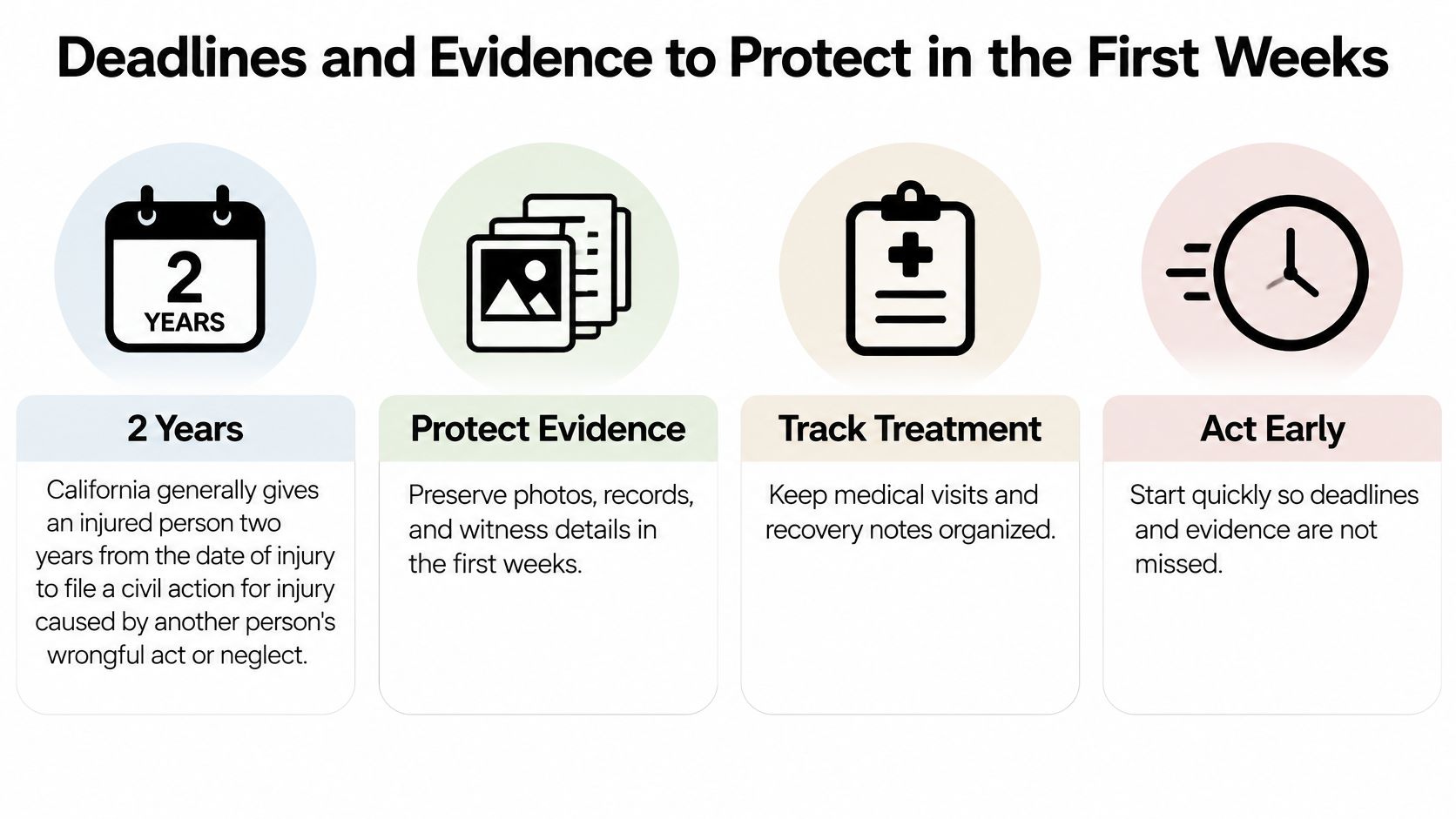
Use this checklist while the details are fresh:
- Photographs: Preserve images of the scene, vehicles, hazards, and injuries, preferably taken on the day. Don’t put yourself at risk to obtain them.
- Witness details: Save names, phone numbers, and email addresses.
- Incident records: Keep the police or incident report number and copies of reports you receive.
- Medical documents: Organize visits, prescriptions, instructions, and bills in one folder.
- Work records: Retain pay records, work restrictions, and dates you missed work.
- Symptom journal: Date each entry and describe symptoms and specific activities you couldn’t complete.
At the scene, safety comes before documentation. For that separate decision, 3rd-i’s guide to when to call responders after a crash provides additional context.
Practical rule: Save original files as well as copies. Don’t edit the only photograph or delete messages because they seem unimportant.
Write the injury date on your calendar and gather these materials before a substantive insurer interview whenever possible. Don’t delay urgent care or ignore required reporting while collecting documents.
How a Claim Moves From First Call to Settlement
Say you’re receiving treatment after a collision and an adjuster asks whether you’re ready to settle. The immediate task isn’t to pick a number. Your attorney needs to understand the injury, obtain supporting records, and determine what remains uncertain.
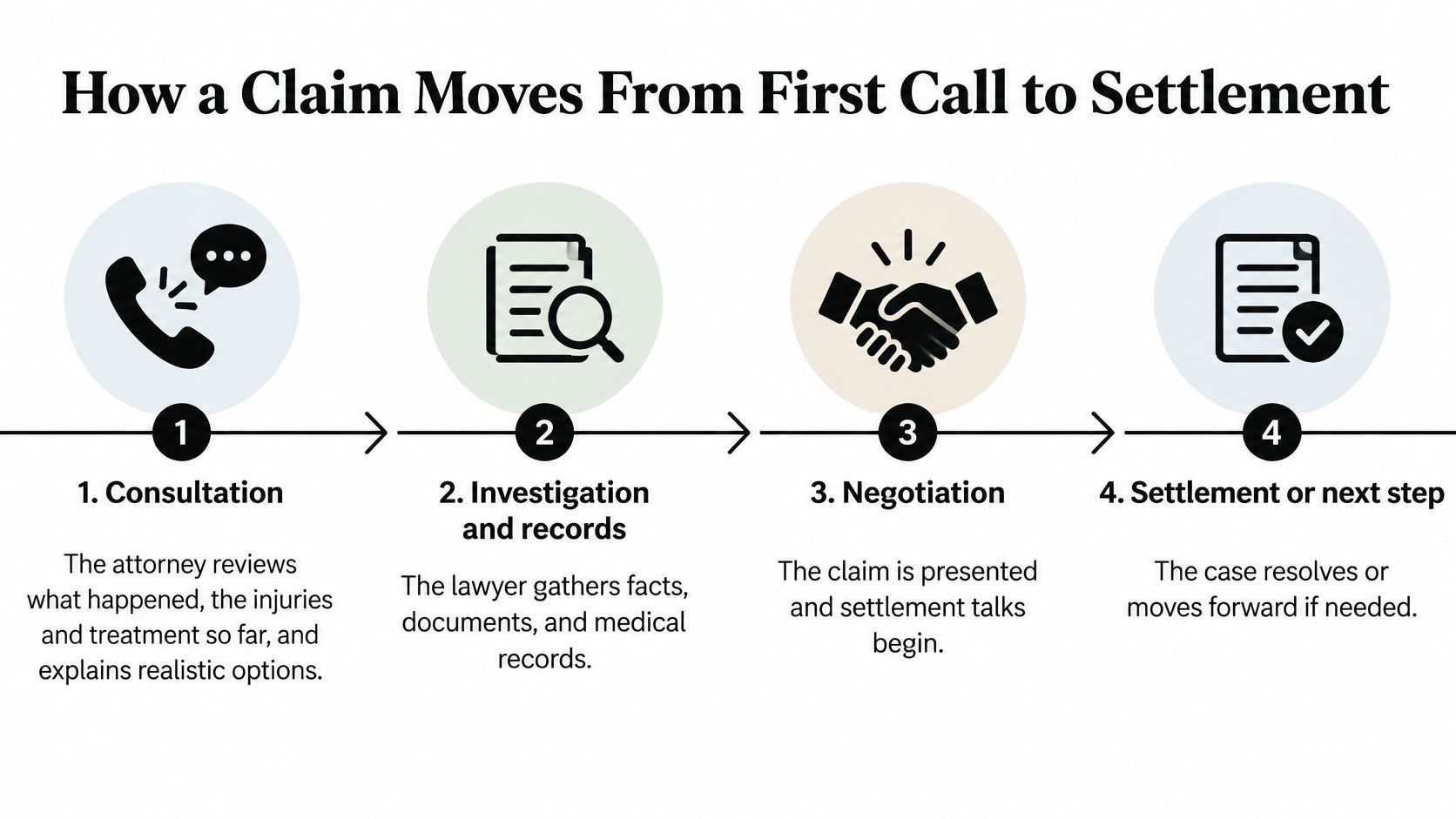
A claim generally progresses through these stages:
- Consultation: The attorney reviews the incident, injuries, treatment so far, and realistic options. Bring the facts you know and identify what you’re unsure about rather than guessing.
- Investigation and records: The firm gathers reports, photographs, witness accounts, and medical files. You can help by providing provider names and telling counsel about new treatment or work restrictions.
- Demand and negotiation: The lawyer presents the claim and responds to the insurer’s position. At our firm, we first negotiate a settlement with the insurance company.
- Litigation if needed: If we can’t reach an agreement, the matter may proceed to litigation. Filing suit doesn’t automatically mean a trial will occur.
The timeline below summarizes those decision points.
Progress isn’t the same as speed
Many personal injury cases handled by our firm take six months to reach settlement, and some lawsuits could take up to three years. Those are firm-specific observations, not a promise or a deadline for your matter. Injury severity, insurer responses, disputed evidence, and court schedules affect timing.
An early offer deserves particular care when your doctor hasn’t established a reliable prognosis. A final release can close off claims for later costs, so ask your lawyer what uncertainty remains before responding.
During the process, attend medical appointments, keep dated recovery notes, and obtain advice before giving a recorded statement. Report improvement while noting ongoing symptoms. Accurate records are more useful than exaggerated descriptions.
Our explanation of the personal injury claim process provides additional context about these stages.
A steady case has an identifiable next task, someone responsible for completing it, and an explanation of what’s preventing the next decision.
Ask which records remain outstanding, whether responsibility is disputed, and when you should expect another update. A useful progress report explains both completed work and unresolved issues.
How Injury Damages Are Calculated and Documented
Damages are the losses for which a claimant seeks compensation. California Courts’ personal injury guidance identifies categories that can include medical bills, lost wages, emotional harm, and other injury-related losses.
The starting point is separating measurable expenses from harms that don’t arrive with an invoice. Neither category proves itself merely because an accident occurred.
Economic losses need supporting records
Economic damages include medical and surgical bills, recovery expenses, and lost income. Transportation to treatment or necessary home assistance may also warrant evaluation when connected to the injury.
For a clearly hypothetical example, suppose a claimant has $40,000 in medical bills and $15,000 in lost wages. Those items total $55,000 in claimed economic losses, but the arithmetic alone doesn’t establish that every expense is recoverable. Counsel must connect treatment to the incident and verify the income loss.
| Claimed loss | Useful supporting evidence |
|---|---|
| Treatment expenses | Medical records, itemized bills, and payment information |
| Missed earnings | Employer confirmation, payroll records, or tax documents |
| Recovery expenses | Receipts and evidence explaining why assistance was needed |
| Future care or work limitations | Physician opinions about prognosis and functional restrictions |
A bill shows an amount charged. The accompanying diagnosis and treatment history help explain why the care was necessary and related.
Non-economic harm needs a concrete explanation
Non-economic damages address pain, emotional harm, and lost enjoyment of life. Useful documentation describes actual changes: difficulty sleeping, inability to lift a child, or discomfort during activities the person previously enjoyed.
A claimant’s statement should be consistent with medical records and the recovery timeline. Future losses require a supported assessment of ongoing care, work restrictions, or permanent limitations, not an assumption that symptoms will continue indefinitely.
For some cases, we determine non-economic damages by applying a multiplier to economic damages. That’s a valuation method, not a statutory formula or a guarantee that an insurer or jury will agree.
A sound valuation considers both categories and distinguishes established losses from unresolved future needs. Don’t treat a medical-bills-only offer as a complete assessment without examining what it leaves out.
Who Is Responsible in Auto and Premises Cases
An injury claim may involve more than the person you first associate with the accident. A lawyer examines who controlled the risk, what each party did, and which conduct contributed to the injury.
A consultation can help separate those questions from assumptions about who must pay.

Common case types, responsible parties and key evidence
| Case type | Who may be responsible | Key evidence |
|---|---|---|
| Auto accident | At-fault driver, vehicle owner, or employer; commercial insurance may provide coverage | Crash report, vehicle data, photos, witness statements |
| Premises slip and fall | Property owner, manager, or maintenance contractor | Notice of the hazard, inspection and cleaning records, incident photos |
| Pedestrian or bicycle collision | Driver and any party whose road or vehicle condition contributed | Scene photos, witness accounts, police report |
| Wrongful death | The at-fault party, with a claim pursued by eligible surviving family members | Death certificate, incident records, financial dependency evidence |
These are investigation starting points, not automatic findings of liability. An insurer or insurance policy isn’t itself the person who caused the harm. Counsel distinguishes legal responsibility from the coverage available to pay for it.
How fault affects recovery
Under California Civil Code section 1431.2, each defendant in a comparative-fault action is liable for non-economic damages in proportion to that defendant’s assigned fault; for example, $100,000 in non-economic damages with 30% fault assigned to a defendant produces a $30,000 share for that defendant. This is several liability for that category, not a blanket rule for all damages.
A lawyer also examines allegations that the injured person contributed to the incident, because a supported allocation of fault to the claimant can reduce recovery. The response requires evidence, not disagreement with the adjuster.
In a slip-and-fall scenario, for example, counsel may investigate how long a spill existed, who inspected the aisle, and whether warning signs were present. A photograph of the spill helps, but inspection records may answer a different and important question: whether the responsible party knew or should have known about it.
The following video provides an additional viewing resource.
Cross-border driving raises separate insurance questions. Amigo Mex Insurance’s explanation of penalties for lacking Mexican auto insurance is relevant to travel planning, not a statement of California liability law.
Rideshare Passenger Claims and Which Insurance Applies
Why can two passengers in similar crashes face different insurance answers? Trip phase often sets which policy responds first. A car linked to a rideshare app does not automatically bring the highest company limit into play.
The lawyer starts by placing the trip in order. Was the driver waiting for a request, traveling to pick up an accepted ride, or transporting a passenger? The California Public Utilities Commission’s insurance requirements describe at least $1 million in primary commercial liability coverage while a driver is transporting a passenger. Other app periods, such as traveling to collect an accepted passenger, fall under lower limits, so the phase label changes the analysis.
Read limits alongside the law that covers the trip phase
The cited legislative text lists passenger-occupancy liability coverage of at least $1 million, uninsured and underinsured motorist coverage of $60,000 per person and $300,000 per incident in the California SB 371 legislative comparison text. It also lists lower-period limits of $50,000 per person, $100,000 per incident, and $30,000 for property damage in that same comparison text. Confirm with counsel which limits apply to the trip phase and incident date before relying on any figure.
Rideshare insurance limits by trip phase
| Trip phase | Coverage source | Limits in the cited text |
|---|---|---|
| Passenger in vehicle, entry to exit | Company liability, primary | At least $1 million for death, personal injury, and property damage |
| Passenger in vehicle, entry to exit | Primary uninsured and underinsured motorist | $60,000 per person and $300,000 per incident |
| Other app periods, such as logged in or traveling to pickup, requiring precise classification | Company coverage | At least $50,000 per person and $100,000 per incident for death and injury; $30,000 for property damage |
The table shows typical ranges from the cited text. It does not replace proof of the actual trip phase and the rules in effect on the crash date. Logged-in status and active travel to an accepted pickup need separate proof and should not be treated as the same period.
Save app screenshots, trip receipts, pickup and drop-off times, driver messages, and anything showing login or ride acceptance. Counsel can request platform records when personal screenshots leave gaps. This early record protects the claim before settlement talks begin, because LA Law Group handles the claim process and deals with insurance companies on the client’s behalf.
Coverage review still matters when another driver caused the crash. A lawyer weighs that driver’s policy alongside any available uninsured or underinsured motorist coverage. Our guide to working with an Uber passenger accident lawyer explains the passenger-focused issues. Counsel should also check whether a release given to one insurer could reduce another available claim.
How Contingency Fees Work
A contingency fee ties the attorney’s fee to a recovery rather than billing solely for hours worked. Under that arrangement, there’s no attorney fee unless the case produces a recovery, and the agreement specifies the percentage. Case costs are a separate question, so don’t assume that no attorney fee means no possible financial obligation.
Gross recovery and net recovery aren’t interchangeable
Consider a hypothetical settlement of $100,000, case costs of $5,000, and an agreed fee of 33%. These are illustrative figures, not our fee schedule.
| Hypothetical calculation | Attorney fee | Client remainder after stated costs and fee |
|---|---|---|
| Fee calculated on gross settlement | $33,000 | $62,000 |
| Fee calculated after costs | $31,350 | $63,650 |
The difference is $1,650, before any medical balances, liens, or other deductions. The written agreement determines which calculation applies.
Confirm these points before signing:
- Percentage and stages: Does the percentage change after a lawsuit is filed or at another defined stage?
- Calculation order: Is the fee applied before or after case costs are deducted?
- Covered costs: How are medical records, filing charges, depositions, and expert expenses handled?
- Unsuccessful outcome: Must you repay costs if there’s no recovery?
Medical providers or health insurers may also assert payment rights against settlement proceeds. Ask how those claims will be identified and addressed, and request an explanation of your estimated take-home amount rather than focusing only on the headline settlement.
Before signing: Have the lawyer show the calculation using the actual agreement’s terms.
Our explanation of a contingent fee agreement offers further context. You should understand the financial arrangement before deciding whether to hire counsel.
Decide Whether to Speak With a Lawyer This Week
Consider an early legal review if your injury required treatment, another party may share responsibility, an insurer has contacted you, a rideshare or commercial vehicle was involved, or you were injured on someone else’s property. You don’t need to know the claim’s value before asking for an assessment.
A case review should clarify your options and the proposed fee terms, not promise a result. At our firm, the first consultation is free and confidential, and you meet with the attorney who will handle the matter.
Questions to bring
- Which deadline applies? Ask what facts or documents are needed to confirm it.
- Which policies may pay? Identify every known driver, vehicle, business, property operator, and insurer.
- What must be confirmed before a release is signed? Ask about unresolved medical needs, other claims, and deductions from any recovery.
Bring your photographs, witness details, incident information, treatment and wage records, symptom notes, and insurer letters. Missing documents shouldn’t stop you from arranging a review; identify what you have and what still needs to be obtained.
We serve clients throughout California in English, Spanish, and Farsi from our Chatsworth office. If needed, we can travel to a client’s home or hospital.
This article is for informational purposes only and isn’t to be construed as legal advice. Reading it creates no attorney-client relationship, and none of the information in this article is legal advice.
LA Law Group, APLC offers a free, confidential consultation with the attorney who will handle your matter to review your injury claim options. Gather your incident records and insurer correspondence, then visit LA Law Group, APLC to arrange a discussion about deadlines, available coverage, and the evidence your claim needs.
Attorney Advertising. This article is general information, not legal advice, and does not create an attorney-client relationship. Prior results do not guarantee a similar outcome.