
What Is Negligent Driving and How It Affects Injury Claims
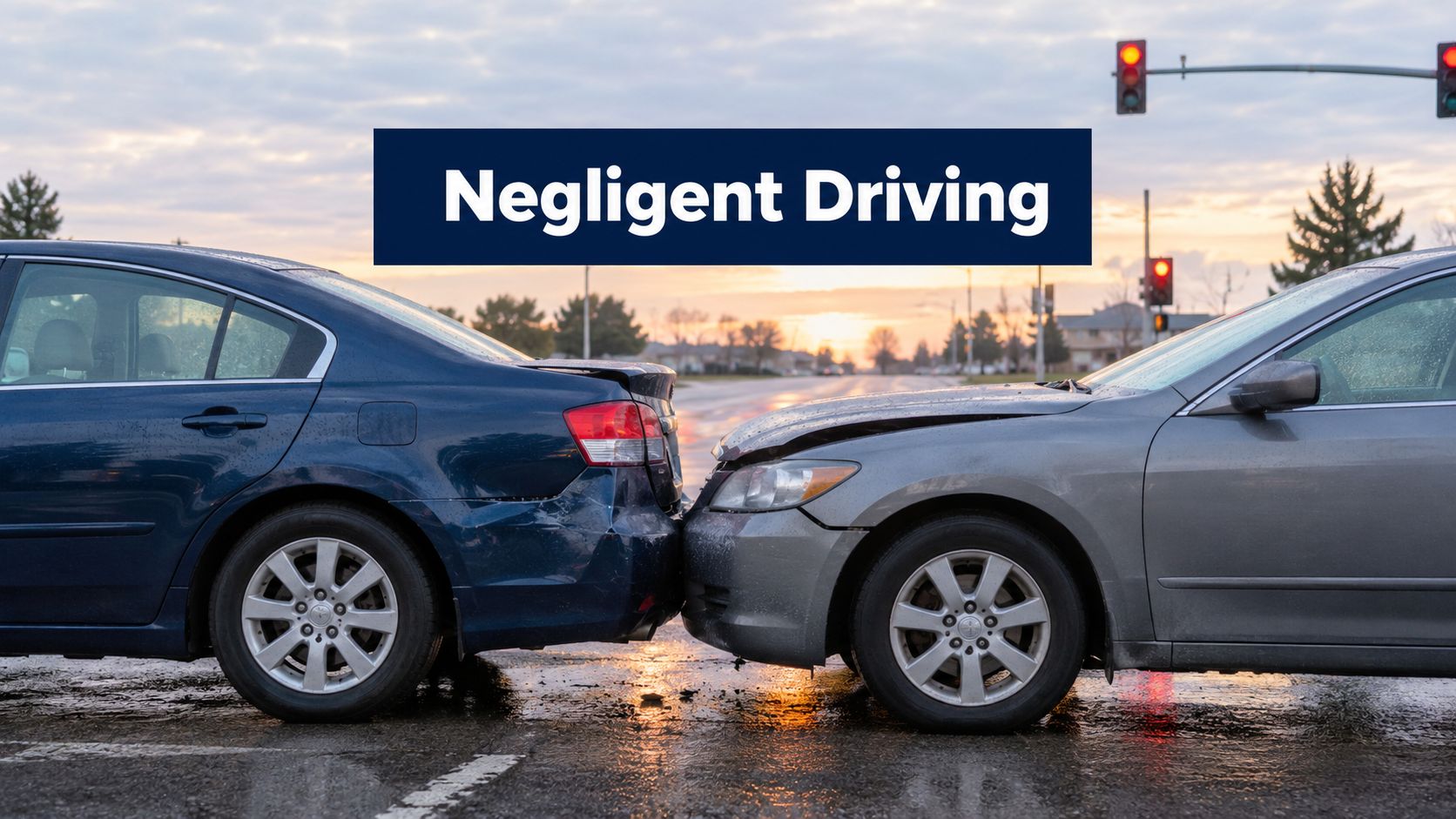
Negligent driving means failing to use the care a reasonable driver would use under the same circumstances. Texting at a red light, looking down as traffic moves, and rear-ending the car ahead can fit that definition even when the driver never intended to hurt anyone.
You may be reading this after a collision, sitting in a damaged vehicle, reviewing an insurance message, or trying to understand whether an ordinary traffic mistake gives you a personal injury claim. The word negligent sounds technical, but the starting point is familiar. A driver makes a choice, that choice falls below ordinary care, and someone else suffers a foreseeable injury or loss.
The consequences matter beyond one commute. The World Health Organization’s global road safety report estimates that road traffic crashes caused about 1.19 million deaths in 2021, or roughly 15 deaths per 100,000 people worldwide. The same source reports between 20 million and 50 million injuries each year. Those figures help explain why distraction, speeding, impairment, fatigue, and other careless conduct receive serious attention from lawmakers and courts.
This article focuses on the everyday meaning of negligent driving and the precise framework used in California personal injury claims. It also distinguishes civil negligence from reckless or intentional conduct, explains how fault can affect compensation, and outlines practical steps after a crash.
What Negligent Driving Actually Means
A driver checking a phone at a red light may look up just as traffic starts moving. If the vehicle then hits the car ahead, the driver may face a negligence claim even without intending to injure anyone. That everyday scenario captures the basic idea: negligent driving occurs when a driver fails to exercise ordinary care and creates an unreasonable risk of harm.
Ordinary care means the caution a reasonably careful driver would use in the same circumstances. It includes watching traffic, following applicable rules, adjusting to weather and road conditions, and responding to hazards. The legal question is not whether the driver believed they were responsible. It is whether their conduct fell below that objective standard.
A familiar commute example
Suppose a driver stops at a red light while reading a text message. The signal changes, traffic begins moving, and the driver keeps looking at the phone instead of the road. The vehicle strikes the car ahead.
The driver may say the glance was brief or that there was no intention to cause a crash. Those explanations do not erase the unsafe choice. The National Highway Traffic Safety Administration’s distracted-driving guidance describes manual, visual, and cognitive distraction as separate ways a phone can interfere with driving.
Negligence is generally unintentional carelessness, rather than a plan to injure someone. A driver who fails to check a blind spot, follows too closely, or misses a stop sign may have acted carelessly without acting maliciously. If that conduct foreseeably causes injury or property loss, the driver may still be responsible in a civil claim.
Practical rule: A lack of intent to hurt someone does not make unsafe driving safe.
California personal injury claims therefore focus on the connection between the driving conduct, the collision, and the claimant’s injury and losses. Civil responsibility can exist even when prosecutors do not file criminal charges.
How California Law Establishes Negligence Behind the Wheel
California personal injury claims use an objective standard. Courts don’t ask only what the driver believed, hoped, or intended. They ask what a reasonably careful driver would have done under comparable circumstances.
Consider an intersection on a wet evening. A driver approaches a signalized crossroads while the pavement is slippery. The traffic light changes, visibility is limited, and cross traffic may be difficult to see. A prudent driver might reduce speed, leave additional stopping distance, and check the intersection before proceeding. A driver who continues too quickly, fails to observe cross traffic, and causes a collision may have breached the duty of care.
The four building blocks
A negligence claim generally requires evidence of four connected points:
-
Duty of care. Drivers owe other road users a duty to operate their vehicles with reasonable care. The duty exists because vehicles can cause serious harm when operated without attention to traffic, weather, visibility, and surrounding people.
-
Breach. The driver breached that duty through an unsafe act or omission. Failing to slow for rain, looking at a phone, or failing to yield can provide the conduct that supports this element.
-
Causation. The breach must have caused the collision or contributed to it in a legally meaningful way. If the driver was looking down but the crash would have happened for an unrelated reason, the distraction alone may not establish causation.
-
Damages. The claimant must show a compensable loss, such as bodily injury, vehicle damage, medical expense, lost income, or other legally recognized harm. A near miss without injury or loss may raise safety concerns but doesn’t automatically create a personal injury recovery.
The legal test remains external. A driver can’t defeat a claim by saying, “I didn’t mean to do that.” The relevant comparison is the conduct of a reasonably careful driver facing the same wet intersection, traffic signal, and visibility conditions.
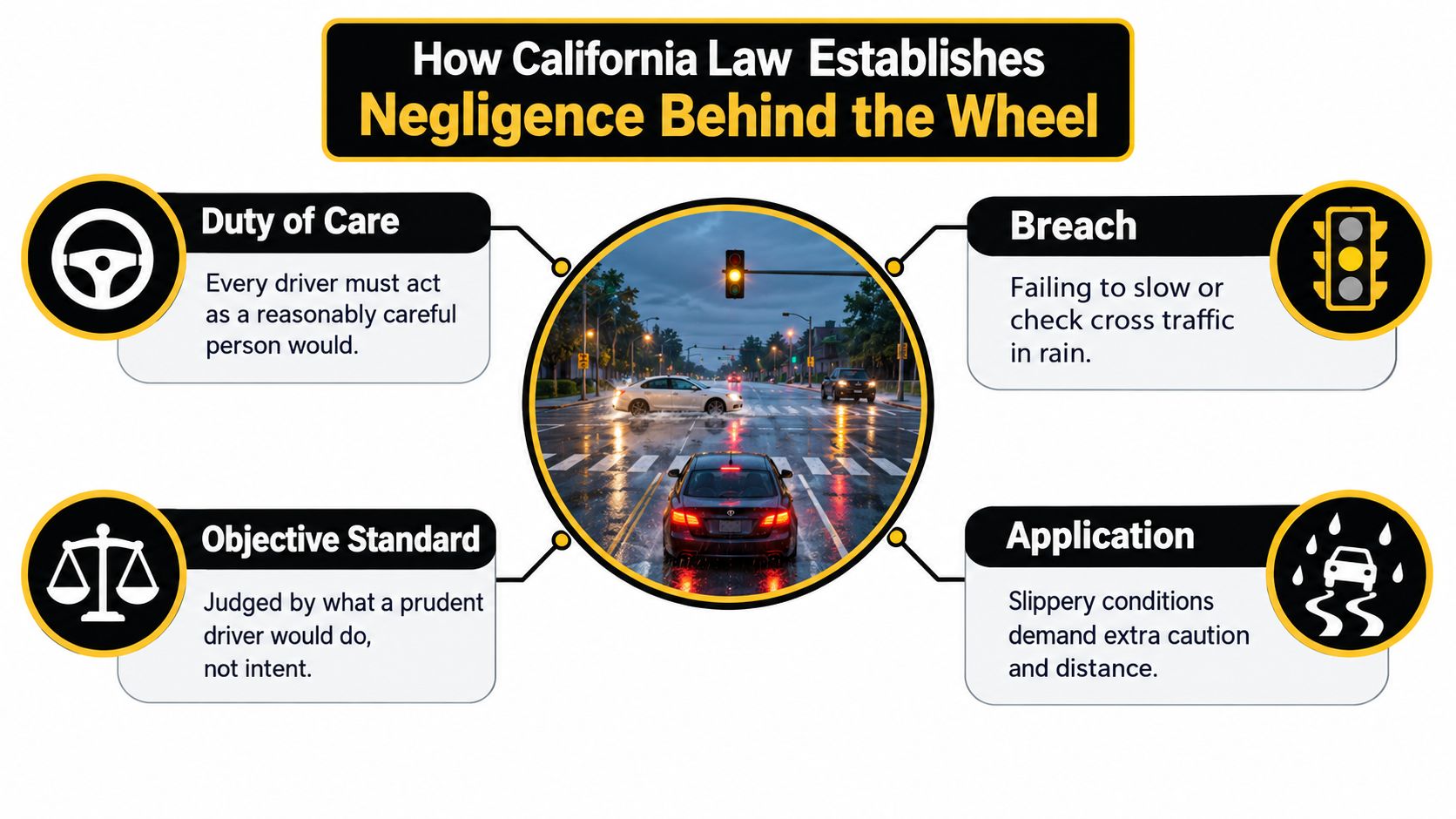
These four concepts turn an everyday description, such as “the other driver wasn’t paying attention,” into a legal question. What did the driver do, what should a careful driver have done, did that difference cause the crash, and what loss followed?
Common Examples Drivers and Courts Recognize
A driver glances at a text while turning through an intersection. That brief choice can matter because the maneuver demands lane control and awareness of pedestrians, cyclists, and cross traffic. If the driver drifts, fails to yield, or strikes another road user, the facts may support a negligence claim.
Distraction and divided attention
Distraction can take several forms. Eating, adjusting a navigation app, reaching for an item, or looking at a passenger may interfere with vehicle control. The relevant question is whether the activity diverted the driver’s manual, visual, and cognitive attention and created a foreseeable safety risk. A person does not need to hold a phone for divided attention to become legally significant.
The same conduct can have different consequences depending on what happened next. Looking down for a moment may be negligent if it causes a driver to miss a stopped car, while the distraction alone does not establish liability without a legally meaningful connection to the crash.
Speed and aggressive maneuvers
A driver enters a wet intersection too quickly, runs a stale yellow signal, or changes lanes without checking nearby traffic. The driver may think there is enough time to proceed, yet the foreseeable risks include inadequate stopping distance, a side-impact collision, or striking someone crossing the road.
Speed and maneuvering must be judged against the conditions. Rain, traffic, visibility, road design, and nearby vehicles can make a choice unsafe even when the driver does not intend to cause harm. Conduct that shows conscious disregard for a substantial risk may support a more serious allegation, but the legal label depends on the evidence and applicable law.
Impairment and fatigue
A driver consumes alcohol and then struggles to maintain a lane. Another driver continues through fog after sleeping only a few hours and fails to see a stopped vehicle. Alcohol-impaired driving and fatigue are recognized major crash factors in WHO’s road safety guidance.
Both examples involve reduced judgment, alertness, or reaction ability. Those limitations make a collision foreseeable, especially when the driver continues despite warning signs.
A crash involving impairment may support civil negligence and a criminal driving-under-the-influence case. Excessive speed may support negligence, reckless driving, or another charge. The evidence, the driver’s mental state, the injuries, and the governing law determine where the conduct falls.
Civil Consequences Versus Criminal Charges
One collision can create two separate legal tracks. A civil personal injury case seeks compensation for the injured person, while a criminal prosecution seeks to punish conduct that violates a criminal statute. The same evidence may matter in both proceedings, but the claims have different purposes and proof requirements.
In a civil negligence case, the injured person generally must establish the claim by a preponderance of the evidence. In plain English, the evidence must show that the negligence more likely than not caused the injury and resulting losses. A criminal case requires proof beyond a reasonable doubt, a substantially higher standard.
One rear-end crash, two possible paths
Suppose a driver follows too closely while looking at a phone and rear-ends another vehicle. The injured driver may pursue a civil claim by showing that the other motorist owed a duty of care, breached it through distraction and insufficient following distance, caused the impact, and caused compensable harm.
The same facts might prompt an investigation into reckless driving or driving under the influence if additional evidence supports those charges. But a civil claim doesn’t automatically become criminal merely because someone was injured. A prosecutor must decide whether the conduct satisfies the elements of a particular criminal offense, such as reckless driving under California Vehicle Code 23103 or driving under the influence.
| Factor | Civil Negligence | Criminal Charge, Reckless or DUI |
|---|---|---|
| Purpose | Compensate an injured person for legally recognized losses | Punish conduct that violates a criminal law |
| Who brings the case | The injured person or claimant | The government |
| Proof standard | Preponderance of the evidence | Beyond a reasonable doubt |
| Focus | Duty, breach, causation, and damages | The elements of the charged offense and required mental state |
| Possible result | Financial recovery, subject to applicable fault rules | Criminal penalties, which can include fines, license consequences, or incarceration |
A criminal acquittal doesn’t necessarily eliminate a civil claim because the proof standards differ. Conversely, a settlement of a civil claim doesn’t decide whether criminal charges should be filed.
How Negligence Drives a Personal Injury Claim
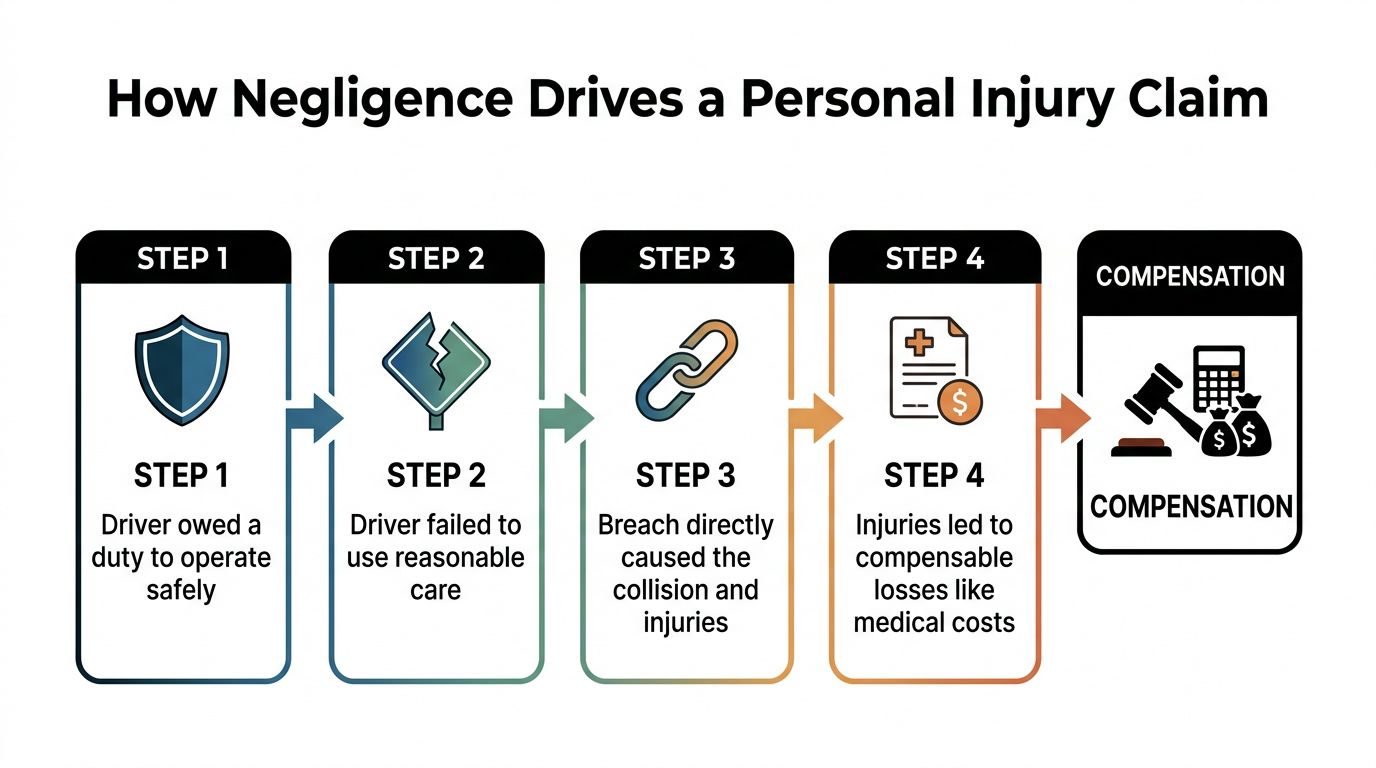
The negligence framework becomes a compensation claim only when the evidence connects the driver’s conduct to a real loss. The injured person must show more than a traffic mistake. The claim needs a duty, a breach, causation, and damages, supported by records and testimony that tell a consistent story.
From crash facts to compensation
Start with the driver’s obligation to operate safely. Then identify the specific departure from ordinary care, such as failing to yield, looking at a phone, or driving too fast for conditions. Next, connect that conduct to the impact and the impact to the injury. Medical records, photographs, vehicle damage, witness accounts, collision reports, and other evidence can help establish that sequence.
Damages commonly fall into two broad categories:
-
Economic losses: Medical bills, rehabilitation expenses, property damage, and income lost because injuries prevent work.
-
Non-economic losses: Pain, suffering, emotional distress, inconvenience, and effects on daily life, where supported by the facts and applicable law.
California follows a pure comparative fault approach. If an injured person contributed to the crash or the severity of the harm, the person’s recovery can be reduced by the assigned share of fault, but that fault doesn’t automatically eliminate recovery. The practical dispute may therefore involve both the other driver’s conduct and the claimant’s own actions.
Insurance carriers use these same questions during settlement discussions. An adjuster may examine photographs, medical treatment, statements, traffic evidence, and competing accounts before assigning responsibility and valuing the claim. Strong evidence of breach and causation can improve the claimant’s negotiating position, while inconsistent statements or treatment gaps can create disputes.
For background on organizing the proof, see this guide on how to prove negligence. Readers also may find it useful to review California auto insurance from Mai & Associates when evaluating coverage questions after a collision.
Negligent Driving Compared to Reckless and Intentional Conduct
Driver misconduct exists on a spectrum, but the legal labels aren’t interchangeable. Negligent driving is careless conduct without an intent to cause harm. Reckless driving involves a more serious form of conscious disregard for a substantial risk and can become criminal under California Vehicle Code 23103. Intentional misconduct involves purposeful action, such as using a vehicle to attack or deliberately ram another car.
Parallel examples make the difference clearer. A driver who follows too closely may be negligent if the conduct reflects ordinary inattention. A driver who participates in street racing may face a reckless-driving allegation because the behavior shows a conscious disregard for danger. A driver who deliberately steers into another vehicle during road rage is not merely careless. The purpose behind the act can support an intentional-misconduct theory.
| Conduct Type | Driver’s Mental State | Likely Legal Outcome |
|---|---|---|
| Negligent driving | Careless or inattentive, without a purpose to cause harm | Civil injury claim, traffic consequences, or a lower-level offense depending on jurisdiction |
| Reckless driving | Conscious disregard for a substantial and unjustifiable risk | Potential criminal prosecution, civil liability, or both |
| Intentional conduct | Deliberate act directed toward another person or vehicle | Intentional tort claims and potentially serious criminal charges |
The distinction affects available remedies and punishment. A civil claimant may seek compensation based on negligence even when the driver didn’t intend harm. Criminal consequences require the government to prove the elements of the charged offense, including any required mental state.
California readers often confuse careless driving with the higher threshold used for reckless conduct. A practical overview of what is considered reckless driving can help separate those concepts, but the facts of an individual crash still require careful legal analysis.
Steps to Take After a Suspected Negligent Driving Crash
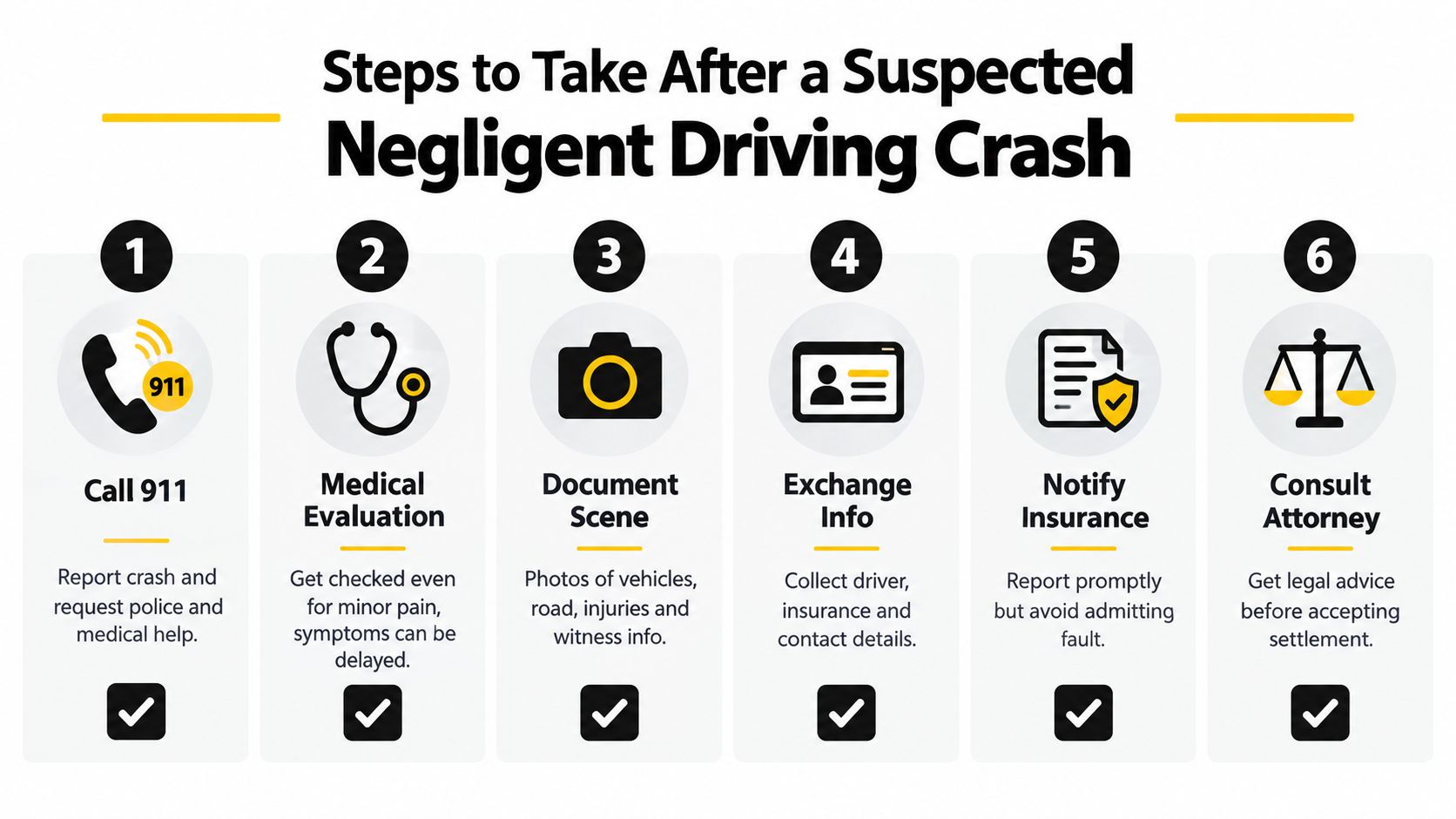
The first priority after a collision is safety and medical care, not deciding which legal label applies. Move away from immediate danger if you can do so safely, call 911, and request police and medical assistance. Even minor pain deserves medical attention because some symptoms develop later.
Preserve the details
If your condition permits, document the scene without interfering with emergency responders:
-
Photograph the scene: Capture vehicle positions, damage, road conditions, traffic signals, visibility, and visible injuries.
-
Collect witness information: Obtain names and contact details from people who saw the collision, if they’re willing to provide them.
-
Exchange identifying information: Gather the other driver’s name, contact details, vehicle information, and insurance details.
-
Preserve evidence: Keep damaged clothing and relevant vehicle parts. Save dashcam footage, photographs, medical records, repair estimates, and communications related to the crash.
Report the collision to law enforcement so an official report can be created. California also requires an SR-1 report within ten days for qualifying injury crashes. Confirm the current reporting requirements with the California Department of Motor Vehicles or a licensed attorney because the consequences of an incomplete or late report can depend on the circumstances.
Communicate carefully
Notify your insurer promptly, but don’t guess about fault or provide a recorded statement before understanding what you’re saying. Avoid posting photographs, opinions, or updates about the crash on social media. An insurer or opposing lawyer may later examine those statements outside the context in which you wrote them.
For a broader checklist, review what to do after a car accident. Before accepting a settlement, signing a release, or giving a deposition, consider consulting a California personal injury attorney who can evaluate the evidence and explain the effect of each decision.
Key Takeaways and When to Seek Legal Guidance
Negligent driving is a failure to use reasonable care behind the wheel. The driver doesn’t need to intend harm. The central question is whether the conduct departed from what a reasonably careful driver would have done under the same circumstances.
A personal injury claim generally turns on four connected issues:
-
Duty: The driver owed other road users a duty to operate safely.
-
Breach: The driver failed to use ordinary care through an act or omission.
-
Causation: That failure caused the collision and the claimed injuries.
-
Damages: The injuries produced compensable financial or personal losses.
California’s pure comparative fault rule can reduce recovery when the injured person also contributed to the event. Clear documentation helps establish what happened, who caused it, what injuries followed, and how those injuries affected work, treatment, finances, and daily life.
You should consider legal guidance when fault is disputed, injuries are serious, a commercial vehicle is involved, multiple insurers are communicating with you, or an insurer offers a quick settlement before your medical condition is clear. You may also need advice when the facts could support both a civil claim and allegations of reckless driving or DUI.
This article is for informational purposes and isn’t to be construed as legal advice. No attorney-client relationship exists based on the review of this article, and none of the information in this article is legal advice. A licensed California attorney can apply the law to your specific facts, evidence, injuries, and deadlines.
LA Law Group, APLC offers consultations and legal guidance for California injury victims evaluating claims involving negligent drivers, disputed fault, and insurance settlement pressure. Visit LA Law Group, APLC to discuss your crash with a legal team that handles personal injury matters and can help assess your next steps.
Attorney Advertising. This article is general information, not legal advice, and does not create an attorney-client relationship. Prior results do not guarantee a similar outcome.