
Abogados Para Accidentes De Carro: California Guide
Your car is at the repair shop, your neck hurts, and an insurance adjuster wants to record a call in English. You may be searching for abogados para accidentes de carro because you need more than someone who can translate words. You need to understand what you’re being asked, what you might sign away, and who can help protect your claim.
For Spanish-speaking Californians, clear communication is part of protecting evidence and making informed decisions. A useful lawyer should explain the process in language you understand without rushing you toward an answer or a settlement.
Whether Your Crash Calls for a Car Accident Lawyer
California recorded 4,061 traffic fatalities in 2023, an approximately 11% decrease from 4,539 in 2022, according to the California Office of Traffic Safety. Those figures describe fatal crashes, not the likelihood that any particular driver will need a lawyer. Your decision should turn on your injuries, the evidence, and the insurance questions involved.
A small repair claim with no injuries may be manageable without representation. A claim involving ongoing treatment or disputed responsibility deserves a closer look before you agree to payment terms.
Crash situations and whether to contact a lawyer soon
| Situation | Lawyer involvement | Why it matters |
|---|---|---|
| Minor property damage, no injuries | Optional | Insurers may offer a quick settlement, so keep all records first |
| Injuries needing treatment beyond one visit | Contact soon | Medical costs and lost wages need documentation |
| Fault disputed by the other driver | Contact soon | Evidence and fault percentages change what you can recover |
| Passenger in a rideshare vehicle | Contact soon | Several insurance layers may apply |
| Hit-and-run or uninsured driver | Contact soon | Coverage can depend on identifying the driver |
| Death of a family member | Contact immediately | Wrongful death claims follow their own rules and deadlines |
A quick self-check
Ask yourself:
- Were you hurt? Include symptoms that developed after you left the scene.
- Is the other driver’s fault disputed? Conflicting accounts deserve attention while evidence is available.
- Do you know the at-fault driver’s insurer and policy limits? An insurance card identifies a carrier, but it doesn’t necessarily establish available coverage.
A yes to either of the first two questions means a lawyer is worth calling this week. An unanswered coverage question is another reason to get help before deciding an offer is enough.
A consultation doesn’t obligate you to hire someone. It should help you identify what remains uncertain and what actions you can take next.
This article is for informational purposes only and must not be construed as legal advice. Reading it creates no attorney-client relationship, and none of its information is legal advice.
How to Vet an Accident Lawyer Who Speaks Your Language
A relative may help you schedule an appointment, but shouldn’t have to interpret a recorded insurance interview or explain a settlement release. Someone who speaks conversational Spanish may not know how to interpret medical restrictions, legal conditions, or ambiguous questions accurately.
California courts recorded more than 2.5 million interpretation events during fiscal years 2020–21 through 2023–24, and Spanish was the most frequently interpreted language among certified language needs, according to the California court language-need and interpreter-use study. Qualified court interpretation serves a different role from informal bilingual assistance.
Questions to use during your first call
-
Verify California licensing. Search the attorney’s name in the State Bar of California directory and confirm their status. Make sure you’re checking the lawyer who would handle your matter, not a name in an advertisement.
-
Ask who speaks Spanish directly with you. Find out whether that’s the attorney, a staff member, or an interpreter. You shouldn’t need a relative to relay private medical or financial information.
-
Ask how interpretation is arranged. Cover calls, meetings, medical appointments, and court appearances. A useful answer distinguishes qualified interpretation from informal bilingual help and identifies who arranges it.
-
Request Spanish copies of important agreements. Include the retainer agreement, settlement offers, and any release. Ask how differences between versions will be explained before you sign.
-
Get the fee arrangement in writing. Ask whether the fee is contingency-based, which expenses the firm advances, and which costs are deducted before you’re paid. Request an explanation of how deductions affect your net recovery.
-
Identify your communication contact. Ask who will speak to insurers and how often you’ll receive updates. A clear answer names a person or role and explains how to raise urgent questions.
-
Ask about auto accident work. Ask how many automobile cases the firm handles and how it approaches claims involving disputed fault or complicated coverage. Relevant experience matters more than a promised result.
We serve clients throughout California in English, Spanish, and Farsi from our Chatsworth office. Whatever firm you consider, look for specific answers rather than a general assurance that someone speaks Spanish.
Understanding check: After an explanation, describe the decision back in your own words. If your understanding differs, resolve that difference before agreeing.
A court interpreter won’t necessarily translate every insurance, medical, or employment document. Request those documents in Spanish separately and confirm how any unavailable translation will be addressed.
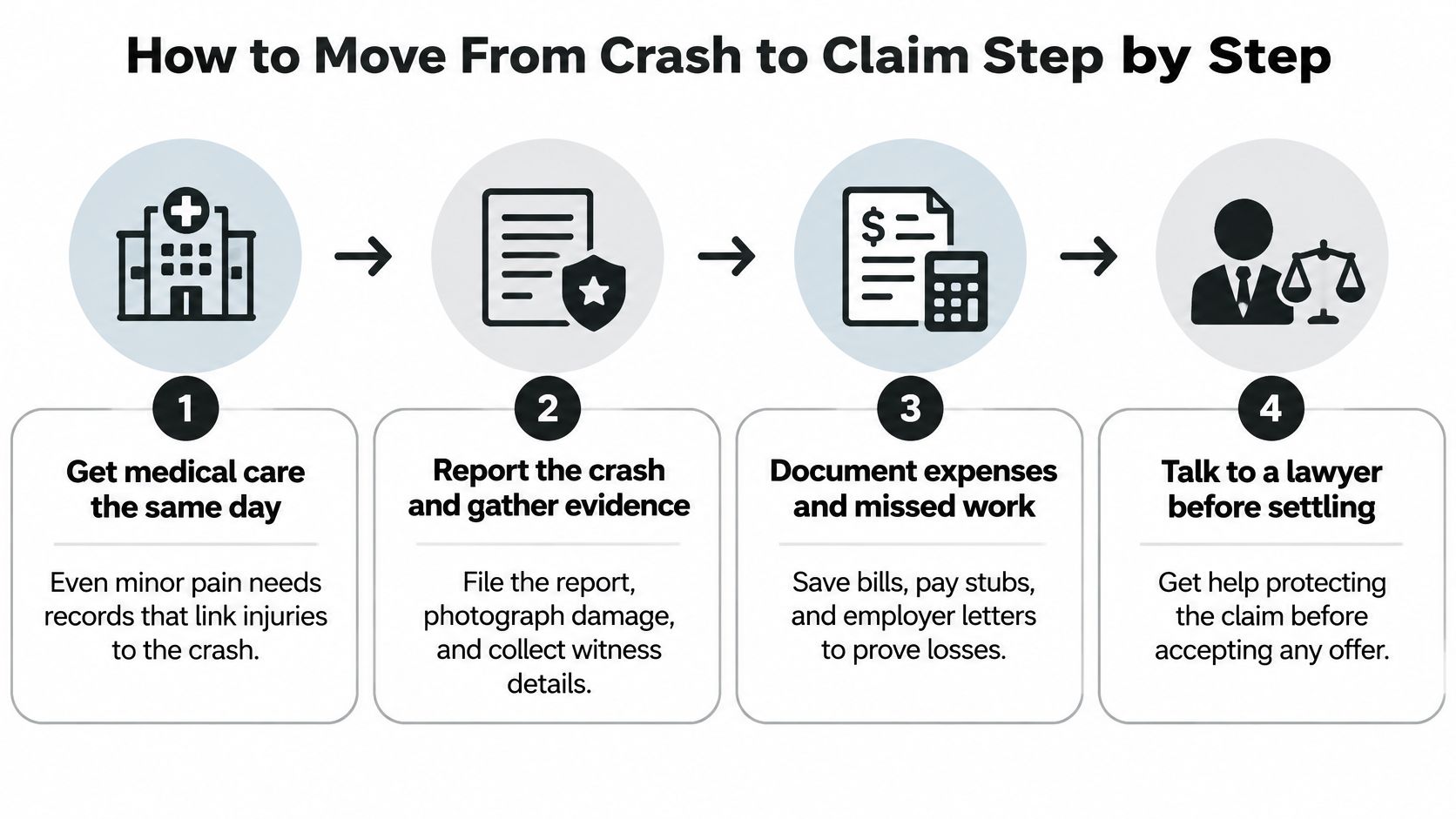
How to Move From Crash to Claim Step by Step
Start with your health, then preserve the information that explains what happened and what it cost you. You don’t need a perfect file before seeking help.
This visual summarizes the main tasks from medical care through representation.
Actions that protect the claim
-
Get medical care the same day. Even if pain seems minor, seek an appropriate evaluation and explain that you were in a collision. Treatment protects your health, while the resulting records document your symptoms and their timing.
-
Get the police report number and officer’s name. Keep them with the crash date and location so you can request the correct report. Don’t assume the report contains every detail you’ll need.
-
Photograph and identify evidence safely. Capture vehicles, road markings, the wider scene, and visible injuries without entering traffic or delaying care. Collect witness names and phone numbers because an independent account can clarify conflicting descriptions.
-
Create an expense and work-loss file. Save medical bills, prescriptions, travel mileage, pay stubs, and employer correspondence about missed work. Keep the original documents and a simple log explaining each expense.
-
Notify your insurer of the basic facts. Don’t give a recorded statement or sign a release until you understand the questions and terms. If language is a barrier, request interpretation promptly rather than ignoring communications or policy obligations.
-
Discuss the claim with a lawyer. We can review what happened, explain injury claim options in plain language, and communicate with insurers on your behalf. Our car accident injury claim guidance can help you organize questions before that conversation.
-
Prepare for negotiation and possible litigation. We first negotiate a settlement with the insurance company; if an agreement isn’t reached, the matter may proceed to litigation. Many personal injury cases we handle take six months to settle, and some lawsuits could take up to three years, but those are not promises for your case.
Ask for a case-specific timeline and what could change it. Treatment progress, missing records, coverage disputes, and the need to file suit can affect the next step.
The following video provides another format for reviewing the process.
Bring the police report, the at-fault driver’s policy declarations page, and your medical records to a consultation if available. If you don’t have a document, identify what’s missing rather than postponing the appointment.
Statements, Releases and Exams in Spanish
Language mistakes can change the apparent meaning of your account. The protective step is not just requesting Spanish. It’s ensuring that the final record reflects what you intended.
Where misunderstandings cause problems
Recorded statements. An unclear question can produce an answer that sounds more certain than you intended. Before answering an insurer’s recorded questions, request a Spanish-language call or qualified interpreter; if you need time, ask to respond in writing and confirm whether that arrangement is acceptable.
Medical examinations. A summary such as mild discomfort may leave out that you can’t stand through a work shift. Request an interpreter from the provider or examiner, describe symptoms and limitations in your own words, and ask how to correct any inaccurate history.
Releases and settlement papers. A payment amount doesn’t explain everything you’re giving up. Never sign a release you can’t read in full; request a Spanish copy and an explanation of the claims, people, and obligations it covers before responding to deadline pressure.
Mediation and testimony. Misinterpreted testimony can distort dates, distances, or symptoms. Request a qualified interpreter early through the appropriate attorney or court process, speak in manageable sentences, and say when you don’t understand.
Don’t guess to keep a conversation moving. Asking for clarification is more accurate than agreeing with words you don’t understand.
Bring a preparation packet
- Dated symptom notes: Include pain, limitations, treatment, and changes.
- Written questions: List unfamiliar terms and decisions you need explained.
- Existing documents: Bring letters, forms, and papers you’ve already received.
- Translation requests: Identify missing Spanish versions before the appointment.
Interpretation during a proceeding doesn’t automatically provide written translations of the documents used there. Confirm both needs separately.
Insurance Limits That Decide What Is Collectible
California auto coverage limits at a glance
The liability minimums below are described by the California Department of Insurance, and the policy comparison amounts come from its basic and increased-limits examples.
| Coverage | Basic minimum policy | Increased-limits example | What it covers |
|---|---|---|---|
| Bodily injury liability | $30,000 per person / $60,000 per accident | $100,000 per person / $300,000 per accident | Injuries the at-fault driver causes to others |
| Property damage liability | $15,000 per accident | $50,000 per accident | Damage to other vehicles and property |
| Uninsured/underinsured motorist bodily injury | $30,000 per person / $60,000 per accident | $30,000 per person / $60,000 per accident | Your injuries when the other driver has no or too little coverage, subject to policy terms |
| Uninsured motorist property damage | Up to $3,500 | Confirm whether included in the policy | Only if the uninsured at-fault driver is identified |
| Medical payments | $2,000 | $5,000 | Covered medical costs regardless of fault |
The table’s basic column includes coverage examples, not a statement that every listed benefit is mandatory. Your declarations page identifies what you purchased.
Say two passengers are injured under the minimum liability policy shown: they share the bodily-injury accident pool, subject to the individual limit. They don’t each receive the full accident limit, and losses beyond that pool require investigation of other available coverage or recovery sources.
Policy limits are not settlement values. A limit describes available insurance under particular terms, not proof of fault, damages, or an automatic payment. Our guide to California minimum car insurance requirements helps distinguish compliance from adequate protection.
Audit the available coverage
- Obtain the at-fault driver’s declarations page. Check the named insured, vehicle, coverage types, and limits.
- Confirm coverage on the accident date. A current policy doesn’t necessarily establish coverage when the collision occurred.
- Review endorsements and coverage letters. An endorsement can change coverage; a reservation-of-rights letter identifies issues the insurer is preserving.
- Check your own uninsured and underinsured motorist coverage. Review applicable household, employer, or commercial policies rather than assuming the other driver’s policy is the only source.
Request declarations pages, endorsements, written coverage positions, and any reservation-of-rights correspondence in writing. Ask for explanations of unfamiliar terms before treating a verbal coverage description as complete.
What a Claim Can Recover and How Fault Is Split
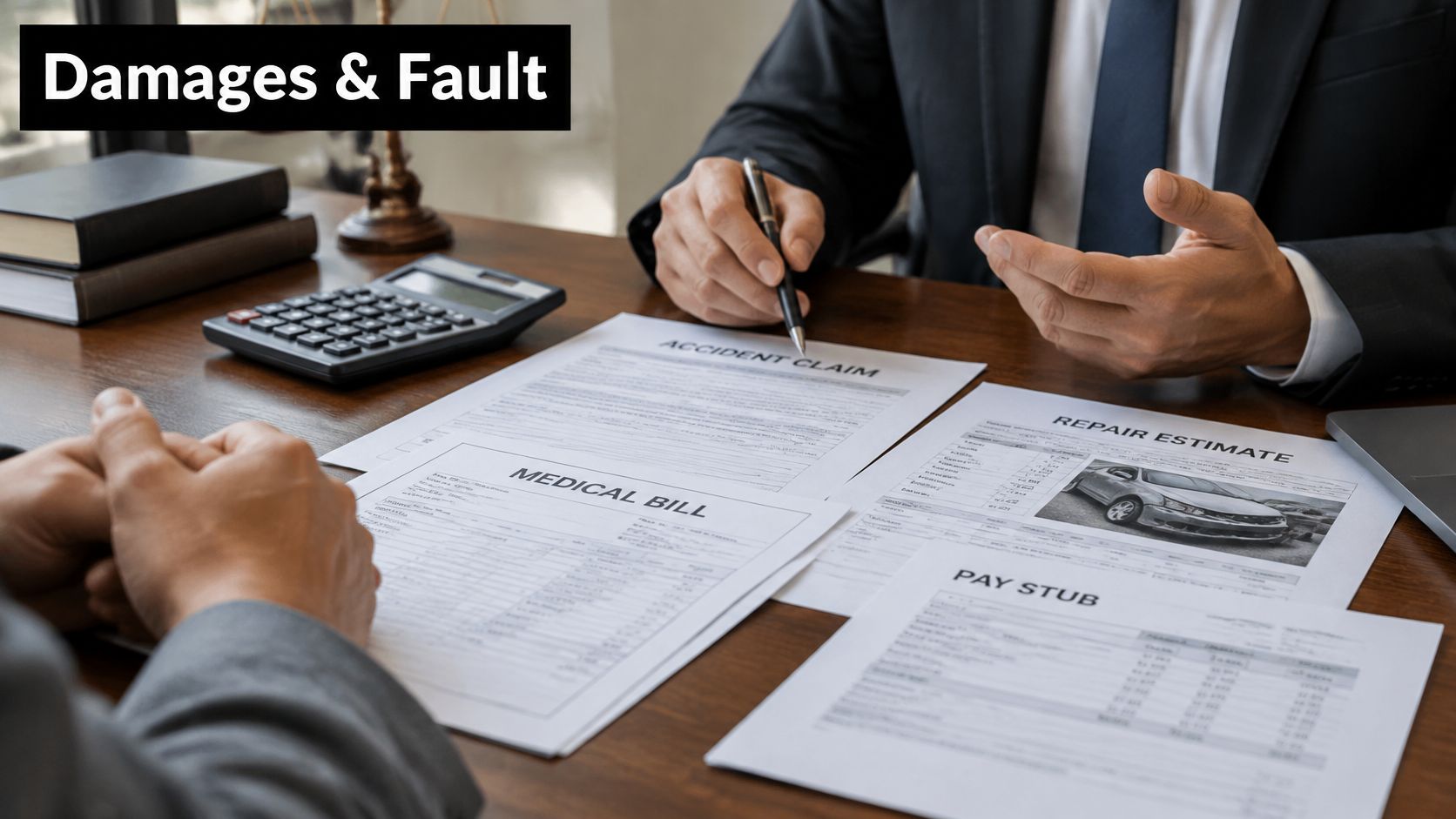
Economic damages address financial losses such as medical and surgical bills, recovery costs, and lost wages. We seek reimbursement for these losses using records such as invoices, pay stubs, and employer letters.
Non-economic damages address pain, suffering, and emotional distress. For some cases, we determine a proposed amount by applying a multiplier to economic damages, but that approach isn’t a guaranteed formula or a substitute for documenting the injury’s effects.
Reviewing the paperwork means separating documented losses from disputed assumptions.
A worked fault example
Under California Civil Code section 1431.2, each defendant’s liability for non-economic damages is limited to that defendant’s assigned fault share; for example, 40% and 60% fault applied to $100,000 in non-economic damages produces allocations of $40,000 and $60,000.
Those are hypothetical allocations, not predicted payments. The rule concerns non-economic liability and shouldn’t be treated as a universal formula for every category of damages.
If you share responsibility for the crash, your recovery is reduced according to your assigned share of fault. That makes the explanation of how the collision occurred as important as the total amount of your bills.
Useful evidence includes:
- Photographs and footage: Vehicle positions, impact damage, road markings, and traffic-camera recordings.
- Witness accounts and reports: Descriptions that connect a specific driving act to the collision.
- Reconstruction analysis: Examination of collision mechanics when the parties dispute how events unfolded.
Two numbers deserve close attention when evaluating collection: the fault split and the insurance available to pay the claim.
For another explanation of valuation factors, you can assess accident claim value with Ares. Use that resource to prepare questions, not as a promise of what your individual claim will recover.
Rideshare, Hit-and-Run and Uninsured Driver Cases
Special crash types and where recovery may come from
| Case | Possible sources of recovery | What to verify | Main risk |
|---|---|---|---|
| Rideshare passenger | At-fault driver’s liability policy; possible platform coverage if the app was active | App status at the time of the crash and policy terms | Coverage layers may be disputed |
| Hit-and-run | Your uninsured motorist bodily-injury coverage | Police report and witness details | Property damage benefit may not apply if the driver is unidentified |
| Uninsured at-fault driver | Your uninsured motorist coverage | Your declarations page limits | Limits may be lower than medical costs |
| Underinsured at-fault driver | At-fault driver’s liability plus applicable underinsured coverage | The other driver’s declarations page | Per-accident limits are shared with other injured people |
| Pedestrian or bicycle crash | At-fault driver’s liability; your own policy if applicable | Whether your policy covers you on foot or on a bicycle | The driver’s policy limits can restrict that source of recovery |
Verify the facts that trigger coverage
Rideshare passengers should preserve trip receipts, screenshots, driver information, and the platform’s crash correspondence. App activity and trip status help determine which policy may respond, but an active app alone doesn’t establish every coverage condition.
Pedestrians and cyclists shouldn’t assume their own automobile policy is irrelevant because they weren’t driving. Have the policy reviewed for applicable protection, while documenting the driver’s identity and the collision circumstances.
Hit-and-run claims require careful separation of injury coverage from property coverage. The California Department of Insurance’s automobile insurance guide explains that uninsured motorist property-damage coverage requires identification of the uninsured at-fault driver, so preserve witness details and available footage without trying to pursue the fleeing vehicle.
Uninsured and underinsured claims require a review of your own policy’s conditions, exclusions, and limits. Our guidance on an accident with an uninsured driver can help you organize the information needed for that review.
We help injured people with car accidents, rideshare crashes, pedestrian and bicycle injuries, and premises claims. For these automobile-related situations, we examine the specific trip facts and policy language rather than assuming that a possible coverage source must pay.
Book Your Case Review This Week
First, calendar the filing deadline. California generally gives two years to commence a personal injury or wrongful death action under Code of Civil Procedure section 335.1. That concerns filing the lawsuit, not merely submitting an insurance claim; exceptions and other deadlines, including those involving public entities, require individual review.
Next, gather your records. Bring the police report, available declarations pages, medical records, and a list of missed work. Include unanswered insurer letters so the attorney can identify pending requests.
Then, book a consultation. Bring your questions about Spanish communication, interpretation, translated documents, and fees. Request the fee arrangement and deadline analysis in writing before deciding how to proceed.
Our first consultation is free and confidential, with the attorney who will handle the matter. We review your options and can travel to your home or hospital if needed.
This article is for informational purposes only and must not be construed as legal advice. Reviewing it creates no attorney-client relationship, and none of the information in this article is legal advice.
LA Law Group, APLC offers a free, confidential attorney consultation to review your accident and explain your injury claim options. Visit LA Law Group, APLC to arrange a case review, request Spanish-language communication, and bring your insurance papers and questions about next steps.
Attorney Advertising. This article is general information, not legal advice, and does not create an attorney-client relationship. Prior results do not guarantee a similar outcome.