
Washington Wrongful Termination: Your Rights Explained
If you believe your Washington firing involved discrimination or retaliation, the Washington State Human Rights Commission generally gives you 180 days, while the EEOC generally allows 300 days for discrimination-related charges. Retaliation complaints to Washington Labor & Industries generally have a 180-day window, and some worker-rights complaints may have a three-year limit.
You may have been fired yesterday, but the questions often begin earlier. Perhaps your employer ended your job after you complained about unpaid wages, reported a safety concern, requested protected leave, or objected to discriminatory conduct. Now you’re looking at your final paycheck and wondering whether the decision was unfair or legally wrongful.
Washington is an at-will employment state, but at-will employment doesn’t give an employer permission to fire someone for an illegal reason. Washington recognizes a public-policy exception for certain firings, and state and federal laws prohibit retaliation for exercising protected rights or reporting certain workplace violations. The Washington Department of Labor & Industries explains that employees can’t be fired or retaliated against for exercising protected rights or filing complaints under certain employment laws (Washington Labor & Industries termination and retaliation guidance).
This article walks through four practical questions: What makes a termination wrongful? Which personal traits and workplace activities receive protection? What evidence can show that the protected conduct caused the firing? Where should you file, and which deadline controls?
This article is for informational purposes and isn’t to be construed as legal advice. No attorney-client relationship exists based on your review of this article, and none of the information in this article is legal advice.
What Just Happened and What This Article Covers
Your manager may have called you into a short meeting, handed you a termination letter, and offered little explanation beyond “business reasons” or “performance concerns.” Your work email may already be disabled. Your final paycheck may be sitting on the kitchen table while you try to remember every conversation that came before the firing.
That uncertainty is common, but the first legal question isn’t whether the employer’s decision felt harsh. The question is why the employer made the decision. Washington generally permits an employer to end an at-will employment relationship without cause, but the employer can’t terminate you for an illegal reason.
The two exceptions that matter first
The first major exception is Washington’s common-law public-policy rule. In simple terms, an employer may face liability if it fires a worker for exercising an important legal right, performing a duty the law protects, reporting unlawful conduct, or refusing to participate in illegal conduct. The second is a statutory anti-retaliation rule. For example, the Washington Law Against Discrimination prohibits retaliation for opposing discriminatory practices, and similar protections apply to other legally protected complaints and activities.
Those exceptions can turn an apparently ordinary at-will firing into a potential wrongful-termination claim. The label alone doesn’t decide the case. The facts, the legal theory, the employer’s size, and the evidence all matter.
Practical rule: Start with the protected event, not the termination label. Ask what you did or what protected characteristic may have influenced the decision, then identify the deadline attached to that theory.
Four questions to answer
- Definition: Was the firing connected to discrimination, retaliation, public policy, a protected right, or an employment agreement?
- Protection: Did the facts involve a protected category or activity?
- Causation: Can you show that the protected fact played a meaningful role in the decision?
- Routing: Should you begin with the Washington State Human Rights Commission, the EEOC, Labor & Industries, or a court?
Those questions help you avoid a common mistake: waiting for a complete answer before preserving evidence. You can protect documents and calendar deadlines while you investigate the legal theory.
This article explains the general framework. It can’t determine whether your employer acted unlawfully, which claim applies to your facts, or whether you should file a lawsuit.
How Washington Defines Wrongful Termination
Wrongful termination means an employer ended someone’s employment in violation of a law, a clearly recognized public policy, or an enforceable employment agreement. “Wrongful” is a legal conclusion, not just a description of rude or unfair treatment. A harsh manager, poor evaluation, or sudden layoff may cause real harm without breaking employment law.
Washington generally follows at-will employment. The relationship works like an arrangement either side may end without proving cause, unless a contract, law, or recognized exception limits that power. An employer therefore may make difficult business decisions, but cannot use the at-will rule as cover for discrimination, retaliation, or conduct that conflicts with an important legal policy.
The public-policy foundation
The Washington Supreme Court recognized the state’s wrongful-discharge tort in Thompson v. St. Regis Paper Co. in 1984. That decision established a narrow public-policy exception to at-will employment. It supports claims in which the termination is connected to an activity or right that the law strongly protects. A general belief that an employer acted unfairly is not enough.
Public policy is the principle that some interests matter beyond the private workplace. An employee may have a claim after exercising a statutory right, refusing to commit an illegal act, or taking action that serves a clearly established public purpose. The worker must still connect that protected interest to the employer’s decision. Washington’s termination and retaliation materials explain the at-will framework and its limits.
Statutory claims and related theories
Some wrongful-termination claims come directly from statutes rather than the common-law public-policy doctrine. Examples include discrimination under the Washington Law Against Discrimination, retaliation involving wages, family or medical leave, workplace safety complaints, and other worker protections. Each statute can define its own protected conduct, covered employer, required proof, and filing deadline. A practical overview of these statutory and common-law paths appears in Washington termination and wrongful-termination laws.
Washington courts also developed the public-policy theory in Wilmot v. Kaiser Aluminum in 1991. The court allowed a wrongful-discharge claim based on retaliation for a workers’ compensation claim, even though the claim did not depend solely on the text of the compensation statute. That example shows why the same firing may involve more than one legal theory.
Constructive discharge is a related but separate concept. The employee resigns instead of being directly fired, claiming that working conditions became intolerable. A difficult supervisor or unpleasant workplace does not automatically meet that demanding standard.
Protected Categories and Protected Activities
A termination can look ordinary on paper while raising a legal question underneath. For example, an employer may cite “performance,” but the employee had recently reported unsafe conditions or requested medical leave. To sort out what happened, separate the analysis into two buckets: who the employee is and what the employee did.
Protected categories
The first bucket covers personal characteristics protected by law. The Washington Law Against Discrimination identifies categories including race, color, creed, religion, national origin, sex, disability, marital status, HIV infection, use of a trained guide or service dog, and military status. Depending on the claim and applicable law, protections may also involve age, sexual orientation, gender identity, citizenship, veteran status, and other traits (Washington wrongful-termination legal framework).
Employer coverage is part of the same question. The WLAD generally covers employers with eight or more employees, while federal laws may use different thresholds, including 15 employees for ADA coverage and 50 employees for FMLA coverage (Washington employment law thresholds and termination rules). Employer size can therefore determine which legal path is available. Count the employer’s workforce carefully rather than assuming that one statute’s coverage applies to every claim.
Protected activities
The second bucket concerns conduct the law protects. Examples include filing or discussing a wage complaint, reporting a safety problem, requesting family or medical leave, participating in an investigation, testifying about unlawful conduct, pursuing a workers’ compensation claim, or refusing to participate in illegal activity. Retaliation rules can protect the complaint itself, not only the underlying workplace problem (Washington Labor & Industries retaliation guidance).
| Category | What It Means | Key Washington Source |
|---|---|---|
| Protected categories | The employer allegedly relied on a protected trait, such as race, disability, religion, sex, age, or military status. | Washington Law Against Discrimination |
| Protected activities | The employee exercised a legal right, made a protected complaint, participated in an investigation, or refused illegal conduct. | Labor & Industries and applicable retaliation statutes |
| Public-policy conduct | The firing allegedly conflicts with a clear public policy recognized by Washington law. | Washington common law and Washington Supreme Court decisions |
A protected activity does not need to be the employer’s only reason for termination. The practical question is whether it was a meaningful reason. Preserve the timing, wording, and records surrounding the activity, because those details help distinguish retaliation from an unrelated employment decision.
What You Must Prove to Win a Claim
A Washington plaintiff generally needs to establish three connected elements. The exact test can vary by claim, but the practical structure is straightforward.
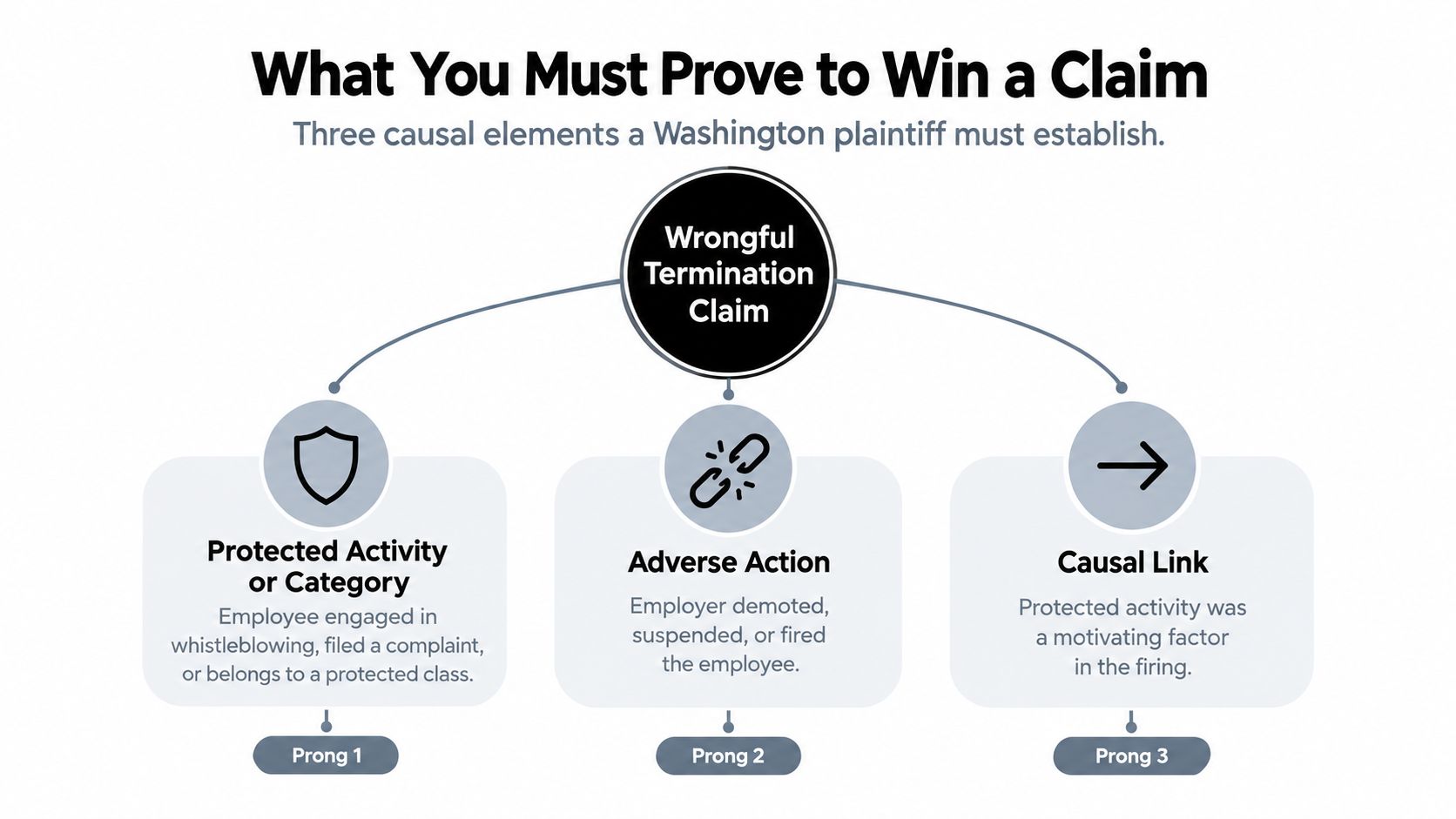
First, identify the protected right or status
You need evidence that you engaged in protected conduct or that a protected characteristic was involved. Useful records may include a wage complaint, an email to human resources, a safety report, a workers’ compensation filing, a request for protected leave, or a notice connected to jury service.
For a discrimination theory, the evidence may instead involve comments, unequal treatment, hiring or promotion records, performance reviews, or information showing that the employer treated similarly situated workers differently.
Second, prove the adverse action
The adverse action may be termination, but it can also include a demotion, suspension, or another serious employment consequence. Preserve the termination letter, meeting notes, final paycheck records, separation paperwork, and any negative review created shortly before the firing.
A personnel document that says one thing while the employer’s earlier records say another can matter. For example, a sudden performance memo may carry less persuasive force if prior reviews consistently described the employee’s work positively and no earlier discipline exists.
Third, connect the two
The causal link is usually the hardest part.
Timing can help. So can a manager’s retaliatory statement, an HR email acknowledging the complaint, or inconsistent enforcement of workplace policies. But close timing alone may not resolve the issue. You need to compare the employer’s stated reason with the surrounding documents and treatment of other employees.
A strong complaint and a clear termination notice still may not prove wrongful termination if the evidence doesn’t connect the two events.
For a related discussion of liability questions involving worker classification and business conduct, see this guide to independent contractor liability.
Where to File and How Long You Have
A valid claim can fail if it reaches the wrong forum after the applicable deadline. The deadline depends on the legal theory, and one termination may involve more than one possible route.
The Washington State Human Rights Commission generally allows six months, or 180 days, from the discriminatory act to file a discrimination complaint. In Washington, the EEOC generally allows 300 days for discrimination-related charges because Washington is treated as a deferral state. Retaliation complaints to Washington Labor & Industries generally have a 180-day filing window, while other worker-rights complaints may have a three-year limit (Washington wrongful-termination deadlines and claim routing).
| Claim Type | Forum | Deadline |
|---|---|---|
| Discrimination complaint under Washington law | Washington State Human Rights Commission | Generally 180 days |
| Federal discrimination-related charge | EEOC | Generally 300 days in Washington |
| Retaliation complaint | Washington Labor & Industries | Generally 180 days |
| Other worker-rights complaint | Washington Labor & Industries or another applicable forum | Some claims may have a three-year limit |
| Final wages | Employer’s regular payroll process | By the end of the next regular pay period |
The filing window for a state administrative complaint isn’t automatically the same as the deadline to file a lawsuit. A contract claim, wage claim, discrimination claim, public-policy claim, and workers’ compensation retaliation claim may follow different procedures. Don’t assume that filing one complaint preserves every possible theory.
A practical routing decision
If the facts point to discrimination or retaliation under Washington law, examine the Washington State Human Rights Commission and EEOC deadlines immediately. If the issue involves wages, safety, or another worker-rights complaint, examine the Labor & Industries route. If the claim depends on a contract or common-law public policy, a court filing and a consultation with an employment attorney may be necessary.
Filing with an agency first can be useful because it starts the administrative process and may preserve later options, but it isn’t a universal solution. For perspective on why limitation periods must be matched to the legal theory, review this explanation of statutes of limitation and claim deadlines. The California focus is different, so don’t transfer its rules to Washington.
Preserving Evidence Before the Deadline Hits
Deadlines and evidence work together. A filing made on time may still be difficult to pursue if the employee can’t show what happened, when it happened, and who knew about it.
Start with a simple preservation routine. Don’t alter records, access information you’re no longer authorized to use, or take confidential material belonging to customers or the employer. Preserve your own employment records lawfully and ask an attorney how to handle documents containing trade secrets or personal information.
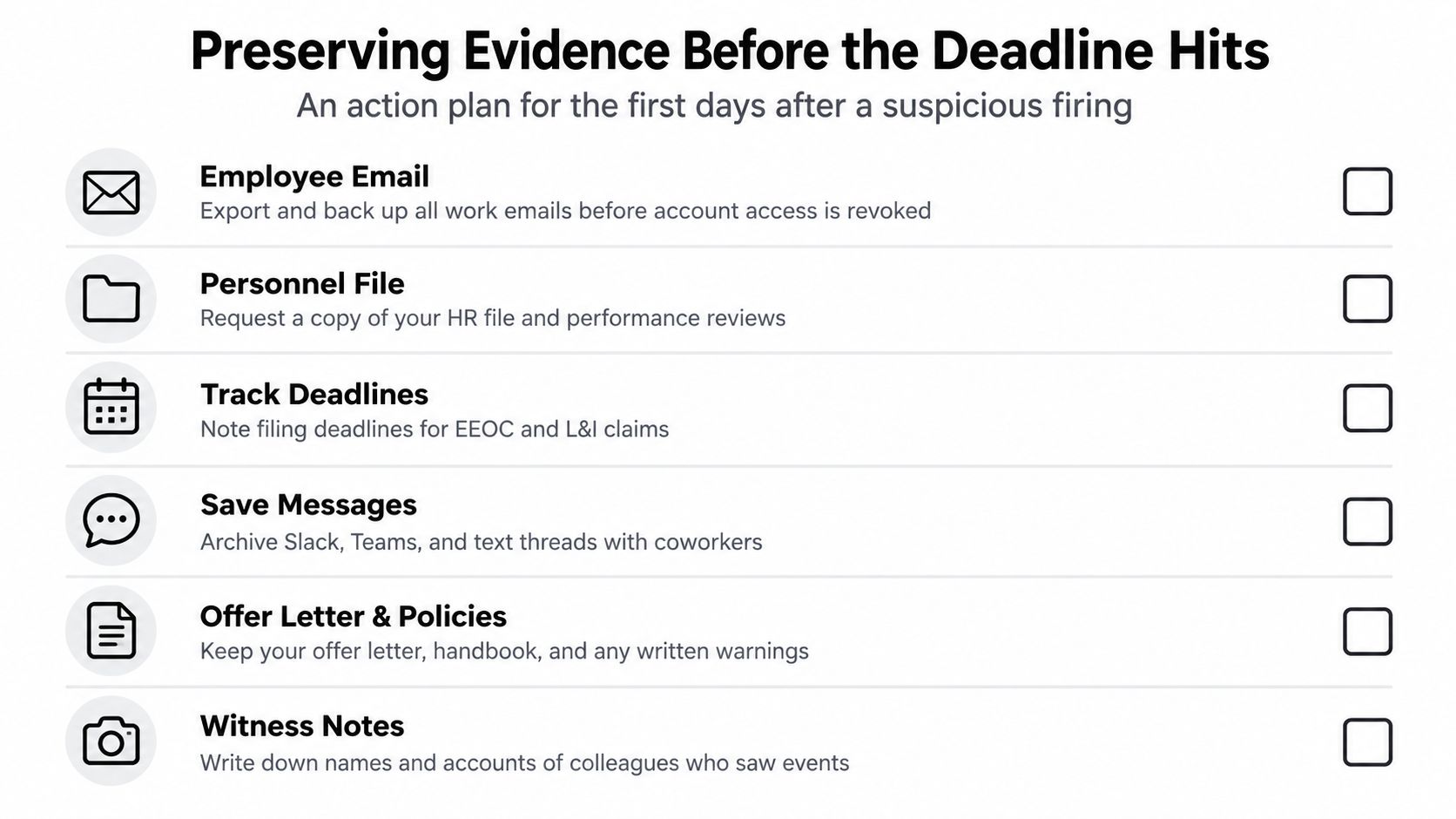
A first-days checklist
- Download permitted communications: Save emails, text messages, and workplace messages that concern complaints, leave requests, discipline, or the termination.
- Photograph physical documents: Capture termination letters, posted policies, schedules, written warnings, and your final paycheck records.
- Write a dated timeline: Record conversations, participants, exact phrases you remember, and what happened immediately afterward.
- List witnesses: Note coworkers, supervisors, HR personnel, and others who saw the events. Include reliable contact information you already lawfully possess.
- Request relevant personnel records: Ask for your personnel file and performance documents under the Washington Personnel Files Act where applicable. Washington guidance identifies personnel-file access as an important evidence issue, but the exact request process may depend on the record and employment circumstances.
- Keep separation paperwork together: Preserve the termination notice, benefits information, wage statements, and communications about the reason for separation.
- Stay off social media: Public posts can remove context, reveal private information, or create statements the employer may use against you.
Evidence preservation costs less than reconstructing events from memory. A clear record can help an attorney evaluate the claim and can make the employer’s explanation easier to test.
A Real-World Wrongful Termination Scenario
Consider Maya, a hospital billing clerk in Spokane. She sends a written complaint to HR stating that she believes the employer missed overtime payments. The HR email chain acknowledges the complaint, but three weeks later the hospital terminates her for a vague “performance issue.”
This is an illustrative composite, not a real case and not legal advice. Maya’s termination isn’t automatically unlawful, but the timeline raises questions under both a public-policy theory and statutory anti-retaliation protections connected to wage complaints. Washington’s framework recognizes retaliation tied to wage complaints and other protected workplace activities (Washington wrongful-termination overview and claim timing).
How the evidence fits
Maya begins with a documented protected event, the wage complaint. She also has proof of the adverse action, the termination notice. Her causation evidence includes the three-week gap, the HR email acknowledging the complaint, a negative performance memo created after the complaint, and the absence of earlier discipline.
That evidence doesn’t prove the employer’s intent by itself. The employer might argue that it discovered a legitimate performance problem. Maya’s attorney would need to compare the stated reason with earlier reviews, attendance records, discipline practices, and how the employer treated similar performance issues before her complaint.
Why claim routing matters
Maya may need to examine a Labor & Industries retaliation complaint because her theory concerns a wage-related protected activity. If the facts also suggest discrimination, a separate agency route may apply, including the EEOC or Washington State Human Rights Commission. The same timeline can therefore raise parallel legal questions, but each claim may carry its own elements and deadline.
The lesson isn’t that every termination soon after a complaint is retaliation. The lesson is that contemporaneous documents make the causal question concrete. Maya’s written complaint, the employer’s acknowledgment, the later performance memo, and the termination date tell a more useful story than a general statement that “my boss didn’t like me.”
Remedies, Next Steps, and Where to Get Help
Potential remedies depend on the claim, the evidence, the forum, and the facts of the loss. Depending on the applicable law, a successful claimant may seek back pay, front pay, reinstatement, emotional-distress damages under the Washington Law Against Discrimination, attorney fees and costs, and punitive damages where a statute permits them.
Back pay generally concerns wages lost after the termination. Front pay can address future earnings when returning to the job isn’t practical. Reinstatement means returning to an equivalent position, but the appropriate remedy depends on the relationship, workplace conditions, and legal authority available in the particular case.
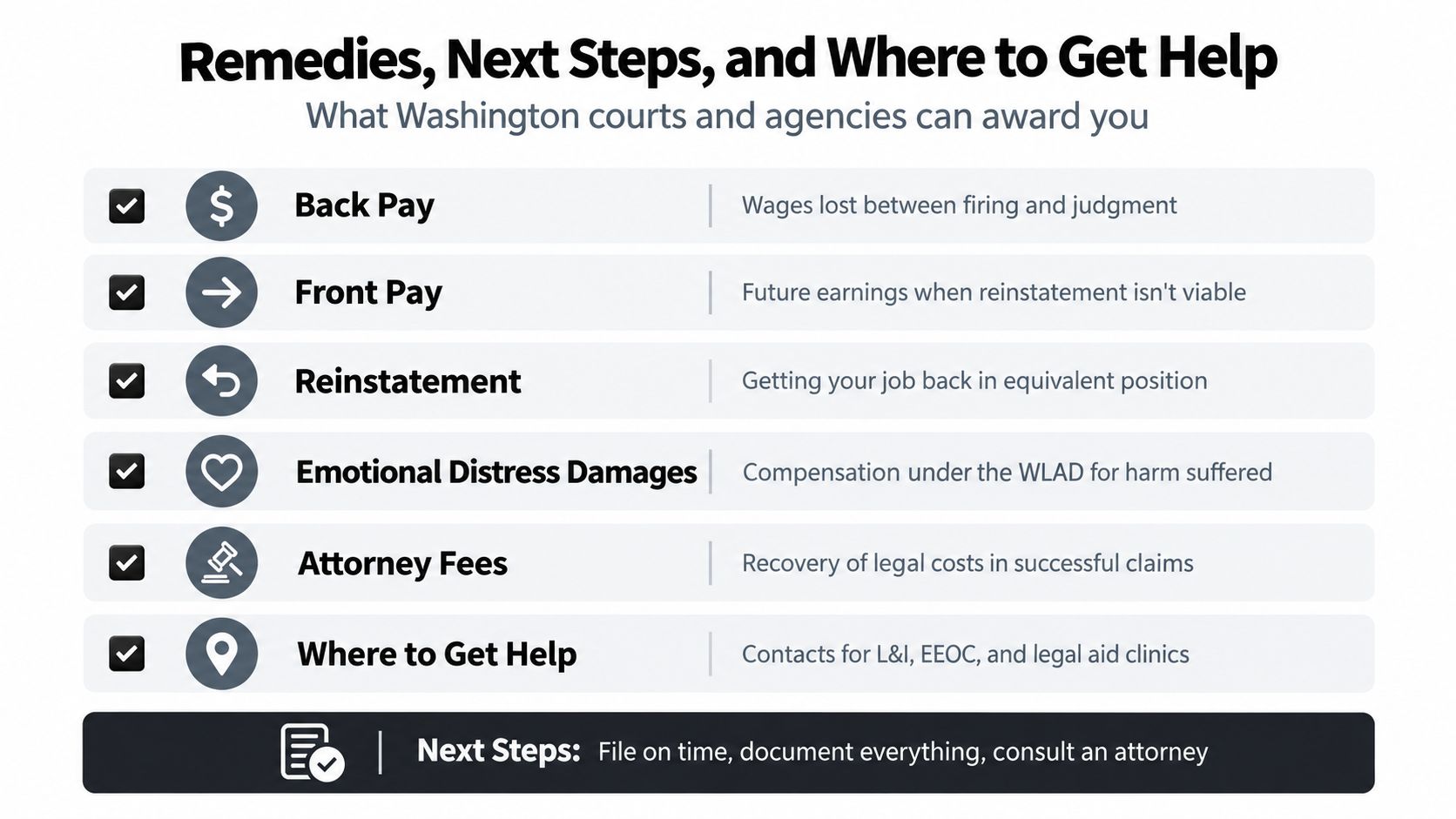
A practical next-step path
- Preserve documents now: Save lawful copies of communications, notices, evaluations, wage records, and your timeline.
- Identify the theory: Separate discrimination, retaliation, wage, safety, leave, workers’ compensation, contract, and public-policy issues.
- Calendar every deadline: Record the relevant agency and court windows, including the applicable 180-day, 300-day, or three-year period where it fits.
- Request personnel records: Use the applicable Washington personnel-file process and keep proof of your request.
- Choose the forum carefully: Consider Labor & Industries for qualifying worker-rights or retaliation issues, and the Washington State Human Rights Commission or EEOC for discrimination-related claims.
- Speak with a Washington employment attorney: An attorney can evaluate claim overlap, filing strategy, evidence, damages, and whether a fee-shifting rule may apply.
Useful starting points include the L&I Civil Rights Division, the EEOC Seattle Field Office, and the Washington State Bar Association lawyer referral service. When researching how to evaluate legal representation, you can also review this guide on finding a good personal injury lawyer, although wrongful-termination matters require an attorney familiar with employment law.
The following video provides additional general information:
This article is for informational purposes and isn’t to be construed as legal advice. No attorney-client relationship exists based on your review of this article, and none of the information in this article is legal advice. If you were recently fired, preserve your records and seek advice promptly because the correct agency and filing deadline may depend on facts that aren’t visible from the termination letter alone.
If your Washington termination may involve retaliation, discrimination, unpaid wages, or a public-policy violation, LA Law Group, APLC can help you organize the facts, assess your available legal options, and plan the next step. Visit LA Law Group, APLC to request an initial consultation and discuss your situation with the firm.
Attorney Advertising. This article is general information, not legal advice, and does not create an attorney-client relationship. Prior results do not guarantee a similar outcome.