
Understanding Hit and Run Laws in California A Practical Guide

Disclaimer: This article is for informational purposes and is not to be construed as legal advice. No attorney-client relationship exists based on the review of this article, and none of the information provided constitutes legal advice.
In California, the law on car accidents is crystal clear: if you’re involved in a collision, you must stop. Period. It doesn’t matter who was at fault or how minor the scrape seems. Leaving the scene is a serious crime, with penalties that can range from a misdemeanor all the way up to a felony conviction.
What’s the deciding factor? It all boils down to one critical question: Was anyone injured or killed?
Your Legal Duties After a California Collision
Disclaimer: This article is for informational purposes and is not to be construed as legal advice. No attorney-client relationship exists based on the review of this article, and none of the information provided constitutes legal advice.
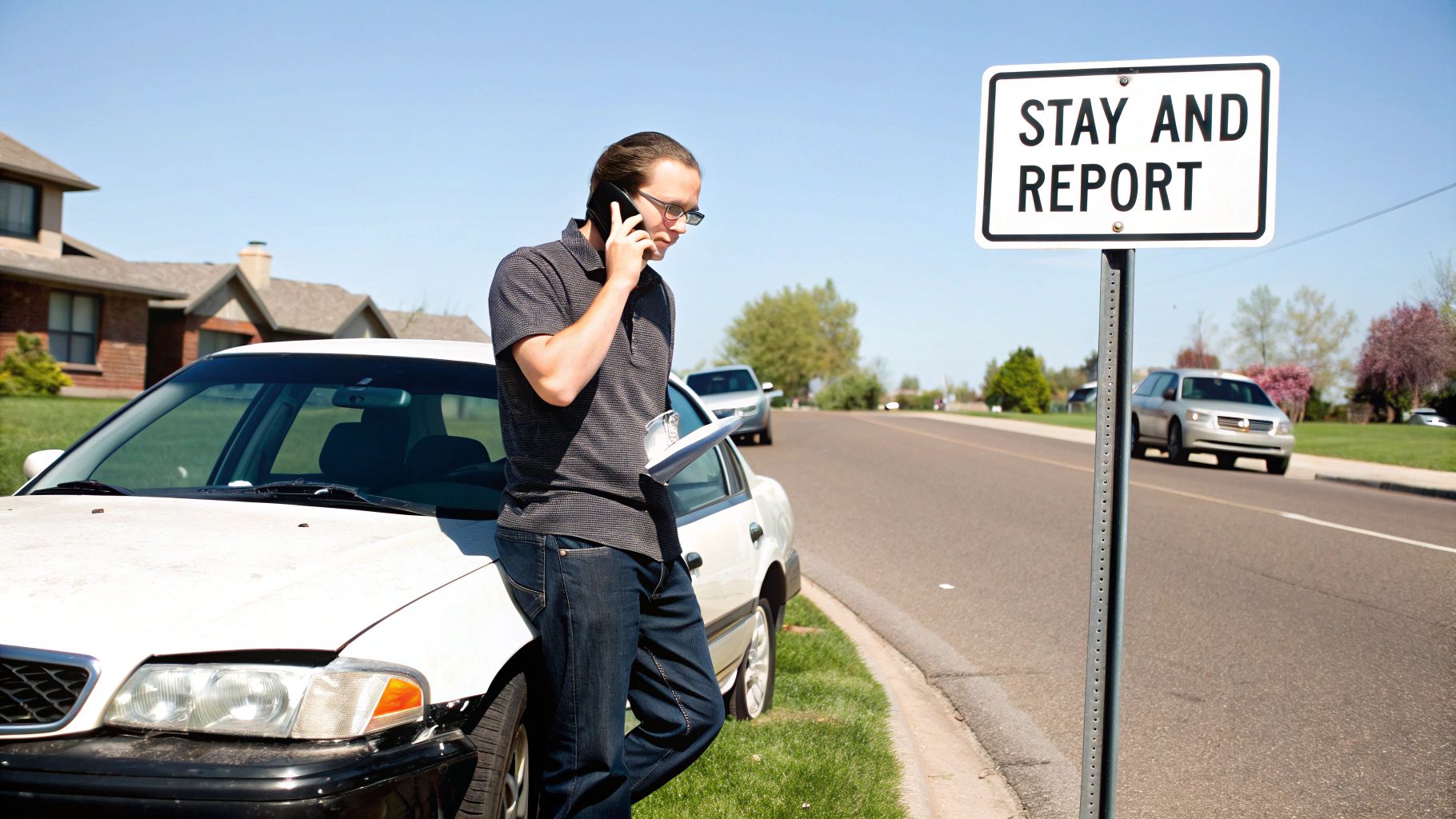
When an accident happens, a driver’s legal duties kick in immediately. You can think of it as a social contract we all agree to when we get behind the wheel. We follow specific rules in exchange for the privilege of driving. Fleeing the scene shatters that contract.
California law requires you to stop your car at or near the scene, give your information to the other people involved, and provide reasonable help if someone is hurt. This isn’t just a suggestion—it’s a legal mandate built to keep people safe and ensure accountability.
Property Damage vs. Personal Injury
The hit and run laws in California draw a very sharp line between accidents involving only property damage and those resulting in physical injury or death. This distinction is the single most important factor in figuring out the legal trouble a driver could be in.
-
Property Damage Only: If you hit a parked car, a fence, or another vehicle with no one inside, the law sees it as a property damage incident. Your job is to find the owner. If you can’t, you must leave a note in a place where they’ll see it, with your name, address, and a quick explanation of what happened.
-
Injury or Fatality: If another person is injured—even if it seems minor—or killed in the crash, the situation becomes much more serious. Your legal duties expand significantly. You now have a responsibility to render aid, which could mean calling 911 or, if necessary, helping transport the injured person to get medical care.
The core difference lies in the potential for harm. Damaging property is a financial issue, but causing injury is a matter of public safety and personal well-being, which the law treats with much greater severity.
Getting a handle on this difference is the first step to understanding what happens legally after a hit-and-run. The table below breaks down how these two scenarios lead to very different charges.
California Hit and Run At a Glance: Misdemeanor vs. Felony
| Aspect | Misdemeanor (Property Damage VC 20002) | Felony (Injury or Death VC 20001) |
|---|---|---|
| Triggering Event | Collision causes damage to any property or vehicle. | Collision results in any injury or death to a person. |
| Primary Duty | Stop and exchange information or leave a secure note. | Stop, provide ID, and render reasonable assistance. |
| Legal Classification | Typically charged as a misdemeanor crime. | Can be charged as a misdemeanor or a felony (“wobbler”). |
| Potential Penalty | Up to 6 months in county jail and/or fines up to $1,000. | Up to 4 years in state prison and/or fines up to $10,000. |
Breaking Down California Vehicle Codes 20001 and 20002
Disclaimer: This article is for informational purposes and is not to be construed as legal advice. No attorney-client relationship exists based on the review of this article, and none of the information provided constitutes legal advice.
To really understand hit-and-run laws in California, you have to look at the rulebook every driver is expected to follow: the California Vehicle Code. Two sections, in particular, form the backbone of these laws: Vehicle Code 20002 for property damage and Vehicle Code 20001 for accidents involving injury or death.
Think of them as two different levels of responsibility. The law changes its demands based entirely on the human element—whether someone was hurt. Understanding the difference between these two codes is the first step in seeing why the legal consequences can escalate so dramatically from a simple fender-bender to a serious collision.
Vehicle Code 20002: Your Duty When Property is Damaged
California Vehicle Code 20002 deals with the most common kind of hit-and-run—an accident where only property is damaged. Picture this: you’re trying to back out of a tight spot in a parking garage and you hear that awful crunch of metal against metal. You’ve scraped the car next to you. No one’s hurt, but there’s a clear dent and paint transfer.
Your legal duty here is crystal clear. Under VC 20002, you can’t just drive off and pretend it didn’t happen. The law requires you to stop right there and make a real effort to find the owner of the damaged car or property.
What if they’re nowhere to be found? Your job isn’t done. The law says you must:
- Leave a written note in a secure, obvious spot on the vehicle.
- The note has to include your name and address.
- It also needs a quick explanation of what happened.
- After leaving the note, you must report the accident to the local police or the California Highway Patrol as soon as possible.
The whole point of this law is accountability. Even a minor dent is someone else’s problem, and VC 20002 makes sure the responsible driver steps up so the other party isn’t left holding the bag for repairs.
Ignoring these steps turns a simple mistake into a misdemeanor crime. The penalties are serious and can include up to six months in county jail, a fine of up to $1,000, or both. That’s a steep price to pay for what started as a minor accident.
Vehicle Code 20001: The Higher Stakes of an Injury Accident
Now, let’s look at a much more serious situation, one governed by California Vehicle Code 20001. This law kicks in the second an accident causes any injury—even a minor one—or tragically, a death. Imagine a driver hits a cyclist in a bike lane. The moment a person is hurt, the legal requirements become much, much stricter.
Under VC 20001, your duties go far beyond just leaving a note. The law demands that you stop immediately at the scene and take several crucial actions:
- Provide Identification: You are required to give your name, current address, vehicle registration number, and the car owner’s name to the injured person and any police officer at the scene.
- Show Your License: If asked, you must present your driver’s license.
- Render Reasonable Aid: This is the most critical part. You have a legal duty to provide “reasonable assistance” to the injured person. This almost always means calling 911 right away and could include helping to transport them for medical treatment if necessary.
The legal system puts human life and safety above everything else. Violating VC 20001 is a “wobbler,” which means prosecutors can charge it as either a misdemeanor or a felony, depending on how badly the person was hurt. A felony conviction can result in up to four years in state prison and fines as high as $10,000.
California has been ground zero for the nation’s hit-and-run crisis for years, with statistics that are truly shocking. In 2016, the state saw 337 deaths from hit-and-run crashes, which was a 60% jump from 2009. More recently, there are roughly 40,000 hit-and-run crashes every year, injuring over 19,000 people annually. That’s more than 52 victims every single day. You can find more data on this disturbing trend and how it affects victims’ rights.
The True Cost of a Hit and Run Conviction
Disclaimer: This article is for informational purposes and is not to be construed as legal advice. No attorney-client relationship exists based on the review of this article, and none of the information provided constitutes legal advice.
Getting a conviction for a hit and run in California isn’t like dealing with a simple traffic ticket. Far from it. This is a serious criminal offense that leaves a permanent mark on your record, setting off a chain reaction of consequences that can impact your freedom, your bank account, and your entire future.
The law draws a very sharp line between accidents that only involve property damage and those where someone gets hurt. That single distinction is what separates a misdemeanor charge from a life-altering felony, and the penalties climb steeply from there. To truly understand what’s at stake, you have to look at the full picture.
Immediate Criminal Penalties
When a judge hands down a guilty verdict, the first thing you’ll face are the direct criminal penalties. These aren’t suggestions; they’re punishments enforced by the state, and their severity is tied directly to the specific vehicle code you’ve violated.
A misdemeanor conviction under VC 20002, which applies to property damage cases, typically involves:
- Up to six months behind bars in county jail.
- Fines and court fees that can add up to $1,000.
- An automatic two points added to your DMV driving record.
But if someone was injured or killed, you’re looking at a felony conviction under VC 20001. The stakes get exponentially higher:
- Up to four years in a California state prison.
- Fines and assessments that can soar as high as $10,000.
- A permanent felony record that will follow you for the rest of your life.
The difference is stark: a misdemeanor can throw your life into chaos for a few months, but a felony can define it for decades. And the court’s sentence is just the beginning.
Criminal Penalties for California Hit and Run Convictions
To see just how different these outcomes can be, it helps to put them side-by-side. This table breaks down the potential criminal sentences for misdemeanor versus felony hit and run convictions.
| Penalty Type | Misdemeanor (VC 20002) | Felony (VC 20001) |
|---|---|---|
| Maximum Jail Time | Up to 6 months in county jail | Up to 4 years in state prison |
| Maximum Fines | Up to $1,000 | Up to $10,000 |
| DMV Points | 2 points | 2 points (often leading to license suspension) |
| Criminal Record | Permanent misdemeanor record | Permanent felony record |
As you can see, the jump from misdemeanor to felony is massive, turning a bad situation into a potentially catastrophic one.
Hidden Consequences That Last for Years
The trouble doesn’t end when you leave the courtroom. A hit and run conviction sends ripples into almost every corner of your life, and these “hidden” costs often inflict more long-term damage than the initial fines or jail sentence.
First, get ready for your auto insurance rates to skyrocket. Insurance companies see a hit and run conviction as a massive red flag for high-risk behavior. Many will jack up your premiums to astronomical levels, while others might just cancel your policy outright. Good luck finding affordable coverage after that.
Next up is an almost certain driver’s license suspension. The DMV will move to suspend the license of anyone convicted of a felony hit and run. Even with a misdemeanor, those two points are often enough to push you over the edge into a suspension, especially if you have any other violations on your record.
Finally, that permanent criminal record becomes a huge barrier. Finding a decent job gets infinitely harder when employers see that conviction on a background check. Trying to rent an apartment? Many landlords will deny your application on the spot. This single mistake can slam the door on professional licenses, educational programs, and financial opportunities, creating a burden that you’ll have to carry for years to come.
A Victim’s Action Plan After a Hit and Run
Disclaimer: This article is for informational purposes and is not to be construed as legal advice. No attorney-client relationship exists based on the review of this article, and none of the information provided constitutes legal advice.
The moments after a hit and run are a chaotic mix of shock, anger, and confusion. It’s natural to feel completely overwhelmed, but taking a few specific, methodical steps right away can protect your health and give you the best shot at recovering your losses.
Your number one priority is always safety. If you’re in a safe spot, stay put. If your car is dangerously positioned—say, in the middle of a busy road—only move it if you can do so without creating another hazard. Flip on your hazard lights immediately to alert other drivers.
Become the Detective of Your Own Case
Once you are safe, it’s time to shift gears. Think of yourself as the lead detective at a crime scene, because that’s essentially what it is. Every tiny detail you can remember or document could be the key to tracking down the driver who fled.
Try to jot down everything you can about the other vehicle. Don’t stress about getting it perfect; even a fragment of information can be a huge help to the police.
- Vehicle Details: What was the make, model, and color? Was it a car, a truck, an SUV?
- License Plate: Did you catch the whole plate number? Even a partial plate—like the first three letters or the last few numbers—is incredibly valuable.
- Unique Features: Did you notice any bumper stickers, a roof rack, tinted windows, or existing damage? Anything that made the car stand out is important.
- Direction of Travel: Which way did they speed off? Note the street name and the direction they were heading.
After you’ve written down what you remember, pull out your phone and start taking pictures. Get shots of the damage to your car from every angle, the general scene, any debris left behind from the other car, and any injuries you have.
Take Official Action Immediately
With your initial evidence in hand, there are two steps that are absolutely non-negotiable: calling the police and getting medical attention.
You must report the accident to law enforcement. This creates an official police report, which is the cornerstone of any insurance claim you’ll need to file. Without it, you’re fighting an uphill battle.
Even if you think you feel fine, go see a doctor. Injuries from car accidents, especially things like whiplash or internal bruising, often don’t show symptoms for hours or even days. A medical evaluation creates a professional record tying your injuries directly to the accident—critical for both your well-being and any future legal claims. The financial and personal fallout from a hit and run can be massive, impacting your health, your wallet, and your peace of mind.
This flowchart shows just how quickly the costs of a hit and run can spiral out of control.
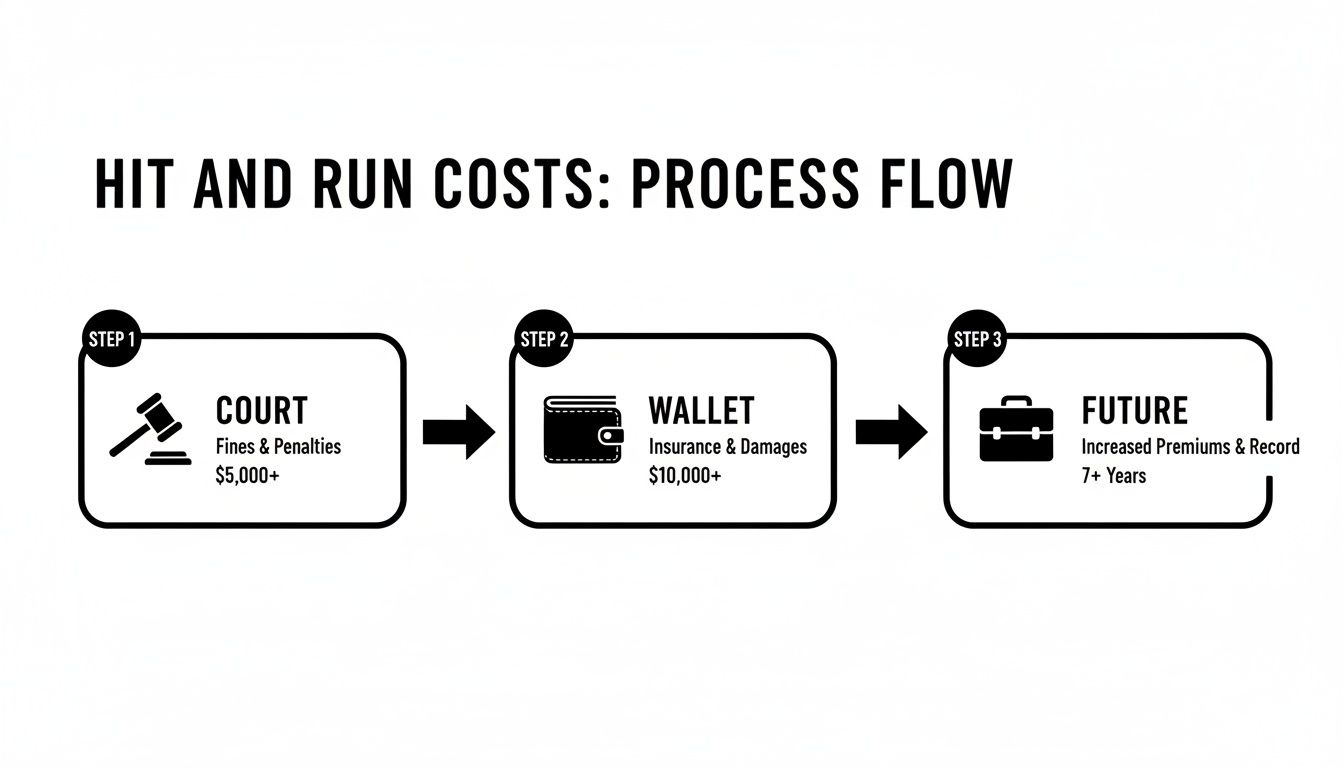
As you can see, the consequences ripple far beyond the initial crash, affecting your legal standing, finances, and long-term security. Understanding the process and knowing your rights is the first step toward taking back control. For a deeper dive, you can learn more about the complexities of hit and run car accidents and how to protect yourself.
How Victims Can Recover Financial Compensation
Disclaimer: This article is for informational purposes and is not to be construed as legal advice. No attorney-client relationship exists based on the review of this article, and none of the information provided constitutes legal advice.

When a hit-and-run driver takes off, they leave a messy situation behind—and not just a legal one for them. They actually kick off two separate legal battles. The first is the criminal case, where the state of California goes after the driver for breaking the law.
But the second battle is entirely yours: the fight for your financial recovery. It’s absolutely critical to understand that these two paths are separate. A criminal conviction for the driver doesn’t mean your medical bills magically get paid.
To get your losses covered, you have to file a civil claim. This is a completely different process from the criminal case and focuses on one thing: making you financially whole again. Think of it this way: the criminal court is there to punish the offender, while the civil court is there to compensate you, the victim.
Types of Damages You Can Claim
In a California personal injury claim, the money you can recover—legally known as “damages”—is broken down into two main categories. Each one is designed to address a different type of harm you’ve suffered.
Economic Damages
Economic Damages are the straightforward, calculable costs that have piled up because of the accident. These are tangible losses with receipts and price tags attached.
- Medical Bills: This covers everything. We’re talking about the initial ambulance ride and ER visit, plus any ongoing physical therapy, future surgeries you might need, and prescriptions.
- Lost Wages: If your injuries forced you to miss work, you can claim the income you lost while you were recovering.
- Property Damage: This is the cost to either repair or completely replace your vehicle and any other personal items that were wrecked in the crash.
Non-Economic Damages
Non-Economic Damages are much more personal and subjective, but they are just as real. They are meant to compensate you for the intangible suffering the accident has put you through. This can include things like pain and suffering, emotional distress, and loss of enjoyment of life.
You can’t put a price tag on physical pain or the emotional trauma of a hit-and-run, but the law recognizes how significant these losses are. A skilled attorney knows how to assign a fair monetary value to this suffering to make sure you’re compensated for the full impact of the accident.
Your Secret Weapon: Uninsured Motorist Coverage
So, what happens if the police never find the driver who hit you? This is a terrifying thought for many victims, but it’s where your own insurance policy can become your most powerful tool.
Many drivers in California have Uninsured/Underinsured Motorist (UM/UIM) coverage, often without even realizing how valuable it is.
This specific type of coverage is designed for this exact nightmare scenario. When the at-fault driver is a ghost or has no insurance, your own UM/UIM policy steps in and essentially acts as their insurance. It can cover your medical bills, lost wages, and even your pain and suffering, right up to your policy limits. For a deeper dive into how this works, check out our detailed guide that answers the question: does uninsured motorist cover hit and run?
This coverage is a vital safety net that can protect you from financial ruin. While laws can differ by location, understanding accident rights and claim procedures in different contexts gives you a foundation of knowledge. It empowers you to ask the right questions and take the right steps to protect your future after a collision.
Why You Need an Experienced Attorney on Your Side
Disclaimer: This article is for informational purposes and is not to be construed as legal advice. No attorney-client relationship exists based on the review of this article, and none of the information provided constitutes legal advice.
Whether you’re the victim of a hit and run or the person being accused, trying to navigate the aftermath on your own is a huge risk. The legal system is a maze, and the stakes—from your financial future to your personal freedom—are incredibly high.
For victims, an experienced attorney is more than just a lawyer; they’re your advocate. They step in to manage the entire fight, from launching an independent investigation into the crash to going toe-to-toe with insurance companies that are programmed to lowball your claim. This frees you up to focus on what really matters: your recovery.
Protecting Your Rights and Future
Now, if you’re the one accused of a hit and run, a sharp defense lawyer is your absolute best first move. The prosecutor has to prove every single element of the crime, and a good attorney’s job is to poke holes in their evidence and narrative.
There are several angles a defense lawyer might take.
Common defense strategies in these cases often include:
- Lack of Knowledge: Arguing you were genuinely unaware that a collision even happened. This is especially common in minor accidents with minimal impact where you might not have felt a thing.
- Mistaken Identity: Challenging the proof that puts you behind the wheel. Think blurry security footage or a shaky witness who only got a fleeting glimpse.
- Emergency Situation: Showing that you left the scene only because you had a legitimate fear for your safety or another urgent, compelling reason.
A strong defense can be the difference between a conviction and a dismissal. This is precisely why victims also need a powerful legal ally to counter these arguments and ensure the responsible party is held accountable for their actions.
Getting professional legal help is non-negotiable for the best outcome. If any documents needed for your case are in another language, you’ll need certified document translation services to make sure they’re valid for court or insurance claims. An attorney handles these critical details, protecting you at every turn.
Many victims have no idea how much compensation they are truly owed. You can learn more about why a hit and run accident attorney is so essential for getting the money you deserve.
Common Questions About California Hit and Run Laws
Disclaimer: This article is for informational purposes and is not to be construed as legal advice. No attorney-client relationship exists based on the review of this article, and none of the information provided constitutes legal advice.
Even after you understand the black-and-white text of the law, real-world accidents are messy. The moments after a crash are chaotic, filled with panic and adrenaline. To cut through the confusion, we’ve answered some of the questions we hear most often about hit and run laws in California.
Think of these answers as a starting point to reinforce what we’ve covered. But remember, every single case is different. Nothing beats talking to a qualified attorney who can give you advice tailored to your specific situation.
What If I Only Hit a Parked Car and Can’t Find the Owner?
This is an incredibly common scenario. You clip a parked car or bump into a fence, and there’s not a soul in sight. It’s tempting to just drive away, but under Vehicle Code 20002, you have a clear legal duty.
Here’s exactly what the law requires you to do:
- You must find a secure, obvious spot to leave a note on the damaged property. Think under a windshield wiper or taped to a door.
- That note has to include your name, your address, and a quick explanation of what happened.
- You also have to call the local police department or the California Highway Patrol to report what you did.
If you skip these steps, a simple accident instantly becomes a misdemeanor crime. The law is built on accountability, even when you think no one is watching.
Does It Matter If the Accident Was Not My Fault?
No, it makes absolutely no difference. The legal requirement to stop, share your information, and help anyone who is hurt applies to every single driver involved in an accident, regardless of who caused it. Fleeing the scene is a completely separate crime from whatever traffic violation led to the crash.
Even if someone else ran a red light and hit you, leaving the scene means you could be the one facing serious hit and run charges. At that moment, the law cares more about ensuring everyone is safe and accounted for than it does about pointing fingers.
The core principle of California’s hit and run laws is presence and accountability. The question of fault is sorted out later through police reports and insurance claims; your immediate legal obligation is simply to stay.
What Should I Do If I Panicked and Left the Scene?
That sinking feeling you get when you realize you’ve just made a massive mistake by driving away is terrifying. But the absolute worst thing you can do now is to sit back and hope you don’t get caught.
Your very first move should be to contact an experienced criminal defense attorney. A good lawyer can guide you on the best way to report the accident to the police. Sometimes, coming forward proactively and showing remorse can make a huge difference in how your case is handled, potentially impacting the charges and penalties you face. Taking control of the situation is almost always better than waiting for a knock on your door.
How Long Do Police Have to File Hit and Run Charges?
That window of time prosecutors have to file charges is known as the statute of limitations. How long they have depends entirely on whether the hit and run was a misdemeanor or a felony.
- For a misdemeanor hit and run (damage to property only), prosecutors generally have one year from the date of the incident to file charges.
- For a felony hit and run (involving an injury or death), the statute of limitations is usually three years. It can even be extended up to six years if the injuries are particularly severe.
This means you aren’t necessarily in the clear just because a few weeks or months have gone by. Charges can be filed long after the fact, especially if a new witness comes forward or video footage surfaces.
Disclaimer: This article is for informational purposes and is not to be construed as legal advice. No attorney-client relationship exists based on the review of this article, and none of the information provided constitutes legal advice.
Navigating the complexities of a hit and run case, whether as a victim or the accused, requires expert legal guidance. The team at LA Law Group, APLC has the experience to protect your rights and fight for the best possible outcome. Contact us today for a free consultation to understand your options. Learn more at https://www.bizlawpro.com.
Attorney Advertising. This article is general information, not legal advice, and does not create an attorney-client relationship. Prior results do not guarantee a similar outcome.