
Who Is at Fault in a Pedestrian Accident in California? A Decision Guide
Also available in Español
Short answer: California has no rule that makes the driver or the pedestrian automatically at fault. The Vehicle Code tells drivers to yield to pedestrians in crosswalks and tells pedestrians to yield outside them when a vehicle is an immediate hazard, but both sides owe due care. Fault depends on where the pedestrian was, whether anyone broke a traffic rule, and how each person’s conduct contributed. When both were careless, fault is shared, which reduces a recovery rather than barring it.
There is also a Spanish version of this guide.
This guide covers only the fault framework. For the crosswalk rules in more detail, see our California pedestrian crosswalk laws guide. For crossing outside a crosswalk, see our California jaywalking law guide.
Attorney Advertising. This guide explains California fault rules for pedestrian accidents and the primary sources behind them. It is not a promise of any outcome. Prior results do not guarantee a similar outcome. This page is general information, not legal advice.
Who has the right-of-way where?
The first fault question is where the pedestrian was. Under Vehicle Code section 275, a crosswalk is either a marked crossing or the unmarked area at an intersection where the sidewalk lines would continue across the road. There is no crosswalk where local authorities have posted signs saying not to cross.
| Where the pedestrian was | Who must yield | Duty that still applies to the other side | Statute |
|---|---|---|---|
| Marked crosswalk | Driver yields to the pedestrian | Pedestrian may not suddenly step into the path of a vehicle that is an immediate hazard | Veh. Code §21950 |
| Unmarked crosswalk at an intersection | Driver yields to the pedestrian | Same pedestrian duty of due care | Veh. Code §§21950, 275 |
| Between adjacent intersections with signals or officers directing traffic | Pedestrian must cross only in a crosswalk | Driver keeps a duty of due care | Veh. Code §21955 |
| Elsewhere on the roadway outside a crosswalk | Pedestrian yields to vehicles close enough to be an immediate hazard | Driver keeps a duty of due care | Veh. Code §21954 |
| Near a pedestrian tunnel or overhead crossing that serves the spot | Pedestrian crossing another way yields to vehicles that are an immediate hazard | Driver keeps a duty of due care | Veh. Code §21953 |
| Car crossing a sidewalk, such as at a driveway | Driver yields to pedestrians approaching on the sidewalk | Pedestrian keeps a duty of due care | Veh. Code §21952 |
| Walking along a road outside a business or residence district | Pedestrian walks close to the left-hand edge, facing traffic, unless crossing is unsafe or unavailable | Driver keeps a duty of due care | Veh. Code §21956 |
| Driver behind a car stopped at a crosswalk for a pedestrian | The driver behind may not pass the stopped car | Pedestrian keeps a duty of due care | Veh. Code §21951 |
“Business or residence district” is a defined term shaped by the buildings along the road, with limits set out in Vehicle Code section 240. For how right-of-way plays out between people and cars more broadly, see our pedestrian vs. vehicle guide.
How is fault decided, step by step?
- Where was the pedestrian? Use the table above to find which rule applies.
- Who had the right-of-way? The answer comes from the Vehicle Code section for that location.
- Did anyone break a traffic rule? Under Evidence Code section 669, a person who violated a statute is presumed to have failed to use due care if the violation caused injury of the kind the law was meant to prevent, to a person the law protects. The presumption can be rebutted.
- Was the violation a substantial factor? CACI No. 418, Presumption of Negligence per se, tells jurors that if a party proves the other side violated the law and the violation was a substantial factor in causing the harm, they must find that side negligent unless the violation was excused.
- Did each side use ordinary care? Civil Code section 1714(a) makes everyone responsible for injury caused by their want of ordinary care, except so far as the injured person brought the injury on themselves.
- How is responsibility split? CACI No. 405, Comparative Fault of Plaintiff, has the jury decide the injured person’s percentage of responsibility, and their damages are reduced by that percentage.
These steps apply to both sides. A driver who broke a rule may be presumed negligent, and so may a pedestrian.
What must drivers do even when a pedestrian is outside a crosswalk?
A pedestrian losing the right-of-way does not give a driver permission to hit them. Under Vehicle Code section 21950, a driver approaching a pedestrian in a crosswalk must use all due care and reduce speed or take other action as needed to protect the pedestrian, and the pedestrian’s own duties do not relieve the driver of due care.
Outside a crosswalk, Vehicle Code section 21954(b) says the pedestrian’s duty to yield does not relieve the driver of the duty to use due care for the safety of any pedestrian on the roadway. And under Vehicle Code section 21951, a driver approaching from behind may not pass a vehicle that has stopped at a crosswalk to let someone cross.
When can a pedestrian share fault?
Some situations where a pedestrian’s conduct may count against them:
- Suddenly leaving a curb or other place of safety and walking or running into the path of a vehicle so close that it is an immediate hazard, which section 21950(b) forbids even in a crosswalk.
- Unnecessarily stopping or delaying traffic while in a crosswalk.
- Crossing outside a crosswalk without yielding to a vehicle close enough to be an immediate hazard, under section 21954(a).
- Crossing mid-block between adjacent intersections with signals or officers directing traffic, which Vehicle Code section 21955 does not allow.
- Crossing near a pedestrian tunnel or overhead crossing that serves the spot without yielding to a vehicle that is an immediate hazard, under Vehicle Code section 21953.
- Walking along a road outside a business or residence district without keeping close to the left-hand edge when Vehicle Code section 21956 requires it.
Sharing fault is not the same as losing the claim. A pedestrian who broke one of these rules can still recover if the driver was also careless, with the recovery reduced by the pedestrian’s share.
Did AB 2147 change who is at fault?
AB 2147 (Stats. 2022, ch. 957) added limits on when a peace officer may stop a pedestrian for several of these crossing rules. Generally, an officer may not stop a pedestrian unless a reasonably careful person would realize there is an immediate danger of a collision. Each amended section also keeps two duties in place. The pedestrian must still use due care for their own safety, and the driver must still use due care for pedestrians in the roadway.
Vehicle Code section 21961 also says the pedestrian chapter does not prevent local authorities from adopting ordinances prohibiting crossing other than at crosswalks, with the same stop limit and the same due-care duties on both sides. So the law changed enforcement, not the duties that decide fault. Our jaywalking law guide covers the rest.
What happens when both were careless?
California uses comparative fault. Under CACI No. 405, the driver must prove that the pedestrian was negligent and that the pedestrian’s negligence was a substantial factor in causing the harm. If the driver proves both, the jury decides the pedestrian’s percentage of responsibility, and the pedestrian’s damages are reduced by that percentage. The pedestrian’s own share does not end the claim. For more on the concept, see what pure comparative negligence means.
Illustrative hypothetical (not a case result)
Suppose a pedestrian crosses mid-block between two signal-controlled intersections at dusk, and a driver who is looking at a phone hits them. The pedestrian broke section 21955, and the driver may have failed to use the due care that section 21954(b) still requires. A jury could find both careless and assign each a share of responsibility, with the pedestrian’s damages reduced by their share. The facts, the evidence and the jury decide the shares. This example shows how the rules fit together; it does not predict any outcome.
Who else may share responsibility?
- The vehicle’s owner. When the driver used someone else’s car with permission, the owner may also be responsible. See our car owner liability guide.
- A public entity. Under Government Code section 835, except as provided by statute, a public entity can be liable for injury caused by a dangerous condition of its property only if specific elements are proven. The property was in a dangerous condition when the injury happened, the condition caused the injury, and it created a reasonably foreseeable risk of that kind of injury. Then either a public employee’s negligent or wrongful act created the condition, or the entity knew or should have known of it in time to take protective measures. Showing that a crossing was poorly marked does not by itself prove these elements. See our government claim guide.
What evidence answers the fault question?
Some kinds of evidence that can show where the pedestrian was and how each side acted:
- The exact spot of impact and whether it was in a marked or unmarked crosswalk
- The signal phase for both the driver and the pedestrian
- Video from nearby cameras, dashcams or phones
- Witness names and statements
- The police report and any diagram
- Where the damage is on the vehicle
For what to do in the days after being hit, see our pedestrian struck by vehicle guide. For what a claim can include, see our page on pedestrian accident compensation.
What if you are a driver who hit a pedestrian?
Under Vehicle Code section 20001(a), a driver in an accident that injures or kills another person must stop at the scene. Vehicle Code section 20003 requires the driver to give their name, current address, the vehicle’s registration number and the owner’s name and address to the person struck and to any officer at the scene, to show a license on request, and to give reasonable assistance to anyone injured. That includes taking or arranging transport for medical treatment when it is apparently necessary or the injured person asks.
If someone dies and no officer is at the scene, Vehicle Code section 20004 requires the driver to report the accident without delay to the nearest California Highway Patrol office or local police. Meeting these duties does not mean the driver was at fault. For leaving the scene, see our hit-and-run laws guide.
What are the deadlines?
Code of Civil Procedure section 335.1 generally gives two years to sue for an injury caused by another’s wrongful act or neglect. If a public entity may be responsible, Government Code section 911.2(a) generally requires a written claim within six months after the claim accrues. Exceptions and tolling rules can move these dates, and waiting for a report generally does not pause them. See our statute of limitations guide.
How LA Law Group can help from Chatsworth
LA Law Group serves California personal injury clients from our Chatsworth office at 21540 Prairie St Unit A, Chatsworth, CA 91311. We can review where the crash happened, which Vehicle Code rules apply, and how fault may be shared in your situation.
No attorney fee unless we win your case. You are responsible for case costs regardless of the outcome.
Your initial consultation is free.
To learn more, visit our personal injury practice page or contact us. Call (866) 625-2529.
Sources checked
Official sources checked on November 1, 2026:
- Vehicle Code section 275
- Vehicle Code section 240
- Vehicle Code sections 21950, 21951, 21952, 21953, 21954, 21955, 21956 and 21961
- Vehicle Code sections 20001, 20003 and 20004
- Evidence Code section 669
- Civil Code section 1714, subdivision (a)
- Government Code section 835 and section 911.2, subdivision (a)
- Code of Civil Procedure section 335.1
- CACI No. 405 and CACI No. 418, in the Judicial Council of California Civil Jury Instructions
Statutes and jury instructions can change. Re-check the official source before you rely on it.
Key takeaways
- No California rule makes the driver or the pedestrian automatically at fault.
- Drivers yield in marked and unmarked crosswalks; pedestrians yield outside them when a vehicle is an immediate hazard.
- Drivers owe due care to pedestrians everywhere, and pedestrians owe due care for their own safety.
- Breaking a traffic rule can create a presumption of negligence for either side.
- AB 2147 limited certain pedestrian stops but kept both sides’ due-care duties.
- When both were careless, the injured person’s damages are reduced by their own share, not barred.
Short checklist
- Note exactly where the pedestrian was when the crash happened.
- Check whether that spot was a marked or unmarked crosswalk.
- Write down the signal phase and any traffic controls.
- Ask nearby businesses and drivers about video quickly.
- Get witness names and the police report number.
- Mark the two-year date, and the six-month date if a public entity may be involved.
This article is for general information only. It is not legal advice and does not create an attorney-client relationship. Reading it does not make LA Law Group your lawyers. Results depend on the facts and California law. Prior results do not guarantee a similar outcome. Attorney Advertising.
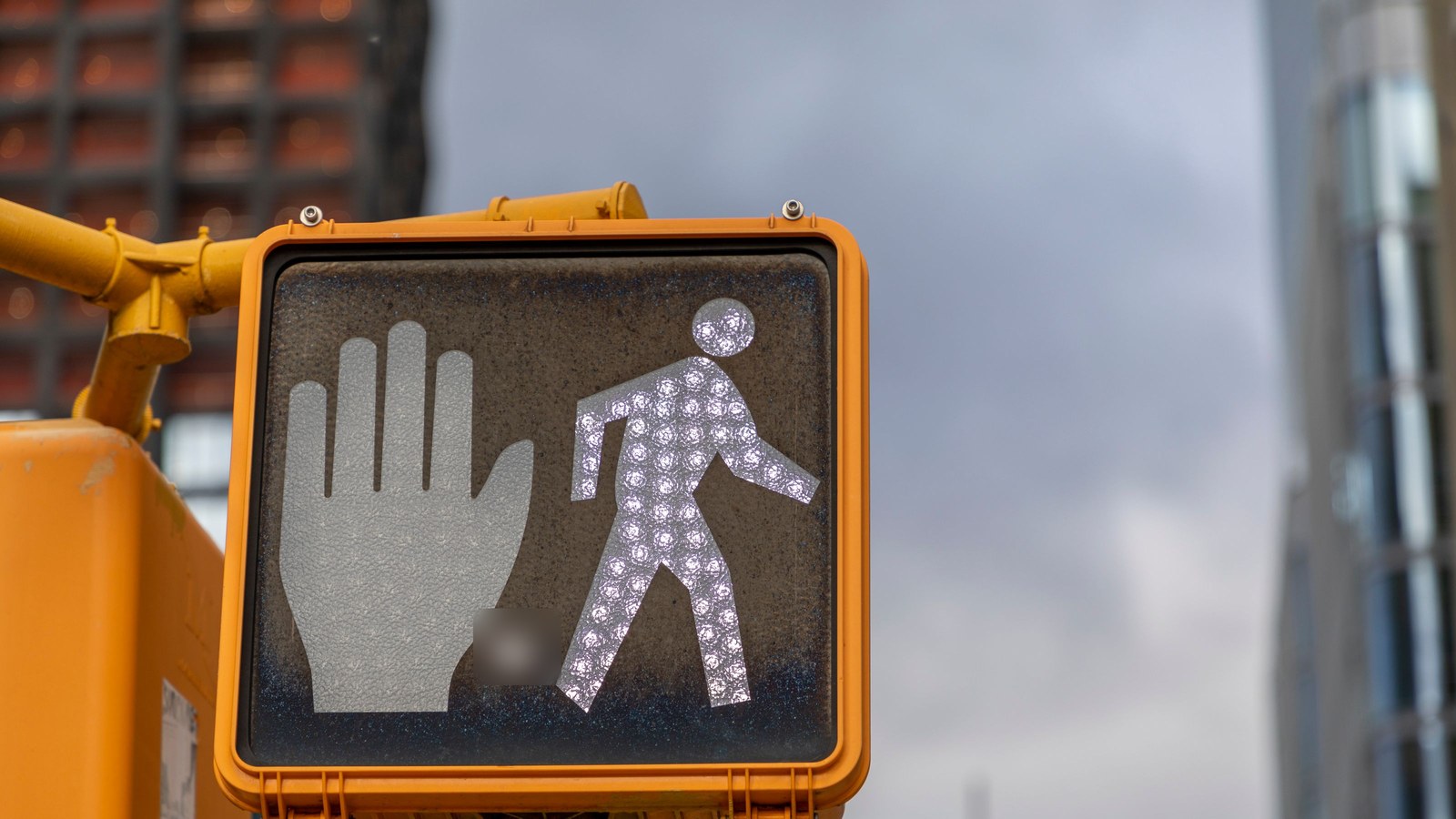
Photo: Elizabeth Iris on Pexels (photo 7730415), under the Pexels License. Location not given by the source. Cropped and resized to 1600x900, with a small sticker on the signal face blurred.
Frequently asked
Who is at fault if a car hits a pedestrian in California?
There is no automatic answer. The Vehicle Code tells drivers to yield to pedestrians in marked and unmarked crosswalks and tells pedestrians to yield outside them when a vehicle is close enough to be an immediate hazard. Drivers must use due care everywhere, and pedestrians must use due care too. Fault turns on where the pedestrian was, whether anyone broke a traffic rule, and how each person's conduct contributed to the harm.
Who is at fault if you hit a pedestrian who is jaywalking?
A pedestrian crossing outside a crosswalk must yield to vehicles close enough to be an immediate hazard, but Vehicle Code section 21954(b) says the driver still owes due care to any pedestrian on the roadway. Both can share fault. A pedestrian's share reduces what they can recover rather than automatically ending the claim.
Can a pedestrian be liable for an accident?
Yes. A pedestrian may not suddenly leave a curb or other place of safety and walk or run into the path of a vehicle so close that it is an immediate hazard, and must yield outside crosswalks when a vehicle is that close. A pedestrian who breaks a traffic rule may be presumed careless, and that share of fault can reduce their own recovery or make them responsible for harm to others.
What must a driver do after hitting a pedestrian in California?
The driver must stop at the scene, give their name, address, vehicle registration and the owner's name and address to the person struck and to any officer there, show a license on request, and give reasonable help to anyone injured, including arranging medical transport when treatment is apparently necessary or requested. If someone died and no officer is at the scene, the driver must report the accident without delay to the California Highway Patrol or local police.
Did AB 2147 make it legal to cross anywhere?
No. AB 2147 limits when an officer may stop a pedestrian for certain crossing violations, but the same sections say pedestrians still owe due care for their own safety and drivers still owe due care to pedestrians in the roadway. It changed enforcement, not the duties used to decide fault.
Is the driver always at fault if the pedestrian was in a crosswalk?
Not always. A driver must yield to a pedestrian in a marked or unmarked crosswalk and must slow down or take other action as needed to protect them. A pedestrian in a crosswalk still may not dart into the path of a vehicle that is too close to stop, and may not unnecessarily stop or delay traffic while in the crosswalk.
Can I still recover if I was partly at fault as a pedestrian?
Generally yes. Under the comparative fault rule in California's civil jury instructions, the jury decides each side's percentage of responsibility, and the injured person's damages are reduced by their own share. Their own carelessness is not a complete bar.
How long do I have to file a pedestrian injury claim in California?
Code of Civil Procedure section 335.1 generally gives two years to sue for an injury caused by another's wrongful act or neglect. If a city, county or other public entity may be responsible, a written claim generally must be presented within six months. Exceptions and tolling rules can move these dates, and waiting for a report generally does not pause them.
Attorney Advertising. This article is general information, not legal advice, and does not create an attorney-client relationship. Prior results do not guarantee a similar outcome.